
- Metabolic Balance and Dysregulation
- Central Sensing and Regulation
- Inflammation and Immune Responses
- Genetics and Epigenetics
- Circadian Rhythms and Metabolism
- Microbiome and Microenvironment
- New Anti-Obesity Targets Identified
- Anti-Obesity Drug Interventions and Novel Drug Development
- Advances in Novel Anti-Obesity Therapies
Rethinking Metabolic Inflammation: The Dual Roles of Metaflammation in Obesity
InquiryWhile chronic low-grade metabolic inflammation, commonly referred to as metaflammation, has long been cast as the primary driver of insulin resistance, an insightful review in PLOS Biology, titled "Immunometabolism in obesity: Understanding the beneficial and detrimental roles of inflammation", challenges this one-sided perspective.
Although obesity is a major driver of metabolic syndrome and type 2 diabetes mellitus (T2D), immunometabolism research has historically focused on the premise that obesity-induced inflammation directly impairs glycemic control. This concept was established by early rodent studies showing that neutralizing elevated tumor necrosis factor (TNF) improves insulin sensitivity. However, clinical trials targeting classical pro-inflammatory pathways have frequently yielded disappointing efficacy or raised safety concerns in humans, exposing a major knowledge gap: past research has disproportionately focused on the late, destructive stages of chronic obesity while leaving early metabolic adaptation poorly understood. This essay discusses how metabolic inflammation is a double-edged sword that serves crucial adaptive and protective functions during early weight gain, raising the core scientific question of whether early-stage metaflammation is inherently pathological or represents a necessary homeostatic response to acute nutrient overload.
Highlights
- The Timeline Dictates the Outcome: While deleting immune cells protects mice against insulin resistance during chronic obesity, the same interventions fail to prevent metabolic dysfunction during acute, short-term high-calorie intake.
- Compartmentalization and Location: Inflammatory signaling pathways function differently depending on the cell type. For instance, IκB kinase β (IKKβ) signaling in myeloid cells promotes systemic inflammation, but its activation in hepatocytes or adipocytes assists in resolving endoplasmic reticulum (ER) stress and promoting beneficial cytokine release.
- The Complexity of Weight Loss: Adipose tissue macrophages (ATMs) transiently increase during active weight loss, acting not as drivers of tissue damage, but as critical buffers that control lipid release and prevent lipotoxicity.
- Beyond the M1/M2 Binary: The paper highlights that the traditional M1 (pro-inflammatory) and M2 (anti-inflammatory) classification is inadequate for describing the highly heterogeneous, specialized macrophage subtypes active in vivo.
Key Findings
The core of this publication breaks down the scientific discoveries of immunometabolism into key quantitative shifts, cellular stress mechanisms, and macrophage lineage dynamics, illustrating how early-stage adaptive processes eventually deteriorate into chronic disease states.
- Visceral Adipose Tissue Hypoxia and the Adaptive Role of HIF-1alpha
The primary trigger of metaflammation is visceral adipose tissue (VAT) hypoxia, occurring within one day of starting a high-fat diet (HFD) in mice due to rapid fat expansion and ANT2-dependent oxygen consumption. Initially, hypoxia-inducible factor 1-alpha (HIF-1alpha) acts adaptively by upregulating vascular endothelial growth factor (VEGF) to promote healthy angiogenesis. Under chronic overload, sustained HIF-1alpha activation becomes pathological, upregulating Nos2, Slc2a1, and Pdk1. This drives nitric oxide (NO) and lactate production, causing insulin receptor S-nitrosylation and hepatic gluconeogenesis. Adipocyte-specific Hif1a deletion or pharmacological inhibition rescues insulin sensitivity in obese mice.
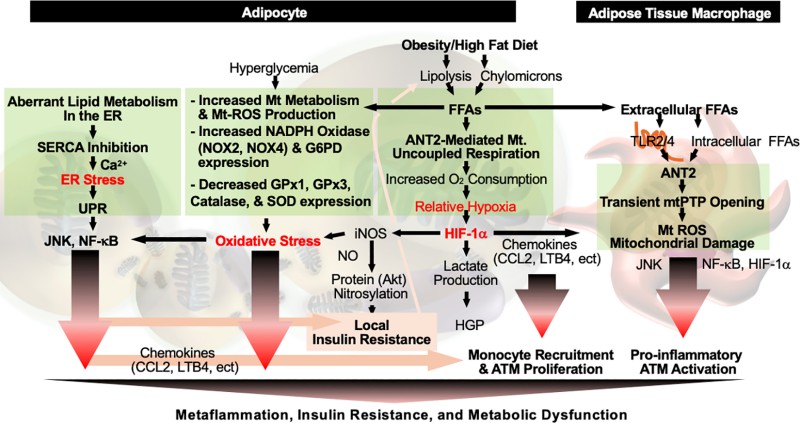 Fig.1 Obesity related metabolic stress in visceral adipose tissue triggers inflammatory changes and alters immune cell activity. (Lee, 2026)
- The Timeline of ATM Accumulation and Systemic Insulin Resistance
ATMs in visceral fat directly correlate with systemic insulin resistance over time:
- Baseline: ATMs comprise 5% to 10% of stromal vascular cells (SVCs).
- 7 Days HFD: ATMs increase to 15% to 25% of SVCs, causing a 34% drop in glucose infusion rates during clamp studies.
- Chronic Obesity: ATMs reach up to 40% of SVCs, causing a 77% decline in insulin sensitivity.
Chronic obesity impairs specialized pro-resolving mediators (SPMs) synthesis, triggering ER stress, oxidative stress, and non-resolving inflammation.
- Functional Dissection of Specialized Macrophage Subpopulations
Rather than fitting the M1/M2 model, metabolic health is determined by five specialized ATM subpopulations:
- Exosome-Secreting ATMs: Lean resident ATMs release insulin-sensitizing miR-690 exosomes, whereas obese recruited ATMs release miR-155 and miR-210 exosomes that promote insulin resistance.
- Iron-Handling ATMs (MFe-high): These resident ATMs sequester extracellular iron. In obesity, their depletion via ferroptosis causes adipocyte iron overload, oxidative stress, and pro-inflammatory activation.
- Lipid-Associated Macrophages (LAMs): TREM2+, CD9+, and CD36+ LAMs clear lipids and debris in crown-like structures. In chronic obesity, upregulated TM4SF19 blocks lysosomal acidification, but overexpressing TFEB or deleting TM4SF19 restores clearance and insulin sensitivity.
- Catecholamine and Acetylcholine ATMs (SAMs/ChAMs): Sympathetic neuron-associated macrophages (SAMs) catabolize norepinephrine (NE), and their proliferation blunts thermogenesis. Conversely, rare acetylcholine-synthesizing ATMs (ChAMs) release acetylcholine to promote thermogenesis and inflammation resolution.
- Angiogenesis-Regulating ATMs (LYVE-1 ATMs): Recruited via CXCL12, these ATMs secrete PDGF for vascular remodeling. Their decline in chronic obesity exacerbates hypoxia and tissue fibrosis.
Tab. 1 Different adipose tissue macrophage subtypes show protective or harmful metabolic effects during obesity progression. (Lee, 2026)
| Resident ATMs | Recruited ATMs | |
|---|---|---|
| In health or the early stages of obesity (adaptive) | Anti-inflammatory cytokine production; insulin-sensitizing exosome secretion; pro-angiogenic factor production (e.g., PDGF); NE clearance (SAMs); buffering local iron concentration (iron-handing ATMs); cholesterol reverse transport (ABCA1+ ATMs) | Pro-angiogenic ATMs (LYVE-1+ ATMs, Ly6c+ ATMs); clearing extracellular lipids and dead adipocyte debris (LAMs); supporting adaptive thermogenesis (ChAMs and Cx3cr1+ ATMs); resolution of inflammation (LAMs and ChAMs) |
| In the late stages of obesity (maladaptive) | Increased resident ATM death; pro-inflammatory activation; deecreased IL-10 production; decreased secretion of insulin-sensitizing exosomes; decreased iron metabolism gene expression; increased NE clearance (SAMs); catecholamine resistance | Transition of LAMs to pro-inflammatory, M-IR ATMs; increased secretion of exosomes that induce insulin resistance and liver fibrosis |
Interpretation & Translational Value
These findings completely reshape the approach to therapeutic design for obesity and metabolic syndrome. Because specific inflammatory pathways within adipocytes and resident immune cells are essential for healthy tissue remodeling, lipid storage, and resolution, global anti-inflammatory suppression is fundamentally flawed and potentially harmful. Instead of attempting to completely block inflammation, future drug discovery must focus on precise, timing-dependent immunomodulatory strategies. This means developing therapies that selectively target the chronic, maladaptive phase of myeloid signaling while preserving or boosting the early, adaptive responses of resident ATMs. Promising avenues include the direct administration of synthetic SPMs to restore failing resolution programs or utilizing targeted drug-delivery platforms to deliver therapeutic agents directly to specific macrophage subsets.
Research Support
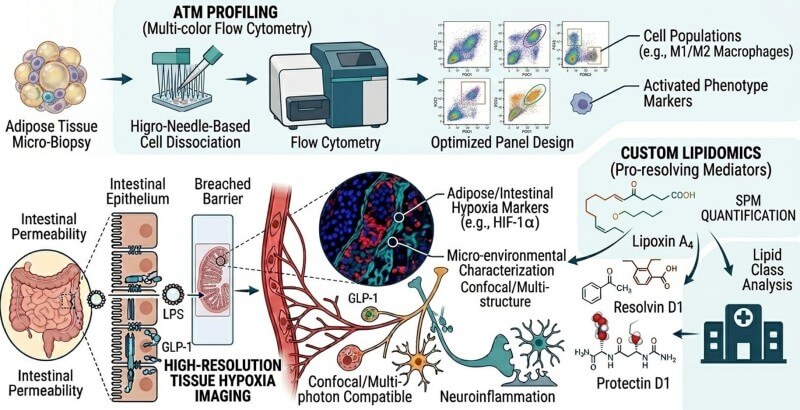
For researchers interested in exploring these dynamic immunometabolic mechanisms, Protheragen provides comprehensive, end-to-end services, including optimized multi-color flow cytometry panels for ATM profiling, high-resolution tissue hypoxia imaging, custom lipidomics to analyze specialized pro-resolving mediators, etc.
Reference
- Lee, Y.S. Immunometabolism in obesity: Understanding the beneficial and detrimental roles of inflammation. PLoS biology. 2026, 24(1): e3003620. (CC BY 4.0)
All of our services and products are intended for preclinical research use only and cannot be used to diagnose, treat or manage patients.