
GPCR Microarray-based Membrane Protein Screening Service
InquiryG-protein-coupled receptors (GPCRs) represent the most significant class of therapeutic targets, accounting for approximately 35% of all drugs. Despite their clinical importance, screening for high-affinity ligands or functional antibodies against GPCRs is notoriously difficult due to their complex seven-transmembrane architecture and the requirement for a native lipid environment to maintain structural integrity.
High-Throughput GPCR Microarray Profiling: Precision Membrane Protein Screening for Preclinical Drug Discovery
Protheragen has pioneered a high-throughput GPCR microarray-based membrane protein screening service that overcomes these hurdles. By immobilizing correctly folded, full-length GPCRs onto specialized surfaces, we enable the rapid profiling of thousands of interactions simultaneously. This platform is designed specifically for preclinical drug discovery, offering unparalleled sensitivity for identifying lead compounds, characterizing antibody specificity, and mapping orphan receptor ligands.
Core Technologies
The backbone of our screening platform lies in two proprietary technological advancements:
We utilize advanced surface chemistries that allow for the attachment of GPCRs contained within liposomes, virus-like particles (VLPs), or nanodiscs. This ensures the receptor remains embedded in a lipid bilayer, preserving the extracellular loops and ligand-binding pockets in their bioactive conformations.
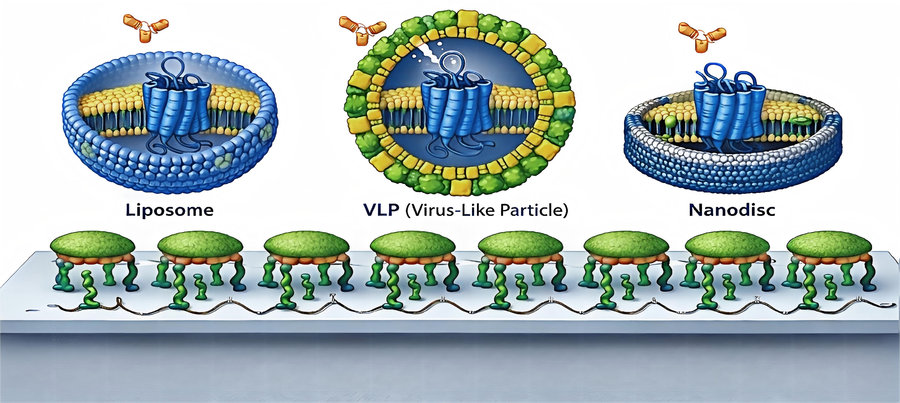
Using ultra-low volume piezoelectric dispensing, Protheragen can print hundreds of different GPCR targets onto a single chip. This allows for "one-to-many" or "many-to-many" screening, significantly reducing the amount of sample required while maximizing data output.
Our platform supports fluorescence, chemiluminescence, and label-free surface plasmon resonance imaging (SPRi), providing both qualitative binding data and quantitative kinetic profiles (Ka/Kd) in a single workflow.
Solution Scope
Our GPCR microarray platform is comprehensive, covering every facet of early-stage discovery:
- Antibody Specificity Profiling
Screening lead antibodies against a library of hundreds of non-target GPCRs to ensure high selectivity and minimize potential off-target toxicity.
- Orphan GPCR Ligand Screening
Utilizing our vast library of immobilized orphan receptors to identify endogenous or synthetic ligands.
- Small Molecule Library Screening
Rapidly identifying binders from chemical libraries with minimal protein consumption.
- Epitope Mapping
Analyzing the binding of antibodies to different conformational states or mutant versions of a specific GPCR.
- De-orphaning Services
Comprehensive screening to match unknown receptors with biological signaling molecules.
- Serum Profiling
Identifying anti-GPCR autoantibodies in preclinical animal models to support biomarker discovery.
Maximize your pipeline's potential with our comprehensive library
Workflow
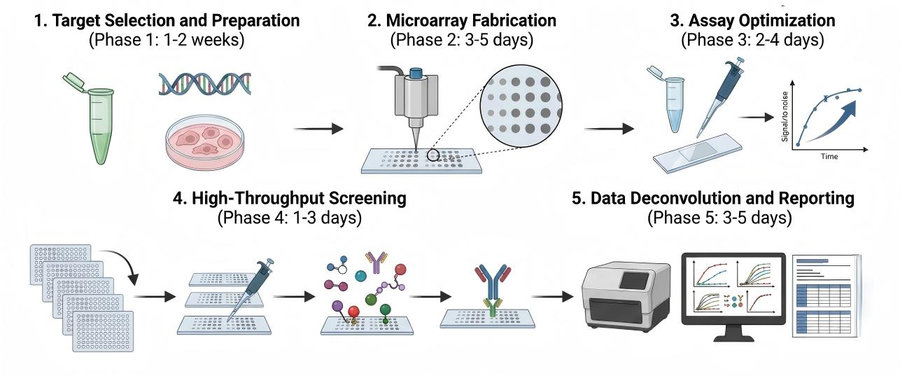
Protheragen ensures a seamless transition from target selection to data delivery through a rigorous five-stage process:
Fields of Application
The high-density screening capacity of Protheragen's microarray technology provides a transformative advantage across diverse therapeutic landscapes, enabling researchers to map complex GPCR interactions in several critical preclinical domains.
- Oncology: Identifying GPCRs overexpressed in tumors and developing targeted therapeutic antibodies.
- Neuroscience: Screening for ligands that modulate CNS-specific GPCRs involved in neurodegeneration.
- Metabolic Diseases: Discovering novel agonists for receptors involved in glucose regulation and lipid metabolism.
- Immunology: Characterizing chemokine receptor interactions and developing inhibitors for autoimmune pathways.
Advantages
Choosing Protheragen provides your research with a competitive edge in the crowded GPCR landscape:
Structural Integrity
Unlike traditional ELISA or Western blotting, our microarrays keep proteins in a membrane-embedded state, which is critical for recognizing conformational-dependent epitopes.
High Throughput, Low Consumption
Screen thousands of interactions using microliters of sample, preserving your most precious candidates.
Unrivaled Specificity Data
Our "retrogenix-style" library approach allows us to screen your lead against a massive panel of human membrane proteins to predict off-target effects early.
Expert Consultation
Our biology specialists work directly with your team to customize array layouts and buffer conditions for challenging targets.
Gain a competitive edge with high-throughput data precision.
Customer Review
De-Risking Preclinical Development Through High-Resolution Off-Target Profiling
"Working with Protheragen transformed our lead optimization phase. Their GPCR microarray identified a critical off-target interaction for our primary antibody candidate that we had missed in flow cytometry. This allowed us to pivot early, saving us months of preclinical work. The technical depth of their team is unmatched."
Dr. K. S., Senior Scientist, Biopharma Discovery
Data Delivered with Unmatched Precision and Speed
"The specificity profiling provided by Protheragen was instrumental in our studies. We were able to demonstrate the high selectivity of our lead peptide across a panel of 300+ GPCRs. Their data was clear and professional. We look forward to our next project together."
Dr. B. C., Head of Research, Therapeutic Biotech
Frequently Asked Questions
-
How does ABPP differ from standard Western Blotting for obesity targets?
Western Blotting measures total protein mass, which often stays constant even if the enzyme is inhibited or degraded. ABPP measures the active protein, providing a direct readout of biological function.
-
How do you ensure the GPCRs are not denatured during the printing process?
We use specialized "soft" printing technology and lipid-based stabilization buffers that mimic the cellular environment, ensuring the protein never dries out or loses its fold.
-
Can you screen for low-affinity interactions?
Yes, our high-sensitivity fluorescence detection can capture micromolar affinities that are often missed by other high-throughput methods.
-
What type of samples can I send for screening?
We accept purified antibodies, serum, hybridoma supernatants, small molecule libraries, and peptide pools.
-
Do you offer custom array layouts?
Absolutely. We can print specific subsets of GPCRs (e.g., all class A receptors) based on your project requirements.
-
How much protein is required for the array?
Because of our micro-dispensing technology, we require significantly less protein than traditional SPR or flow cytometry-based methods.
-
Is this service suitable for GPCRs with low expression levels?
Yes, our enrichment protocols for VLPs and nanodiscs allow us to present low-abundance receptors at high density on the array.
-
How long does a typical screening project take?
Once the targets are prepared, the microarray screening and analysis are typically completed within 3-4 weeks.
-
Can you detect allosteric modulators?
Yes, by pre-incubating the array with known orthosteric ligands, we can identify compounds that bind to allosteric sites.
-
How do you handle non-specific binding?
We utilize proprietary blocking buffers and include multiple "decoy" membrane proteins on every chip to filter out "sticky" compounds.
-
What is the primary deliverable?
You receive a comprehensive data package including raw images, processed binding curves, affinity rankings, and a specialist's interpretation of the results.
Contact Us
Protheragen provides an industry-leading GPCR microarray-based membrane protein screening service that combines structural biology expertise with high-throughput technology. Our platform ensures that your preclinical candidates are screened against correctly folded, membrane-embedded targets, providing the high-quality data necessary to de-risk your drug discovery program. Welcome to Contact Protheragen.
All of our services and products are intended for preclinical research use only and cannot be used to diagnose, treat or manage patients.