
PK/PD Modeling & Dose Escalation
InquiryIn the high-stakes environment of early-phase drug development, the transition from preclinical data to human application is the most critical juncture. Protheragen provides industry-leading PK/PD modeling & dose escalation services designed to mitigate risk and maximize therapeutic index.
PK/PD Modeling & Dose Escalation for Early Phase Clinical Pharmacology
By integrating pharmacokinetics (PK) and pharmacodynamics (PD), we characterize the relationship between drug exposure and biological response. Our approach moves beyond traditional empirical observation, employing model-informed drug development (MIDD) to predict human clearance, determine the first-in-human (FIH) starting dose, and guide rapid, safe dose escalation. This scientific rigor ensures that our partners make data-driven "go/no-go" decisions with absolute confidence.
Core Technologies
Protheragen utilizes a sophisticated suite of quantitative tools to transform raw bioanalytical data into actionable clinical intelligence:
- Physiologically Based Pharmacokinetics (PBPK)
Simulating drug distribution based on physiological parameters to predict DDI (drug-drug interaction) risks and specialized population behaviors.
- Non-Linear Mixed Effects Modeling (NLME)
Capturing inter- and intra-subject variability to understand how demographics and genetics influence drug disposition.
- Population PK (PopPK)
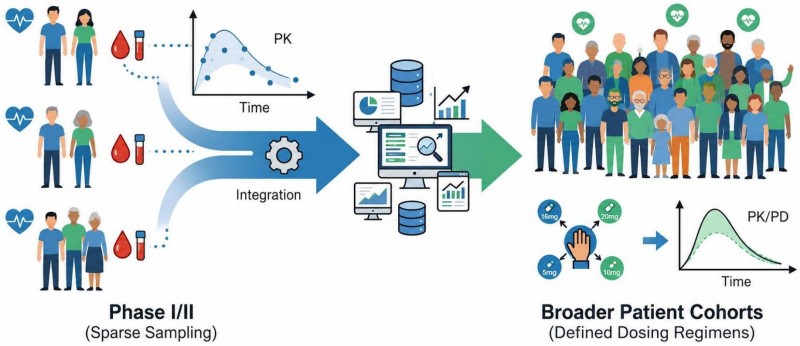
Streamlining data from sparse sampling in Phase I/II to define dosing regimens for broader patient cohorts.
- Mechanism-Based PK/PD Models
Linking target engagement and receptor occupancy to downstream clinical efficacy markers.
- Bayesian Feedback Modeling
Utilizing real-time clinical data to adjust dose escalation paths dynamically during active trials.
Contact Our Team for More Information and to Discuss Your Project
Solution Scope
Protheragen provides a versatile suite of quantitative pharmacology services designed to navigate the complex transition from preclinical discovery to definitive clinical proof-of-concept.
- First-in-Human (FIH) Support
Calculation of MABEL (maximum adverse benefit level) and NOAEL-based starting doses.
- Dose Escalation Management
Support for single ascending dose (SAD) and multiple ascending dose (MAD) studies.
- Special Population Modeling
Predicting PK changes in hepatic/renal impairment or geriatric/pediatric populations.
- Food Effect & DDI Assessment
Evaluating the impact of extrinsic factors on drug bioavailability.
- QTc Modeling
Concentration-QTc analysis to assess cardiac safety early, potentially waiving the need for TQT studies.
Workflow
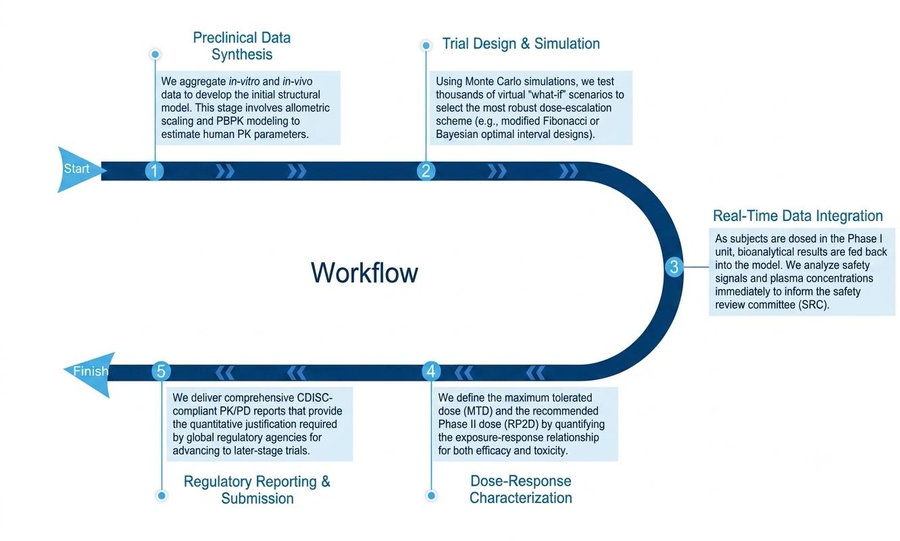
Our systematic approach ensures that every assessment is conducted with scientific rigor and regulatory compliance in mind:
Fields of Application
Our PK/PD modeling and dose escalation frameworks are precision-engineered to address the unique biological complexities and regulatory requirements of diverse therapeutic areas.
- Oncology: Evaluating cytotoxic and immuno-oncology agents where the window between efficacy and toxicity is narrow.
- Rare Diseases: Maximizing data utility in small patient populations through sparse-sampling PopPK.
- Neurology: Modeling blood-brain barrier penetration and central nervous system receptor occupancy.
- Metabolic Disorders: Assessing long-term exposure-response for biologics and small molecules.
Advantages
Protheragen stands at the forefront of clinical pharmacology by merging biological expertise with computational precision. Our models have a 95% accuracy rate in predicting human clearance, significantly reducing the time spent in sub-therapeutic dose levels.
- Precision Scaling
Our proprietary algorithms for cross-species scaling minimize the "translational gap" by integrating high-fidelity physiological data. We transform complex preclinical metrics into actionable human projections, ensuring your initial clinical parameters are grounded in rigorous computational accuracy.
- Accelerated Timelines
By optimizing dose escalation strategies, we frequently reduce the number of cohorts required for Phase I completion. This strategic efficiency can save months of clinical trial time, allowing your candidate to reach milestones faster.
- Regulatory Alignment
Our modeling strategies strictly follow the latest FDA and EMA guidance on model-informed drug development (MIDD). We provide robust, submission-ready documentation that anticipates regulatory inquiries, facilitating a smoother, more predictable path toward clinical approval.
- Risk Mitigation
We identify potential safety "red zones" and adverse exposure thresholds before the first human subject is ever dosed. By simulating thousands of patient scenarios, we provide a safety buffer that protects participants and your investment.
Inquire Now: Optimize Your Dose Escalation Strategy with Protheragen Expertise
Customer Review
Scientific Accuracy in Predictive Modeling
"Working with Protheragen transformed our Phase I program. Their PBPK modeling accurately predicted a complex drug-drug interaction that we hadn't fully characterized in animals. This allowed us to adjust our inclusion criteria early, saving us from a potential clinical hold and allowing for a seamless transition to Phase II."
Dr. S.X., Mid-sized Biotech
Operational Efficiency and Speed to Clinic
"The precision of the dose-escalation simulations provided by Protheragen was impressive. We reached our target therapeutic concentration in two fewer cohorts than our previous CRO had estimated. Their team functions as a true extension of our scientific department."
Dr. Y.S., Director of Clinical Pharmacology
Frequently Asked Questions
-
Why is PK/PD modeling preferred over empirical dose escalation?
Empirical methods often miss the optimal dose or require more cohorts. Modeling predicts the response, ensuring you reach the therapeutic window faster and safer.
-
How do you determine the starting dose for FIH studies?
We integrate allometric scaling, PBPK, and safety margins based on the NOAEL or MABEL to ensure participant safety while maintaining scientific relevance.
-
Can Protheragen handle real-time modeling during a SAD/MAD study?
Yes, our workflow is designed for rapid data turnaround, providing the SRC with updated model predictions within 24-48 hours of sample analysis.
-
What software platforms do you utilize?
We use industry-standard tools including NONMEM, Phoenix WinNonlin, and R-based modeling packages.
-
How does your modeling help with regulatory submissions?
Regulators favor MIDD approaches because they provide a mechanistic understanding of the drug. Our reports provide the "why" behind your dose selection.
-
Does your service include bioanalytical support?
While we specialize in modeling, we work in tandem with bioanalytical labs to ensure data quality is sufficient for high-fidelity modeling.
-
Is modeling applicable for biologics and biosimilars?
Absolutely. We specialize in target-mediated drug disposition (TMDD) models specifically for large molecules.
-
Can you help if our preclinical data is sparse?
Yes, we utilize Bayesian priors and literature data to supplement sparse internal datasets and build a reliable initial model.
-
How do you account for inter-individual variability?
We use population-based modeling (NLME) to identify covariates such as age, weight, or genotype that drive differences in drug response.
Contact Us
Protheragen is dedicated to turning complex biological data into clear clinical pathways. Our team of PhD-level pharmacometricians and biologists is ready to assist you in navigating the complexities of early-phase development.
Contact Protheragen for More Information and to Discuss Your Project
All of our services and products are intended for preclinical research use only and cannot be used to diagnose, treat or manage patients.