

Anti-Obesity Small Molecule Antagonist Development
InquiryOverview
With the shift in modern lifestyles, obesity has emerged as a global health challenge. It is not merely weight gain but a core risk factor for multiple chronic diseases, including type 2 diabetes, non-alcoholic fatty liver disease, and cardiovascular disorders. Developing highly effective and safe therapeutic strategies has become a top priority. Currently, multiple types of drugs are under investigation, such as anti-obesity small-molecule antagonists. These antagonists precisely target specific molecular pathways involved in obesity development—such as appetite-regulating receptors and mechanisms governing adipocyte differentiation—fundamentally intervening in disease progression while significantly reducing off-target effects and adverse reactions. They represent promising candidates for safe and effective obesity treatments.
The Path to Metabolic Health: Our Approach to Anti-Obesity Small Molecule Antagonist Development
Protheragen stands at the forefront of this transformation, dedicated to developing highly effective Anti-obesity Therapies and providing comprehensive services spanning drug discovery through preclinical research. We precisely target key metabolic pathways, creating a robust platform for developing promising Drugs by designing molecules that specifically antagonize receptors and enzymes involved in lipogenesis and metabolic disorders.
Our success in small-molecule antagonist development stems from a suite of proprietary and advanced technologies. We employ Structure-based Drug Design (SBDD) and Ligand-based Drug Design (LBDD) to rationally design molecules with high affinity and specificity. Our cutting-edge High-throughput Screening (HTS) platform enables rapid screening of vast chemical libraries against target molecules. Chemoinformatics and computational modeling techniques are integrated throughout R&D to accurately predict molecular properties, toxicity, and pharmacokinetic characteristics. This synergistic technology enables us to identify and optimize lead compounds with unparalleled speed and efficiency.
Target Validation
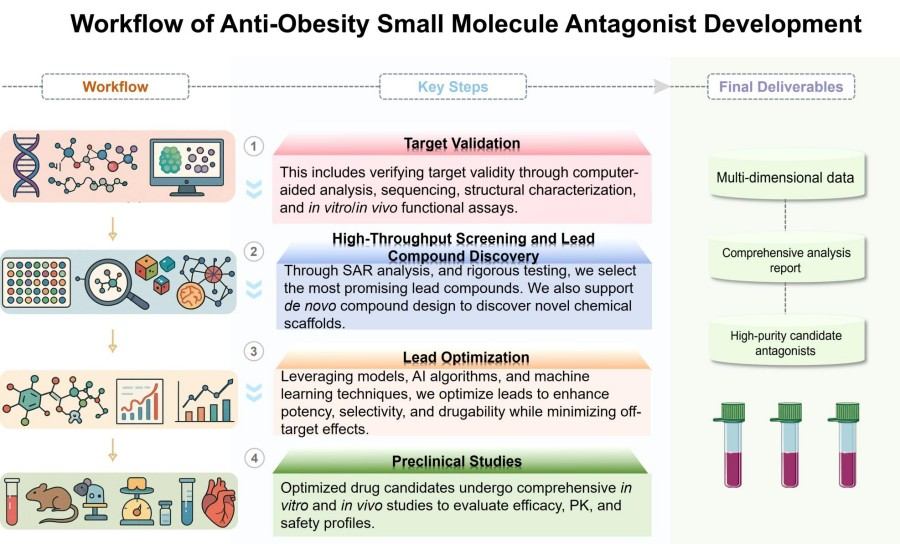
We identify and validate diverse biological targets involved in metabolic regulation and obesity. This includes verifying target validity through computer-aided analysis, sequencing, structural characterization, and in vitro/in vivo functional assays. Our expertise spans broad pathways, including appetite control, energy expenditure, lipogenesis, etc.
Anti-Obesity Drug Development
- High-Throughput Screening and Lead Compound Discovery
Leveraging our high-throughput screening platform, we identify initial active molecules from extensive compound libraries. Through structure-activity relationship (SAR) analysis, orthogonal experiments, and rigorous testing, we select the most promising lead compounds. We also support de novo compound design to discover novel chemical scaffolds and explore their biological activities.
- Lead Optimization
Selected leads undergo iterative cycles of synthesis and bioactivity testing. Leveraging ADME/T Models, quantitative structure-activity relationship (QSAR) models, AI algorithms, and machine learning techniques, we optimize leads to enhance potency, selectivity, and drugability while minimizing off-target effects.
Preclinical Studies
Optimized drug candidates undergo comprehensive in vitro and in vivo studies to evaluate efficacy, pharmacokinetics (PK), and safety profiles. We utilize Cell and Animal Obesity Models to assess candidate drugs' effects on body weight, fat mass, glucose homeostasis, and other parameters.
We focus on evaluating the drug's impact on core physiological indicators such as body weight, body fat percentage, food intake, and energy expenditure. Through these studies, we explore its mechanism of action and provide critical data to confirm the drug's efficacy.

Through analysis, we aim to precisely track the absorption, distribution, metabolism, and excretion (ADME) processes of small-molecule antagonists. Concurrently, we analyze interactions, bioavailability, and other properties of the drug candidate. We also determine the optimal dosing regimen to ensure the drug achieves and maintains effective therapeutic concentrations in the body while avoiding potential toxic accumulation.

Our bioanalysis services focus on quantitative analysis of drugs and their metabolites in complex biological samples (e.g., plasma, urine, tissues), delivering precise, reliable, and reproducible bioanalytical data.
Our safety assessment services systematically identify and evaluate potential toxicities of candidate anti-obesity drugs. This encompasses acute and subchronic toxicity studies, assessments of effects on major organ functions (e.g., liver, kidney, heart), etc. Through comprehensive safety research, we gain a thorough understanding of the safety profile of small-molecule antagonist candidates, effectively mitigating risks.
Workflow
Our anti-obesity small molecule antagonist development service is a rigorous and efficient end-to-end process designed to transform your scientific concept into a drug candidate with anti-obesity potential. The entire workflow seamlessly integrates from foundational target discovery to comprehensive preclinical evaluation, ensuring precision at every step.
Applications
The development of small-molecule antagonists offers a novel precision-targeting strategy for obesity treatment, aiming to enhance therapeutic efficacy while minimizing associated side effects.
Small-molecule antagonists are employed to gain profound insights into the pathophysiology of obesity. By specifically blocking or modulating key signaling pathways related to energy metabolism, fat storage, and appetite control, these antagonists serve as valuable tools for exploring complex biological processes.
Given obesity's role as a root cause of multiple severe complications, small-molecule antagonists may also hold therapeutic promise for conditions such as type 2 diabetes, non-alcoholic fatty liver disease (NAFLD), and cardiovascular metabolic disorders.
Advantages
Multidisciplinary Expert Team
Our interdisciplinary team of biologists, chemists, and pharmacologists collaborates seamlessly, advancing projects through synergistic strategies. Our combined effort ensures that the whole is truly greater than the sum of its parts, driving breakthrough therapeutic solutions in the most efficient manner possible.
Rapid Experimental Turnaround
By optimizing workflows and leveraging cutting-edge technology, we have significantly shortened drug development cycles and reduced costs. Machine learning enables early prediction of compound viability, thereby avoiding research on non-viable drug candidates.
Customized Experimental Solutions
Every project presents a unique challenge. Through deep collaboration with our clients, we translate their specific requirements into precise development objectives and tailor the most optimized, efficient execution plan.
We offer comprehensive obesity research services designed to provide a one-stop solution for your project, helping you fully understand the complexities of obesity. Our services span multiple key areas from basic research to applied development, including but not limited to pathological testing, microbiome analysis, obesity risk prediction, and the development of scientific weight management strategies.

Publication Data
Title: Idalopirdine – a small molecule antagonist of 5-HT6 with therapeutic potential against obesity
Journal: Metabolic Brain Disease, 2015
DOI: https://doi.org/10.1007/s11011-015-9736-3
Summary: 5-Hydroxytryptamine-6 (5-HT6) receptor antagonists show promise as safe and effective anti-obesity drugs. This study analyzed the anorexic effects of LuAE58054 (a 5-HT6 receptor antagonist) in a high-fat diet-induced obesity model. Results demonstrated significant reductions in food intake, visceral fat mass, and plasma triglyceride levels. This research provides a novel approach for developing anti-obesity therapies.
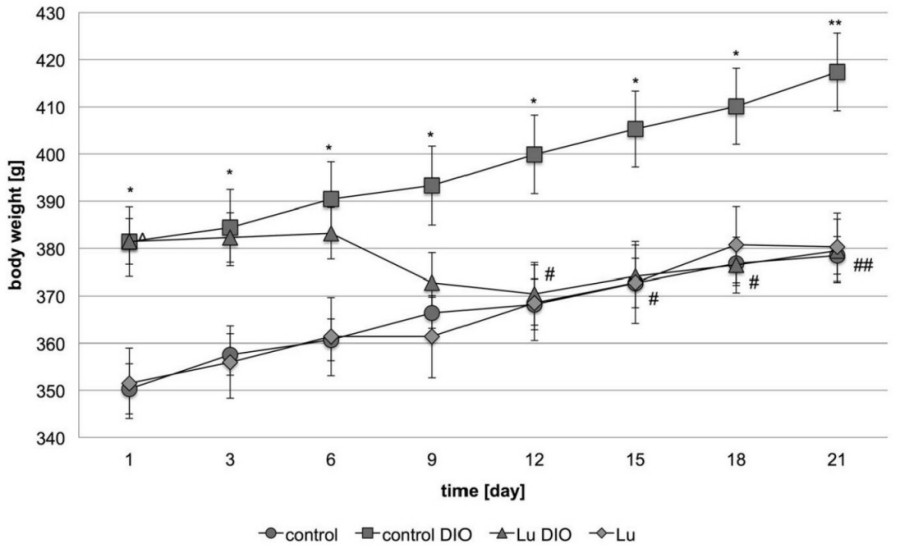 Fig.1 Effects of LuAE58054 on body weight. (Dudek, et al., 2015)
Customer Review
Highly Selective Screening
"Protheragen's services proved indispensable to us. Not only did their highly selective screening rapidly yield high-affinity lead antagonists, but more critically, their subsequent off-target analysis and safety assessments successfully eliminated potential non-specific activities. This significantly reduced the risk of severe side effects emerging in the future."— M*, Research Assistant
SAR Optimization
"Protheragen's medicinal chemistry team demonstrated exceptional expertise in SAR optimization. Through systematic structural modifications, they successfully enhanced the binding kinetics between compounds and targets, ultimately establishing candidate drugs with promising research potential for us."— F*, Scientific Program Lead
Frequently Asked Questions
-
How do we ensure antagonist specificity?
We employ advanced techniques such as SBDD and LBDD, combined with rigorous medicinal chemistry design, to optimize molecular structures for precise target binding while minimizing off-target effects.
-
What if my target isn't part of a known anti-obesity pathway?
Our team possesses extensive experience in both classical and novel targets, assisting you in exploring and validating entirely new therapeutic pathways while providing the scientific support needed to mitigate project risks.
-
Can services be customized for specific research objectives?
Absolutely. Our solutions offer exceptional flexibility. From target validation and lead compound optimization to preclinical studies, we tailor support services to each project phase.
Protheragen delivers comprehensive, technology-driven solutions for developing anti-obesity small molecule antagonists. Leveraging deep scientific expertise and flexible, client-centric approaches, we empower partners to advance research from concept to promising therapeutic candidates. Contact us to learn more and discuss your project.
Reference
- Dudek, M.; et al. Idalopirdine – a small molecule antagonist of 5-HT6 with therapeutic potential against obesity. Metabolic brain disease. 2015, 30(6): 1487-1494. (CC BY 4.0)
All of our services and products are intended for preclinical research use only and cannot be used to diagnose, treat or manage patients.