
Pharmacovigilance & Risk Management
InquiryOverview
In the rapidly evolving landscape of metabolic health, the safety profile of a therapeutic candidate is as critical as its efficacy. Global regulatory bodies like the FDA and EMA demand rigorous, proactive oversight throughout the entire drug lifecycle. Protheragen provides an end-to-end pharmacovigilance & risk management service designed to safeguard patients and protect the commercial viability of your assets. By combining advanced signal detection algorithms with deep regulatory expertise, we transform complex safety data into actionable insights, ensuring that your benefit-risk profile remains favorable from the first-in-human trial to post-market surveillance.
Protecting Patient Safety, Ensuring Regulatory Integrity - Comprehensive PV Solutions for Metabolic Innovation
Protheragen offers a robust infrastructure to manage the complexities of global safety reporting and risk mitigation. We specialize in converting raw safety data into a strategic asset for regulatory success.
Safety Monitoring & Signal Management Service
Effective pharmacovigilance begins with the early detection of potential risks. We utilize large-scale databases and advanced disproportionality analysis (e.g., reporting odds ratio) to identify safety signals that might otherwise be missed. Our team provides continuous monitoring of individual case safety reports (ICSRs) and literature, ensuring that emerging risks—such as cardiovascular events or gastrointestinal tolerability issues—are captured and evaluated in real-time.
Risk Control & Aggregate Reporting Service
Compliance requires more than just identifying risks; it requires structured communication with regulators. We manage the development of the pharmacovigilance system master file (PSMF) and facilitate the submission of mandated aggregate reports, including development safety update reports (DSUR) and periodic benefit-risk evaluation reports (PBRER). By integrating safety data with our Statistical Analysis & CDISC Transformation Service, we ensure that every report is accurate, traceable, and fully compliant with ICH standards.
Workflow
Protheragen employs a standardized, data-centric workflow that synchronizes biostatistical rigor with clinical safety expertise. Our methodology focuses on preventative risk management, ensuring that potential safety hurdles are identified and addressed before they impact trial progression or market authorization.
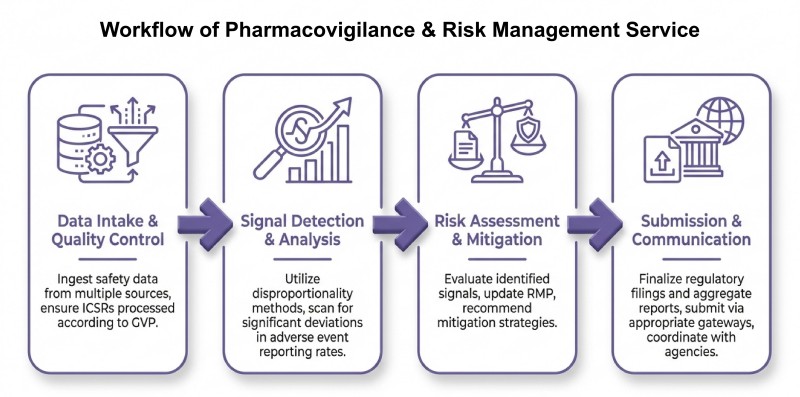
Provide Contact Information to Design Tailored Programs Aligning Corporate Milestones.
Applications
- Cross-Border Clinical Trial Compliance
Establishing international pharmacovigilance systems that align with ICH E2A and E2F standards, ensuring that safety data from global sites is transmitted, evaluated, and reported to both the FDA and EMA in real-time.
- Signal Verification For New Drug Classes
Conducting deep-dive safety assessments for innovative incretin-based therapies or dual-agonists, focusing on high-priority areas such as pancreato-biliary health, medullary thyroid cancer risk, and diabetic retinopathy.
- Real-World Data (RWD) Safety Mining
Utilizing large-scale databases like FAERS or nationwide electronic health records to perform active post-marketing surveillance, identifying rare adverse events in diverse patient populations that were not evident during Phase III trials.
- Lifecycle Risk Management Plan (RMP) Development
Creating and maintaining living risk management plans (RMP) that evolve from phase I through phase IV, incorporating findings from the post-market & real-world study service to ensure long-term market access.
Advantages
Global Regulatory Integration
Our PV systems are natively designed to satisfy the overlapping requirements of the FDA, EMA, and NMPA, reducing the administrative burden on sponsors and minimizing the risk of regulatory delays.
Advanced Analytics & Data Mining
We employ sophisticated signal detection tools that go beyond simple frequency counts, utilizing reporting odds ratios (ROR) and information component (IC) metrics to find significant safety signals in high-volume datasets.
Scalable Safety Infrastructure
Whether managing a localized phase I study or a global phase IV registry, our database and reporting systems scale to handle the volume and complexity of your pharmacovigilance needs.
Medical & Scientific Expertise
Our reports are not just data summaries; they are authored by medical officers and toxicologists who understand the clinical nuances of metabolic disorders, ensuring that every benefit-risk assessment is clinically plausible.
Comprehensive Clinical Research Solutions
Protheragen provides an integrated safety and risk management ecosystem that bridges the gap between clinical data and regulatory expectations. Our service is designed to be a continuous loop of data collection, analysis, and mitigation, ensuring that safety is never a bottleneck in your development timeline. We recognize that metabolic drugs require specialized attention to specific system-organ classes, such as hepatobiliary, psychiatric, and cardiovascular health. By leveraging our interdisciplinary expertise in toxicology, epidemiology, and biostatistics, we help sponsors build a robust safety narrative that addresses the specific concerns of global health authorities. Our systems are fully scalable, supporting both small-scale phase I trials and massive, multinational phase IV observational studies.
Publication Data
Title: A nationwide pharmacovigilance investigation on trends and seriousness of adverse events induced by anti-obesity medication.
Journal: Journal of Global Health, 2023.
DOI: https://doi.org/10.7189/jogh.13.04095
Summary: In this nationwide pharmacovigilance investigation, researchers analyzed adverse drug events (ADEs) associated with anti-obesity medications utilizing real-world data from the Korea Adverse Event Reporting System Database (KIDS-KD). The study aimed to characterize the prevalence and seriousness of ADEs related to these medications and identify predictors associated with serious adverse events (SAEs). Phentermine and liraglutide emerged as the most commonly reported agents, with gastrointestinal and psychiatric disorders being the most frequently reported ADEs. The analysis revealed significant associations between male sex, the use of multiple anti-obesity medications, and concomitant administration of fluoxetine with increased risk of SAEs. The findings highlight the urgent need for ongoing pharmacovigilance and monitoring of anti-obesity treatments to enhance understanding of their safety profiles and improve patient safety in clinical practice. This study underscores the critical role of pharmacovigilance in the post-market surveillance of therapeutic candidates.
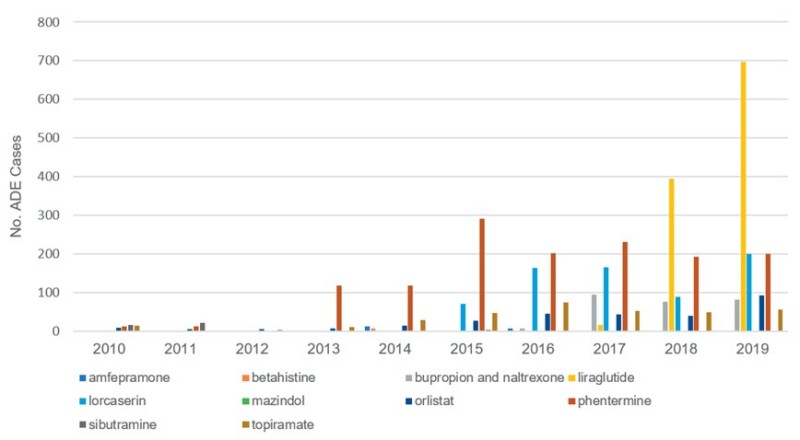 Fig. 1 The number of ADE reports of each anti-obesity medication from 2010 to 2019. (Choi, et al., 2023)
Reach Out to Our Specialists for Dedicated Project Readiness Evaluations.
Customer Review
Excellence in Global Compliance
"Protheragen managed our global PV system across three continents during our Phase III trials. Their attention to ICH compliance and real-time reporting was flawless."
— Dr. M. G., VP of Clinical Operations
Strategic Safety Insight
"Their signal detection team identified a potential hepatic signal early in our post-market phase, allowing us to proactively update our RMP and maintain a positive relationship with the EMA."
— K. L., Head of Regulatory Affairs
Frequently Asked Questions
-
What is a signal detection 'signal'?
In pharmacovigilance, a signal is information that suggests a new potential causal association, or a new aspect of a known association, between an intervention and an event, which warrants further investigation.
-
What is the difference between a DSUR and a PBRER?
A development safety update report (DSUR) is submitted during the clinical development phase to provide an annual, comprehensive overview of safety data for an investigational product across all ongoing trials and completed studies. In contrast, a periodic benefit-risk evaluation report (PBRER) is a post-marketing document that evaluates the benefit-risk balance of an approved product at defined intervals (e.g., every 6 months initially, then annually). While the DSUR focuses primarily on emerging safety findings during development, the PBRER integrates real-world exposure data, efficacy outcomes, and risk minimization measures to support continued regulatory authorization.
-
How do you ensure compliance with multiple global regulators simultaneously?
We maintain a unified pharmacovigilance infrastructure that is natively mapped to the overlapping yet distinct requirements of the FDA, EMA, and NMPA. Our systems are built on ICH E2A, E2B, and E2F standards, ensuring that individual case safety reports (ICSRs), aggregate reports, and risk management plans (RMPs) are generated in formats accepted across jurisdictions. For region-specific mandates—such as the FDA's MedWatch forms, EMA's EVCTM/EVWEB submissions, or NMPA's localized reporting timelines—we deploy automated workflow triggers and dedicated regional PV leads. This dual-layer approach (global standardization + local regulatory nuance) minimizes administrative duplication while ensuring that every submission meets its respective deadline and format requirements.
-
How do you handle expedited reporting?
We maintain a 24/7 safety intake system and utilize automated workflows to ensure that all serious unexpected adverse reactions (SUSARs) are reported to the relevant authorities within the mandatory 7 or 15-day windows.
Protheragen is dedicated to ensuring that your therapeutic innovations are supported by the highest standards of safety and compliance. Whether you are building a global safety database or seeking assistance in other areas, our PV experts are ready to assist. Contact us today to discuss a customized risk management strategy for your program.
Reference
- Choi, Y.J.; et al. A nationwide pharmacovigilance investigation on trends and seriousness of adverse events induced by anti-obesity medication. Journal of Global Health. 2023, 13, 04095. (CC BY 4.0)
All of our services and products are intended for preclinical research use only and cannot be used to diagnose, treat or manage patients.