
Drug Affinity Responsive Target Stability (DARTS)-based Obesity Target Screening Service
InquiryThe global escalation of metabolic disorders has intensified the demand for precise therapeutic interventions. Widespread conditions like type 2 diabetes and obesity highlight the limitations of traditional, one-size-fits-all treatments. This shifting landscape necessitates highly specific therapeutic agents capable of targeting distinct physiological pathways with minimal off-target effects.
Accelerating Preclinical Obesity Drug Discovery with Precision DARTS Screening
At Protheragen, we leverage our extensive expertise in chemical biology to offer a specialized drug affinity responsive target stability (DARTS)-based obesity target screening service. By utilizing the fundamental principle that small molecule binding stabilizes a protein's structure against proteolytic degradation, we provide a label-free, robust methodology to identify the direct protein targets of anti-obesity compounds in complex biological systems.
Core Technologies
Our DARTS platform integrates classical biochemistry with high-resolution analytical tools to ensure sensitive and specific target detection:
Unlike affinity chromatography, DARTS does not require the modification of the drug candidate, preserving its native binding characteristics and ensuring the results reflect physiological interactions.
We employ a range of proteases (such as pronase, thermolysin, or subtilisin) to probe protein stability across diverse cellular environments.
Utilizing TMT-labeling or label-free quantification (LFQ), we identify and quantify protein enrichment or depletion, providing high-confidence target candidates.
We utilize specialized cell lines including adipocytes (3T3-L1), hepatocytes (HepG2), and hypothalamic neuronal models to ensure the biological relevance of the target screening process.
Solution Scope
Protheragen provides an end-to-end screening solution tailored to the specific needs of metabolic disease researchers. Our service scope includes:
Mapping the targets of bioactive compounds derived from traditional medicines known to influence thermogenesis or lipid metabolism.
- Lead Optimization Support
Comparing the target binding affinity and specificity of various structural analogs to guide medicinal chemistry efforts.
Discovering how established anti-obesity candidates interact with key metabolic regulators like AMPK, PPARs, or lipase enzymes.
- Tissue-Specific Target Profiling
Conducting DARTS in specific metabolic depots (e.g., brown vs. white adipose tissue) to identify localized therapeutic targets.
- Competitive Binding Studies
Assessing whether new candidates compete for the same binding pockets as known metabolic modulators.
Unlock the full therapeutic potential of your drug candidates.
Workflow
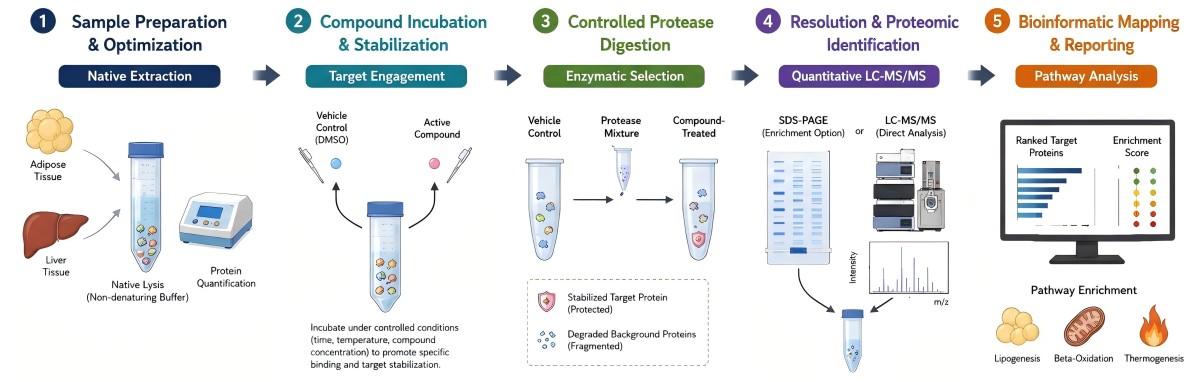
The Protheragen DARTS service follows a rigorous, five-stage experimental pipeline designed to deliver reproducible and actionable data:
Fields of Application
The insights gained from our DARTS service are applicable across various sectors of preclinical research:
- Metabolic Disorder Research: Identifying novel regulators of adipogenesis, lipolysis, and glucose uptake.
- Endocrinology: Discovering targets involved in appetite-regulating hormone signaling (e.g., leptin, ghrelin).
- Mitochondrial Biology: Screening for compounds that stabilize proteins involved in mitochondrial uncoupling and thermogenesis.
- Nutraceutical Development: Validating the molecular targets of dietary supplements and functional food ingredients.
Advantages
Choosing Protheragen for your obesity target screening provides several distinct advantages:
High Versatility
DARTS can be performed on any protein, regardless of its function, and is compatible with any small molecule, including those with low affinity.
Physiological Relevance
Because we use whole-cell or tissue lysates, target identification occurs in the presence of natural competitors and post-translational modifications.
Minimal Sample Requirements
Our optimized micro-scale protocols allow for successful screening even when compound or tissue availability is limited.
Expert Interpretation
Beyond raw data, we provide comprehensive reports that contextualize findings within the complex landscape of obesity-related signaling.
Contact Protheragen for a specialized consultation on your target screening project.
Customer Review
Unlocking Label-Free Discovery for Lead Flavonoid Compounds
"The team at Protheragen was instrumental in helping us identify the target of our lead flavonoid compound. We had struggled with traditional pull-downs for over a year because the compound lost all activity once we added a linker. Their DARTS platform provided clear evidence of target stabilization within weeks. We are already planning our next project with them to look at tissue-specific binding."
Dr. S.T., Director of Metabolic Research
Precision Proteomics and Expert Biological Context for Metabolic Research
"The precision of the MS data provided by Protheragen was impressive. They didn't just give us a list of proteins; they helped us understand which candidates were the most biologically relevant to our obesity model. Their expertise in metabolic pathways is a significant value-add for any preclinical team."
Dr. E.E., Senior Principal Scientist
Frequently Asked Questions
-
What is the primary benefit of DARTS over traditional affinity chromatography?
DARTS is label-free, meaning you don't need to modify your compound. This avoids the risk of losing activity or binding affinity due to the attachment of a bulky biotin or fluorophore tag.
-
Can DARTS identify low-affinity interactions?
Yes, because DARTS relies on the thermodynamic stabilization of the protein, it can often detect interactions that are too transient for traditional "pull-down" assays.
-
What types of small molecules are compatible with this service?
Almost any small molecule is compatible, including hydrophobic natural products, synthetic inhibitors, and even primary metabolites.
-
How much protein lysate is required for a standard screening?
We have optimized our protocols to work with milligram quantities of protein, making it feasible to use rare cell types or small tissue biopsies.
-
How do you differentiate between specific and non-specific binding?
We utilize dose-response digestion assays and competitive binding experiments to ensure the observed stabilization is specific to the compound of interest.
-
Is this service suitable for membrane proteins?
While more challenging, we utilize specialized detergent systems to maintain the stability of membrane-associated proteins for DARTS analysis.
-
How long does a typical DARTS project take at Protheragen?
Standard projects, from sample receipt to the final report, typically take 4 to 8 weeks depending on the complexity of the MS analysis.
-
Can you perform DARTS on specific organelles?
Yes, we can perform subcellular fractionation to concentrate targets within mitochondria, nuclei, or the cytosol before the DARTS assay.
-
What kind of data will I receive?
You will receive a detailed report including SDS-PAGE results, a ranked list of identified proteins via MS, and bioinformatic analysis of the top candidates.
Contact Us
Protheragen is dedicated to accelerating the discovery of transformative obesity treatments through advanced chemical biology solutions. Our DARTS-based target screening service offers a label-free, biologically relevant, and highly sensitive approach to uncovering the molecular mechanisms of your lead compounds. Welcome to Contact Protheragen.
All of our services and products are intended for preclinical research use only and cannot be used to diagnose, treat or manage patients.