

Bile Acid Profile Analysis Service
InquiryBile acids (BAs) have evolved far beyond their traditional roles as lipid solubilizers; they are now recognized as potent signaling molecules, or "bilokines," that orchestrate metabolic homeostasis. For researchers developing anti-obesity therapeutics, profiling the BA pool is critical. BAs act through various receptors, such as TGR5 and FXR, to regulate energy expenditure, glucose metabolism, and inflammation.
Comprehensive BA Profile Analysis for Anti-Obesity Therapeutics
Protheragen provides a specialized BA profile analysis service designed to decode these complex metabolic signatures. By quantifying primary, secondary, and conjugated BAs, we help researchers identify how novel drug candidates influence the gut-liver axis and metabolic rate. Our focus on preclinical models—ranging from rodent obesity studies to non-human primate metabolic profiling—ensures that your therapeutic development is backed by high-resolution molecular evidence.
Core Technologies
To achieve the sensitivity required for trace-level BA detection in diverse biological matrices, Protheragen utilizes a suite of high-end analytical platforms:
- Ultra-High Performance Liquid Chromatography-Tandem Mass Spectrometry (UHPLC-MS/MS)
The gold standard for BA analysis, offering unparalleled specificity to distinguish between isomers (e.g., cholic acid vs. hyodeoxycholic acid).
- Targeted Metabolomics Pipelines
Pre-validated panels covering over 60 distinct BA species, including taurine and glycine conjugates.
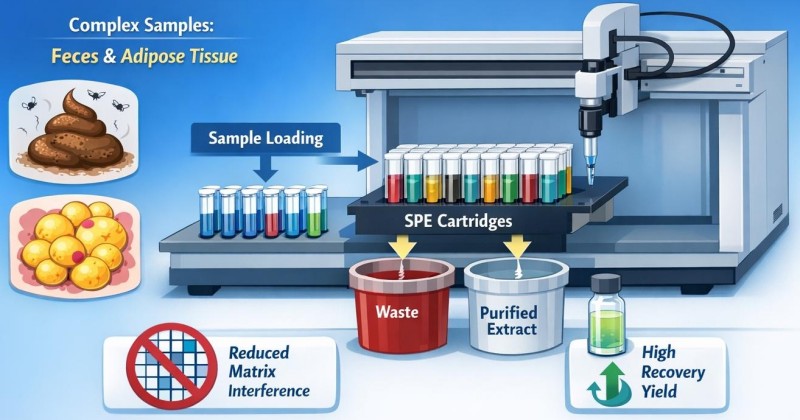
- Automated Solid-Phase Extraction (SPE)
High-precision sample preparation that minimizes matrix interference and maximizes recovery from complex samples like feces and adipose tissue.
- Bioinformatic Statistical Suite
Advanced multivariate analysis (PCA, PLS-DA) to correlate BA shifts with phenotypic changes in body weight and adiposity.
Service Scope
Our analysis covers the full spectrum of the BA pool relevant to metabolic disease:
- Primary BAs
Cholic acid (CA), chenodeoxycholic acid (CDCA), and their conjugates.
- Secondary BAs
Deoxycholic acid (DCA), lithocholic acid (LCA), ursodeoxycholic acid (UDCA), and muricholic acids (relevant for rodent models).
- Conjugation Status
Precise ratio analysis of glycine- and taurine-conjugated species, which are critical for signaling potency.
- Matrix Versatility
Validated protocols for serum, plasma, liver tissue, intestinal contents, and fecal matter.
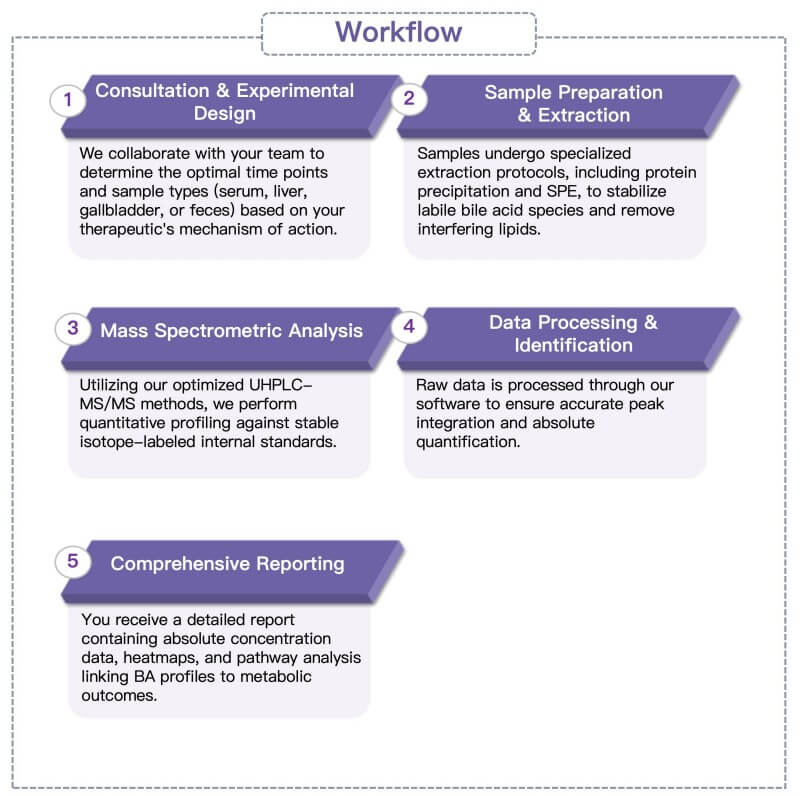
Workflow
Protheragen employs a rigorous, standardized workflow to ensure reproducible data for preclinical obesity research:
Contact Our Specialist Team to Discuss Your Preclinical Workflow
Fields of Application
Our BA profile analysis service provides the high-resolution metabolic mapping necessary to bridge the gap between therapeutic intervention and physiological response across several critical areas of preclinical research.
- Drug Mechanism of Action (MoA): Determining if a compound lowers weight by activating TGR5 or modulating FXR pathways.
- Biomarker Discovery: Identifying specific BA signatures that correlate with weight loss or improved insulin sensitivity.
- Microbiome-Metabolic Axis Research: Assessing how anti-obesity candidates alter gut microbiota-mediated BA transformation.
- Safety & Toxicity: Monitoring for cholestasis or hepatotoxicity in early-stage preclinical safety assessments.
Advantages
Protheragen stands at the forefront of metabolic profiling. Our service offers:
- High Sensitivity
Our platform achieves detection limits in the low pg/mL range, a critical threshold for capturing the nuanced dynamics of BA signaling. By identifying trace-level metabolites that standard assays miss, we enable researchers to monitor subtle physiological shifts during the earliest stages of drug intervention, providing a window into efficacy before macro-symptoms emerge.
- Isomeric Resolution
BAs often exist as structural isomers with identical masses but vastly different biological functions. Our superior chromatographic separation protocols ensure that these isomers are individually resolved and quantified with high precision. This eliminates data crosstalk, ensuring that your metabolic signatures are biologically accurate rather than just numerically present.
- Preclinical Expertise
Deep experience in high-fat diet (HFD) models and genetic Obesity Models (ob/ob, db/db).
We bridge the gap between analytical chemistry and biological reality. Our team brings extensive experience in specialized metabolic research, specifically utilizing high-fat diet (HFD) models and genetic obesity models (ob/ob, db/db). We do not just provide data; we provide context-specific insights tailored to the unique physiological environments of metabolic disease.
- Methodological Rigor & Validation
By aligning our workflows with the most rigorous industry standards, we ensure that every data point is robust, reproducible, and formatted for seamless integration into high-impact publications.
- Rapid Turnaround
Time is a critical variable in drug development. We have optimized our end-to-end pipelines to deliver results with industry-leading speed. By leveraging automated sample preparation and high-throughput analytical workflows, we provide fast data delivery that maintains extreme analytical depth, keeping your project timelines on track.
Inquiry Today to Receive a Customized Quote and Technical Consultation.
Publication Data
Title: Dynamics of the human bile acid metabolome during weight loss
Journal: Sci Rep., 2024
DOI: https://doi.org/10.1038/s41598-024-75831-1
Summary: This study explores the longitudinal dynamics of the human BA metabolome over 12 months in two obesity cohorts undergoing Roux-en-Y gastric bypass (RYGB, n=91) or low-calorie diet (LCD, n=88), quantified via LC–MS/MS. It finds distinct BA alteration patterns between the two interventions: RYGB induces rapid and persistent increases in most BA species, while LCD causes transient BA changes that revert to baseline after switching from liquid to solid hypocaloric meals. Notably, TCDCA, GLCA, and TLCA emerge as promising drug development candidates due to their consistent elevation post-RYGB and transient upregulation during LCD's liquid phase, with catabolism identified as a key driver of BA alterations independent of surgery.
Key Findings
- Weight Loss Outcomes: RYGB achieves sustained weight loss (36% of initial weight at 12 months), while LCD weight loss stabilizes after 3 months (22.6% total), despite similar 3-month weight loss percentages.
- BA Pool Dynamics: RYGB leads to a persistent doubling of the total BA pool (from 3249 ± 3359 to 6332 ± 6084 nM) and increased free, glycine-conjugated, and taurine-conjugated BA; LCD causes transient total BA elevation at 3 months, which reverses by 12 months.
- Primary/Secondary/Tertiary BA Changes: Post-RYGB, primary and secondary BA concentrations rise sharply and persistently, while tertiary BA (e.g., UDCA) remain unchanged; LCD reduces primary BA at 12 months and induces transient tertiary BA elevation at 3 months.
- Key BA Candidates: TCDCA, GLCA, and TLCA meet three critical criteria—rapid increase post-RYGB, persistent elevation for 12 months, and transient upregulation during LCD's liquid phase—making them top drug targets. CA and UDCA are specifically upregulated by RYGB.
- Catabolism's Role: 3 months of LCD-induced catabolism mimics RYGB's BA effects, indicating BA alterations are driven by catabolism itself, not surgery; sustained catabolism post-RYGB explains persistent BA changes.
- Toxicity Consideration: Peripheral BA concentrations (nanomolar range) are non-toxic to adipocytes, but BA-derived drugs must avoid oral/intestinal administration to prevent toxic doses.
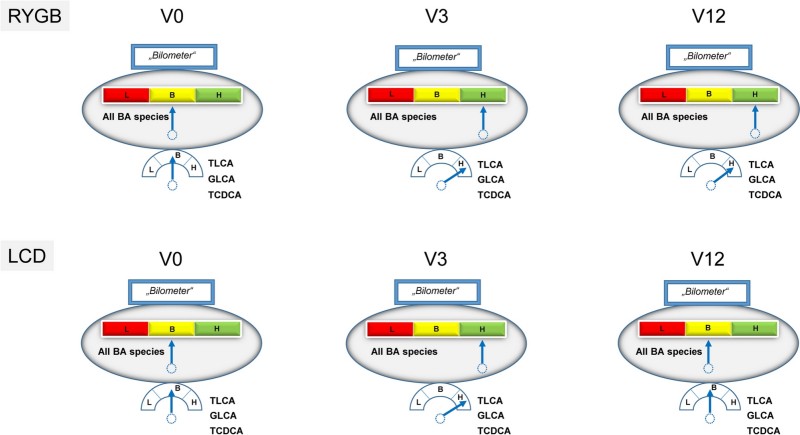 Fig.1 BA metabolome dynamics: persistent elevation with RYGB vs. transient changes with low-calorie diet in obese patients. (Schmid, et al., 2024)
Customer Review
Unlocking Mechanistic Insights into Thermogenesis and Isomer Separation
"The precision of the BA profiling provided by Protheragen was instrumental in our recent study on TGR5-mediated thermogenesis. Their ability to separate complex isomers in mouse fecal samples gave us the clarity we needed to move our lead candidate into the next phase of development. We look forward to our next collaboration on liver lipidomics."
Dr. S. S., Metabolic Research Institute
Accelerating Drug Discovery through Expert Gut-Liver Axis Mapping
"Working with Protheragen has been a seamless experience. Their technical team understands the nuances of preclinical obesity models, and the depth of the BA analysis report was far beyond what we've received from other providers. Their data directly supported our hypothesis regarding gut-liver signaling."
Dr. P. J., Biotech Therapeutics
Frequently Asked Questions
-
Which BAs are most relevant for anti-obesity research?
TGR5 agonists like LCA and DCA are often prioritized due to their role in GLP-1 secretion and thermogenesis.
-
What is the minimum sample volume required?
For serum or plasma, we typically require as little as 50 µL, though 100 µL is preferred for comprehensive panels.
-
Can you distinguish between taurine and glycine conjugates?
Yes, our LC-MS/MS methods provide distinct quantification for both conjugation types.
-
How do you handle fecal samples?
We use a specialized lyophilization and homogenization process to ensure representative sampling of the total BA output.
-
Is it possible to correlate BA profiles with gut microbiota data?
Absolutely. We offer integrated analysis where BA profiles are mapped against 16S or metagenomic data.
-
Do you provide absolute or relative quantification?
We provide absolute quantification using internal standards for the most accurate concentration data.
-
Can you analyze BAs in rodent-specific models?
Yes, we have specialized panels for muricholic acids (α, β, ω-MCA), which are prevalent in mice and rats.
-
What is the typical lead time?
Standard analysis usually takes 2–4 weeks, depending on the sample size and complexity.
-
How are the results delivered?
Data is provided in a secure digital format, including raw data, processed spreadsheets, and a summary PDF.
-
Do you assist with data interpretation?
Our PhD-level scientists provide a detailed discussion of the findings in the context of your specific research goals.
Contact Us
Protheragen is committed to providing the high-resolution metabolic data necessary to advance the next generation of anti-obesity therapeutics. Our specialized BA profile analysis service offers the accuracy, sensitivity, and preclinical expertise your project demands.
Contact Protheragen for More Information and to Discuss Your Project
Reference
- Schmid, A.; et al. Dynamics of the human bile acid metabolome during weight loss. Sci Rep. 2024, 14, 25743. (CC BY 4.0)
All of our services and products are intended for preclinical research use only and cannot be used to diagnose, treat or manage patients.