
Phosphoinositide Analysis Service
InquiryPhosphoinositides (PIPs) are essential lipid signaling molecules that regulate a myriad of cellular processes, including vesicular trafficking, cytoskeletal dynamics, and glucose homeostasis. In the context of metabolic disorders, the dysregulation of phosphoinositide-metabolizing enzymes—such as PIP kinases and phosphatases—is a hallmark of obesity and insulin resistance. Research indicates that specific PIP species, such as PI(4,5)P2 and PI(3,4,5)P3, serve as critical nodes in the insulin signaling pathway and lipid accumulation in hepatic and adipose tissues.
Phosphoinositide Analysis Service for Anti-Obesity Therapeutics
Protheragen provides a specialized phosphoinositide analysis service tailored for the development of anti-obesity therapeutics. By quantifying these low-abundance signaling lipids with high precision, we enable researchers to elucidate the mechanism of action (MoA) of novel drug candidates. Our platform is specifically designed to support preclinical drug discovery, providing the granular lipidomic data necessary to evaluate how small molecules or biologics modulate metabolic flux and energy expenditure.
Core Technologies
To provide a deeper understanding of our analytical capabilities, here is a detailed breakdown of the sophisticated instrumentation and proprietary methodologies Protheragen utilizes to facilitate your anti-obesity drug discovery:
- Derivatization-Enhanced HPLC-MS/MS
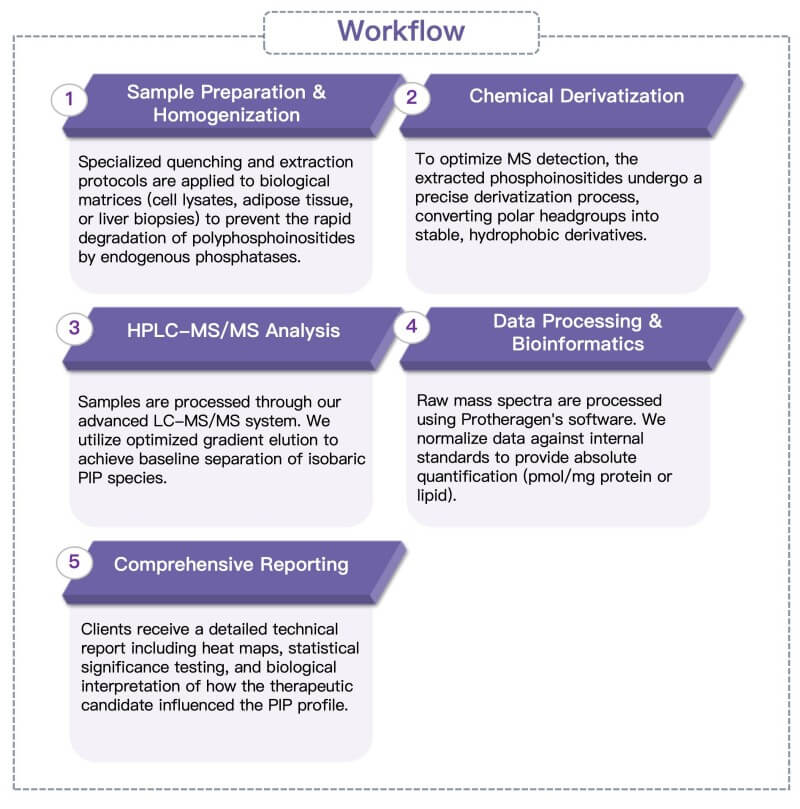
Phosphoinositides are notoriously difficult to detect due to their highly acidic nature and low abundance. Our platform utilizes specialized chemical derivatization (such as trimethylsilyldiazomethane) to neutralize the phosphate headgroups. This process significantly increases the volatility and ionization efficiency of the molecules, allowing for detection limits in the low femtomolar range.
- Isomer-Specific Chromatographic Separation
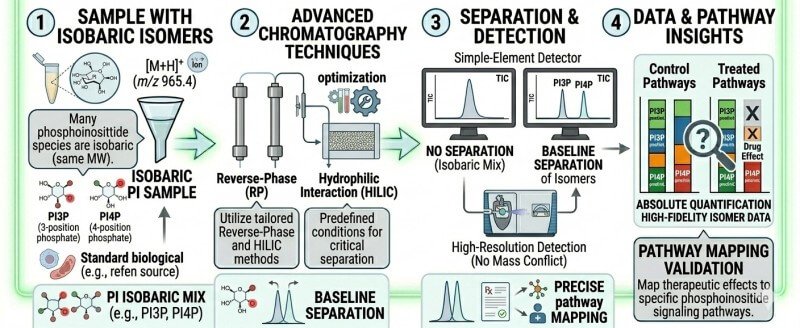
Many phosphoinositide species are isobaric, meaning they share the same molecular weight but differ in the position of the phosphate group (e.g., PI3P vs. PI4P). We employ advanced reverse-phase and hydrophilic interaction liquid chromatography (HILIC) techniques to achieve baseline separation of these isomers, ensuring that your therapeutic's effect on specific signaling pathways is precisely mapped.
- Targeted Multiple Reaction Monitoring (MRM)
By focusing the mass spectrometer on specific precursor-to-product ion transitions, we filter out chemical noise from the complex lipid matrix of liver or adipose tissue. This targeted approach provides a linear dynamic range of over four orders of magnitude, which is essential for quantifying both the low-abundance signaling PIPs and their more abundant precursors.
- Customized Lipid Extraction Protocols
Traditional Bligh and Dyer extractions often fail to recover polyphosphoinositides efficiently. Protheragen uses a proprietary acidified solvent extraction system designed to maximize the recovery of highly phosphorylated species like PI(3,4,5)P3 while maintaining the integrity of the fatty acid chains for downstream profiling.
- High-Resolution Mass Accuracy
Our instruments provide the high mass resolution necessary to determine the exact elemental composition of the acyl chains. This allows us to distinguish between different molecular species of the same phosphoinositide class, providing insights into how dietary fats or metabolic inhibitors alter the lipid signaling landscape.
Workflow
Our streamlined workflow is designed to provide rapid, reproducible, and actionable data for preclinical research:
Consult with Our Scientists to Customize a Workflow for Your Specific Metabolic Model
Fields of Application
Our phosphoinositide analysis service provides the deep molecular insights necessary to bridge the gap between initial compound screening and advanced preclinical validation across several critical areas of metabolic research:
- Target Identification: Discovering novel PIP-metabolizing enzymes that drive lipid storage or insulin desensitization.
- Mechanism of Action (MoA) Studies: Validating that a tyrosine kinase inhibitor or a PIP-kinase modulator reaches its intended lipid signaling target.
- Biomarker Discovery: Identifying specific PIP signatures in plasma or tissues that correlate with weight loss or improved metabolic health.
- Compound Screening: High-throughput targeted profiling to rank lead compounds based on their ability to restore healthy phosphoinositide balances.
Advantages
Protheragen stands at the forefront of lipid signaling analysis. Our advantages include:
- Unrivaled Sensitivity
Standard mass spectrometry often struggles with the low natural abundance of phosphoinositides (PIPs). Our derivatization-enhanced MS protocols address this by chemically modifying the phosphate groups to improve ionization efficiency.
- Isomeric Resolution
Mass-to-charge ratios alone cannot distinguish between phosphoinositide isomers that share identical masses but serve vastly different biological functions. We utilize specialized chromatography and optimized fragmentation patterns to successfully separate critical isomers like PI(3,4)P2 and PI(4,5)P2.
- Preclinical Expertise
Data is only as good as its biological relevance. Our team does not just provide raw numbers; we provide pharmacological insights. With deep experience in obesity, diabetes, and fatty liver disease models, we understand how lipid signaling shifts under metabolic stress.
- Proven Reliability
Historically, radiolabeling was the only way to track PIPs accurately, but it comes with extreme safety risks and regulatory hurdles. Our non-radioactive MS methods are rigorously validated against published "gold-standard" data, demonstrating high correlation with traditional radiolabeling results.
Service Scope
Protheragen offers a comprehensive suite of analytical options for anti-obesity research:
- Glycerophospholipids
PC, PE, PI, PS, PG, and PA, including their ether-linked (plasmalogen) variants.
- Sphingolipids
Sphingomyelins (SM) and ceramides are critical in insulin signaling pathways.
- Lysophospholipids
High-sensitivity detection of LPC and LPE, often used as a marker for inflammation and metabolic stress.
- Mitochondrial Lipids
Specialized analysis of cardiolipin, a key regulator of mitochondrial function and thermogenesis in brown adipose tissue.
- Tissue-Specific Profiling
Analysis optimized for white adipose tissue (WAT), brown adipose tissue (BAT), liver, and skeletal muscle.
Contact Our Specialist Team to Optimize Your Lead Optimization Strategy
Customer Review
Optimizing Lead Candidates via Isomeric Resolution
"The team at Protheragen provided us with exceptional clarity on our lead compound's impact on PI(4,5)P2 levels in the liver. Their ability to distinguish between isomers allowed us to confirm the selectivity of our kinase inhibitor in a way that standard assays could not. The data was instrumental for our preclinical package."
Dr. A. S., Senior Director of Metabolic Discovery
Validating Adipose Tissue Signaling in Preclinical Models
"Protheragen's expertise in handling adipose tissue samples was a game-changer for our anti-obesity program. The precision of their phosphoinositide profiling gave us the confidence to move our candidate into advanced animal models. We look forward to our next collaboration on skeletal muscle signaling."
Dr. W. B., Pharmacology
Frequently Asked Questions
-
Why is PIP analysis more difficult than general lipidomics?
Phosphoinositides are highly charged and present in very low concentrations, requiring specialized extraction and derivatization to be seen by mass spectrometry.
-
Can you distinguish between PI4P and PI3P?
Yes, our HPLC-MS/MS platform is optimized to provide baseline chromatographic separation of these isomers.
-
What sample volume is required for adipose tissue?
Typically, 20–50 mg of tissue is sufficient for a comprehensive PIP profile.
-
Do you provide services for human clinical trials?
No, Protheragen focuses exclusively on preclinical research and discovery phases.
-
How do you prevent the degradation of PIPs during shipping?
We provide detailed protocols for flash-freezing and shipping on dry ice to ensure sample integrity.
-
Can this service help in evaluating PI3K inhibitors?
Absolutely. We can quantify the reduction of PI(3,4,5)P3 levels directly following treatment.
-
What is the typical turnaround time?
Most preclinical projects are completed within 3–4 weeks from sample receipt.
-
Is absolute quantification available?
Yes, we use exogenous internal standards to provide absolute concentration data.
-
Can you analyze the fatty acid distribution of PIPs?
Yes, our high-resolution MS allows us to identify the specific acyl chains attached to the glycerol backbone.
Contact Us
Protheragen is committed to accelerating the discovery of next-generation anti-obesity therapeutics through precision lipidomics. Our specialized phosphoinositide analysis service provides the high-resolution data necessary to turn complex biological questions into actionable drug discovery milestones.
Contact Protheragen for More Information and to Discuss Your Project
All of our services and products are intended for preclinical research use only and cannot be used to diagnose, treat or manage patients.