

Acylcarnitine Profile Analysis Service
InquiryIn the rapidly evolving landscape of metabolic research, understanding the dynamics of mitochondrial fatty acid oxidation is paramount for developing effective anti-obesity therapeutics. Acylcarnitines serve as essential intermediate biomarkers, reflecting the balance between acyl-CoA production and its utilization within the mitochondrial matrix.
Acylcarnitine Profile Analysis for Anti-Obesity Therapeutics
At Protheragen, we provide a specialized acylcarnitine profile analysis service tailored specifically for preclinical drug discovery. By quantifying these metabolites, researchers can pinpoint specific metabolic bottlenecks, evaluate the efficacy of GLP-1 receptor agonists or other metabolic modulators, and gain a granular view of how novel compounds shift lipid metabolism from storage to oxidation. Our platform transforms complex metabolic signatures into actionable data to propel your anti-obesity pipeline forward.
Core Technologies
Protheragen leverages a high-sensitivity analytical suite to ensure the detection of even low-abundance branched-chain and long-chain acylcarnitines.
- Liquid Chromatography-Tandem Mass Spectrometry (LC-MS/MS)
We utilize advanced triple-quadrupole mass spectrometers optimized for multiple reaction monitoring (MRM), providing superior specificity compared to traditional fluorometric assays.
- Targeted Metabolomics Platforms
Our systems are calibrated with a comprehensive library of stable isotope-labeled internal standards, enabling absolute quantification of a wide range of acylcarnitine species.
- Automated Sample Prep
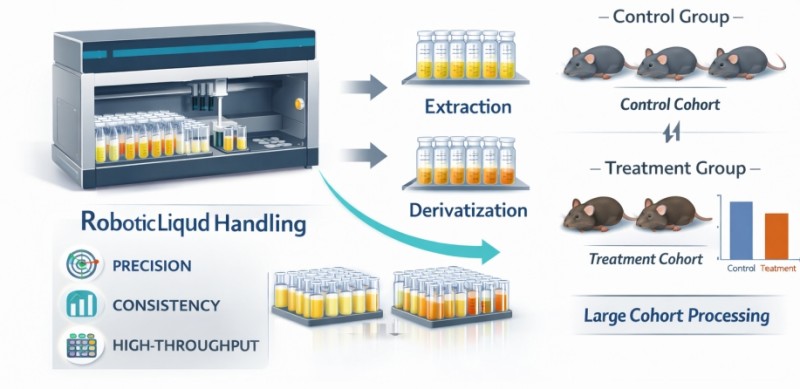
To minimize variability and ensure high-throughput capabilities for large preclinical cohorts, we employ robotic liquid handling systems for extraction and derivatization.
- Advanced Bioinformatic Pipelines
Beyond raw data, we utilize proprietary software to perform pathway enrichment and metabolic flux analysis, linking acylcarnitine shifts directly to β-oxidation efficiency.
Service Scope
Our profiling service covers a vast array of acylcarnitine species relevant to obesity and endocrinology:
- Short-Chain Acylcarnitines (C2-C5)
Including acetylcarnitine (C2) and propionylcarnitine (C3), essential for monitoring carbohydrate oxidation and BCAA metabolism.
- Medium-Chain Acylcarnitines (C6-C12)
Indicators of medium-chain fatty acid oxidation efficiency.
- Long-Chain Acylcarnitines (C14-C18)
Critical markers for mitochondrial uptake and long-chain fatty acid β-oxidation defects or improvements.
- Dicarboxylic and Hydroxy-Acylcarnitines
Specialized markers that provide insights into alternative oxidation pathways and oxidative stress.
- Matrix Versatility
Validated protocols for rodent plasma, skeletal muscle, heart, liver, and adipose tissue biopsies.
Workflow
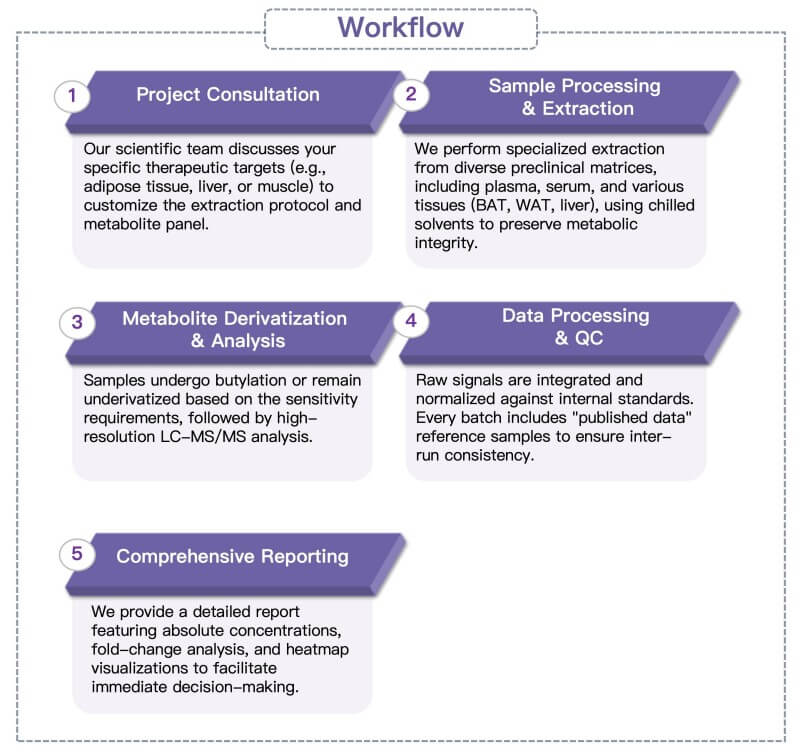
Our service process is designed for rigorous preclinical standards, ensuring transparency and reproducibility at every stage.
Fields of Application
Our comprehensive acylcarnitine profile analysis service provides the high-resolution metabolic mapping necessary to validate therapeutic efficacy across a diverse range of preclinical obesity and endocrine research models.
- Anti-Obesity Drug Screening: Evaluating how novel leads affect fatty acid transport and mitochondrial combustion.
- Insulin Resistance Research: Monitoring the accumulation of long-chain acylcarnitines, which are often associated with lipotoxicity and impaired insulin signaling.
- Incretin Mimetic Studies: Assessing the metabolic downstream effects of GLP-1/GIP Receptor Co-agonists on lipid handling.
- NAFLD/NASH Studies: Analyzing hepatic lipid metabolism to identify compounds that reduce liver fat accumulation through enhanced oxidation.
Advantages
Protheragen offers a unique combination of biological expertise and analytical precision. Unlike generalist labs, our focus on anti-obesity therapeutics means our panels are optimized for the metabolic shifts induced by weight-loss compounds.
- Unrivaled Sensitivity
Generalist labs often miss the early markers of efficacy because their assays aren't tuned for the high-dynamic range of metabolic signaling. By achieving industry-leading lower limits of quantification (LLOQ), we capture low-abundance metabolites that serve as early indicators of drug action.
- Biological Context
A list of metabolites is just a spreadsheet; a ratio is a story. Our focus on specific biomarkers, such as the C3/C2 (propionylcarnitine/acetylcarnitine) ratio, allows us to pinpoint exactly where a metabolic pathway is bottlenecked.
- Speed and Scale
In anti-obesity research, longitudinal studies involve thousands of samples over months. Our high-throughput infrastructure is designed to maintain consistency across these massive datasets without "batch effect" drift.
- Data Integrity & Methodological Rigor
We go beyond "standard" protocols by aligning our workflows with the rigorous methodologies found in top-tier journals. By benchmarking our results against published findings, we ensure your data is robust, reproducible, and provides the mechanistic depth required for high-impact publication or internal drug-candidate progression.
Contact Our Specialists Today to Integrate Our Precision Workflow into Your Next Preclinical Study.
Customer Review
Unlocking Mechanistic Clarity: Validating Mitochondrial β-Oxidation in Lead Optimization
"The team at Protheragen provided us with a level of metabolic granularity we couldn't achieve in-house. Their acylcarnitine profiling in skeletal muscle was pivotal in demonstrating that our lead compound was indeed enhancing β-oxidation rather than just suppressing appetite. We look forward to our next study together."
Dr. S. D., Metabolic Disease Biotech
Expert Metabolic Mapping for Targeted Endocrine Research
"What sets Protheragen apart is its interpretation of the data. Instead of a simple spreadsheet, we received a comprehensive metabolic map that highlighted exactly where our compound was intervening in the mitochondrial fatty acid transport chain. Their expertise saved us months of trial and error."
Dr. L. S., Endocrine Research Institute
Frequently Asked Questions
-
Why is acylcarnitine profiling better than measuring total fatty acids?
Acylcarnitines reflect the rate of fatty acid entry into the mitochondria, providing a dynamic view of oxidation rather than just static storage levels.
-
Which preclinical species do you support?
We primarily work with mouse and rat models, but have validated protocols for non-human primate (NHP) and porcine samples.
-
What is the required sample volume for plasma?
We can provide high-quality profiles from as little as 20-50 µL of plasma, making it ideal for longitudinal rodent studies.
-
Can you distinguish between different C5 isomers?
Yes, our LC-MS/MS methods are specifically optimized to separate pivaloylcarnitine, valerylcarnitine, and isovalerylcarnitine.
-
How do you handle tissue samples?
We require snap-frozen tissue. Our team performs the homogenization and extraction using optimized buffers to prevent metabolite degradation.
-
Do you offer custom panels for specific targets?
Absolutely. We can expand our standard panel to include specific dicarboxylic species if your target involves ω-oxidation.
-
What is the typical turnaround time?
Standard preclinical cohorts are typically processed and reported within 15-20 business days.
-
How do I interpret the results?
Each report includes a summary from our Ph.D. scientists explaining the metabolic significance of the observed changes.
Contact Us
Protheragen provides an industry-leading acylcarnitine profile analysis service designed to decode the complexities of mitochondrial metabolism in anti-obesity drug development. Our LC-MS/MS platform delivers high-sensitivity, absolute quantification of short, medium, and long-chain species across various preclinical matrices. By combining analytical precision with deep biological insight, we empower researchers to validate their therapeutic strategies and accelerate the journey from discovery to lead optimization.
Contact Protheragen for More Information and to Discuss Your Project
All of our services and products are intended for preclinical research use only and cannot be used to diagnose, treat or manage patients.