

Mevalonate & Isoprenoid Pathway Analysis Service
InquiryThe mevalonate (MVA) pathway is a fundamental metabolic cascade responsible for the synthesis of sterols and non-sterol isoprenoids, such as farnesyl pyrophosphate (FPP) and geranylgeranyl pyrophosphate (GGPP). Emerging preclinical evidence underscores the critical role of MVA pathway flux in adipocyte turnover, lipid droplet formation, and the regulation of thermogenic gene expression. In the context of anti-obesity therapeutics, modulating key enzymes like HMG-CoA reductase (HMGCR) or targeting downstream isoprenoid intermediates offers a promising avenue for controlling adiposity and systemic metabolic inflammation.
Mevalonate & Isoprenoid Pathway Analysis for Anti-Obesity Research
Protheragen provides a specialized mevalonate & isoprenoid pathway analysis service tailored for preclinical drug discovery. By quantifying metabolic intermediates with high precision, we empower researchers to evaluate how novel anti-obesity compounds influence lipid homeostasis and cellular signaling.
Core Technologies
To unravel the complexities of isoprenoid metabolism, Protheragen utilizes a suite of high-sensitivity analytical platforms designed for biological matrices.
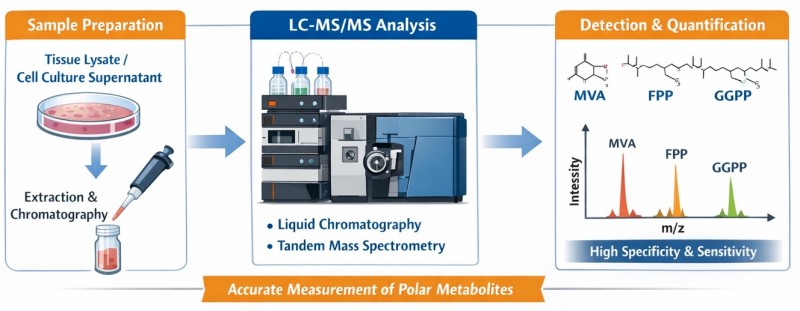
- Liquid Chromatography-Tandem Mass Spectrometry (LC-MS/MS)
Our primary platform for the absolute quantification of polar intermediates, including MVA, FPP, and GGPP. This technology ensures high specificity and sensitivity, even in complex tissue lysates or cell culture supernatants.
- Gas Chromatography-Mass Spectrometry (GC-MS)
Utilized for the profiling of downstream sterols and fatty acids, providing a holistic view of lipid metabolism and structural isoprenoids.
- High-Resolution Mass Spectrometry (HRMS)
Employs Orbitrap technology for non-targeted lipidomics and discovery-based metabolic flux analysis, allowing the identification of novel biomarkers in obesity models.
- Stable Isotope Labeling (SIL)
Integration of 13C or 2H-labeled precursors to track carbon flow through the MVA pathway, distinguishing between de novo synthesis and dietary uptake in preclinical models.
Service Scope
Protheragen offers a broad analytical spectrum to cover every facet of MVA-related anti-obesity research:
- MVA Intermediate Profiling
Quantification of mevalonate, mevalonate-5-phosphate, and isopentenyl pyrophosphate (IPP).
- Isoprenoid Quantification
Targeted analysis of FPP and GGPP to evaluate protein prenylation potential.
- Sterol & CoQ10 Analysis
Measurement of cholesterol precursors (lanosterol, desmosterol) and ubiquinone levels to assess mitochondrial health and oxidative stress.
- Enzymatic Activity Assays
Preclinical assessment of HMGCR activity and other rate-limiting enzymes in response to inhibitors.
- Metabolic Flux Analysis
Dynamic tracking of pathway throughput using labeled precursors in cell-based or Animal Models.
Request a Detailed Quote and Technical Consultation Today
Workflow
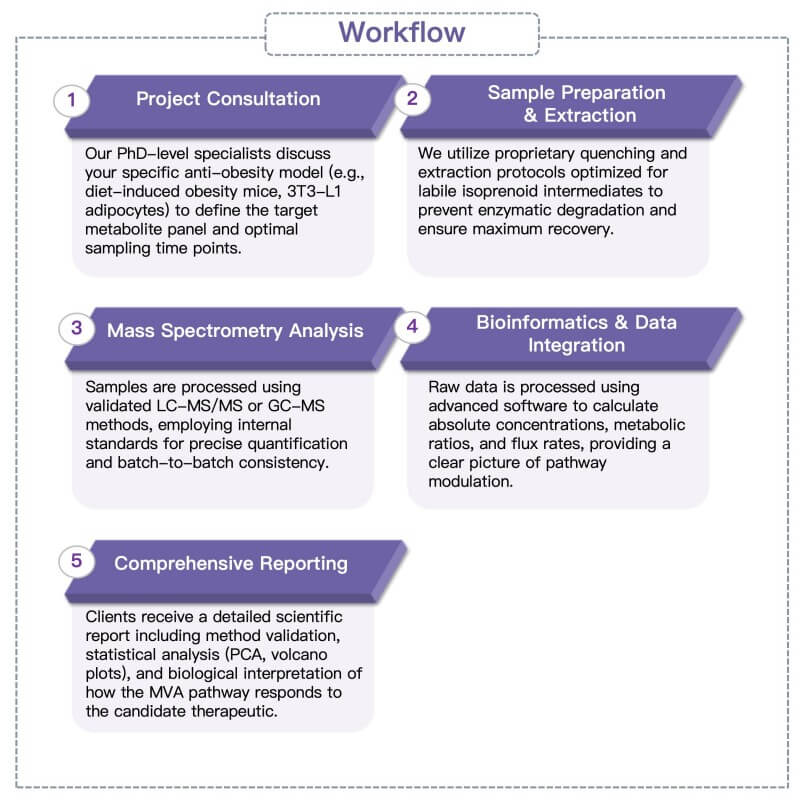
Our streamlined service process ensures rigorous data generation from initial consultation to final reporting:
Fields of Application
The strategic analysis of MVA and isoprenoid flux is instrumental across diverse stages of drug development, providing the mechanistic clarity required to translate novel metabolic targets into viable anti-obesity interventions.
- Target Identification: Discovering novel regulatory nodes within the MVA pathway that influence adipocyte differentiation.
- Lead Optimization: Assessing the potency and selectivity of HMGCR inhibitors or isoprenoid transferase inhibitors.
- Mechanism of Action (MoA) Studies: Validating if a compound's anti-obesity effect is mediated through MVA pathway suppression or downstream protein prenylation.
- Biomarker Discovery: Identifying circulating isoprenoid signatures that correlate with weight loss or improved insulin sensitivity in preclinical models.
- Safety Profiling: Monitoring off-target effects on essential sterol synthesis or mitochondrial CoQ10 levels.
Contact Protheragen Today to Design Your Customized Analysis Plan.
Advantages
Choosing Protheragen provides your preclinical program with unparalleled metabolic insights:
- Exceptional Sensitivity
Our platform utilizes state-of-the-art mass spectrometry to detect isoprenoid intermediates at femtomolar levels, providing a window into metabolic activities that remain invisible to standard analytical methods. This high-resolution sensitivity is a critical asset for programs working with limited biomass—such as rare cell populations or needle biopsies—allowing researchers to quantify subtle metabolic shifts and trace-level flux changes with absolute confidence.
- Adipose-Specific Expertise
Navigating the complexities of lipid-rich environments requires more than standard equipment; it requires specialized chemical intuition to overcome significant matrix interference. Protheragen has pioneered extraction protocols specifically designed to partition target metabolites from the dense triglyceride backgrounds of white and brown adipose tissues, which typically "quench" signals in lesser assays.
- High-Confidence Research Support
We provide datasets anchored in stringent validation protocols. With detailed calibration and QC parameters as standard, we ensure your results possess the methodological rigor required for both prestigious journals and preclinical decision-making.
- Rapid Turnaround
Recognizing that time is the most valuable currency in drug development, we have optimized our internal pipeline to deliver standard results within a condensed 2–4 week window. This accelerated timeline is achieved through a streamlined workflow that integrates sample intake, high-throughput processing, and expert bioinformatic analysis without compromising on technical precision.
Customer Review
Mechanism Validation and Technical Excellence in Adipose Research
"Working with Protheragen has been transformative for our anti-obesity program. Their ability to quantify FPP and GGPP in adipose tissue with such high precision allowed us to confirm the mechanism of action for our lead candidate. The technical depth of their reports is outstanding, providing us with the confidence needed to move into the next phase of development. We look forward to a long-term partnership."
Dr. B. P., Metabolic Diseases Research
Seamless Collaboration and Precision Flux Analysis for Discovery Biology
"The team at Protheragen provided exceptional support during our metabolic flux studies. Their expertise in the MVA pathway is evident, and the data they generated were pivotal for our recent publication. Their fast turnaround and willingness to customize extraction protocols for our specific mouse models made them an invaluable extension of our lab."
Dr. V. C., Director of Preclinical Pharmacology
Frequently Asked Questions
-
Why focus on the MVA pathway for obesity?
The pathway regulates adipocyte turnover and inflammatory signaling; modulating it can reduce fat accumulation and improve metabolic health.
-
What sample types do you accept?
We process cell pellets, adipose tissue (WAT/BAT), liver tissue, and plasma/serum from preclinical models.
-
How do you ensure the stability of pyrophosphate intermediates?
We use specialized cold-extraction buffers and immediate flash-freezing to prevent the hydrolysis of FPP and GGPP.
-
Can you distinguish between different isoprenoid species?
Yes, our LC-MS/MS methods provide clear chromatographic separation of isomers like IPP and DMAPP.
-
Is metabolic flux analysis available?
Yes, we offer 13C-labeling studies to measure the actual rate of synthesis rather than just steady-state levels.
-
Do you provide statistical analysis?
Every project includes comprehensive statistics, including t-tests, ANOVA, and multivariate analysis.
-
What is the minimum sample requirement?
Typically, 20–50 mg of tissue or 1x10⁶ cells, though we can optimize for smaller amounts.
-
Can you analyze the effects of statins in these models?
Absolutely; we frequently benchmark novel compounds against known HMGCR inhibitors.
Contact Us
Protheragen is committed to accelerating the development of next-generation anti-obesity therapeutics through precise MVA and isoprenoid pathway analysis. Our specialized preclinical services provide the deep metabolic insights required to validate targets and optimize lead compounds.
Contact Protheragen for More Information and to Discuss Your Project.
All of our services and products are intended for preclinical research use only and cannot be used to diagnose, treat or manage patients.