
Phospholipid Analysis Service
InquiryPhospholipids are not merely structural components of cellular membranes; they are dynamic signaling mediators that govern metabolic homeostasis, adipocyte differentiation, and insulin sensitivity. In the pursuit of next-generation anti-obesity therapeutics, understanding the precise alterations in lipidomic profiles is paramount.
Comprehensive Phospholipid Analysis for Anti-Obesity Therapeutics
Protheragen provides a specialized phospholipid analysis service tailored specifically for preclinical research. By quantifying diverse lipid species—from phosphatidylcholines to sphingomyelins—we empower researchers to elucidate the mechanism of action (MoA) of small molecules, peptides, and gene therapies aimed at metabolic regulation. Our platform bridges the gap between lipid biochemistry and therapeutic efficacy, ensuring that your drug candidates are evaluated with the highest degree of molecular resolution.
Core Technologies
Our phospholipid analysis service at Protheragen is built upon a foundation of high-resolution analytical platforms designed to resolve the immense complexity of the lipidome. For anti-obesity research, where subtle changes in membrane composition dictate metabolic signaling, we utilize the following core technologies:
- High-Resolution Shotgun Lipidomics
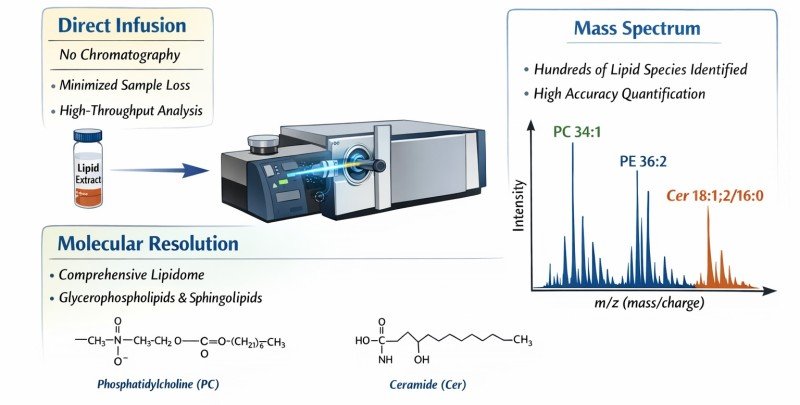
This "top-down" approach allows for the rapid identification and absolute quantification of hundreds of lipid species directly from a complex sample extract.
- Direct Infusion: By bypassing chromatography, we minimize sample loss and ensure high-throughput processing.
- Molecular Resolution: This technology provides a comprehensive "snapshot" of the lipidome, capturing glycerophospholipids and sphingolipids with high precision.
- Liquid Chromatography-Tandem Mass Spectrometry (LC-MS/MS)
For studies requiring the separation of isomeric or isobaric species (lipids with the same mass but different structures), we employ advanced LC-MS/MS.
- Isomeric Separation: We distinguish between lipids that differ only in the position of their double bonds or the attachment point of their fatty acid chains.
- Dynamic Range: This platform is exceptionally sensitive, making it ideal for detecting low-abundance signaling phospholipids, such as lysophosphatidic acids (LPA), which are often involved in inflammatory pathways in adipose tissue.
- Electrospray ionization (ESI) and Orbitrap technology
We utilize state-of-the-art mass spectrometers equipped with ESI sources and Orbitrap analyzers to achieve ultra-high mass accuracy.
- Mass Accuracy: Our systems operate at sub-ppm mass accuracy, ensuring that every lipid identification is statistically significant and verified against curated libraries.
- Fragmentation Patterns: By utilizing collision-induced dissociation (CID) or higher-energy collisional dissociation (HCD), we determine the exact fatty acid composition (e.g., PC 36:2 vs. PC 18:0/18:2).
- Automated Extraction and Internal Standardization
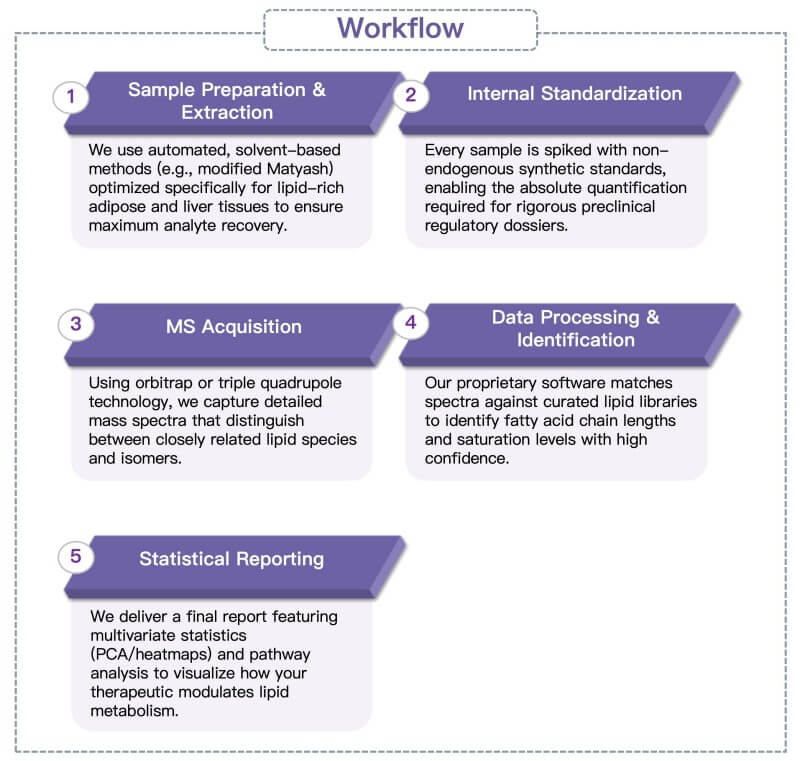
Consistency is the bedrock of preclinical lead generation. Our platform automates the extraction process to eliminate human error.
- Multi-Internal Standards: We utilize a complex cocktail of non-endogenous synthetic lipid standards. This allows for absolute quantification (molar concentration) rather than just relative intensity, which is critical for comparing data across different animal cohorts or longitudinal studies.
- Specialized Bioinformatics Pipeline
The raw data generated by mass spectrometry is processed through our proprietary bioinformatics suite, specifically tuned for metabolic disease markers.
- Pathway Mapping: We do not just provide a list of lipids; we map them to metabolic pathways such as the Kennedy pathway or the Lands' cycle to show how your drug candidate influences lipid remodeling.
- Multivariate Statistics: Our reports include PCA, OPLS-DA, and volcano plots to highlight the most significant lipidomic shifts caused by your anti-obesity therapeutic.
Service Scope
Our phospholipid analysis service covers a vast array of lipid classes essential for metabolic research:
- Glycerophospholipids
PC, PE, PI, PS, PG, and PA, including their ether-linked (plasmalogen) variants.
- Sphingolipids
Sphingomyelins (SM) and ceramides, which are critical in insulin signaling pathways.
- Lysophospholipids
High-sensitivity detection of LPC and LPE, often used as a marker for inflammation and metabolic stress.
- Mitochondrial Lipids
Specialized analysis of cardiolipin, a key regulator of mitochondrial function and thermogenesis in brown adipose tissue.
- Tissue-Specific Profiling
Analysis optimized for white adipose tissue (WAT), brown adipose tissue (BAT), liver, and skeletal muscle.
Workflow
Our streamlined preclinical workflow ensures data integrity and rapid turnaround times for your drug development programs:
Contact Our Team for More Information and to Discuss Your Project
Fields of Application
Our phospholipid analysis service provides the high-resolution metabolic mapping necessary to bridge the gap between drug administration and phenotypic outcome across diverse preclinical research areas.
- Target Identification: Identifying unique phospholipid signatures associated with obesity-resistant phenotypes.
- Mechanism of Action (MoA) Studies: Evaluating how drug candidates modulate lipid remodeling and membrane composition in the liver and adipose tissue.
- Biomarker Discovery: Screening for circulating phospholipid markers that predict therapeutic efficacy or metabolic improvement.
- Safety & Toxicity: Monitoring lipid-related off-target effects, such as drug-induced phospholipidosis or hepatic steatosis.
- Combination Therapy Research: Analyzing the synergistic effects of multiple compounds on systemic lipid metabolism.
Advantages
Protheragen stands at the forefront of lipidomic innovation, offering several distinct advantages for anti-obesity research:
- Exceptional Sensitivity
Our platform utilizes advanced high-resolution mass spectrometry to detect low-abundance signaling lipids—such as bioactive sphingolipids and specialized pro-resolving mediators—that are often masked by more dominant lipid species. By capturing these subtle shifts in the lipidome, we provide researchers with a granular view of adipocyte signaling pathways that conventional assays simply cannot see.
- Absolute Quantification
Moving beyond "fold-change" observations, we provide exact molar concentrations (e.g., nmol/g or pmol/mg) through the use of internal standards. This absolute quantification allows for seamless data integration across multi-site preclinical studies and different animal models, providing the "hard numbers" required for definitive pharmacokinetic/pharmacodynamic (PK/PD) modeling.
- Adipose-Optimized Protocols
Adipose tissue presents unique analytical challenges due to its overwhelming triglyceride content, which often causes "ion suppression" in standard assays. We have developed refined extraction techniques specifically for lipid-rich tissues. These protocols effectively "clean" the sample of interfering bulk lipids, ensuring that the critical signaling molecules remain visible and accurately measured.
- Rapid Throughput
Speed should never compromise precision. Our automated sample preparation and data processing workflows allow for the rapid analysis of large cohorts without the risk of manual error. This scalability is essential for high-volume dose-response studies and longitudinal monitoring, enabling you to track metabolic shifts in real-time across various treatment windows.
- Benchmark-Validated Methodology
Our analytical workflows consistently demonstrate high reproducibility and strong correlation with established metabolic phenotypes in DIO models. This alignment with industry-standard benchmarks ensures that your results are grounded in proven science and rigorous metabolic logic.
Publication Data
Title: Visceral Adipose Tissue Phospholipid Signature of Insulin Sensitivity and Obesity
Journal: J. Proteome Res, 2021
DOI: https://dx.doi.org/10.1021/acs.jproteome.0c00918
Summary: This study delves into the metabolic characteristics of visceral adipose tissue (VAT) in relation to insulin resistance (IR) and obesity, aiming to identify metabolic signatures and potential biomarkers. A total of 71 subjects were divided into four groups: non-obese insulin-sensitive (IS), non-obese IR, obese IS, and obese IR. Using an untargeted UPLC-Q Exactive metabolomic approach, combined with univariate and multivariate statistical analyses, the research explored VAT metabolic profiles and associated pathways. The results revealed distinct metabolic alterations in VAT of obese individuals, particularly involving lipid, nucleotide, carbohydrate, and amino acid metabolism. A panel of six 18-carbon fatty acyl-containing phospholipids was identified as a highly effective biomarker for distinguishing the "insulin-sensitive obesity" metabotype. While these findings shed light on the metabolic links between obesity, IR, and VAT, further validation in larger cohorts and more accessible samples like blood is needed for clinical application.
Key Findings
- Obesity-Related VAT Metabolic Alterations: Obese subjects showed significant changes in 118 metabolites in VAT, involving six key pathways such as branched-chain amino acid metabolism, tricarboxylic acid cycle, and glycerolipid metabolism. Compared to non-obese individuals, obese subjects had lower levels of phospholipids like glycerophosphatidylcholine (GPC) and plasmalogen glycerophosphatidylethanolamine (GPE).
- IR-Specific Lipid Remodeling in Obese Subjects: IR in obese individuals specifically affected the metabolism of 18-carbon fatty acyl-containing phospholipids. Obese IR subjects had lower levels of lipids including GPE (18:2), glycerophosphatidylinositol (GPI) (18:0), and glycerophosphatidylserine (GPS) (18:0) compared to obese IS subjects, with no such differences observed in non-obese groups.
- Highly Predictive Multimetabolite Biomarker Panel: The combined panel of six phospholipids (GPE 18:2, GPI 18:0, GPS 18:0, GPC 18:0/18:1, GPC 18:2/18:2, GPC 18:2/18:3) exhibited exceptional predictive performance. It achieved an AUC of 96.7% (91.9–100) in distinguishing obese IS from obese IR subjects, and an AUC of 87.6% (79.0–96.2) across the entire study population.
- Discordant Phenotype Metabolic Differences: Metabolic variations between obese IS and obese IR (discordant obesity phenotypes) were mainly reflected in IR markers and phospholipid levels. In contrast, high IR phenotypes (non-obese IR vs. obese IR) showed no significant differences in adiposity or liver damage markers.
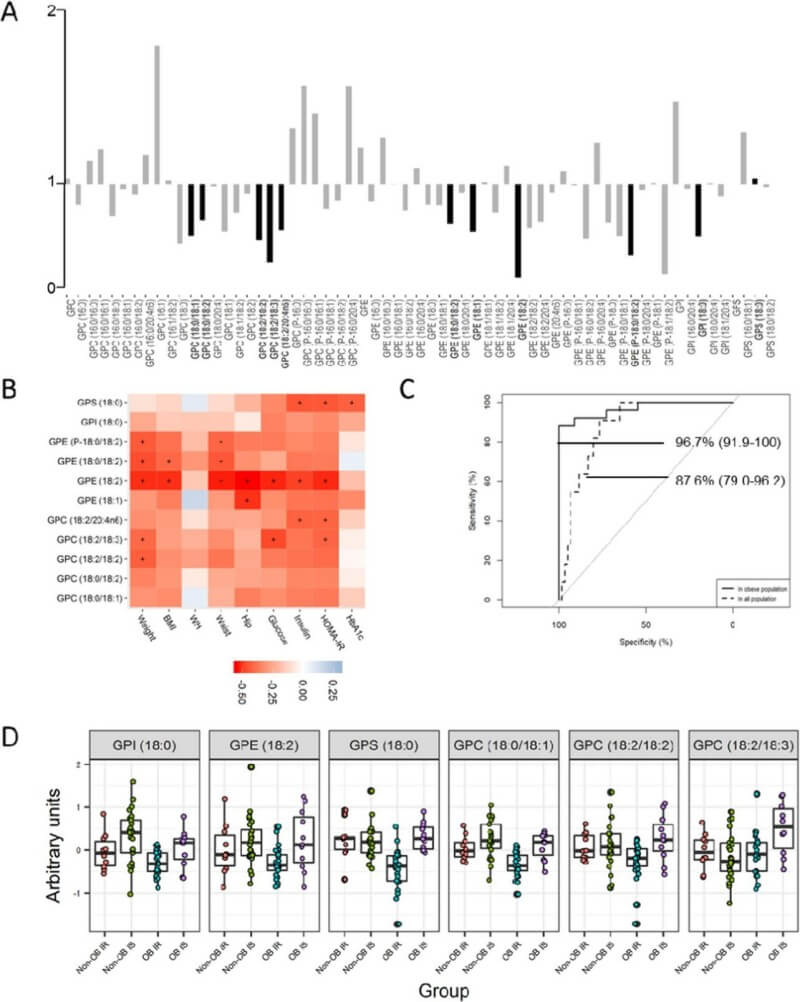 Fig.1 Phospholipid profiling of visceral adipose tissue (VAT) distinguishes insulin-sensitive vs. insulin-resistant obesity phenotypes—biomarker panel validation with high AUC. (Magalí, et al., 2021)
Customer Review
Elucidating Drug Mechanism of Action (MoA) in Diet-Induced Obesity Models
"The team at Protheragen provided us with an unprecedented level of detail regarding the lipid remodeling occurring in our DIO mouse models. Their ability to quantify specific phosphatidylcholine species allowed us to pinpoint the exact mechanism by which our lead compound improves insulin sensitivity. We were particularly impressed by the clarity of their bioinformatic reports. We look forward to scaling our next study with them."
Dr. A. S., Metabolic Research
Unmatched Reproducibility and Technical Precision for Complex Adipose Tissues
"Protheragen has been an essential partner in our preclinical development. Their phospholipid analysis service is far more robust than other providers we've used, especially when dealing with complex brown adipose tissue samples. The data reproducibility they offer has given us the confidence to move our anti-obesity peptide into the next phase of development. Their technical support is always available to help us navigate the complexities of the lipidome."
Dr. L. D., Director of Pharmacology
Frequently Asked Questions
-
Why focus on phospholipids in anti-obesity research?
Phospholipids are key regulators of membrane-bound receptors and intracellular signaling. Changes in PC/PE ratios, for example, are directly linked to liver health and insulin resistance.
-
What sample types can Protheragen process?
We specialize in preclinical samples, including plasma, serum, tissue biopsies (liver, muscle, adipose), and cell lysates.
-
How do you ensure the stability of lipids during shipping?
We provide detailed protocols for flash-freezing and shipping on dry ice to prevent enzymatic degradation of sensitive lipid species.
-
Can you differentiate between isobaric lipid species?
Yes, our high-resolution LC-MS/MS platforms allow us to distinguish species with the same nominal mass based on retention time and fragmentation.
-
Is your service suitable for high-throughput screening?
Absolutely. Our automated platforms are designed to handle hundreds of samples per week with consistent precision.
-
Do you provide bioinformatic support?
Every project includes a comprehensive report with statistical analysis, helping you interpret the biological significance of the lipidomic changes.
-
What is the typical turnaround time?
Most preclinical studies are completed within 3-4 weeks from sample receipt to final report delivery.
-
Can you measure cardiolipins for mitochondrial studies?
Yes, we have a specialized module for cardiolipin analysis to support research into mitochondrial bioenergetics.
-
How do your services compare to traditional biochemical assays?
Traditional assays usually measure total phospholipids; our service provides molecular-level detail, identifying specific fatty acid compositions.
-
How can I get a quote for my specific animal model study?
Simply reach out through our inquiry portal with your sample count and lipid classes of interest for a tailored proposal.
Contact Us
Protheragen is dedicated to accelerating the discovery of transformative anti-obesity therapies through precision lipidomics. Our specialized phospholipid analysis service provides the depth and accuracy required for rigorous preclinical evaluation.
Contact Protheragen for More Information and to Discuss Your Project.
Reference
- Magalí, P. R.; et al. Visceral Adipose Tissue Phospholipid Signature of Insulin Sensitivity and Obesity. Journal of Proteome Research. 2021, 20 (5), 2410-2419. (CC BY 4.0)
All of our services and products are intended for preclinical research use only and cannot be used to diagnose, treat or manage patients.