

Redox Metabolites and Oxylipins Analysis Service
InquiryIn the landscape of preclinical anti-obesity research, the transition from simple caloric imbalance to complex metabolic signaling is the new frontier. Protheragen provides specialized redox metabolites and oxylipins analysis services designed to decode the intricate lipid signaling pathways that drive adiposity, inflammation, and metabolic dysfunction. Oxylipins—oxygenated polyunsaturated fatty acids (PUFAs)—function as potent bioactive mediators that regulate adipocyte differentiation, thermogenesis in brown adipose tissue (BAT), and the "browning" of white adipose tissue.
Precision Redox Metabolites and Oxylipins Analysis for Anti-Obesity Therapeutics
As obesity is fundamentally characterized by chronic low-grade inflammation and oxidative stress, monitoring redox homeostasis and the oxylipin profile is critical. Our platform enables researchers to identify specific biomarkers associated with insulin resistance and adipose tissue remodeling. By mapping the flux of pro-inflammatory vs. pro-resolving lipid mediators, Protheragen empowers pharmaceutical and biotech developers to validate the efficacy of novel anti-obesity compounds at the molecular level.
Core Technologies
Our analytical suite integrates high-resolution mass spectrometry (HRMS) with sophisticated redox-specific chemistries to ensure the detection of highly unstable and low-abundance metabolites.
- Ultra Performance Liquid Chromatography-Tandem Mass Spectrometry (UPLC-MS/MS) Targeted Profiling
Utilizing state-of-the-art triple quadrupole (QQQ) systems, we achieve picogram-level sensitivity for over 100 distinct oxylipins, including prostaglandins, leukotrienes, and hydroxy-octadecadienoic acids (HODEs).
- Redox Proteomics & Metabolomics Integration
We employ specialized quenching techniques to "freeze" the redox state of samples, preventing the ex vivo oxidation that often plagues lipidomics studies.
- Chiral Lipid Separation
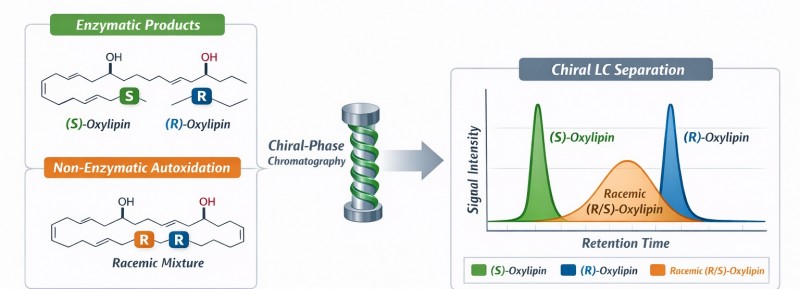
Since many oxylipins exist as enantiomers with vastly different biological activities, our platform utilizes chiral-phase chromatography to distinguish between enzymatic products and non-enzymatic autoxidation markers.
- Advanced Bioinformatics Suite
Every project is supported by multidimensional scaling and pathway enrichment analysis to correlate metabolite flux with phenotypic changes in Obesity Models.
Service Scope
Our analysis covers a broad spectrum of metabolic indicators essential for obesity research:
- Oxylipin Profiling
Comprehensive coverage of arachidonic acid (AA), eicosapentaenoic acid (EPA), and docosahexaenoic acid (DHA) derivatives.
- Redox Homeostasis Markers
Quantification of GSH/GSSG ratios, malondialdehyde (MDA), and 8-isoprostane as indicators of systemic oxidative stress.
- Energy Metabolism Intermediates
Analysis of TCA cycle intermediates and short-chain fatty acids (SCFAs) that intersect with lipid signaling.
- Adipokine Correlation
Optional integration of lipidomic data with protein-level adipokine secretion profiles.
Request a Detailed Quote and Technical Consultation Today
Workflow
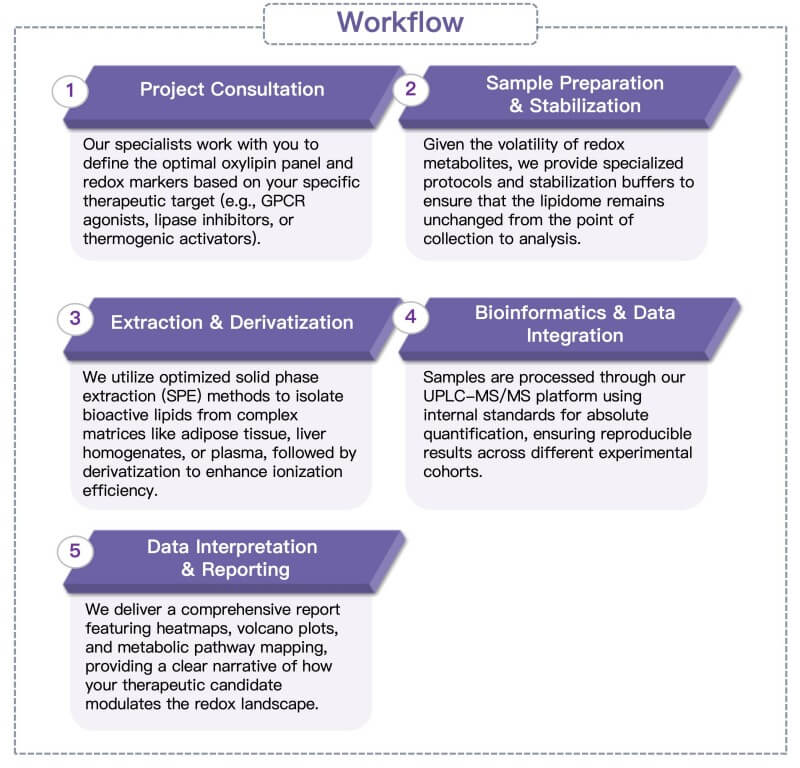
Protheragen maintains a rigorous five-stage workflow to ensure data integrity and biological relevance for your preclinical studies.
Fields of Application
Our redox and oxylipin profiling platform is engineered to drive discovery across diverse research domains, providing the high-resolution metabolic data necessary to validate therapeutic efficacy in multiple preclinical contexts.
- Drug Discovery: Screening Small Molecules for their ability to shift the lipid profile from pro-inflammatory to pro-resolving (e.g., increasing resolvins and protectins).
- Nutraceutical Development: Evaluating the impact of dietary lipids or antioxidants on adipose tissue inflammation.
- Biomarker Identification: Discovering early-stage redox signatures that predict the development of secondary metabolic complications like NAFLD/MASH.
- Mechanism of Action (MoA) Studies: Determining if an anti-obesity agent works through mitochondrial uncoupling or by suppressing lipotoxicity markers.
Advantages
Choosing Protheragen means partnering with a leader in metabolic flux analysis.
- Unrivaled Sensitivity
Our analytical platform is engineered to transcend the limitations of standard metabolomics by detecting low-abundance signaling lipids that often fall below the noise floor of conventional assays. In the context of obesity research, where a complex "oxylipin storm" can mask critical regulatory markers, our high-resolution mass spectrometry ensures that even the most elusive bioactive molecules are quantified with precision.
- Preclinical Specialization
Unlike clinical labs that must adapt to diverse human variables, Protheragen's entire infrastructure is purpose-built to handle the unique matrices of animal model tissues and cell culture supernatants. We have optimized our homogenization and extraction protocols for the specific challenges of preclinical samples—such as small tissue volumes from murine models or the high protein content of conditioned media—to ensure maximum recovery and minimal degradation.
- High Quality Data
Our methodologies are rigorously validated against industry benchmarks to ensure that every result is consistent, reproducible, and aligned with the standards of high-impact metabolic research.
- Actionable Insights
At Protheragen, we believe that raw data is only the beginning of the discovery process; the true value lies in biological translation. We go beyond delivering spreadsheets of concentrations by providing a comprehensive interpretation that maps your results directly onto metabolic maps, pinpointing exactly which enzymatic pathways—such as CYP450, LOX, or COX—are being modulated by your drug candidate.
Contact Our Team for More Information and to Discuss Your Project
Publication Data
Title: Multi-tissue profiling of oxylipins reveal a conserved up-regulation of epoxide:diol ratio that associates with white adipose tissue inflammation and liver steatosis in obesity
Journal: eBioMedicine, 2024
DOI: https://doi.org/10.1016/j.ebiom.2024.105127
Summary: This study explores the cross-tissue dynamics of polyunsaturated fatty acid (PUFA)-derived oxylipins in 88 obese patients (undergoing bariatric surgery) and 9 lean controls (undergoing upper gastrointestinal surgery), aiming to clarify the relationship between oxylipins and metabolic syndrome (including insulin resistance, type 2 diabetes mellitus [T2DM], and metabolic dysfunction-associated liver disease [MASLD]). Using UPLC-MS/MS, oxylipin levels were quantified in omental white adipose tissue (WAT), liver biopsies, and plasma, and integrated with WAT phenotypes (adipogenesis, hypertrophy, macrophage infiltration, fibrosis) and MASLD severity. Key adjustments for confounding factors (age, sex, ethnicity) and metformin effects were performed. Results reveal conserved dysregulation of the cytochrome P450-soluble epoxide hydrolase (CYP-sEH) pathway across tissues, with potential implications for clinical trials targeting sEH inhibition in metabolic syndrome.
Key Findings
- CYP-derived diols downregulation: Obesity is associated with a generalized reduction in CYP-derived diols (e.g., 5,6-DHET, 11,12-DHET, 12,13-DiHOME) in both WAT and plasma, regardless of their parent PUFA (AA, LA, DHA).
- Elevated epoxide:diol ratio: The epoxide:diol ratio (a surrogate for sEH activity) increases with WAT inflammation/fibrosis, hepatic steatosis, and T2DM. Notably, 12,13-EpOME:DiHOME is elevated in WAT and liver, serving as a marker of worsening metabolic syndrome in obese patients.
- Cross-tissue conservation: The increased epoxide:diol ratio observed in inflamed WAT is conserved in MASLD livers, with hepatic 14,15-EET:DHET positively correlating with T2DM and hepatic ballooning/steatosis.
- WAT phenotype associations: Fatty acid diols (e.g., 5,6-DHET, 11,12-DHET) decrease with adipocyte hypertrophy, while 12,13-EpOME:DiHOME correlates with WAT macrophage infiltration (CD68, TREM2 expression) and inflammation.
- Metformin independence: The key oxylipin signatures (10,11-DiHDPA, 11,12-DHET, 12,13-EpOME:DiHOME) are not significantly altered by metformin treatment, confirming their association with obesity per se.
- CYP-sEH pathway dysfunction: The findings suggest overall reduced sEH activity in WAT and liver during metabolic syndrome, highlighting a previously unrecognized role of fatty acid diols in adipose tissue homeostasis and supporting fatty acid diol supplementation as a potential therapeutic approach.
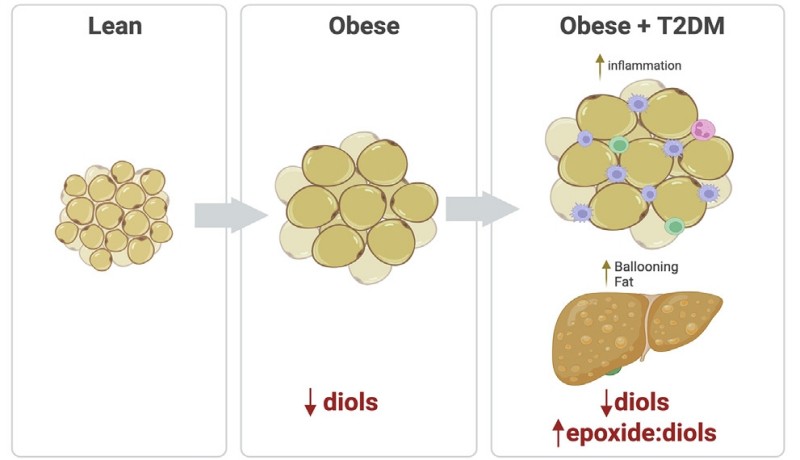 Fig.1 CYP-sEH pathway changes in obesity: diol levels drop as epoxide:diol ratios rise (linking adipose tissue damage to fatty liver. (Hateley, et al., 2024)
Customer Review
Unlocking Molecular Insight: Validating Adipose Tissue "Browning" Mechanisms
"Working with Protheragen was a turning point for our obesity program. Their ability to quantify the subtle shifts in the oxylipin profile allowed us to demonstrate that our lead compound was actively promoting the 'browning' of white adipose tissue via specific HETE pathways. The depth of their bioinformatics report saved us weeks of internal analysis."
Dr. C. T., Metabolic Disease Biotech
Precision Homeostasis: Resolving Inconsistent Data in Antioxidant Efficacy Trials
"The resolution provided by Protheragen is unmatched. We had previously struggled with inconsistent redox data in our mouse models, but their stabilization protocols and chiral separation clarified the mechanism of our therapeutic antioxidant. We are already planning our next three efficacy studies with their team."
Dr. D. P., Preclinical Research Org
Frequently Asked Questions
-
Why focus on oxylipins rather than total fatty acids in obesity research?
While total fatty acids show energy storage, oxylipins represent the active signaling molecules that dictate whether tissue remains healthy or becomes inflamed.
-
How do you prevent the degradation of unstable redox metabolites during shipping?
We provide detailed flash-freezing protocols and recommend the addition of BHT or other antioxidants during the initial harvest phase.
-
Can you analyze oxylipins from extremely small adipose tissue biopsies?
Yes, our micro-extraction techniques are optimized for samples as small as 10-20mg of tissue.
-
Do you distinguish between enzymatic and non-enzymatic lipid peroxidation?
Absolutely. Our chiral separation and specific marker panels (like isoprostanes vs. prostaglandins) allow us to differentiate these two processes.
-
Is it possible to correlate oxylipin data with gene expression?
Yes, we offer multi-omics integration services to see if changes in lipid mediators correlate with the upregulation of fatty acid desaturases or oxygenases.
-
What is the typical turnaround time for a standard anti-obesity study?
Generally, results are delivered within 3-4 weeks from the receipt of stabilized samples.
-
Do you provide absolute or relative quantification?
We prioritize absolute quantification using stable isotope-labeled internal standards for the most robust data.
-
Can your platform detect specialized pro-resolving mediators (SPMs)?
Yes, our targeted panel includes key SPMs like lipoxins, resolvins, and maresins, which are crucial in "cooling" adipose inflammation.
Contact Us
Protheragen delivers a high-precision analytical platform for redox metabolites and oxylipins, specifically tailored for the rigors of anti-obesity drug development. By combining ultra-sensitive mass spectrometry with deep biological expertise, we help you transform complex lipidomic data into actionable therapeutic insights.
Contact Protheragen for More Information and to Discuss Your Project.
Reference
- Hateley, C.; et al. Multi-tissue profiling of oxylipins reveal a conserved up-regulation of epoxide:diol ratio that associates with white adipose tissue inflammation and liver steatosis in obesity. eBioMedicine. 2024, 103, 105127. (CC BY 4.0)
All of our services and products are intended for preclinical research use only and cannot be used to diagnose, treat or manage patients.