
Steroid Quantification Service
InquiryThe endocrine system plays a pivotal role in the pathophysiology of obesity, with steroid hormones acting as primary modulators of adipogenesis, lipid metabolism, and energy homeostasis. As the global pharmaceutical industry pivots toward more sophisticated anti-obesity therapeutics—including GLP-1 agonists, melanocortin receptor ligands, and novel metabolic modulators—the demand for precise steroid profiling has never been higher.
Precision Steroid Quantification for Anti-Obesity Therapeutic Development
At Protheragen, we provide a specialized steroid quantification service designed to support preclinical drug discovery and development. By accurately measuring fluctuations in androgens, estrogens, progestogens, and corticosteroids, we help researchers decipher the complex hormonal shifts induced by weight-loss candidates, ensuring a deeper understanding of both efficacy and metabolic safety.
Core Technologies
In the realm of preclinical anti-obesity research, the ability to distinguish between structurally similar hormones is the difference between a successful drug profile and an overlooked metabolic risk. Protheragen employs a suite of sophisticated technologies designed to provide absolute quantitative certainty.
- Liquid Chromatography-Tandem Mass Spectrometry (LC-MS/MS)
We utilize LC-MS/MS as our foundational platform. Unlike traditional immunoassays (ELISA), which rely on antibodies that can "cross-react" with similar steroid structures, LC-MS/MS identifies molecules based on their unique mass-to-charge ratio (m/z). This ensures that the data you receive is free from interference, providing a true reflection of the hormonal environment.
- High-Resolution Chromatography (UPLC)
Steroids are often isobaric, meaning they share the same molecular weight but have different chemical structures (e.g., testosterone and epitestosterone). We utilize ultra-performance liquid chromatography (UPLC) with sub-2-micron particle columns. This allows for superior temporal separation, ensuring that each steroid reaches the detector at a distinct time, preventing overlap and ensuring precise quantification.
- Advanced Chemical Derivatization
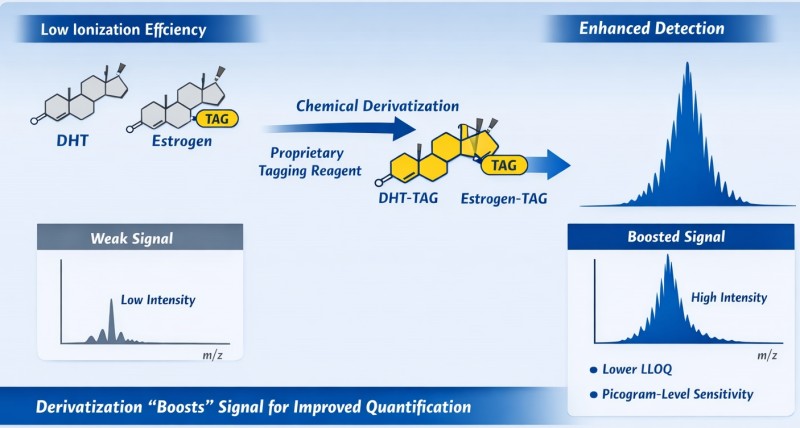
Certain steroids, such as dihydrotestosterone (DHT) or estrogens at post-menopausal levels, exhibit poor ionization efficiency in a mass spectrometer. To overcome this, Protheragen employs proprietary chemical derivatization techniques. By chemically tagging these molecules, we "boost" their signal, allowing us to reach lower limits of quantification (LLOQ) in the picogram-per-milliliter range.
- Isotope Dilution Strategy
To guarantee accuracy, we implement an isotope dilution approach. We spike every sample with stable, heavy-isotope-labeled internal standards (e.g., 13C or 2D labeled cortisol). Because these standards behave identically to the endogenous steroids during extraction but are seen as distinct by the mass spectrometer, they act as an internal "GPS" to correct for any sample loss or matrix effects.
- Multi-Matrix Extraction Protocols
Anti-obesity therapeutics often require looking beyond blood. We have engineered specialized sample preparation workflows for:
- Adipose Tissue: Targeted extraction from lipid-dense white and brown fat.
- Fecal Steroids: Critical for studying cholesterol excretion pathways.
- Microsamples: Validated methods for low-volume capillary blood are often used in longitudinal rodent studies.
Service Scope
Our quantification capabilities cover a broad spectrum of steroidal compounds essential for obesity research:
- Glucocorticoids
Cortisol, cortisones, and corticosterone to monitor stress response and metabolic syndrome.
- Sex Steroids
Testosterone, estradiol, estrone, and progesterone for investigating fat distribution and reproductive health impacts.
- Mineralocorticoids
Aldosterone and precursors to assess fluid balance and cardiovascular implications of obesity.
- Steroid Precursors
DHEA, DHEA-S, and androstenedione to map the entire biosynthetic pathway.
- Tissue-Specific Profiling
Specialized extraction from white and brown adipose tissue (WAT/BAT) and liver biopsies.
Consult with Our Specialists Today to Optimize Your Steroid Profiling Strategy.
Workflow
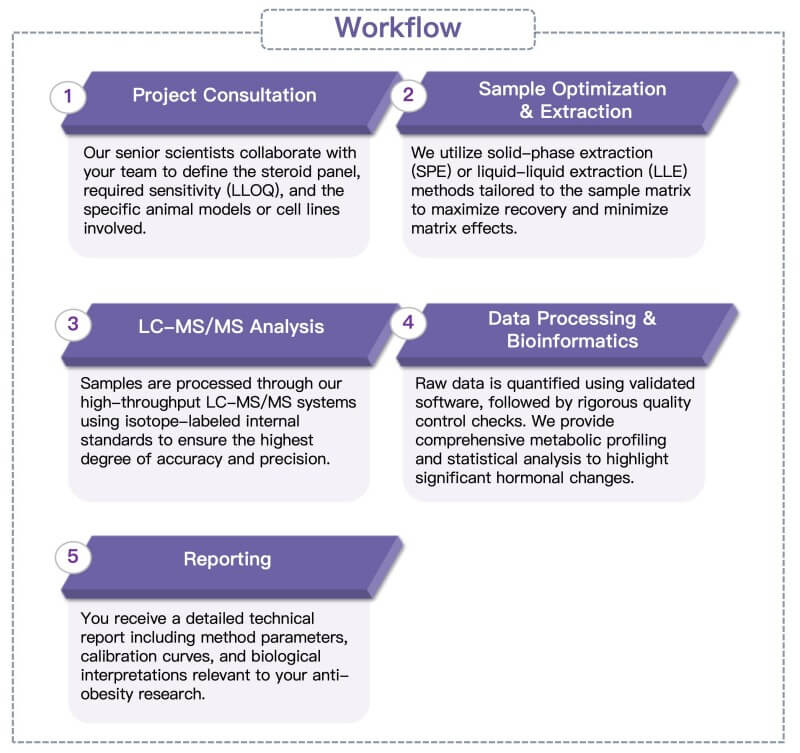
Our streamlined service process is designed to integrate seamlessly into your preclinical timeline:
Contact Our Specialist Team to Discuss Your Preclinical Workflow
Fields of Application
The application of high-precision steroidomics at Protheragen extends across the entire preclinical development spectrum, providing the granular endocrine insights required to validate therapeutic targets and ensure metabolic safety.
- Pharmacodynamics (PD) Studies: Assessing how anti-obesity drugs alter the hypothalamic-pituitary-adrenal (HPA) and hypothalamic-pituitary-gonadal (HPG) axes.
- Mechanism of Action (MoA): Investigating how compounds affect 11β-HSD1 activity or aromatase expression in adipose tissue.
- Safety Assessment: Monitoring for potential endocrine disruption or unintended androgenic/estrogenic effects during preclinical safety cycles.
- Biomarker Discovery: Identifying steroidal signatures that predict weight loss responsiveness in varying metabolic phenotypes.
Advantages
Protheragen stands at the forefront of metabolic endocrinology. Our steroid quantification service offers:
- Unmatched Sensitivity
We achieve lower limits of quantification (LLOQ) in the low pg/mL range. This is a critical differentiator for preclinical models where sample volumes are often limited (e.g., murine serum) and hormonal shifts are minute. Our platform ensures that even the most subtle physiological changes aren't lost in the "noise," allowing for the detection of trace-level steroids like estradiol or aldosterone with absolute confidence.
- High Specificity
By utilizing multi-stage mass filtering (MRM/SRM), we effectively eliminate "matrix effects" and cross-reactivity. Traditional assays often struggle with interference from therapeutic drug metabolites or structurally similar endogenous precursors (like DHEA vs. testosterone). Our protocols ensure that the signal you see belongs strictly to the target analyte, providing a clean "chemical fingerprint" for every sample.
- Validated Protocols
Reliability is our benchmark. Every method is developed following strict internal standards that mirror GLP-like environments, ensuring high inter-run and intra-run reproducibility. This rigor guarantees that data from a study cohort analyzed today will be directly comparable to one analyzed six months from now, providing the longitudinal stability required for multi-phase research.
- Validated Analytical Standards
Our methodologies align with industry-recognized standards for steroidomics, consistently yielding high-confidence data that supports high-impact publications.
- Expert Interpretation
Our team provides a deep-dive analysis of how steroid fluctuations correlate with broader metabolic indicators, such as adiposity markers (leptin, adiponectin) and insulin sensitivity indices (HOMA-IR). We help you connect the dots between endocrine signaling and systemic metabolic health.
Customer Review
Bridging the Gap Between Endocrine Safety and Therapeutic Efficacy
"Working with Protheragen has been transformative for our lead optimization phase. Their ability to quantify low-abundance steroids in mouse serum allowed us to prove that our GLP-1/GIP co-agonist was not adversely affecting the adrenal axis. The data was exceptionally clean, and their scientific team provided invaluable context that we used in our internal reporting. We look forward to scaling our next project with them."
Dr. V. P., Biopharmaceutical Client
Unrivaled Precision in Tissue-Specific Metabolic Profiling
"The precision of the LC-MS/MS steroid panel provided by Protheragen was impressive. We were specifically looking at the conversion of cortisone to cortisol in adipose tissue, and their tissue-specific extraction protocol delivered the most consistent results we've seen to date. Their technical support team is always available to walk through the data, making the entire process seamless."
Dr. C. P., Metabolic Research Institute
Frequently Asked Questions
-
Why choose LC-MS/MS over ELISA for my obesity study?
LC-MS/MS offers superior specificity by distinguishing between closely related steroid structures, which ELISA often misidentifies due to antibody cross-reactivity.
-
What sample volume is required?
We have optimized micro-sampling techniques, often requiring as little as 50–100 µL of serum or plasma for a comprehensive panel.
-
Can you analyze steroids in adipose tissue?
Yes, we have specialized homogenization and extraction protocols for lipid-rich tissues to ensure complete steroid recovery.
-
How do you handle matrix effects?
We use matrix-matched calibration and stable isotope-labeled internal standards for every analyte to correct for any suppression or enhancement.
-
Is your service suitable for high-throughput screening?
Absolutely. Our automated sample preparation allows for the rapid processing of large preclinical batches.
-
Can you customize a steroid panel for a specific drug target?
Yes, we can build custom MRM transitions for specific precursors or metabolites relevant to your therapeutic's mechanism.
-
What is the typical turnaround time?
Standard projects are usually completed within 2–4 weeks, depending on the complexity and sample volume.
-
Do you provide statistical analysis?
Yes, we offer optional multivariate analysis, including PCA and OPLS-DA, to help identify significant metabolic trends.
Contact Us
Protheragen provides the high-resolution data necessary to navigate the complexities of steroid metabolism in anti-obesity drug development. Our expertise ensures that your preclinical decisions are backed by rigorous, accurate, and reproducible scientific evidence.
Contact Protheragen for More Information and to Discuss Your Project.
All of our services and products are intended for preclinical research use only and cannot be used to diagnose, treat or manage patients.