
Obesity-Related Mitochondrial Damage & Pathological Mechanism Study Service
InquiryObesity remains a complex, multifactorial metabolic disorder characterized by excessive lipid accumulation in adipose tissues and peripheral organs. At the subcellular level, mitochondrial dysfunction plays a central role in driving the metabolic derangements associated with high-fat diets, nutrient excess, and chronic energy imbalances. Nutrient overload leads to structural fragmentation, elevated reactive oxygen species (ROS) production, impaired oxidative phosphorylation, and altered calcium handling within mitochondria.
Preclinical Assessment Services for Obesity-Induced Mitochondrial Damage & Pathological Dynamics
Understanding these subcellular alterations in preclinical models is essential for identifying potential therapeutic interventions. Dysfunctional mitochondria not only reduce cellular ATP generation but also release pro-inflammatory signaling molecules and mitochondrial DNA (mtDNA) fragments into the cytosol, triggering chronic low-grade inflammation and cellular stress responses. Protheragen provides comprehensive preclinical assessment services to evaluate mitochondrial integrity, dynamics, and metabolic stress pathways in obesity research models.
Core Technologies
Protheragen utilizes advanced analytical platforms to assess mitochondrial morphology, function, and signaling pathways in preclinical obesity models:
Quantifies mitochondrial oxygen consumption rates (OCR) and respiratory control ratios (RCR) in real-time, providing functional assessments of mitochondrial electron transport chain (ETC) complexes.
Facilitates direct visual analysis of mitochondrial ultrastructure, cristae density, and morphological dynamics (fission/fusion states) under lipid-overload conditions.
Enables selective detection of mitochondrial membrane potential changes (ΔΨm), localized ROS accumulation, mitochondrial permeability transition pore (mPTP) opening, and mitophagic activity
Measures absolute and relative mtDNA copy numbers alongside nuclear DNA standards to evaluate mitochondrial biogenesis and genetic integrity.
Assesses organelle-specific calcium ion flux across mitochondrial-associated membranes (MAMs) and inner mitochondrial membranes.
Service Scope
Protheragen offers specialized preclinical evaluation pipelines designed to dissect the cellular and molecular mechanisms of mitochondrial damage in obesity research.
Persistent overnutrition alters intracellular signaling cascades, often impairing PGC-1α-driven transcriptional pathways that regulate mitochondrial biogenesis. Our service evaluates both nuclear and mitochondrial genetic markers to quantify biogenesis dynamics. We assess relative and absolute mtDNA copy numbers using dPCR and qPCR assays calibrated against tissue-specific baseline controls. In addition, expression profiles of downstream target genes (such as NRF1 and TFAM) are profiled alongside functional assays to measure total functional organelle volume.
Chronic nutrient excess impairs mitophagic clearance pathways, leading to the accumulation of compromised mitochondria that exacerbate intracellular oxidative stress. Protheragen offers tracking of mitophagy markers, including PINK1, Parkin, and LC3-II recruitment to damaged outer mitochondrial membranes. Using reporter constructs and western blotting panels, we measure autophagosome-lysosome fusion events and quantify mitochondrial degradation rates under lipid-induced stress conditions.
Subcellular stress, high Ca2+ loading, and excessive ROS generation facilitate the opening of the mPTP, leading to membrane depolarization, swelling, and the release of pro-apoptotic factors. Our mPTP analysis evaluates pore-opening kinetics using Calcein-AM/CoCl2 quenching assays and isolated mitochondrial swelling assays. Changes in ΔΨm are simultaneously tracked using lipophilic cationic dyes (such as JC-1 or TMRE) to map threshold sensitivities in lipid-treated cell lines and primary tissues.
Mitochondria-associated endoplasmic reticulum membranes (MAMs) coordinate spatial calcium transfer between the ER and mitochondrial matrix. In obese states, altered MAM integrity disrupts calcium homeostasis, causing calcium overload that impairs organelle function. Our assays utilize organelle-targeted fluorescent probes (such as Rhod-2 and Pericam) combined with live-cell imaging platforms to monitor mitochondrial calcium influx, efflux, and matrix buffering capabilities during metabolic stress.
Lipid accumulation drives electron leakage along respiratory chain complexes, significantly elevating matrix and cytosolic reactive oxygen species production. Protheragen utilizes targeted fluorescent indicators (MitoSOX, H2DCFDA) alongside biochemical assays for lipid peroxidation products (such as MDA and 4-HNE) to evaluate organelle-specific oxidative burden. Antioxidant enzyme activities (SOD2, catalase, glutathione peroxidase) are measured in parallel to evaluate intrinsic enzymatic defenses under nutrient-dense conditions.
Contact our scientific team today to design your custom preclinical study!
Workflow
Our streamlined preclinical workflow provides end-to-end support, moving your samples efficiently from experimental design to validated bioenergetic reporting.
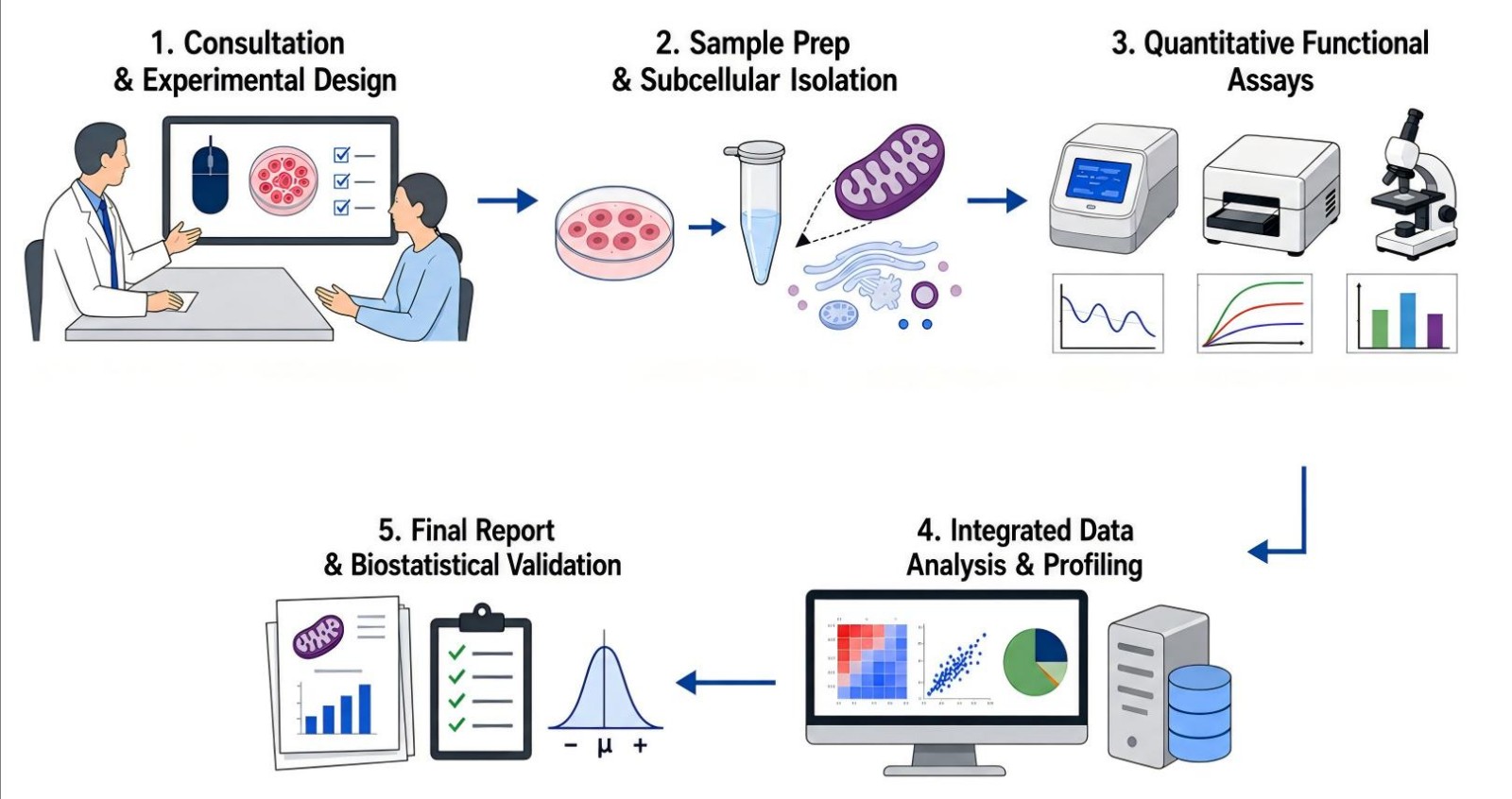
- Step 1: Alignment on preclinical models, compound treatment protocols, assay metrics, controls, and study timelines.
- Step 2: Processing of cellular or animal tissue samples with specialized mitochondrial isolation and quality control.
- Step 3: Execution of target bioenergetic, respirometric, fluorometric, and genetic assays using standardized analytical instrumentation.
- Step 4: Integrated processing of bioenergetic raw data, statistical analysis, and normalization against cell or organelle standards.
- Step 5: Final reporting featuring methodology details, high-resolution figures, quality control records, and statistical analysis.
Fields of Application
Our specialized mitochondrial testing platform supports a wide range of preclinical research programs aimed at unraveling bioenergetics-driven disease mechanisms and validating targeted therapeutic interventions.
- Preclinical Metabolic Drug Discovery
Screen novel lead compounds targeted at improving bioenergetics, mitochondrial biogenesis, or reducing oxidative stress.
- Adipose Tissue Remodeling Research
Analyze metabolic alterations in brown, beige, and white adipose tissues during diet-induced obesity progression.
- Skeletal Muscle Bioenergetics
Assess oxidative capacity, mitochondrial density, and respiration dynamics in insulin-resistant skeletal muscle models.
- Non-Alcoholic Fatty Liver Research
Investigate the role of mPTP opening, calcium overload, and organelle injury in hepatic steatosis models.
- Endothelial & Cardiovascular Pathophysiology
Evaluate vascular endothelial mitochondrial damage secondary to hyperlipidemia and systemic inflammation.
Advantages
Partnering with Protheragen provides your research team with validated analytical rigor, high-throughput capabilities, and specialized bioenergetic insights designed to accelerate preclinical metabolic drug discovery.
Comprehensive Organelle-Specific Profiling
Our specialized platform integrates bioenergetic respirometry, structural imaging, and genetic assays into streamlined preclinical study workflows.
Validated Protocol Standards
Protocols are standardized against verified control models to ensure reproducible data for preclinical drug screening programs.
High-Throughput Assays
Microplate-based fluorometric and respirometric assays allow efficient evaluation of candidate therapeutic molecules in cell and tissue samples.
In-Depth Bioenergetic Interpretation
Analytical reports deliver contextualized data interpretation linking cellular bioenergetics to broader metabolic disease mechanisms.
Contact Protheragen today to discuss your project requirements
Customer Review
Evaluating Drug Mechanisms in High-Fat Diet Models
"Working with Protheragen simplified our preclinical bioenergetic evaluation. Their team provided clear respirometry datasets and TEM images that helped confirm our candidate molecule's mechanism of action in high-fat diet models. The technical guidance throughout the project was excellent."
Dr. S. D., Senior Director of Pharmacology
Uncovering Organelle Dynamics in Hepatic Steatosis Studies
"Protheragen delivered reproducible flow cytometry and fluorometric mPTP data from our palmitate-treated cell models. The technical discussions with their scientific team helped refine our experimental controls, saving us time during compound optimization. We look forward to working together on our next metabolic screening campaign."
Dr. A. T., Principal Scientist
Frequently Asked Questions
-
What preclinical sample types are compatible with your mitochondrial damage assay services?
We accept a broad range of biological materials, including primary cell cultures, immortalized cell lines, fresh frozen tissue biopsies, and freshly isolated tissue samples (e.g., liver, adipose, skeletal muscle, heart).
-
Can Protheragen handle both isolated mitochondria and intact cell preparations?
Yes. Respirometry, ROS, and calcium flux assays can be performed on either intact functional cells or enriched mitochondrial fractions depending on your research objectives.
-
How do you normalize bioenergetic and respirometric assay data?
Data can be normalized against total cellular protein content, specific organelle marker proteins (such as VDAC or citrate synthase), or total genomic DNA/cell counts depending on the sample type.
-
What distinguishes mPTP analysis from general membrane potential (ΔΨm) assays?
Membrane potential dyes track changes in electrical gradient across the inner membrane. mPTP opening assays specifically measure channel transition events through fluorescence quenching or swelling assays.
-
Are these services applicable to non-obesity metabolic disease models?
Yes. While optimized for obesity and high-fat diet models, these analytical pipelines apply to general metabolic, neurodegenerative, and cardiovascular conditions involving mitochondrial dysfunction.
-
What is the typical sample quantity required for isolated mitochondrial respirometry?
Sample requirements vary by tissue type, but generally require 50–100 mg of fresh tissue or approximately 106 to 107 intact cultured cells. Detailed guidelines are provided during study design.
-
How are tissue samples shipped for mitochondrial function assays?
For functional respirometry requiring intact organelles, fresh tissue must be processed immediately or transported in specialized tissue preservation media on ice. Fixed or frozen tissue can be used for molecular assays like qPCR (mtDNA copy number).
-
Can custom target markers be added to the mitophagy western blotting panels?
Yes. We can customize protein panels to include specific targets of interest alongside baseline markers like PINK1, Parkin, and LC3.
-
How do your assays differentiate mitochondrial ROS from cytosolic ROS?
We utilize organelle-targeted fluorescent probes (such as MitoSOX) that selectively accumulate within the mitochondrial matrix, avoiding interference from cytosolic ROS sources.
Contact Us
Protheragen offers specialized preclinical analytical platforms designed to evaluate subcellular damage, bioenergetic impairments, and structural changes in obesity models. From respirometry to genetic copy number assays, our services provide reliable endpoints for drug discovery and academic research. Contact Protheragen now for more information and a personalized consultation.
All of our services and products are intended for preclinical research use only and cannot be used to diagnose, treat or manage patients.