
Obesity-Related Mitochondrial Permeability Transition Pore (mPTP) Analysis Service
InquiryMetabolic dysregulation in obesity triggers profound shifts in cellular bioenergetics. Chronic nutrient excess leads to mitochondrial calcium overload, elevated reactive oxygen species (ROS) production, and lipid accumulation. These stress factors directly trigger the abnormal opening of the mitochondrial permeability transition pore (mPTP). The mPTP is a high-conductance, non-selective channel located in the inner mitochondrial membrane. Its sustained opening dissipates the mitochondrial membrane potential (ΔΨm), halts ATP synthesis, causes matrix swelling, and triggers cell death cascades in tissues like the liver, skeletal muscle, and adipose tissue.
Preclinical mPTP Analysis Services for Obesity & Metabolic Disease Research
Understanding mPTP kinetics under high-fat diet conditions or in genetic models of obesity provides critical mechanistic insights for metabolic disease drug discovery. Protheragen delivers preclinical obesity-related mPTP analysis services. We offer precise, reproducible assay systems designed to evaluate mPTP sensitivity, calcium retention capacity (CRC), and pore opening kinetics across cellular and tissue-derived samples. Our preclinical platform helps researchers profile therapeutic compounds targeting mitochondrial health, helping advance lead molecules through discovery pipelines.
Core Technologies
Protheragen utilizes advanced biophysical and fluorometric methods to capture mPTP opening dynamics accurately.
A fluorometric approach for live cells and primary isolated tissues. Calcein-AM freely enters cells and accumulates within cellular compartments, fluorescing intensely upon cleavage by intracellular esterases. CoCl2 quenches cytosolic calcein signal while leaving intact mitochondrial fluorescence unquenched. When mPTP opens, CoCl2 enters the matrix, extinguishing mitochondrial fluorescence.
Assesses the threshold of matrix calcium required to trigger mPTP opening. Using low-affinity fluorescent calcium indicators like Calcium Green-5N or Isolectin dyes, we monitor sequential pulsed additions of Ca2+ to isolated mitochondria, measuring the point of abrupt calcium release.
Tracks changes in light scattering (A540) in isolated mitochondrial preparations under calcium overload, providing real-time measurements of structural matrix swelling.
Enables single-cell profiling of mPTP opening in mixed cell populations (e.g., primary hepatocytes or adipocytes derived from obese models), measuring fluorescent intensity changes concurrently with mitochondrial membrane potential dyes.
Service Scope
Our platform evaluates mPTP function in obesity models across various preclinical test systems.
- Isolated Mitochondria Functional Profiling
High-resolution testing using mitochondria isolated from diet-induced obese (DIO) or ob/ob / db/db mouse models.
- In Vitro Metabolic Stress Models
In vitro evaluation of human and rodent cell lines exposed to saturated fatty acids (e.g., palmitate), high glucose, or pro-inflammatory cytokines to simulate obesity microenvironments.
- Tissue-Specific mPTP Sensitivity Screening
Comparative analysis across metabolically relevant tissues, including liver, skeletal muscle, heart, and white/brown adipose tissue.
Dose-response testing of mPTP inhibitors, cyclophilin D (CypD) modulators, or anti-apoptotic agents.
- Multi-Parametric Mitochondrial Health Profiling
Concurrent testing of mPTP opening alongside respiration rates (OXPHOS), ROS accumulation, and ATP yield.
Partner with Protheragen to unlock precise mPTP functional insights
Workflow
Our assay workflow ensures reliable data generation from tissue extraction to final analysis.
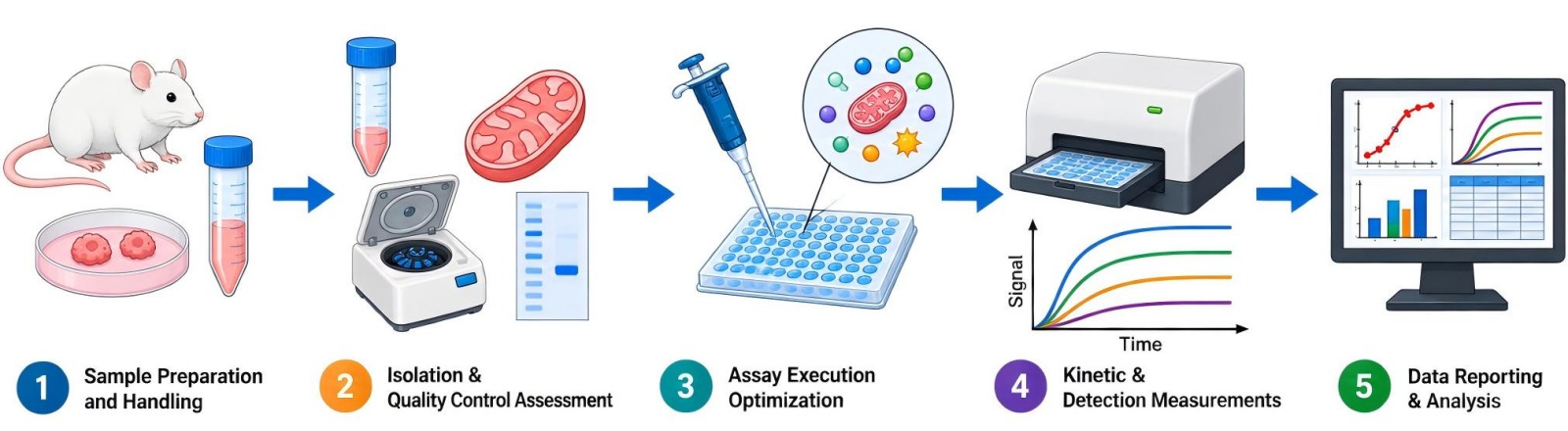
- Step 1: Tissues or cell cultures from preclinical study models are harvested, processed, and preserved using tailored buffers.
- Step 2: Mitochondria are isolated using differential centrifugation, followed by protein quantification and integrity verification.
- Step 3: Samples are loaded into micro-volume reaction systems with optimized fluorescent dyes and specialized assay buffers.
- Step 4: High-throughput readers or flow cytometers record real-time calcium retention, swelling rates, or fluorescence quenching profiles.
- Step 5: Signal curves are processed to yield threshold parameters like Vmax, EC50, and total calcium retention capacity.
Fields of Application
Evaluating mPTP opening kinetics provides critical insights across diverse Preclinical Models of metabolic disease and lipotoxic tissue injury.
- NASH and Metabolic Liver Disease
Evaluating hepatic mPTP sensitivity in steatotic livers, where calcium dysregulation exacerbates hepatocyte injury and apoptosis.
- Diabetic Cardiomyopathy
Assessing how lipotoxicity alters cardiac mPTP opening, contributing to impaired contractile function and cell death.
- Obesity-Induced Muscle Wasting
Analyzing mitochondrial pore susceptibility in skeletal muscle exposed to lipotoxic conditions.
- Metabolic Drug Discovery
Validating therapeutic candidates targeting cyclophilin D (CypD), ANT, or VDAC interactions to prevent mitochondrial collapse.
Advantages
Protheragen combines decades of specialized biophysical expertise with highly optimized, micro-volume assay systems to deliver the precise mPTP functional data your preclinical pipelines demand.
High Sensitivity via Direct Pore Detection
Rather than relying solely on indirect organelle swelling, our dual-dye calcein-AM/CoCl2 assays directly track pore open-state probability. It is confirmed that detection thresholds down to 5% pore opening yield consistent signal resolution even in low-volume tissue samples.
Low Sample Volume Optimization
Micro-scale testing protocols require minimal mitochondrial sample input per reaction. It has been shown that robust kinetic data can be captured from as little as 10–20 µL of isolated mitochondrial suspension. This saves tissue for complementary Biomarker Studies.
Context-Specific Buffer Formulations
Assays utilize specialized intracellular-mimicking buffers (containing balanced KCl, HEPES, and physiological ion concentrations) that prevent premature pore opening during preparation. It has been shown that these conditions reduce false-positive pore activation by up to 50% compared to standard isotonic buffers.
Extensive Preclinical Experience
Protheragen brings over two decades of expert biophysical characterization experience. We deliver reproducible screening data tailored to preclinical drug discovery pipelines.
Inquire Today to Discuss Your Project Setup
Customer Review
Accelerating Metabolic Compound Validation Through Precise CRC Profiling
"Working with Protheragen provided key insights into our lead metabolic drug compound. Their team adjusted the assay conditions for our liver tissue samples, generating clear CRC data that demonstrated compound-mediated protection against mPTP opening. We plan to expand our partnership with Protheragen to evaluate skeletal muscle tissue in our upcoming preclinical studies."
Dr. E. R., Senior Director of Pharmacology
Streamlining Lipotoxic Cell Models with Reliable Single-Cell Flow Cytometry
"Protheragen delivered reproducible flow cytometry and fluorometric mPTP data from our palmitate-treated cell models. The technical discussions with their scientific team helped refine our experimental controls, saving us time during compound optimization. We look forward to working together on our next metabolic screening campaign."
Dr. A. T., Lead Investigator
Frequently Asked Questions
-
Why measure mPTP opening specifically in the context of obesity research?
Obesity leads to intracellular lipid accumulation and elevated ROS levels, which cause mitochondrial calcium overload. This sensitizes the mPTP to open at lower calcium thresholds, causing metabolic failure. Profiling mPTP kinetics helps identify targets that protect mitochondrial integrity.
-
How does Protheragen differentiate mPTP opening from general membrane damage?
We use dual-dye fluorometric techniques (like calcein-AM/CoCl2) alongside calcium retention assays. These methods measure selective permeability changes and calcium release kinetics, distinguishing specific pore opening from non-specific outer membrane rupture.
-
What tissue types are best suited for mPTP analysis in preclinical obesity models?
Liver and skeletal muscle are common due to their central roles in metabolic homeostasis. Cardiac muscle and adipose tissue are also frequently analyzed. Protheragen supports tissue preparations across all these rodent and non-human sample sources.
-
Can you perform mPTP assays on frozen tissue samples?
mPTP functional assays (such as CRC and swelling assays) require intact, functionally active mitochondria. Freezing can disrupt membrane integrity, so we recommend using freshly isolated tissue or carefully cryopreserved cellular samples following validated isolation protocols.
-
How much sample volume or tissue mass is needed for an assay run?
Thanks to micro-volume detection techniques, we can perform assays with small sample inputs. Typically, 5 to 10 milligrams of fresh tissue per assay run is sufficient.
-
What controls are used to confirm mPTP-specific inhibition?
We routinely run controls using known mPTP inhibitors, such as cyclosporin A (CsA), which targets cyclophilin D. Calcium ionophores like Ionomycin are used as positive controls to induce total pore opening.
-
Is your assay platform suitable for high-throughput screening of compound libraries?
Yes, our microplate formats (96-well and 384-well setups) enable screening of small-molecule libraries against isolated mitochondria or cell lines under high-fat stress conditions.
-
How do you address high fluorescent background signals in lipotoxic cell samples?
Lipotoxic cells often accumulate lipid droplets that scatter light or trap lipophilic dyes. Protheragen uses optimized washing steps and specialized fluorophore combinations to maintain low background and clear signal-to-noise ratios.
Contact Us
Protheragen delivers high-quality biophysical assay services to advance metabolic disease research. Our scientific team works closely with you to design testing workflows tailored to your study goals. Please feel free to Contact Protheragen for more information.
All of our services and products are intended for preclinical research use only and cannot be used to diagnose, treat or manage patients.