
Gene Microarray Service
InquiryObesity is a complex, polygenic metabolic disorder characterized by chronic inflammation and significant shifts in systemic gene expression. At Protheragen, we recognize that understanding the transcriptomic architecture of adipose tissue, liver, and hypothalamic regions is critical for breakthrough discoveries in metabolic health.
Gene Microarray Service for Obesity Research
Our gene microarray service for obesity research provides a high-throughput, precision-driven platform designed specifically for preclinical investigators. By quantifying thousands of transcripts simultaneously, we enable researchers to map the molecular pathways involved in adipogenesis, lipid metabolism, and insulin resistance. Our service focuses exclusively on preclinical models, ensuring that your fundamental research is supported by robust data and expert biological interpretation.
Core Technologies
At Protheragen, our gene microarray service for obesity research is built upon a foundation of precision-engineered technologies designed to capture the dynamic transcriptomic changes associated with metabolic dysfunction. We utilize a multi-layered technological approach to ensure that every preclinical study yields high-fidelity, reproducible results.
- High-Density Oligonucleotide Arrays
We employ advanced photolithography-based oligonucleotide synthesis to create high-density arrays. This technology allows for the immobilization of millions of unique, 25-mer probes per chip, providing comprehensive coverage of the whole transcriptome. In obesity research, this high resolution is critical for detecting subtle expression changes in low-abundance transcripts, such as hypothalamic neuropeptides or rare adipokines.
- Whole-Transcriptome (WT) Amplification & Labeling
Unlike traditional 3'-biased methods, our WT labeling protocol utilizes random hexamers to prime the entire length of the RNA transcript. This ensures that even degraded samples or those with complex splicing patterns—common in lipid-rich adipose tissues—provide an accurate representation of the gene expression profile. This is particularly advantageous when studying alternative splicing in genes like PPARγ or FTO.
- Dual-Color Fluorescence Detection
For comparative metabolic studies, we offer dual-color hybridization systems. By labeling control and experimental preclinical samples with distinct fluorophores (e.g., Cy3 and Cy5), we can co-hybridize them to a single array. This eliminates inter-array variability and provides an extremely precise measure of fold-change in response to high-fat diets or therapeutic interventions.
- Signal Noise Reduction Algorithms
Metabolic tissues often contain high levels of endogenous pigments and lipids that can interfere with fluorescence scanning. Protheragen utilizes proprietary signal-processing algorithms that perform spatial background correction and local noise subtraction. This ensures that the data used for your analysis is clean and reflective of the true biological signal.
- Integrated Pathway Mapping
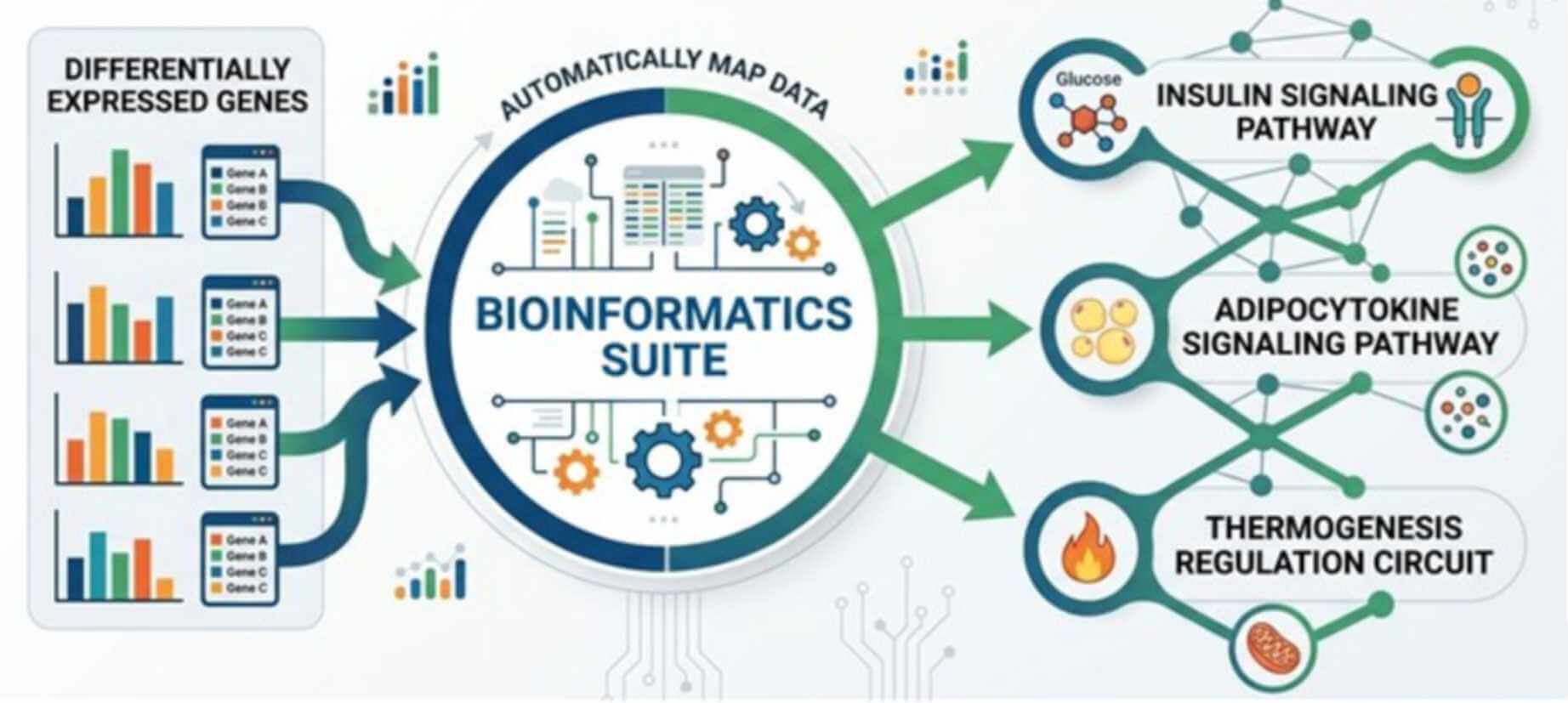
Our core technology extends into the digital realm with our bioinformatics suite. This platform automatically maps differentially expressed genes onto specialized metabolic maps, including the insulin signaling pathway, the adipocytokine signaling pathway, and the thermogenesis regulation circuit.
Service Scope
Protheragen provides specialized microarray solutions across a wide range of preclinical models essential for metabolic research:
Ideal for DIO (diet-induced obesity) and transgenic models (e.g., ob/ob, db/db).
Optimized for Zucker fatty rats and Sprague-Dawley metabolic studies.
Supporting high-throughput screening for lipid accumulation and developmental metabolic programming.
Facilitating the study of fundamental nutrient sensing and insulin-like signaling.
Focused on atherosclerosis and lipid transport models.
Enabling rapid genetic screening for longevity and fat storage pathways.
Workflow
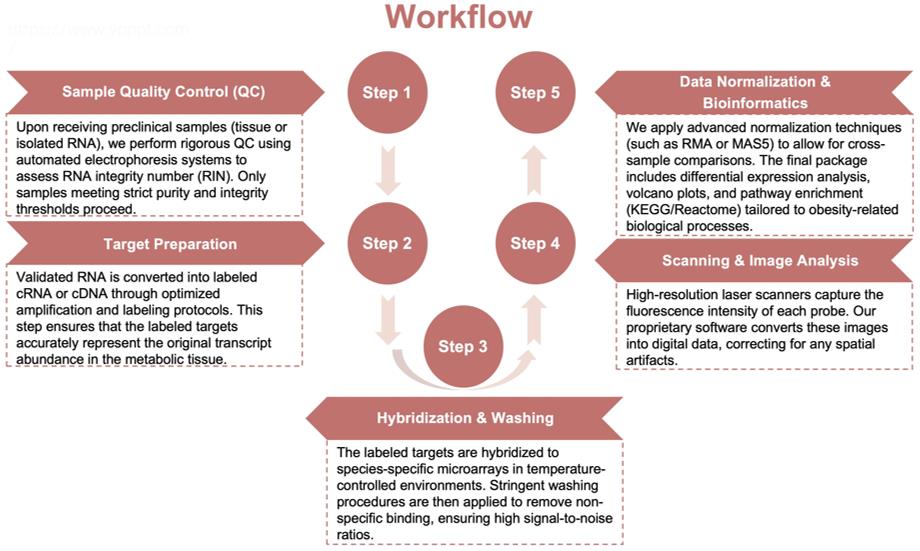
Our streamlined workflow is designed to ensure the highest data integrity from sample submission to final reporting:
Fields of Application
Our gene microarray service is pivotal for various research avenues:
- Adipogenesis Studies: Identification of novel markers for white, brown, and beige adipocyte differentiation.
- Endocrine Signaling: Analysis of the cross-talk between adipose tissue and the brain-gut axis.
- Inflammation and Macrophage Polarization: Mapping the transition from M2 to M1 macrophages in obese adipose tissue.
- Drug Target Discovery: Identifying differentially expressed genes in response to novel anti-obesity compounds in lead optimization.
- Nutrigenomics: Evaluating how dietary interventions influence gene expression patterns in metabolic organs.
Advantages
Choosing Protheragen means partnering with a team that understands the nuances of metabolic transcriptomics.
Unparalleled Sensitivity
Our platforms are engineered to detect even the most subtle regulatory shifts in key metabolic transcription factors, such as PPARγ and SREBP-1c. By leveraging high-precision signal-to-noise ratios, we ensure that low-abundance transcripts—often the "master switches" of metabolic pathways—are captured with high reproducibility across biological replicates.
Specialized Content
We provide more than just a snapshot of the protein-coding genome. Our specialized arrays offer comprehensive coverage of the entire transcriptome, with a strategic focus on non-coding RNAs (lncRNAs and miRNAs). These regulatory elements are critical drivers of adipocyte differentiation and lipid metabolism, allowing you to uncover deeper layers of epigenetic control.
Rapid Turnaround
In the fast-paced world of drug discovery and preclinical research, time is your most valuable asset. Our optimized preclinical pipeline streamlines the workflow from sample prep to data delivery. We guarantee that you will receive your raw data and a sophisticated, "publication-ready" bioinformatics report within weeks, ensuring your project momentum never stalls.
Methodological Fidelity & Validation
Our analytical platform is engineered to meet the rigorous standards of high-impact scientific publishing. By maintaining an exceptional correlation with RT-qPCR and proteomic benchmarks, we provide the multi-omic confidence necessary to ensure your findings are both robust and ready for advanced academic presentation.
Contact Our Team for More Information and to Discuss Your Project.
Customer Review
Unlocking New Insights into Hypothalamic Inflammation and Leptin Resistance
"Working with Protheragen significantly accelerated our study on hypothalamic inflammation. The precision of their mouse gene microarrays allowed us to identify a subset of genes involved in leptin resistance that we had previously overlooked. Their technical support team was instrumental in helping us navigate the pathway analysis, making the entire process seamless."
Dr. S. I., Metabolic Diseases Research Institute
Consistent Data Excellence for Large-Scale Preclinical Metabolic Cohorts
"We transitioned our rat model studies to Protheragen because of their specialized focus on preclinical models. The data consistency we’ve seen across multiple cohorts is exceptional. Their ability to handle lipid-rich tissues for RNA extraction was a game-changer for our lab. We plan to utilize their zebrafish services for our next high-throughput screening project."
Dr. L. S., Preclinical Drug Development Firm
Frequently Asked Questions
-
What types of samples can I submit for the obesity microarray service?
We accept stabilized tissue biopsies (e.g., WAT, BAT, liver) or total RNA isolated from our supported preclinical species.
-
How do you ensure the accuracy of low-abundance transcripts?
We use high-sensitivity labeling kits and advanced background-subtraction algorithms specifically calibrated for the low-signal levels typical of certain metabolic regulators.
-
Can this service distinguish between white and brown adipose tissue expression?
Yes, our bioinformatics pipeline includes specific markers to validate tissue-specific expression profiles.
-
Is your service compliant with preclinical regulatory standards?
Absolutely. While we do not provide clinical services, our preclinical workflow follows rigorous internal quality standards to ensure data reproducibility.
-
What is the minimum amount of RNA required?
Typically, 100-200ng of high-quality total RNA is sufficient, though we have protocols for lower input if required.
-
Do you provide raw data or just the analysis?
We provide the full suite: raw CEL/DAT files, normalized data, and a comprehensive bioinformatics report.
-
How does microarray compare to RNA-Seq for obesity research?
Microarrays offer a highly standardized, cost-effective, and faster alternative for focused transcriptomic profiling of known genes and pathways.
-
Can you help with the biological interpretation of the data?
Yes, our reports include pathway enrichment analysis focusing on metabolism, inflammation, and endocrine signaling.
-
What species-specific arrays are most commonly used for obesity?
Mouse and rat arrays are our most frequent requests, particularly for high-fat diet studies.
Contact Us
Protheragen is dedicated to providing the high-resolution transcriptomic data required to solve the complexities of obesity. Our expert team combines biological expertise with technical precision to deliver insights that drive metabolic research forward.
Contact Protheragen for More Information and to Discuss Your Project
All of our services and products are intended for preclinical research use only and cannot be used to diagnose, treat or manage patients.