
Target Structure Prediction Service
InquiryThe global escalation of metabolic disorders has shifted the focus of drug discovery toward novel, non-traditional obesity targets. While GLP-1 receptor agonists have validated the metabolic market, the next generation of therapeutics seeks to address weight loss maintenance, thermogenesis, and adipocyte modulation through diverse mechanisms. Protheragen provides a specialized target structure prediction service specifically tailored for new obesity target screening.
Target Structure Prediction Service in New Obesity Target Screening
In the preclinical stage, the primary hurdle is often the lack of high-resolution experimental structures for emerging protein targets, such as G-protein coupled receptors (GPCRs), memory-linked hypothalamic neurons, and mitochondrial uncoupling proteins. Our service bridges this gap by utilizing advanced computational modeling to provide high-fidelity structural insights. By predicting the 3D architecture of these "undruggable" or novel targets, we enable researchers to conduct precise virtual screening and lead optimization long before entering the wet-lab validation phase.
Core Technologies
Protheragen integrates a proprietary suite of computational tools designed to handle the complexities of metabolic proteins. Our core technological framework includes:
We utilize advanced neural network architectures to predict protein folding with atomic-level accuracy, specifically optimized for multi-domain metabolic enzymes.
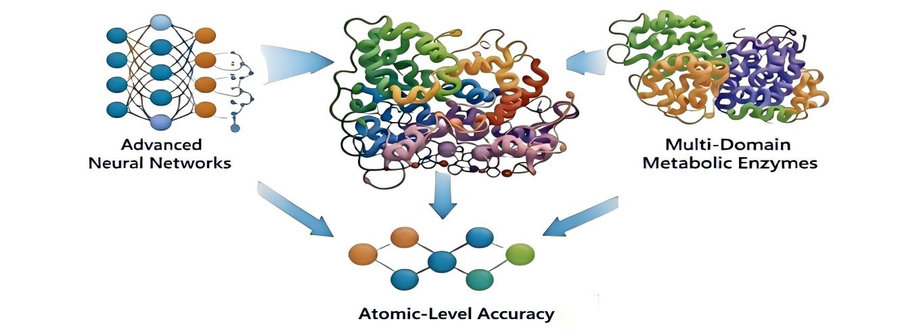
Since many obesity targets are membrane-bound, our platform excels at modeling transmembrane helices and extracellular loops, which are critical for ligand binding.
Rather than a static "snapshot," we model the flexibility of target proteins to identify cryptic pockets that only appear during specific signaling states.
Beyond structure, we calculate the physicochemical properties of potential binding sites to rank targets based on their "lead-likeness."
Solution Scope
The Protheragen target structure prediction service is designed to be the foundational pillar of your obesity drug discovery program. Our scope covers a wide array of emerging metabolic pathways:
- GPCR Structural Profiling
Modeling of orphan GPCRs and neuro-linked receptors (e.g., those found in the dorsomedial hypothalamus) associated with appetite regulation and energy expenditure.
- Mitochondrial & Thermogenic Targets
Prediction of structures for proteins involved in "browning" of white adipose tissue and mitochondrial uncoupling.
- Small Molecule Interaction Modeling
Predict how potential oral small-molecule candidates, such as GLP-1R non-peptide agonists, interact with specific structural motifs to minimize side effects.
- Protein-Protein Interaction (PPI) Mapping
Identifying the structural interface between metabolic signaling proteins to facilitate the design of inhibitors or stabilizers.
- Mutational Impact Analysis
Modeling how specific genetic polymorphisms related to obesity (e.g., FTO or MC4R variants) alter protein structure and drug response.
Contact Protheragen to define your project's custom preclinical scope and genomic targets.
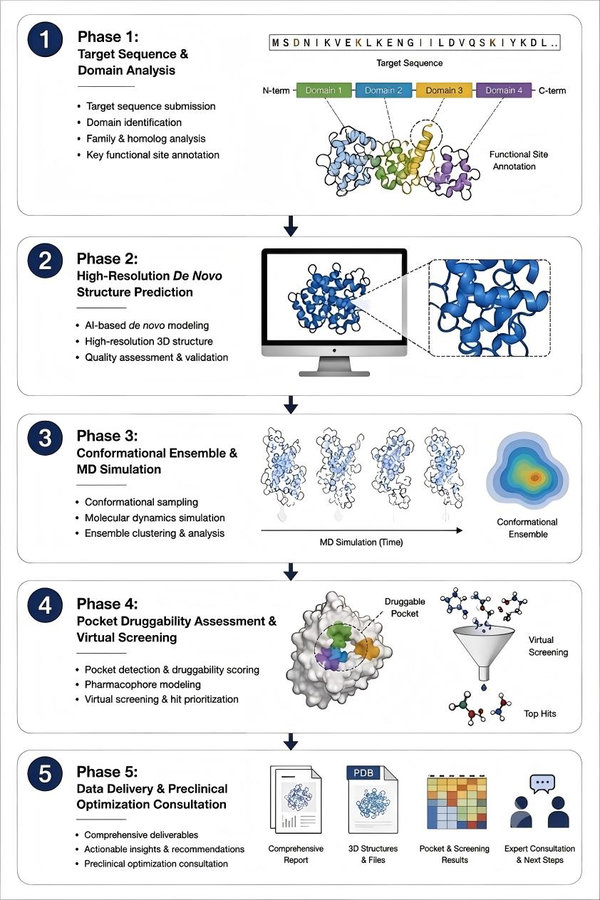
Workflow
Our structured workflow ensures that every prediction is grounded in biological relevance and ready for immediate preclinical application.
Fields of Application
The target structure prediction service from Protheragen provides high-resolution structural clarity across a diverse spectrum of metabolic research areas, enabling the precise identification of druggable pockets in both classic and emerging obesity pathways.
- Endocrine Drug Discovery: Designing next-generation incretin mimetics and glucagon receptor dual/triple agonists.
- Neuroscience & Appetite Control: Targeting hypothalamic circuits and memory-linked brain cells that influence eating behavior.
- Adipose Tissue Engineering: Developing therapeutics that target lipid storage and adipocyte differentiation pathways.
- Cardiometabolic Research: Identifying targets that bridge the gap between obesity, insulin resistance, and cardiovascular health.
Advantages
Protheragen offers unparalleled expertise in translating sequence data into actionable drug targets. Our advantages include:
Accelerated Discovery Timelines
Move from a genetic sequence to a validated structural model in weeks, significantly reducing the "hit-to-lead" timeframe.
Precision in "Undruggable" Spaces
We specialize in targets where traditional X-ray crystallography or cryo-EM may fail due to protein instability or size.
Preclinical Synergy
Our models are purpose-built for downstream preclinical workflows, including high-throughput virtual screening and SAR (structure-activity relationship) analysis.
Contact Our Team to Discuss Your Project
Publication Data
Title: Anti-Obesity Therapeutic Targets Studied In Silico and In Vivo: A Systematic Review
Journal: International Journal of Molecular Sciences, 2024
DOI: https://doi.org/10.3390/ijms25094699
Summary: This systematic review set out to bridge the gap between computational bioinformatics and preclinical testing for obesity therapy, answering the question: What therapeutic targets are used in in silico analysis for obesity treatment, and do their predicted effects hold in in vivo validation? The research team screened 1,142 articles across six databases (PubMed, ScienceDirect, Scopus, Web of Science, BVS, EMBASE) and ultimately included 12 studies that met strict criteria: in silico analysis (molecular docking/ dynamics) of human obesity targets with subsequent in vivo validation. Only 7 of these studies yielded clear, cross-validated therapeutic targets, with human pancreatic lipase (HPL) emerging as the most widely studied target. The review found strong alignment between in silico predictions (e.g., ligand-target binding affinity) and in vivo outcomes (e.g., reduced weight gain, improved lipid profiles) for all identified targets, confirming the value of integrating computational tools into anti-obesity drug discovery. However, the study also highlighted critical gaps in methodological reporting across the research landscape, leading to high "unclear risk of bias" ratings for most included studies. Overall, the review concludes that combining in silico and in vivo approaches accelerates the identification of selective, specific anti-obesity drug candidates, addressing the global challenge of obesity and its comorbidities (type 2 diabetes, cardiovascular disease, cancer).
Key Findings
- Seven cross-validated anti-obesity therapeutic targets were confirmed through in silico analysis and rodent in vivo trials: HPL, LEPR, PTP1B, FTO, CD36, ACC and CB1, all producing consistent anti-obesity effects matching computational predictions. HPL represented the most researched target across four studies; its inhibitors suppress dietary lipid absorption, boost faecal lipid loss and mitigate weight gain, marking it a leading candidate for drug development.
- All 12 included studies adopted molecular docking as the core in silico method, while only one added molecular dynamics simulations. Most targets used high-resolution experimentally determined 3D structures, except CB1 which used homology models. AutoDock Vina, PyRx and Glide were the most common analytical tools. In vivo validation solely employed mice and rats, with 10 studies using male rodents. Obesity was predominantly induced by high-fat non-genetic diets, apart from one LEPR investigation using genetically modified ob/ob mice. All targets lowered key obesity biomarkers including body weight and serum lipids.
- Over half the studies carried an unclear bias risk due to insufficient methodological reporting, harming experimental reproducibility. Peripheral targets (HPL, ACC, CD36, peripheral CB1) offer greater safety by avoiding central nervous system adverse effects seen in CNS-targeted agents such as rimonabant. Important translational limitations remain: many in vivo assays tested crude plant extracts rather than purified compounds, toxicity and off-target assessments were absent, and rodent obesity models lacked uniform protocols. Overall, integrating computer-aided drug design and animal testing effectively streamlines anti-obesity candidate discovery, achieving full alignment between in silico binding forecasts and in vivo functional results.
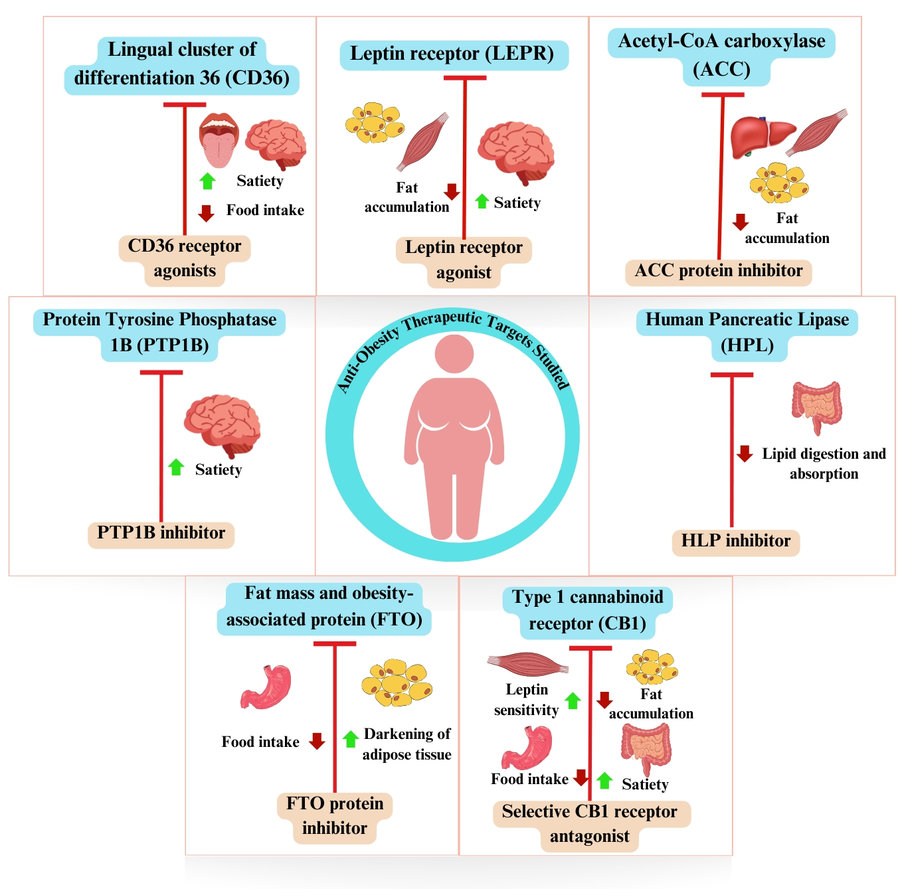 Fig.1 Validated anti-obesity therapeutic targets and how they modulate metabolic pathways. (de Medeiros, et al., 2024)
Customer Review
Collaborative Success in Metabolic Innovation
"Working with Protheragen was a turning point for our orphan GPCR project. We had a sequence but no structural data to guide our lead discovery. Their target structure prediction service provided us with a high-resolution model that identified an allosteric pocket we hadn't considered. This insight allowed us to pivot our strategy early in the preclinical phase, saving us months of trial and error. We plan to utilize Protheragen for all our future structural modeling needs."
Dr. B. M., Principal Scientist
Precision Modeling for Accelerated Lead Optimization
"The depth of expertise at Protheragen is evident. They didn't just give us a static file; they provided a dynamic model that explained the binding kinetics we were seeing in our early assays. Their team functioned as an extension of our own R&D department. The data was robust enough to support our internal milestone reviews and accelerated our transition to lead optimization."
Dr. F. G., Director of Preclinical Development
Frequently Asked Questions
-
How accurate are your predictions for membrane-bound proteins?
Our algorithms are specifically trained on lipid-environment datasets, ensuring high-fidelity modeling of transmembrane domains common in obesity targets.
-
Can you model proteins with no known homologs?
Yes, our de novo modeling capabilities allow us to predict structures based on physical principles and deep learning even when a template is unavailable.
-
Does the service include ligand docking?
While this service focuses on the target structure, we offer seamless integration with our molecular docking platforms to test your library against the predicted model.
-
What format are the final structures delivered in?
We provide industry-standard PDB and SDF files, along with comprehensive technical reports.
-
How do you handle targets with high flexibility?
We use molecular dynamics simulations to provide an ensemble of structures, representing the protein's movement in a physiological environment.
-
Is this service suitable for large protein complexes?
Absolutely. We can model multi-subunit complexes and their interaction interfaces.
-
Can you predict the effect of specific mutations on drug binding?
Yes, we provide comparative modeling to show how point mutations alter the binding pocket architecture.
-
How long does a typical project take?
Most target predictions are completed within 4 to 6 weeks, depending on the complexity of the protein.
-
Do you provide support for interpreting the results?
Every project includes a consultation with our senior biologists to discuss the implications of the predicted structure for your research.
Contact Us
Protheragen provides industry-leading target structure prediction services designed to empower the discovery of novel obesity therapeutics. By combining deep learning technologies with metabolic expertise, we provide the structural clarity needed to transform genomic data into viable drug targets. Welcome to Contact Protheragen.
Reference
- de Medeiros, W.F.; et al. Anti-Obesity Therapeutic Targets Studied In Silico and In Vivo: A Systematic Review. Int. J. Mol. Sci. 2024, 25, 4699. (CC BY 4.0)
All of our services and products are intended for preclinical research use only and cannot be used to diagnose, treat or manage patients.