

Glutamine Metabolic Flux Analysis Service
InquiryGlutamine is no longer viewed merely as a "non-essential" amino acid; in the context of obesity, it is a critical pivot point for metabolic health. Recent landmark studies have revealed that obesity-associated insulin resistance is characterized by a significant decrease in the glutamine-to-glutamate ratio within white adipose tissue. This metabolic shift promotes a proinflammatory state and suppresses energy expenditure.
Quantifying the Flow: Glutamine Metabolic Flux Analysis for Anti-Obesity Drug Discovery
Protheragen provides a specialized glutamine metabolic flux analysis (MFA) service tailored for preclinical anti-obesity research. Unlike traditional metabolomics which only measures "snapshots" of metabolite levels, our MFA platform utilizes stable isotope tracers (e.g., [U-,13C5] glutamine) to determine the actual rates of metabolic reactions. By tracking how glutamine-derived carbon fuels the TCA cycle, supports reductive carboxylation, or modulates thermogenic gene expression, we provide the functional evidence required to advance anti-obesity candidates toward clinical success.
Core Technologies
Our platform integrates high-resolution analytical chemistry with advanced computational modeling to map the "metabolic traffic" within cellular and animal models.
- Stable Isotope Tracing
We utilize 13C-labeled glutamine tracers to distinguish between oxidative and reductive pathways, providing a high-fidelity map of carbon partitioning.
- High-Resolution Gas Chromatography-Mass Spectrometry (GC-MS) & Liquid Chromatography Tandem Mass Spectrometry (LC-MS/MS)
Our laboratory is equipped with state-of-the-art mass spectrometry systems to detect even the most subtle isotopologue distributions in complex biological matrices.
- Elementary Metabolic Unit (EMU) Modeling
We employ sophisticated EMU-based software (such as INCA or OpenFLUX2) to perform non-linear regression, converting raw mass spectrometry data into precise intracellular flux maps.
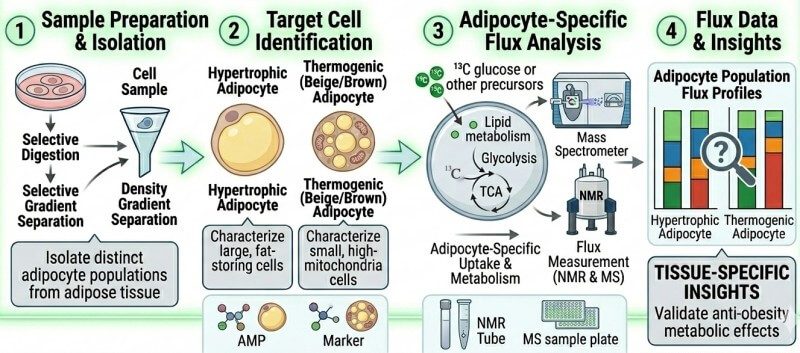
- Adipocyte-Specific Fluxomics
Specialized protocols for isolating and analyzing the flux within hypertrophic and thermogenic adipocytes, ensuring tissue-specific insights.
Service Scope
Protheragen offers a versatile range of glutamine-centric flux analysis options to support diverse research objectives:
- TCA Cycle Dynamics
Quantifying how glutamine entry into the TCA cycle supports mitochondrial oxidative capacity and ATP production.
- Reductive Carboxylation Analysis
Evaluating the role of glutamine in lipid synthesis under hypoxic or mitochondrial stress conditions common in obese adipose tissue.
- HBP & Epigenetic Mapping
Tracking glutamine's contribution to UDP-GlcNAc levels, linking metabolism to inflammatory gene expression in adipocytes.
- Thermogenesis Support
Analyzing how glutamine turnover influences p38 MAPK signaling and UCP1 expression in brown or "beige" adipose tissue models.
Contact Our Specialist Team for a Detailed Project Consultation and Quote
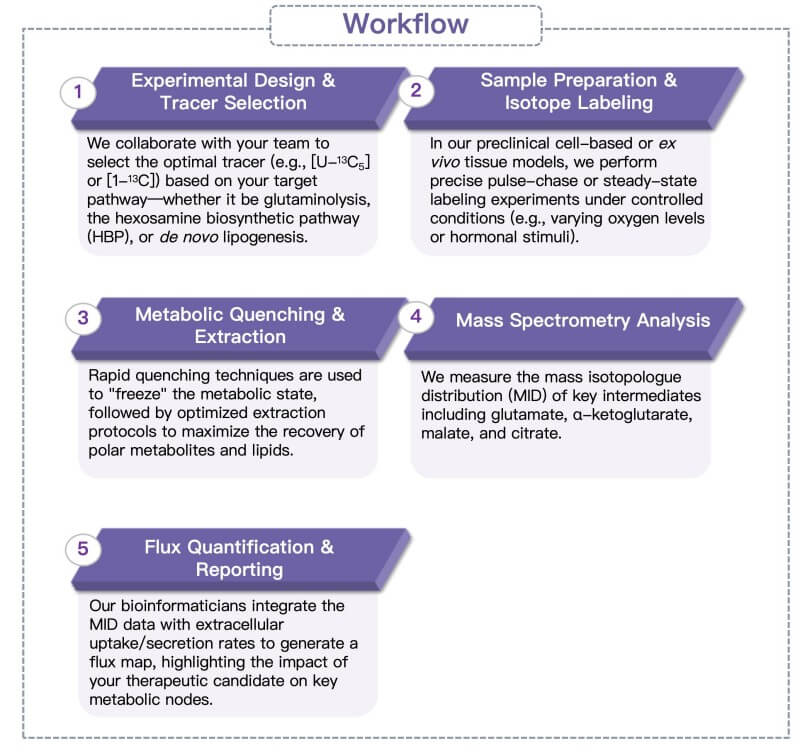
Workflow
Protheragen ensures a streamlined, rigorous process to deliver actionable data for your drug discovery pipeline.
Fields of Application
Our glutamine metabolic flux analysis platform serves as a vital bridge between theoretical target discovery and functional therapeutic validation across multiple stages of metabolic disease research.
- Target Identification: Discovering novel metabolic "bottlenecks" in obese states that can be targeted by small molecules or RNA therapeutics.
- Mechanism of Action (MoA) Studies: Validating exactly how a lead compound (e.g., a GLP-1/GIP co-agonist) affects nutrient partitioning and energy homeostasis.
- Lead Optimization: Comparing the metabolic "footprints" of multiple analogs to select the most potent modulator of thermogenic flux.
- Biomarker Discovery: Identifying specific isotopologue signatures that correlate with therapeutic response in Preclinical Obesity Models.
Advantages
Choosing Protheragen means partnering with a leader in metabolic flux precision.
- Functional Resolution
While standard metabolomics might show "high glutamate," our MFA can determine if that glutamate is being oxidized for energy or redirected toward proinflammatory signaling. We don't just report high glutamate levels; we determine the metabolic fate of that molecule. Our platform can distinguish whether glutamate is being oxidized in the TCA cycle for ATP production or redirected toward pro-inflammatory signaling pathways.
- Unrivaled Sensitivity
We have optimized our extraction and detection workflows to capture minor flux alterations in low-biomass preclinical samples. Whether working with primary adipocytes, rare cell populations, or small tissue biopsies from specific brain regions or muscle groups, our high-sensitivity mass spectrometry ensures robust data without requiring prohibitive amounts of starting material.
- Proven Track Record
Our platforms do more than measure; they discover. Published data from our collaborative research demonstrates the real-world impact of our MFA platform, such as identifying glutaminase inhibition as a viable strategy to enhance energy expenditure in diet-induced obesity (DIO) models.
- Preclinical Specialization
We focus exclusively on the high-stakes environment of discovery-stage research. Unlike clinical labs that prioritize high-volume throughput, our workflows are custom-built for the agility and rigorous validation required for target identification and lead optimization. This specialization ensures that your preclinical data is not only generated with speed but is also of the highest quality for internal "go/no-go" decision-making.
Contact Our Scientists Today to Initiate Your Customized MFA Workflow.
Publication Data
Title: Reduced adipocyte glutaminase activity promotes energy expenditure and metabolic health
Journal: Nat Metab., 2024
DOI: https://doi.org/10.1038/s42255-024-01083-y
Summary: This study uncovers the critical role of white adipocyte glutamine metabolism in metabolic health. Obesity-induced insulin resistance is linked to elevated fat cell glutaminolysis (glutamine-to-glutamate conversion), driven by increased glutaminase (GLS) and decreased glutamine synthase (GLUL) levels. Through clinical analyses and experiments in humans and mice, the research shows that reducing GLS activity—via genetic depletion or pharmacologic inhibitors (e.g., CB-839)—rewires adipocyte metabolism: it boosts glycolysis, lactate production, and mitochondrial oxidative capacity via HIF1α and p38 MAPK signaling, activating thermogenic gene programs (e.g., UCP1) in inguinal white adipose tissue (iWAT). This "browning" of white fat increases whole-body energy expenditure, improves glucose tolerance, and protects against high-fat diet-induced obesity and insulin resistance, highlighting GLS as a potential therapeutic target for metabolic disorders like type 2 diabetes.
Key Findings
- Obesity Alters Glutamine-Glutamate Balance: Obese individuals with insulin resistance have lower plasma and white adipose tissue (WAT) glutamine-to-glutamate ratios, tied to higher GLS and lower GLUL expression in fat cells.
- GLS Inhibition Triggers Adipocyte Browning: Reducing GLS activity (genetically or pharmacologically) induces thermogenic gene expression (UCP1, ETC proteins) in human adipocytes and mouse iWAT, shifting white fat to a brown-like, energy-burning phenotype.
- Metabolic Rewiring Mechanism: GLS depletion lowers α-ketoglutarate, stabilizing HIF1α to promote glycolysis and lactate accumulation; lactate then activates p38 MAPK signaling, driving mitochondrial oxidative capacity.
- In Vivo Metabolic Benefits: Adipocyte-specific GLS knockout male mice and CB-839-treated mice (both sexes) show higher energy expenditure, reduced fat mass, and improved glucose tolerance—even on a high-fat diet.
- Therapeutic Potential: GLS inhibitors (e.g., CB-839, already tested safely in cancer trials) offer a novel strategy to treat obesity, insulin resistance, and type 2 diabetes by targeting adipocyte glutaminolysis.
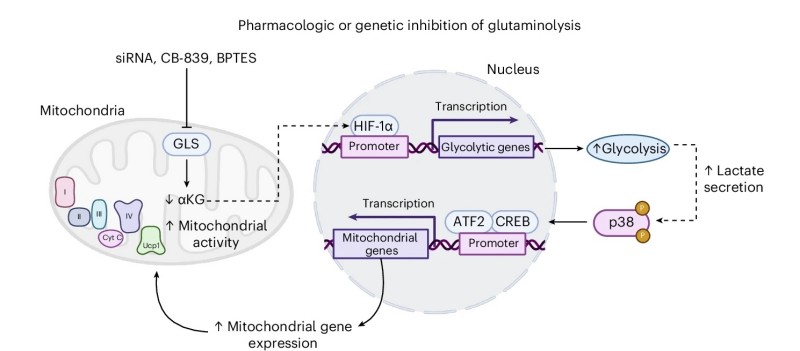 Fig.1 Mechanistic model: glutaminase (GLS) inhibition drives adipocyte thermogenesis via HIF1α-lactate-p38 MAPK signaling. (Lecoutre, et al., 2024)
Customer Review
Bridging the Gap from Hit Identification to Mechanistic Proof-of-Concept
"The depth of metabolic insight provided by Protheragen was a game-changer for our anti-obesity program. We had previously struggled to explain why our compound was improving glucose tolerance without affecting weight; their glutamine MFA revealed a specific shift in thermogenic flux in 'beige' fat that we had completely overlooked. We look forward to continuing our partnership on our next-generation lipid-modulating candidates."
Dr. J. V., Lead Discovery
Accelerated Validation: Precision Metabolic Mapping for Fast-Track Target Identification
"Protheragen's expertise in handling delicate adipose tissue samples and their sophisticated modeling capabilities allowed us to validate our target's mechanism of action in record time. Their team is scientifically rigorous and highly responsive. We are already planning our next series of ex vivo flux studies with them."
Dr. N. L., Director of Metabolic Research
Frequently Asked Questions
-
How does glutamine MFA differ from standard metabolite profiling?
Standard profiling measures static concentrations. MFA measures the speed and direction of reactions. In obesity, a metabolite concentration may stay the same while its flux (usage rate) changes dramatically; only MFA can reveal this.
-
Can your service handle primary adipocyte cultures?
Yes, Protheragen has optimized protocols for primary murine and human adipocytes, as well as established lines like 3T3-L1.
-
Which tracers do you recommend for studying thermogenesis?
[U-13C5] Glutamine is typically the gold standard for tracking total contribution to the TCA cycle and mitochondrial oxidative capacity.
-
Do you offer in vivo flux analysis?
We provide extensive ex vivo tissue flux analysis and specialized preclinical models. For specific systemic inquiries, please contact our team to discuss the best experimental design for your needs.
-
What is the typical turnaround time for a glutamine MFA project?
Depending on the complexity of the model, we typically deliver a final report within 4 to 6 weeks.
-
Can you help us interpret the results in the context of drug safety?
Absolutely. Our specialists analyze the data to see if your drug causes "metabolic shunting" into unintended or potentially toxic pathways.
-
Is your platform compatible with high-fat diet (HFD) mouse models?
Yes, we frequently work with tissues derived from HFD or genetic models (e.g., ob/ob, db/db) to analyze pathological flux states.
-
What kind of data will I receive in the final report?
You will receive comprehensive flux maps, statistical analyses of isotopologue distributions, and a detailed expert interpretation of the metabolic consequences of your intervention.
-
Do you offer custom tracer synthesis?
We stock a wide range of common tracers. For specialized requirements, we can source or facilitate custom tracer procurement.
Contact Us
At Protheragen, we are dedicated to providing the precision fluxomics data you need to turn metabolic insights into breakthrough anti-obesity therapies. Whether you are in the early stages of target validation or final lead optimization, our team is ready to support your research.
Contact Protheragen for More Information and to Discuss Your Project
Reference
- Lecoutre, S.; et al. Reduced adipocyte glutaminase activity promotes energy expenditure and metabolic health. Nat Metab. 2024, 1329–1346. (CC BY 4.0)
All of our services and products are intended for preclinical research use only and cannot be used to diagnose, treat or manage patients.