

Glycogen Synthesis & Metabolism Analysis Service
InquiryThe global landscape for obesity and metabolic disease drug discovery has shifted fundamentally toward multi-target strategies. Modern breakthroughs, such as GLP-1/GIP/glucagon co-agonists, have underscored the necessity of understanding glucose utilization beyond simple insulin secretion. At the heart of this metabolic nexus is glycogen synthesis—a dynamic process that serves as more than just a passive energy reservoir. Recent preclinical research indicates that glycogen synthesis in beige adipose tissue is a critical requirement for adaptive thermogenesis and energy expenditure. Disruption in glycogen turnover has been shown to aggravate high-fat diet-induced obesity and insulin resistance in mouse models.
Glycogen Synthesis & Metabolism Analysis Service for Anti-Obesity Therapeutics
Protheragen provides specialized glycogen synthesis & metabolism analysis services tailored for preclinical drug development. We help researchers quantify how novel candidates—ranging from small molecules to complex peptide multi-agonists—modulate glycogen flux to drive weight loss and metabolic recovery.
Core Technologies
Protheragen leverages a multi-dimensional technology suite to provide high-resolution insights into metabolic pathways:
- 13C-Labeled Metabolic Flux Analysis (MFA)
Utilizing stable isotope-labeled glucose tracers to track the real-time incorporation of glucose into glycogen, providing a dynamic view of pathway activity rather than a static snapshot.
- High-Resolution LC-MS/HRMS Platforms
For the precise identification and absolute quantification of intermediates in the glycogenesis and glycogenolysis pathways, ensuring high sensitivity even in complex tissue matrices.
- Advanced Bioinformatics Pipeline
Integrated data analysis that combines metabolomics with transcriptomics to map metabolic networks and identify biomarkers of therapeutic efficacy.
Service Scope
Protheragen focuses exclusively on the preclinical phase, supporting drug discovery through:
- Adipose Tissue Metabolism
Analyzing the role of glycogen in brown and beige fat thermogenesis.
- Hepatic & Skeletal Muscle Analysis
Quantifying glycogen storage capacity and turnover in the primary metabolic organs.
- GPCR Signaling Profiling
Evaluating how GLP-1, GIP, and Glucagon Receptor Agonists modulate downstream glycogen synthesis.
- In Vitro Lead Optimization
High-throughput screening of compounds for their ability to enhance metabolic flux in adipocyte or hepatocyte cell models.
Identifying chemical signatures that predict a positive response to anti-obesity interventions.
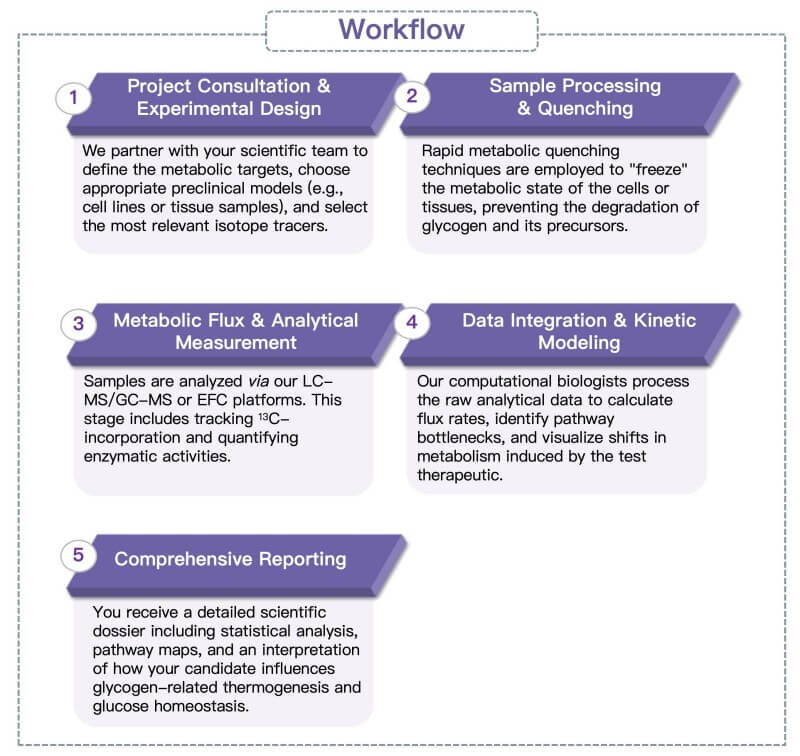
Workflow
Our streamlined preclinical workflow is designed to move your project from hypothesis to actionable data with maximum efficiency:
Fields of Application
Our specialized glycogen synthesis & metabolism analysis service provides critical mechanistic insights across a diverse range of therapeutic research areas, enabling a deeper understanding of how candidate molecules influence energy homeostasis and metabolic recovery in preclinical models.
- Anti-Obesity Drug Development: Validating candidates that target adipose tissue thermogenesis via glycogen pathways.
- Type 2 Diabetes Research: Investigating glycogen storage defects and the efficacy of insulin-sensitizing agents.
- Metabolic Syndrome Studies: Holistic profiling of glucose-to-glycogen flux across multiple organ systems.
- Nutritional Science: Evaluating the metabolic impact of functional food ingredients on glucose homeostasis.
Advantages
Choosing Protheragen means accessing a level of precision that standard metabolic assays cannot match:
- Temporal Resolution
By monitoring the real-time flux of glycogen synthesis and glucose turnover, we allow you to quantify pharmacodynamic onset and duration. This shift from "if a drug works" to "how fast and how long it works" is critical for optimizing dosing schedules and predicting clinical efficacy.
- Mechanism-Reflective Assays
Whether targeting mitochondrial uncoupling, insulin signaling, or enzyme inhibition, our assays ensure that the preclinical response is physiologically relevant. This alignment reduces the risk of "false positives" that often plague simplified, non-mechanistic screening models.
- Phase-Appropriate Formats
We offer HTS-compatible cell-based models for rapid early-stage screening, which then transition into highly robust, qualified bioassays optimized for lead refinement and candidate selection. This phase-appropriate approach ensures that your methodology remains consistent and scalable as your program moves toward IND-enabling studies.
- Proven Precision
Our commitment to data integrity is backed by rigorous statistical benchmarks. Our platforms consistently achieve superior plate uniformity with coefficients of variation (CV) < 10% and exceptional dilution linearity (R2 > 0.97).
Publication Data
Title: Role and Regulation of Glycogen Synthase Kinase-3 inObesity-Associated Metabolic Perturbations
Journal: Kinases Phosphatases, 2024
DOI: https://doi.org/10.3390/kinasesphosphatases2030018
Summary: Obesity, a global epidemic, drives diverse metabolic disorders like type 2 diabetes (T2D), diabetic cardiomyopathy (DCM), non-alcoholic fatty liver disease (NAFLD), and cognitive impairment. Glycogen synthase kinase-3 (GSK-3), a ubiquitous serine/threonine kinase with two paralogs (GSK-3α and GSK-3β), is a critical player in these pathologies—its overactivity in key metabolic tissues exacerbates obesity-associated perturbations. While GSK-3α and GSK-3β share high sequence homology, they exhibit distinct tissue-specific roles: GSK-3α drives lipotoxic cardiomyopathy and atherosclerosis, while GSK-3β dominates in regulating skeletal muscle insulin sensitivity, pancreatic β-cell survival, and hepatic glucose metabolism. Pharmacological inhibitors (e.g., lithium) and natural compounds (e.g., bavachin, probiotics) that target GSK-3 improve insulin sensitivity, reduce liver fat, and protect cardiac function, but systemic inhibition risks context-dependent side effects. The paper emphasizes that GSK-3's role is tissue- and isoform-specific, highlighting the need for targeted strategies (not broad inhibition) to treat obesity-related metabolic diseases, especially when paired with lifestyle interventions.
Key Findings
- Isoform-Specific Roles: GSK-3α drives cardiac lipotoxicity and atherosclerosis, while GSK-3β dominates in skeletal muscle insulin resistance, pancreatic β-cell dysfunction, hepatic NAFLD, and brain cognitive decline.
- Obesity-Driven Overactivity: HFD-induced GSK-3 overactivation disrupts insulin signaling, glycogen synthesis, and fat metabolism, worsening T2D, CVD, and NAFLD.
- Therapeutic Potential: Inhibitors (lithium) and natural compounds (bavachin, probiotics) target GSK-3 to improve insulin sensitivity, reduce liver fat, and protect cardiac/β-cell function.
- Context Dependency: GSK-3's role shifts with disease duration—early GSK-3β deletion protects against obesity-related cardiac dysfunction, but chronic inhibition loses efficacy.
- Targeted Approach Needed: Systemic inhibition risks side effects; tissue/isoform-specific strategies are critical for treating obesity-associated metabolic disorders.
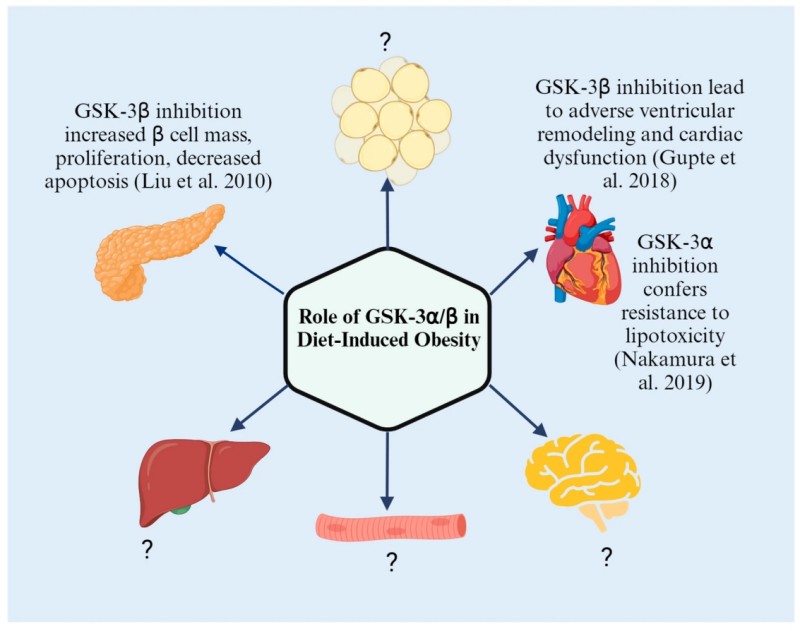 Fig.1 Tissue-specific roles of GSK-3α/β in high-fat diet (HFD)-induced obesity and metabolic perturbations. (Lemon, et al., 2024)
Customer Review
Bridging the Gap from Hit Identification to Mechanistic Proof-of-Concept
"The transition from hit identification to lead optimization was a bottleneck for us until we partnered with Protheragen. Their 13C-metabolic flux analysis provided the mechanistic evidence we needed to show that our candidate was actively promoting thermogenesis in beige fat. Their technical team was instrumental in helping us interpret complex data patterns, and we plan to utilize their platform for all our upcoming preclinical metabolic programs."
Dr. E. V., Senior Scientist at a Biotech Startup
De-Risking Multi-Agonist Development through High-Precision Kinetic Profiling
"Protheragen provided exceptional precision in our co-agonist characterization studies. The ability to see real-time shifts in glycogen turnover allowed us to de-risk our development program early. Their professionalism and adherence to strict SOPs made the data transfer seamless. We look forward to our continued collaboration as we expand our metabolic pipeline."
Mr. M. T., R&D Director at a Global Pharmaceutical Firm
Frequently Asked Questions
-
Why is glycogen synthesis a better endpoint than simple glucose uptake?
While uptake shows glucose entry, glycogen synthesis reflects the utilization and storage efficiency, which is directly linked to thermogenic signaling and long-term metabolic health.
-
Can Protheragen handle different tissue types in one study?
Yes, we specialize in multi-organ analysis, providing a coordinated view of glycogen flux in liver, muscle, and adipose tissues.
-
What is the benefit of using 13C-labeled tracers over traditional kits?
Tracers allow for flux calculation (the rate of flow), whereas kits only provide a static concentration, which can be misleading if both synthesis and breakdown are occurring simultaneously.
-
Are your assays compatible with small molecule and peptide drugs?
Absolutely. Our platforms are designed to characterize a wide array of modalities, including small molecules and unimolecular multi-agonists.
-
Do you offer high-throughput screening (HTS) options?
Yes, our cell-based signaling assays can be miniaturized to 1536-well formats for large-scale library screening.
-
How do you ensure the stability of metabolic samples during transport?
We provide detailed sample collection and rapid-quenching protocols to ensure the integrity of the metabolome remains intact.
-
Can you help distinguish between biased and unbiased agonists?
Yes, by comparing cAMP accumulation versus beta-arrestin recruitment, we can quantify the signaling bias of your compounds.
-
What is the typical turnaround time for a metabolic flux study?
While it depends on complexity, a standard study typically takes 4–6 weeks from sample receipt to final report.
How to Contact Us
Protheragen offers specialized glycogen synthesis & metabolism analysis services, utilizing 13C-flux analysis and HR-MS to provide deep metabolic insights into anti-obesity drug candidates. Our preclinical focus ensures your lead optimization is backed by high-resolution, mechanism-reflective data.
Contact Us
Contact Protheragen for More Information and to Discuss Your Project
Reference
- Lemon, J.J.; et al. Role and Regulation of Glycogen Synthase Kinase-3 in Obesity-Associated Metabolic Perturbations. Kinases Phosphatases. 2024, 2, 279–293. (CC BY 4.0)
All of our services and products are intended for preclinical research use only and cannot be used to diagnose, treat or manage patients.