
In Vitro Anti-Obesity Drug Screening Service
InquiryObesity is a massive global health crisis. No longer viewed simply as a cosmetic or lifestyle issue, it is a complex metabolic disease linked directly to type 2 diabetes, cardiovascular disease, and non-alcoholic steatohepatitis (NASH). Developing effective anti-obesity drugs is a major focus for modern biotechnology. However, bringing a new weight-management compound to market is incredibly difficult. Relying too early on expensive, slow animal models often leads to high attrition rates.
Preclinical Advancements in Weight Management: High-Throughput In Vitro Anti-Obesity Drug Screening
To help overcome these hurdles, Protheragen offers an advanced in vitro anti-obesity drug screening service. We help pharmaceutical and biotech companies quickly find and evaluate promising compounds before starting animal testing. By utilizing high-throughput biochemical assays, customized cell models, and sophisticated physiological tests, we provide the accurate, reproducible data you need to confidently advance your drug development pipeline.
Core Technologies
To study metabolic processes, you need the right tools. Our screening platform uses a mix of traditional and cutting-edge molecular biology technologies.
We use automated fluorescent microscopy to track lipid accumulation inside cells. This lets us measure lipid droplet size, count, and overall area in real time, giving us a clear picture of how compounds affect adipogenesis.
We measure cellular respiration and metabolic activity by tracking the oxygen consumption rate (OCR) and extracellular acidification rate (ECAR). This is crucial for evaluating how compounds influence mitochondrial respiration and the uncoupling processes that turn white fat into brown fat.
Using microplate-based assays, we analyze how compounds interact with key obesity-related enzymes like pancreatic lipase, glycerol-3-phosphate dehydrogenase (GPDH), and adenosine monophosphate-activated protein kinase (AMPK).
We quantify secreted adipokines (including adiponectin, leptin, and resistin) as well as inflammatory cytokines to see how compounds affect systemic metabolism and chronic inflammation.
Solution Scope
Protheragen offers a comprehensive suite of in vitro screening services, giving you a complete look at how your candidate molecules behave.
Developing a successful weight-loss drug requires a deep understanding of how a compound interacts with its molecular target. Our biophysical screening assays use techniques like surface plasmon resonance (SPR) and thermal shift assays to evaluate how candidate molecules bind to metabolic receptors and key enzyme targets. We help you measure binding kinetics (KD, kon, koff) for major obesity targets, including the GLP-1 receptor, GIP receptor, and melanocortin-4 receptor (MC4R). Understanding these physical interactions early on helps you make smarter decisions during the lead optimization phase.
Living cells provide the context needed to see how a drug actually functions. We use primary human preadipocytes and established cell lines (like 3T3-L1) to test how compounds affect cellular fat accumulation and energy expenditure. Our assays measure adipocyte differentiation, lipolysis (measuring released glycerol and free fatty acids), and glucose uptake. We also specialize in tracking "browning" biomarkers like UCP1 expression. This helps you identify compounds that can activate thermogenesis and help burn excess energy.
If you want to quickly screen thousands of molecules, biochemical assays are the most efficient option. Our robust, cell-free platform focuses on the key metabolic enzymes that control digestion and fat synthesis. We offer high-throughput screening for pancreatic lipase inhibitors, acetyl-CoA carboxylase (ACC) modulators, and fatty acid synthase (FAS) inhibitors. These simple, highly reproducible assays help you rapidly narrow down large chemical libraries to the most promising candidate molecules.
Obesity is closely linked to chronic, low-grade inflammation. Over time, inflamed fat tissue can lead to insulin resistance and type 2 diabetes. To study this, we use advanced co-culture models that pair adipocytes with macrophages or T-cells. This setup allows us to measure how your compounds affect the inflammatory signals (such as TNF-alpha, IL-6, and MCP-1) that pass between fat cells and immune cells. By targeting this inflammatory loop, you can find therapeutics that not only manage weight but also help treat metabolic complications.
Reach out to our metabolic experts today to design a custom assay layout for your project.
Workflow
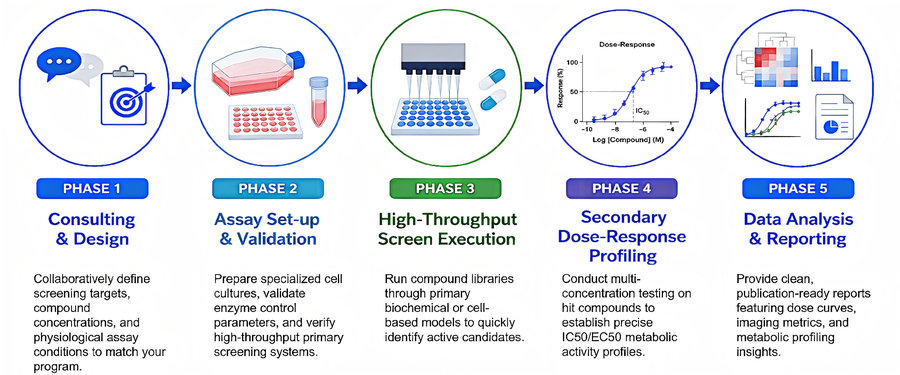
Our workflow is designed to turn your compounds into clean, actionable biological data through a structured five-step process:
Fields of Application
Our workflow is designed to turn your compounds into clean, actionable biological data through a structured five-step process:
- White Adipose Tissue Browning
We help you evaluate how effectively your allogeneic candidates drive the conversion of energy-storing, unilocular white adipocytes into multilocular, UCP1-positive beige or brown-like fat. Our in vitro and in vivo assays specifically measure the resulting upregulation of thermogenic markers and overall increases in resting energy expenditure.
- Systemic Adipose Inflammation Mitigation
Obesity-induced tissue dysfunction is heavily driven by chronic inflammation. We specialize in testing how donor-derived cells modulate the local immune microenvironment, specifically tracking the polarization of adipose tissue macrophages from a pro-inflammatory M1 state to an anti-inflammatory M2 phenotype to restore systemic insulin sensitivity.
- Targeted Adipokine & Peptide Secretion
For therapies designed to act as sustained-release bio-factories, we validate the cells' ability to continuously secrete critical metabolic regulators (such as adiponectin or engineered peptide therapeutics) directly into the subcutaneous adipose niche, avoiding the peaks and troughs of traditional injection schedules.
Advantages
Partnering with Protheragen gives your discovery pipeline a significant competitive edge.
Physiologically Relevant Human Cell Models
We rely primarily on human primary cells and complex co-cultures instead of relying solely on rodent cell lines. This helps ensure your in vitro results translate more reliably to human biology. It has been shown that our human adipocyte models share over 85% metabolic pathway similarity with actual human adipose tissue.
High-Throughput Automation
Our robotic liquid-handling systems and automated high-content imagers allow us to screen thousands of compounds quickly and accurately. We can easily scale from small pilot studies to massive screening campaigns without sacrificing data quality.
Deep Metabolic Expertise
Our team has decades of hands-on experience in metabolic research. We don't just send you raw numbers; we help you interpret the biological data to guide your next steps in drug discovery.
Strict Quality Control Protocols
Every assay we run includes validated reference compounds (like GLP-1 analogs) to ensure consistency. Our rigorous Z'-factor standards guarantee that the screening data you receive is reliable and reproducible.
Request a Custom Proposal & Consult with Our Metabolic Specialists Today.
Publication Data
Title: A glimpse into the pipeline of anti-obesity medication development: combining multiple receptor pathways
Journal: Frontiers in Endocrinology, 2025
DOI: https://doi.org/10.3389/fendo.2025.1630199
Summary: This 2025 Frontiers review maps pipeline anti-obesity drugs, highlighting multi-receptor gut hormone agonists as most potent. It contrasts single/triple GLP-1 combinations, oral injectable formats, plus non-incretin agents for rare obesity and unmet treatment gaps.
Key Findings
- Multi-receptor gut hormone mimetics lead weight loss efficacy: Single GLP‑1 agonists produce 6–15% average weight loss; dual/triple co‑agonists (retatrutide, CagriSema, Amycretin) achieve 22–24% weight reduction in non‑diabetic adults, exceeding currently approved semaglutide and tirzepatide.
- Oral and injectable GLP‑1 formulations progress through late trials: Daily oral small‑molecule GLP‑1 candidates alongside weekly injectable variants address patient aversion to injections and expand treatment accessibility.
- Non‑incretin drugs fill niche clinical gaps: MC4R agonists target monogenic/hypothalamic obesity; activin/myostatin antagonists preserve lean muscle mass during weight loss; metabolic accelerators selectively burn fat without muscle loss.
- Critical unmet barriers limit real-world success: Common gastrointestinal side effects, high medication costs, inconsistent insurance reimbursement, and variable individual treatment adherence reduce long-term drug persistence.
- Synergistic multi-target strategies dominate pipeline innovation: Two core approaches drive enhanced outcomes—single molecules activating multiple receptors, and cross-class drug combinations for refractory obesity.
- Specialized therapies exist for rare obesity subtypes: New agents address underserved populations including Prader-Willi Syndrome and hypothalamic obesity, which lack robust historical treatments.
- Clinical framework reaffirms disease management rules: All anti-obesity pharmacotherapies act only as adjuncts; consistent lifestyle modification remains mandatory for sustained metabolic improvements, as obesity is a lifelong chronic biological disorder.
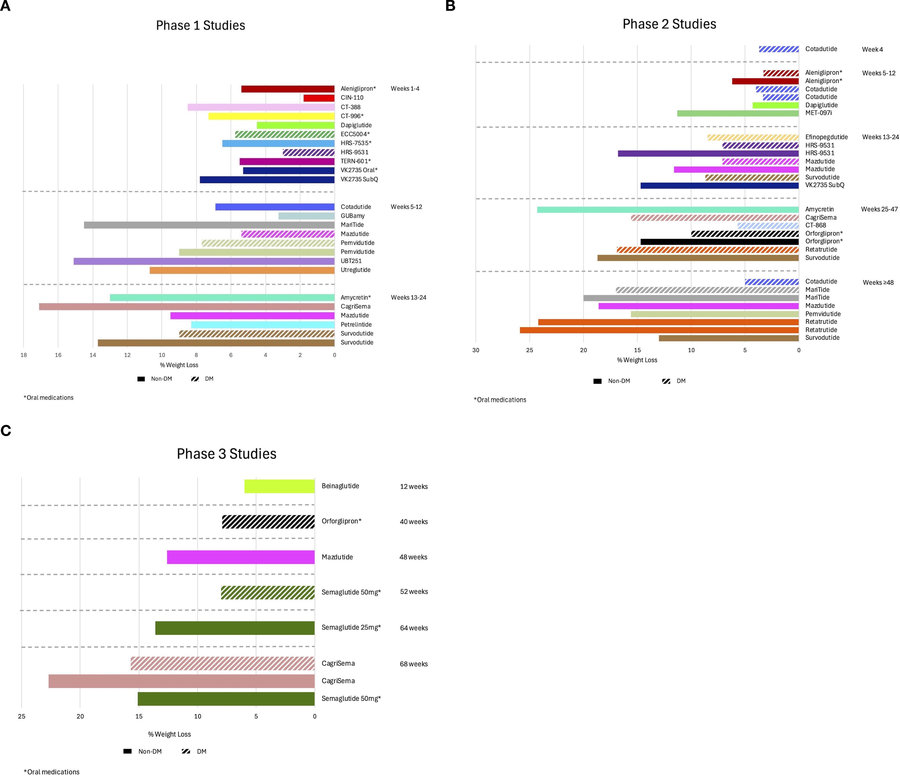 Fig.1 Clinical trial weight loss comparison: all new GLP-1 & multi-receptor obesity drugs (phase 1–3 data). (Park, et al., 2025)
Customer Review
Accelerating Metabolic Discovery Through Expert Data Analysis
"Working with Protheragen changed how we approach our metabolic discovery pipeline. Their team didn't just run the assays; they helped us understand the biology behind our compounds' effects on lipid storage. The high-content imaging data was incredibly clear and helped us secure our next round of funding. We are already planning our next screening campaign with them."
Dr. A. T., MetaboPharma Therapeutics
Rapid Custom Assay Development for Natural Product Screening
"We needed to screen a library of natural products for lipase inhibition and adipocyte browning. Protheragen set up a custom screening protocol in under three weeks. Their technical support was fantastic, and the reproducibility of their assays gave us the confidence we needed to select our lead candidate. They are a reliable extension of our research team."
Dr. E. R., Research Scientist
Frequently Asked Questions
-
What types of cell models do you use for your anti-obesity screens?
We work with several models depending on your goals, including 3T3-L1 cells, primary human preadipocytes (subcutaneous and visceral), and mature brown adipocytes. We can also set up co-cultures with immune cells to study inflammatory responses.
-
Can you customize assays for novel metabolic targets?
Yes, we can. Our team frequently designs and validates custom biochemical and cell-based assays tailored to unique or proprietary drug targets.
-
How do you measure lipolysis in your assays?
We quantify lipolysis by measuring the release of glycerol and non-esterified fatty acids (NEFA) into the cell culture media using high-sensitivity enzymatic assays.
-
What is the typical turnaround time for a screening project?
Most standard projects take 4-8 weeks, depending on the number of compounds and the complexity of the assays. We'll give you a detailed timeline before starting.
-
Do you offer assay validation before running large compound libraries?
Absolutely. We always perform pilot runs to determine optimal cell density, DMSO tolerance, and Z'-factor scores to ensure the assay is robust before screening your library.
-
Can your platform identify compounds that promote adipocyte browning?
Yes. We track browning by measuring UCP1 upregulation, mitochondrial biogenesis, and changes in oxygen consumption rates using Seahorse metabolic analysis.
-
How do you prevent compound cross-contamination during high-throughput screening?
We use automated liquid handlers with disposable tips and strict washing protocols, alongside randomized plate layouts, to prevent contamination and edge effects.
-
What kind of data do you deliver at the end of a project?
You will receive a comprehensive report containing raw data, calculated IC50 or EC50 values, dose-response curves, high-resolution imaging files, and a scientific summary written by our lead biologists.
Contact Us
Protheragen is dedicated to helping you advance your weight-management drug discovery programs. By combining advanced cell models, high-throughput technologies, and deep scientific expertise, we deliver the reliable data you need to move your compounds forward with confidence. Welcome to Contact Protheragen to discuss your project requirements.
Reference
- Park, C.; et al. A glimpse into the pipeline of anti-obesity medication development: combining multiple receptor pathways. Front. Endocrinol. 2025, 16:1630199 (CC BY 4.0).
All of our services and products are intended for preclinical research use only and cannot be used to diagnose, treat or manage patients.