
Immune cell-based Anti-Obesity Drug Screening Service
InquiryObesity is no longer viewed as just a simple fat-storage problem. It is actually a chronic, low-grade inflammatory state. This systemic inflammation is driven heavily by the complex crosstalk between metabolic tissues and the immune system, a field known as immunometabolism. When adipose tissue expands, it recruits various immune cells—like macrophages, T cells, and dendritic cells—which release pro-inflammatory cytokines that shut down healthy thermogenesis and disrupt insulin sensitivity.
Multi-Receptor Target Engagement: Immune Cell-Based Anti-Obesity Drug Screening Service
Traditional drug screening platforms often miss this entire dimension because they rely solely on isolated metabolic cell lines or simple cell-free receptor assays. Protheragen has designed a physiologically relevant immune cell-based anti-obesity drug screening service specifically for preclinical research. By evaluating how candidate compounds impact the delicate intersection of metabolic function and immune cell behavior, we help therapeutic developers identify candidates that not only promote weight loss but also resolve the underlying chronic inflammation that drives metabolic syndrome.
Core Technologies
To truly understand how a candidate compound performs in a complex biological environment, we utilize a suite of advanced, high-throughput preclinical screening technologies.
We set up functional co-cultures pairing primary adipocytes (both white and brown/beige) with specific immune populations, such as tissue-resident macrophages or T cells. This lets us measure real-time cytokine dynamics, lipid accumulation, and immune cell recruitment in a model that mimics actual inflamed adipose tissue.
Many modern anti-obesity therapeutics target G-protein coupled receptors (GPCRs) like GLP-1R, GIPR, and glucagon receptors. Our high-throughput platform screens multi-receptor agonists, monitoring intracellular cyclic AMP (cAMP) accumulation, and calcium mobilization in real-time.
Using advanced bioenergetic platforms, we directly measure oxygen consumption rates (OCR) and extracellular acidification rates (ECAR) in living cells. This allows us to track cellular respiration, glycolytic activity, and mitochondrial uncoupling (thermogenesis) as they happen.
We utilize highly sensitive, bead-based multiplex assays and high-throughput cellular screening reagents to quantify changes in key inflammatory markers like TNF-alpha, IL-6, IL-1-beta, and MCP-1 directly from co-culture supernatants.
Solution Scope
Our screening service is highly customizable, designed to support diverse mechanisms of action within the metabolic and immunometabolic therapeutic landscape.
- Macrophage Polarization and Inflammation Assays
We evaluate how your test compounds affect the transition of adipose tissue macrophages (ATMs) from the pro-inflammatory M1 phenotype to the anti-inflammatory, tissue-repairing M2 state. We track this by measuring cell-surface markers (like CD80, CD86, and CD206) via flow cytometry and analyzing downstream cytokine secretion.
- Thermogenesis and Mitochondrial Uncoupling Profiles
If your therapeutic aims to promote energy expenditure, we assess its ability to induce "browning" in white adipocytes. We measure the upregulation of uncoupling protein 1 (UCP1) and other thermogenic genes, while simultaneously tracking mitochondrial oxygen consumption to confirm functional thermogenesis.
- Multi-Receptor Targeted Agonist Screening
We specialize in evaluating multi-receptor agonists (such as dual GLP-1/GIP or triple GLP-1/GIP/glucagon receptor targets). Our assays quantify signaling bias, receptor internalisation, and downstream metabolic cascades to ensure your multi-targeted compounds are interacting with their target receptors exactly as intended.
- Adipokine Modulation and Lipid Dynamics
We measure how candidate molecules influence the secretion of critical adipokines, including adiponectin and leptin. Additionally, we use high-content imaging to monitor lipid droplet accumulation, lipolysis rates, and overall lipid turnover in inflamed adipocytes.
Workflow
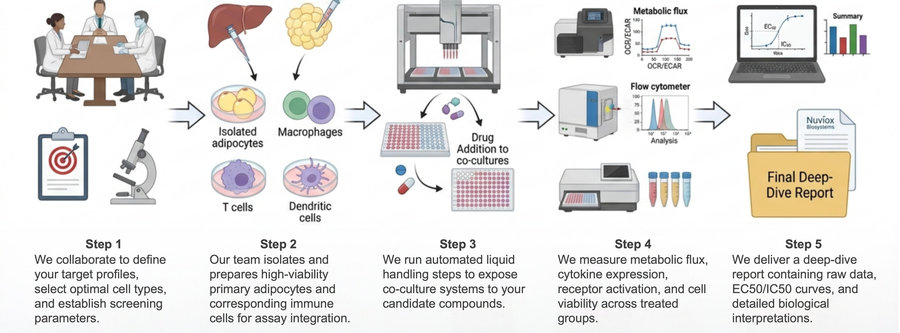
Our preclinical screening pipeline is structured to provide rapid, reproducible, and highly translational data to guide your lead selection.
Fields of Application
Our immune cell-based screening services are widely utilized across several key areas of preclinical drug discovery:
- Next-Generation Multi-Incretin Therapeutics
Optimizing and profiling dual, triple, or multi-receptor agonists targeting GLP-1R, GIPR, and GCGR. - Immunometabolic Small Molecules
Characterizing compounds designed to resolve chronic, low-grade tissue inflammation in obesity and metabolic syndrome. - Targeted Adipose Tissue Therapeutics
Evaluating therapies aimed at promoting white adipose tissue browning and increasing metabolic energy expenditure. - NASH and NAFLD Drug Discovery
Assessing candidates that target liver-resident macrophage (Kupffer cell) inflammation and lipid-induced hepatic stress.
Advantages
Finding a screening platform that actually captures the complex, messy reality of tissue inflammation is tough, but Protheragen bridges that gap by combining high-throughput efficiency with genuine biological relevance.
Physiologically Relevant Human and Rodent Models
We do not rely on basic immortalized cell lines that have lost their metabolic identity. Protheragen utilizes primary cells and specialized co-cultures that closely reflect the real in vivo microenvironment of inflamed adipose tissue, ensuring higher translational success.
High-Throughput Multiplexed Capacity
Our advanced platform combines cellular liquid handling with rapid, functional assays. This means you can screen libraries of multi-receptor targeted candidates quickly, receiving deep functional profiles rather than simple binding data.
Deep Expertise in Immunometabolism
Our scientific team has spent years studying how immune cells and metabolic tissues talk to each other. We do not just hand over raw numbers; we provide deep biological context, helping you understand the exact mechanism of action of your compound.
Proven Assay Reliability
We consistently deliver high-quality, reproducible data. Our assays show robust Z'-factor values (routinely > 0.7) and demonstrate excellent correlation with established in vivo benchmarks, giving you complete confidence in your lead selection decisions.
Publication Data
Title: Adiponectin Limits IFN-γ and IL-17 Producing CD4 T Cells in Obesity by Restraining Cell Intrinsic Glycolysis
Journal: Front. Med., 2019
DOI: https://doi.org/10.3389/fimmu.2019.02555
Summary: This mouse study finds adiponectin curbs obesity-driven Th1/Th17 inflammation by limiting T cell glycolysis via divergent AMPK pathways. Filarial worm extract (LsAg) boosts adiponectin, lowering pro-inflammatory T cells and improving insulin sensitivity in high-fat diet obese mice.
Key Findings
- High-fat diet (HFD) triggers adipose tissue inflammation, elevating activated CD4+/CD8+ T cells and pro-inflammatory IFN-γ/IL-17-secreting Th1/Th17 cells, whose activation correlates with insulin resistance markers like HOMA-IR. Macrophage/B cell depletion only reduces CD8+ T cell inflammation, worsening CD4+ inflammatory cytokine output, revealing CD4+ T cells rely on adipocyte-derived soluble signals for regulation.
- Adiponectin, depleted in obese mice, directly suppresses HFD CD4+ T cell IFN-γ/IL-17 production. It blocks Th17 glycolysis through AMPK signaling yet inhibits Th1 differentiation/glycolysis AMPK-independently; HFD T cells overexpress glycolytic enzymes HK1, LDH-A, PKM driving effector cytokine release.
- Rodent filarial extract LsAg raises circulating and adipocyte-secreted adiponectin in obese mice, cutting adipose Th1/Th17 frequencies. Neutralizing adiponectin in LsAg adipocyte media abolishes these anti-inflammatory effects, proving LsAg's metabolic benefits act through adiponectin-mediated T cell glycolysis restraint.
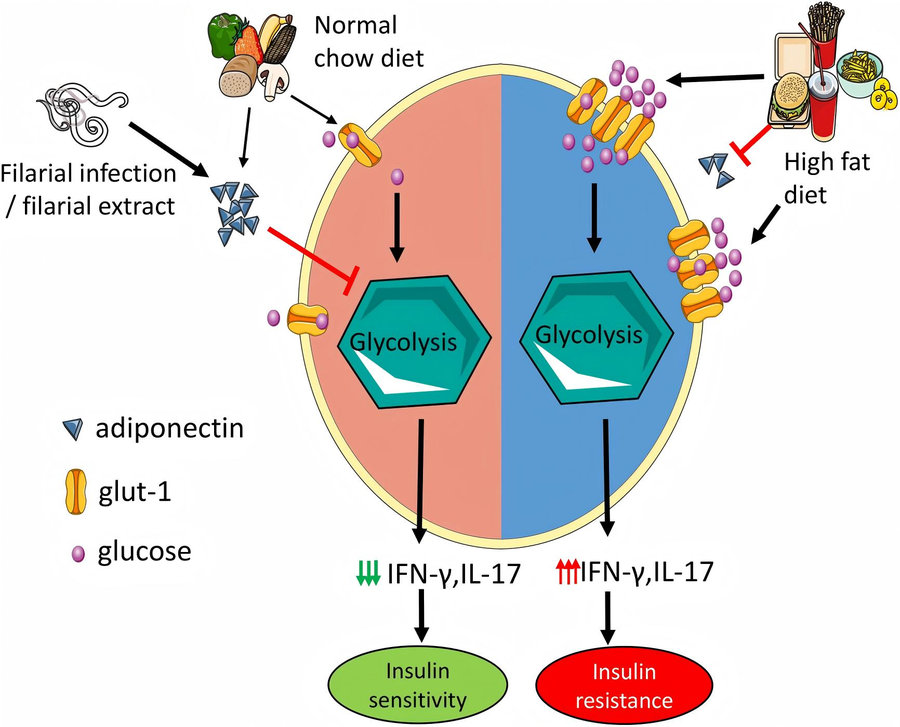 Fig.1 Adiponectin blocks obesity T-cell inflammation by restraining glycolysis: Helminth extract insulin-sensitizing mechanism. (Surendar, et al., 2019)
Customer Review
Bridging the In Vivo Translation Gap for Dual-Targeting Therapeutics
"We were struggling to find an in vitro assay that could accurately predict how our dual-targeting small molecules would impact adipose tissue inflammation in vivo. The scientific team at Protheragen set up a custom primary macrophage-adipocyte co-culture screen that gave us incredibly clear, reproducible data. Their functional GPCR profiling identified our lead candidate, which performed exactly as predicted when we moved to our animal models. We are already planning our next screening project with them."
Dr. A. T., Metacrine Therapeutics
Mapping Complex Immunometabolic Mechanisms with High-Resolution Bioenergetics
"Working with Protheragen has been a fantastic experience for our research group. Their real-time metabolic flux assays and cytokine profiling allowed us to map out the exact anti-inflammatory mechanism of our thermogenic compounds. The depth of their technical reports and their willingness to hop on a call to talk through the biology made a huge difference for our project timeline. They are a key partner for our ongoing discovery program."
Dr. E. R., Associate Scientist
Frequently Asked Questions
-
Why should I use immune cell-based assays instead of standard adipocyte cell lines?
Standard, isolated adipocyte cell lines lack the immune components that actually drive metabolic disease in vivo. By using co-cultures of primary adipocytes and immune cells (like macrophages), our platform recreates the chronic inflammatory environment of obesity. This gives you much more realistic data on how your compound will perform in preclinical animal models.
-
What species are your primary cells sourced from?
We routinely source primary cells from both rodent models (mouse and rat) and human donors. This lets you check for potential species-specific differences early in your pipeline, saving you time and resources before you move too far into development.
-
Can your platform handle multi-receptor agonists like GLP-1/GIP dual targets?
Yes, this is one of our core specialties. Our high-throughput functional GPCR profiling assays are specifically designed to measure signaling pathway activation, receptor internalization, and downstream functional outcomes for dual, triple, and multi-targeted compounds.
-
How do you measure thermogenesis in vitro?
We use real-time metabolic flux analyzers to measure the oxygen consumption rate (OCR) of adipocytes. By adding mitochondrial inhibitors and uncouplers during the assay, we can specifically determine the level of UCP1-dependent, uncoupled respiration induced by your compounds.
-
What is the typical turnaround time for a primary co-culture screen?
Turnaround times generally vary depending on the library size and the specific assays you choose. Typically, once we receive your compounds, a standard profiling project takes about 4 to 6 weeks from initial cell preparation to the final data report.
-
Do you offer custom assay development if we have a novel target?
We do. If your target does not fit into our standard assays, our R&D team can work with you to design, optimize, and validate a custom screening assay that fits your specific project needs.
-
How do you ensure the quality and reproducibility of your primary cell assays?
We perform strict quality control on every batch of primary cells we isolate, testing for viability, cell-specific markers, and functional responsiveness. We also include standard reference compounds in every run to make sure our assays remain highly consistent.
-
Can we submit biologics or antibodies for screening on this platform?
Yes, our platform works well with small molecules, peptides, antibodies, and other biological therapeutics. We can easily adjust the incubation times and assay conditions to suit the stability and characteristics of your specific molecules.
-
What readouts do you provide for inflammatory status?
We provide a complete picture of inflammatory changes by analyzing key pro- and anti-inflammatory cytokines (such as TNF-alpha, IL-6, IL-10) in the culture medium, measuring cell surface polarization markers by flow cytometry, and tracking downstream inflammatory signaling pathways.
-
How do we get started with a pilot study?
The best way to start is to reach out through our contact page. We will set up a quick call with our scientific team to talk about your targets, explain our options, and put together a tailored study plan for your pilot project.
Contact Us
Protheragen is dedicated to delivering high-quality, biologically relevant preclinical data to help you move your metabolic drug candidates forward. Our unique immune cell-based screening services bridge the gap between simple cell assays and complex animal studies, giving you a clearer path to successful lead optimization. Contact Protheragen for more information or a custom quote.
Reference
- Surendar, J.; et al. Adiponectin Limits IFN-γ and IL-17 Producing CD4 T Cells in Obesity by Restraining Cell Intrinsic Glycolysis. Front. Immunol. 2019, 10:2555 (CC BY 4.0).
All of our services and products are intended for preclinical research use only and cannot be used to diagnose, treat or manage patients.