
Anti-Obesity Drug Biophysical Assay Service
InquiryThe landscape of metabolic disease research is shifting fast. With the massive success of GLP-1 receptor agonists, the focus of anti-obesity drug development has rapidly expanded into multi-receptor targets. Designing therapeutics that can dual- or tri-target receptors like GLP-1R, GIPR, and GCGR requires a deep, highly precise understanding of molecular interactions.
Next-Generation Biophysical Characterization: Accelerating Preclinical Anti-Obesity Drug Discovery
At Protheragen, we focus entirely on the preclinical stage, helping drug discovery teams unpack these molecular nuances. Our biophysical assay services provide the quantitative, real-time binding kinetics and thermodynamic data necessary to guide hit-to-lead selection. By looking closely at how multi-receptor targeted peptides, small molecules, and biologics interact with membrane-bound GPCRs, we help you make informed decisions way before clinical trials are even on the horizon.
Core Technologies
Characterizing complex GPCRs and metabolic targets demands a diverse, high-performance biophysical toolkit. We do not rely on a single-method approach. Instead, we match the unique biology of your anti-obesity targets to the right instrumentation.
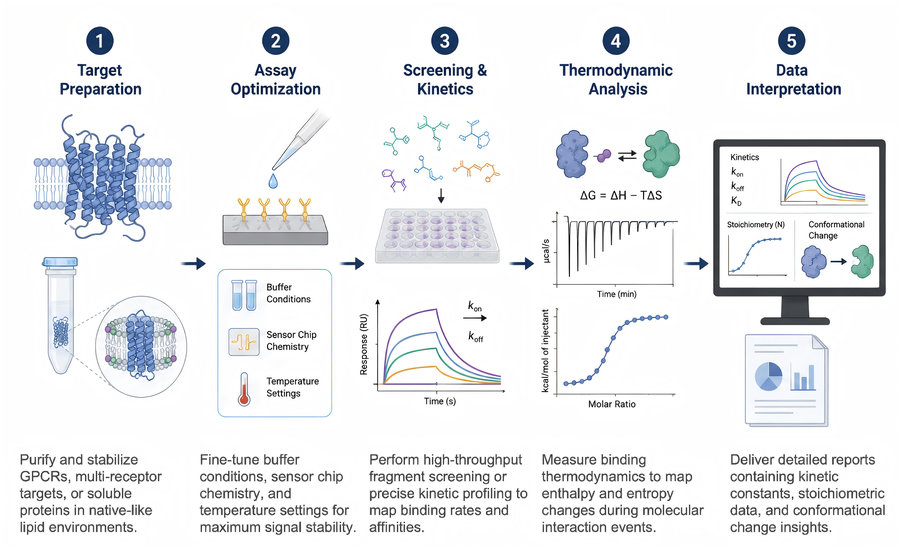
This is our workhorse for label-free, real-time kinetic analysis. SPR lets us measure association rates kon, dissociation rates koff, and overall affinity KD of your anti-obesity drug candidates. We routinely work with stabilized GPCRs embedded in nanodiscs or virus-like particles (VLPs) to capture binding kinetics under native-like conditions.
GPCRs can be delicate. MST allows us to measure molecular interactions in solution, even in cell lysates or complex buffers, by detecting changes in the hydration shell of proteins as they bind ligands. It is incredibly sensitive and uses minimal sample volume, which is a lifesaver when working with precious, hard-to-purify receptor preparations.
If you want to understand the thermodynamics driving your drug-receptor interaction, ITC is the gold standard. It directly measures the heat generated or absorbed during binding, yielding complete thermodynamic profiles—including enthalpy (ΔH), entropy (ΔS), and stoichiometry (n). This is critical for optimizing multi-agonist peptides where entropic penalties can sink a drug's efficacy.
For challenging membrane proteins, we offers high-resolution kinetic screening similar to SPR but with a higher tolerance for complex DMSO concentrations or partially purified samples. This ensures that even weak small-molecule hits can be tracked reliably.
Solution Scope
Protheragen provides a comprehensive suite of preclinical biophysical services tailored specifically to metabolic and anti-obesity drug pipelines. We work with various molecular modalities, including small molecules, peptides, monoclonal antibodies, and multi-specific constructs.
- Multi-Receptor Target Binding Characterization
Designing dual or triple co-agonists (such as GLP-1R/GIPR/GCGR tri-agonists) is highly complex. A key challenge is achieving balanced binding affinities across all target receptors. Our services allow you to run side-by-side SPR or MST assays to characterize the binding affinity and kinetics of your candidate molecule across multiple receptors simultaneously. This ensures your molecule maintains the exact target ratio required for optimal metabolic activity.
- Membrane Protein and GPCR Specialized Assays
GPCRs are notoriously unstable when removed from their lipid bilayers. We have optimized platforms for keeping these crucial obesity targets functional. We reconstitute GPCRs into:
- Nanodiscs: Providing a stable, phospholipid bilayer environment.
- Lipoparticles/VLPs: Displaying high concentrations of the target receptor on a stable viral scaffold.
- Detergent Micelles: Carefully screened to maintain structural integrity during biophysical testing.
- Fragment-Based Drug Discovery (FBDD) Screening
For teams looking to discover novel, non-peptide small molecules targeting obesity-related GPCRs or accessory proteins, we offer robust fragment screening. Using high-sensitivity SPR and GCI, we screen library compounds against metabolic targets, identifying weak binders (KD in the micromolar to millimolar range) that can be chemically optimized into high-affinity leads.
- Peptide Stability and Self-Association Studies
Peptide therapeutics for weight loss often suffer from aggregation or poor stability in solution. We use biophysical tools like dynamic light scattering (DLS) and analytical ultracentrifugation (AUC) to assess self-association, aggregation pathways, and formulation stability in a variety of preclinical buffers.
Inquire about setting up a pilot study for your lead candidates.
Workflow
Our preclinical biophysical assay process is designed to be rigorous, transparent, and highly collaborative. We break down the workflow into five essential steps to ensure your molecules are analyzed under optimized conditions.
Fields of Application
Our biophysical assay services fit seamlessly into several critical stages of preclinical metabolic drug research.
- Hit-to-Lead & Lead Optimization
Screen chemical or peptide libraries to identify compounds with the most favorable binding kinetics. By focusing on slow off-rates koff, we help you select leads that will exhibit prolonged receptor residency times in vivo. - Structure-Activity Relationship (SAR) Support
Quantify how minor chemical modifications—such as fatty acid conjugation or unnatural amino acid substitutions in GLP-1 analogs—impact binding kinetics and thermodynamic stability. - Formulation & Aggregation Assessment
Evaluate how different buffer conditions, pH levels, or excipients influence the oligomeric state and aggregation behavior of peptide co-agonists before starting preclinical animal dosing studies.
Advantages
Partnering with Protheragen means gaining access to high-tier biophysical instrumentation and deep expertise in membrane protein biochemistry. Here is what sets us apart:
Unrivaled Membrane Protein Expertise
GPCRs are notoriously difficult to handle, but our team has spent years optimizing reconstitution methods. We do not just run your samples; we actively stabilize your metabolic targets in custom lipid environments to ensure the binding data reflects physiological reality rather than artifactual binding.
Multi-Agonist Kinetic Profiling
We have designed a specialized screening workflow that measures binding kinetics across GLP-1, GIP, and glucagon receptors in parallel. It is confirmed that our multi-receptor kinetic profiling matches cell-based signaling trends, allowing you to deprioritize poor-performing candidates much earlier in the pipeline.
Low Sample Consumption Protocols
We understand that purifying GPCRs is expensive and time-consuming. Because of this, we have optimized our MST and GCI assays to use less target protein, saving you valuable resources and accelerating your early-stage discovery timelines.
Comprehensive Thermodynamic Mapping
We don't stop at simple affinity constants. By combining SPR kinetics with ITC thermodynamic profiles, we give your medicinal chemists a complete physical picture of the binding pocket interactions, enabling precise, structure-guided optimization of peptide leads.
Contact Our Team for More Information and to Discuss Your Project.
Customer Review
Solving the Multi-Agonist Kinetic Puzzle through GPCR Stabilization
"The team at Protheragen completely transformed our lead optimization process. We were struggling to get reproducible SPR kinetics for our GLP-1R/GIPR dual-agonist peptides using another vendor's platform. Protheragen stepped in, optimized the nanodisc reconstitution of our targets, and delivered incredibly clean, publication-quality kinetic data within four weeks. Their deep understanding of GPCR biochemistry made all the difference, and we are already planning our next project with them."
Dr. A. T., Research Chemist
Rescuing a Small-Molecule Pipeline with Rapid, Solution-Phase MST Assays
"We had a tight timeline to submit our preclinical data package for a novel small-molecule metabolic regulator. Protheragen's MST assays gave us the binding affinity validation we desperately needed when our surface-based assays failed due to ligand aggregation. Their scientific communication was excellent, and the level of detail in their final report gave us total confidence in our compound selection."
Dr. E. R., Bioanalytical Specialist
Frequently Asked Questions
-
How do you handle target proteins that are highly unstable, like wild-type GPCRs?
We use several advanced stabilization techniques. Depending on the target, we can reconstitute the protein into synthetic nanodiscs, polymer-based lipid particles, or virus-like particles (VLPs). This keeps the receptor in a native lipid environment, which dramatically improves its stability and functional shelf-life during our biophysical assays.
-
Can we run assays on multi-receptor targets like GLP-1R/GIPR co-agonists simultaneously?
Yes, absolutely. We can immobilize GLP-1R and GIPR on different channels of the same SPR sensor chip. This allows us to inject your co-agonist peptide once and capture real-time binding kinetics for both target receptors under identical assay conditions, saving you time and sample.
-
How much target protein do you typically need to run an SPR kinetic assay?
Because we have optimized our immobilization chemistry and use high-sensitivity instrumentation, we can often work with microgram quantities of purified protein. The exact amount depends on the molecular weight of your target and the ligand, but we always design our protocols to be highly conservative with your samples.
-
Do you offer cell-based functional assays alongside these biophysical assays?
Protheragen focuses strictly on cell-free biophysical characterization. However, we routinely partner with sister labs and can help coordinate downstream functional testing, or we can use your existing cell-based data to guide our biophysical assay design.
-
What is the main advantage of using MST over SPR for metabolic drug screening?
MST is a completely solution-based assay, meaning neither the protein nor the drug candidate needs to be immobilized to a surface. This eliminates potential steric hindrance issues and allows us to study interactions in complex buffers or even in the presence of mild detergents that might interfere with SPR fluidics.
-
Can you characterize small molecule allosteric modulators of GLP-1R?
Yes, we can. Biophysical assays like SPR and GCI are highly sensitive to conformational changes. By performing competitive binding assays or using specialized sensor chips, we can easily distinguish between orthosteric binding and allosteric modulation.
-
How do you address the high DMSO concentrations often required to dissolve small molecules?
DMSO can cause bulk refractive index shifts in optical assays like SPR. To counter this, we perform rigorous DMSO calibration curves and use high-performance systems with automated solvent correction software, ensuring that your kinetic data remains clean and accurate even at higher solvent concentrations.
Contact Us
Biophysical characterization is a vital bridge in preclinical anti-obesity drug discovery. By looking past simple endpoint assays and diving into real-time kinetics and thermodynamics, you gain the precise molecular insights needed to design safer, more effective multi-receptor therapeutics. Protheragen is here to support your team with high-end instrumentation, optimized GPCR assays, and experienced scientists who understand metabolic disease targets inside and out. Welcome to Contact Protheragen. Let us help you take the guesswork out of your lead optimization.
All of our services and products are intended for preclinical research use only and cannot be used to diagnose, treat or manage patients.