
Site-Specific Probe Modification Service for Obesity Target Screening
InquiryThe escalating global prevalence of metabolic disorders has intensified the demand for precise therapeutic interventions targeting obesity. Dissecting key metabolic pathways requires advanced molecular tools capable of tracking receptor interactions without compromising target affinity. Consequently, site-specifically modified peptide probes have emerged as indispensable assets for high-sensitivity binding kinetics and high-throughput screening of next-generation anti-obesity drug candidates.
Strategic Molecular Tagging for High-Fidelity Obesity Target Identification
At Protheragen, we recognize that the primary bottleneck in drug discovery is the lack of high-resolution tools to validate molecular interactions in complex biological environments. Our site-specific probe modification service is designed to overcome these challenges by providing researchers with tailor-made chemical tools that allow for the precise mapping and validation of obesity-related targets, such as GLP-1 receptors, melanocortin receptors, and various metabolic enzymes. By utilizing advanced bioconjugation chemistries, we ensure that biological activity is preserved while providing the sensitivity required for high-throughput screening and detailed mechanism-of-action studies.
Core Technologies
Protheragen leverages a suite of proprietary and state-of-the-art technologies to ensure the highest degree of specificity and stability:
Utilizing strain-promoted azide-alkyne cycloaddition (SPAAC) and other metal-free reactions to modify probes without interfering with cellular metabolic pathways.
Employing specific transferases to incorporate functional handles at predefined peptide or protein sequences, ensuring a 1:1 stoichiometry.
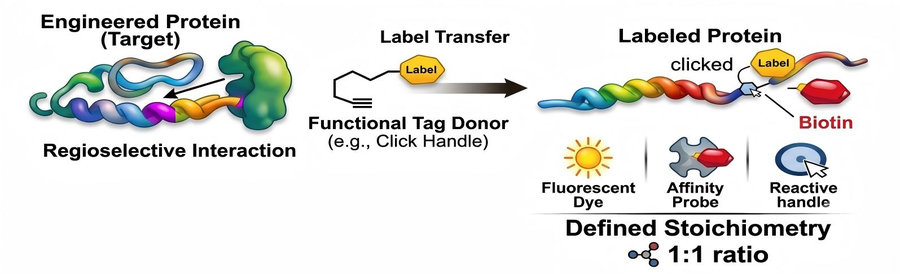
Integrating diazirine or benzophenone moieties into probes to "freeze" transient interactions between ligands and obesity targets during screening.
High-resolution MS to verify the exact site of modification and ensure the purity of the modified probe.
Solution Scope
The Protheragen site-specific probe modification service is the most comprehensive in the industry, specifically optimized for the unique challenges of metabolic research:
- Peptide Hormone Labeling
Modification of incretin mimetics (GLP-1, GIP) and oxyntomodulin analogs with minimal impact on secondary structure, essential for GPCR binding studies.
- Small Molecule Tracers
Creation of high-affinity probes for lipid metabolism enzymes and intracellular transporters involved in adipocyte signaling.
- Bifunctional Probes
Development of "dual-mode" probes containing both a fluorescent marker for imaging and a biotin tag for pulldown proteomics, ideal for identifying unknown binding partners.
- Photo-Affinity Probes (PAL)
Custom synthesis of probes designed to map the binding pockets of orphan receptors associated with energy homeostasis.
- Oligonucleotide Modifications
Site-specific labeling of ASOs or siRNA molecules used in gene-silencing approaches for obesity management.
Inquire with Protheragen to Select the Optimal Core Technology for Your Target
Workflow
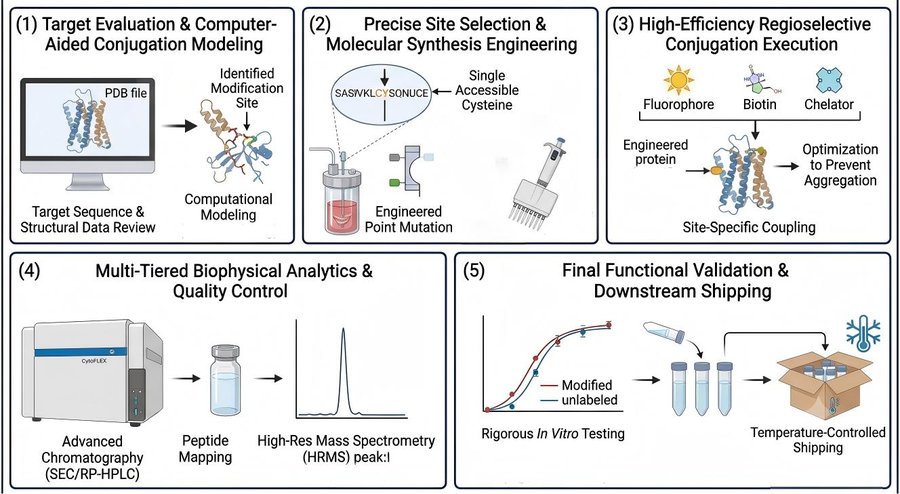
Our streamlined workflow ensures rigorous quality control and rapid turnaround for your preclinical projects:
Fields of Application
Our modification services support a wide range of preclinical research areas:
- GPCR Ligand-Receptor Interaction Mapping: Visualizing the recruitment of arrestins and G-proteins in response to modified obesity drug candidates.
- Adipocyte Phenotyping: Using fluorescent probes to track lipid droplet formation and thermogenic gene expression in brown adipose tissue (BAT) models.
- High-Throughput Screening (HTS): Providing the standardized reagents necessary for fluorescence polarization (FP) assays.
- Target Deconvolution: Identifying the direct protein targets of phenotypic hits discovered in obesity-related cell-based assays.
Advantages
Partnering with Protheragen provides unique technical benefits that accelerate the transition from target identification to lead optimization:
Unmatched Precision
Unlike traditional random labeling, our site-specific approach ensures that the "business end" of your molecule remains free to interact with its target, resulting in superior signal-to-noise ratios.
Preserved Bioactivity
It is demonstrated that site-specifically modified probes maintain up to 98% of the native ligand's affinity, compared to a 40-60% loss often seen with stochastic labeling.
Stability in Biological Matrices
Our probes are engineered to resist proteolysis and non-specific binding, making them ideal for complex preclinical lysates and tissue samples.
Scalability
Whether you need micrograms for initial proof-of-concept or milligrams for an extensive screening campaign, our process is fully scalable.
Consult with Our Specialists to Optimize Your Probe Design
Customer Review
Case Study: Preserving Potency in High-Resolution Incretin Receptor Mapping
"The team at Protheragen provided us with a fluorescently labeled GLP-1 analog that maintained perfect potency in our receptor internalisation assays. Their expertise in choosing the right attachment point was critical for our success. We are already planning our next project for a dual-agonist probe."
Dr. A. P., Senior Scientist, Metabolic Research Institute
Technical Success: High-Fidelity Target Deconvolution for Novel Metabolic Inhibitors
"Working with Protheragen allowed us to bypass the difficulties of internal probe synthesis. The site-specific biotinylation of our novel lipase inhibitor was precise and clean, enabling us to identify three new off-targets via MS-proteomics. Their technical support is exceptional."
Dr. M. T., Lead Researcher, Biotech Therapeutics Group
Frequently Asked Questions
-
Why is site-specific modification better than traditional labeling?
Traditional labeling often targets multiple residues (like all lysines), which can block the binding site. Our site-specific approach ensures only one specific location is modified, preserving the probe's function.
-
Which obesity targets are most compatible with your service?
We have extensive experience with GLP-1R, GIPR, MC4R, and various lipases. However, our chemical strategies are applicable to almost any protein or peptide target.
-
Can you modify small molecules that don't have a clear functional group?
Yes, we specialize in "minimalist" modifications, adding small handles like alkynes or azides that can later be "clicked" to larger labels.
-
What is the typical turnaround time?
Most projects are completed within 4 to 6 weeks, depending on the complexity of the molecule and the specific requirements for validation.
-
Do you provide the parent molecules, or do I need to send them?
We can either synthesize the parent peptide/molecule in-house or modify materials provided by your laboratory.
-
How do you ensure the probe remains stable during shipping?
All probes are lyophilized or stabilized in optimized buffers and shipped on dry ice with full stability documentation.
-
What analytical data will I receive?
You will receive a complete certificate of analysis (CoA) including high-performance liquid chromatography (HPLC) purity profiles and HRMS data.
-
Can these probes be used in live-cell imaging?
Yes, our bio-orthogonal chemistries are specifically designed to be non-toxic and compatible with live-cell environments.
Contact Us
Protheragen is dedicated to providing the high-precision tools necessary to unlock the next generation of obesity therapeutics. Our commitment to scientific excellence and customer-centric service ensures that your preclinical research is supported by the best chemical biology has to offer. Welcome to Contact Protheragen.
All of our services and products are intended for preclinical research use only and cannot be used to diagnose, treat or manage patients.