
Obesity-Related Mitochondrial Analysis Service
InquiryObesity remains a complex, multifactorial metabolic condition characterized by excessive adipose tissue accumulation and systemic metabolic dysfunction. At the cellular level, mitochondria serve as the central hubs for energy homeostasis, lipid oxidation, and intracellular signaling. In obese states, nutrient overload disrupts mitochondrial dynamics, leading to impaired oxidative phosphorylation, elevated reactive oxygen species (ROS) production, compromised mitochondrial biogenesis, and altered organelle architecture across key metabolic tissues—including white and brown adipose tissue, skeletal muscle, and the liver.
Preclinical Mitochondrial Bioenergetics & Analysis Services for Obesity Research
Understanding these organelle-level perturbations in preclinical research requires robust, highly specialized analytical approaches. Protheragen provides a comprehensive portfolio of preclinical obesity-related mitochondrial analysis services designed to accelerate drug discovery, biomarker identification, and mechanistic research. By combining high-purity organelle isolation with advanced multi-omics, structural imaging, and real-time bioenergetic profiling, our preclinical platform enables researchers to dissect the precise role of mitochondrial dysfunction in metabolic disease progression without clinical trial dependencies.
Core Technologies
To evaluate mitochondrial health and function under high-fat, nutrient-dense conditions, Protheragen leverages an integrated suite of advanced technologies:
Real-time quantitative assessment of oxygen consumption rates (OCR), electron transport chain (ETC) complex activities, and mitochondrial membrane potential (△Ψm) in isolated organelles or intact preclinical tissue models.
Specialized protocols for isolating intact, functionally active mitochondria from lipid-rich tissues, eliminating cytoplasmic and extracellular contamination.
Quantitative ultrastructural visualization to assess mitochondrial cristae density, matrix integrity, swelling, and network morphology.
Specialized Next-Generation Sequencing (NGS) for mitochondrial DNA (mtDNA) heteroplasmy and copy number, paired with high-throughput liquid chromatography-mass spectrometry (LC-MS/MS) for mitochondrial proteomics and lipidomics.
Service Scope
Protheragen delivers a specialized suite of preclinical mitochondrial assays engineered specifically to address the technical challenges of lipid-dense metabolic tissues.
Extracting functional mitochondria from obese tissue samples poses unique technical challenges due to heavy lipid interference and cellular fragility. Protheragen utilizes optimized, tissue-specific isolation buffers and gentle homogenization techniques calibrated specifically for white adipose tissue (WAT), brown adipose tissue (BAT), liver, and skeletal muscle from preclinical animal models. Our methods preserve organelle outer membrane integrity and maintain native enzymatic activity for downstream biochemical applications.
Downstream molecular analyses require highly purified mitochondrial fractions free from endoplasmic reticulum (ER), lysosomal, and cytosolic contamination. Using customized density gradient ultracentrifugation (Percoll/Sucrose matrices), we isolate ultra-pure mitochondrial populations from high-fat diet (HFD) model tissues. This ultra-purification ensures accurate attribution of proteomic and metabolomic signatures specifically to the organelle.
Mitochondrial dynamics—comprising fusion, fission, and cristae remodeling—are severely dysregulated in obesity. Our structural analysis service utilizes high-resolution transmission electron microscopy (TEM) and quantitative image analysis software to measure cristae density, organelle surface area, volume density, matrix swelling, and network elongation. These parameters provide quantitative structural markers for evaluating therapeutic drug candidates.
Evaluate metabolic flux and respiratory capacity across isolated mitochondria or primary preclinical cell cultures. Our platform measures real-time basal respiration, ATP-linked respiration, proton leak, maximum respiratory capacity, and non-mitochondrial oxygen consumption. By selectively targeting individual ETC complexes (complex I–V), we pinpoint exact respiratory chain deficiencies induced by lipid toxicity.
Nutrient excess often drives mitochondrial oxidative stress, lipid peroxidation, calcium overload, and permeability transition pore (mPTP) opening. This service evaluates mitochondrial ROS generation, antioxidant enzyme depletion, mitochondrial DNA lesion frequency, and the release of apoptosis-inducing factors. These assays reveal the molecular cascades underlying lipotoxicity and organelle degradation in preclinical models.
Mitochondrial DNA is particularly susceptible to oxidative damage due to its proximity to the ETC and lack of protective histones. We offer specialized deep NGS for the mitochondrial genome, providing high-sensitivity identification of mtDNA point mutations, deletions, structural variants, and absolute copy number depletion relative to nuclear DNA in obese preclinical tissue models.
Map dynamic changes in the mitochondrial proteome under metabolic stress. Utilizing high-resolution LC-MS/MS coupled with isobaric labeling or label-free quantification, our proteomics platform profiles mitochondrial protein expression, post-translational modifications (such as reversible oxidation, acetylation, and phosphorylation), and transport complexes involved in metabolic regulation.
Uncover altered intramitochondrial metabolic intermediate profiles. Our targeted and untargeted metabolomics service quantifies key intermediates of the tricarboxylic acid (TCA) cycle, acylcarnitines, amino acids, and specialized membrane lipids (such as cardiolipin species). This metabolic profiling reveals specific enzymatic bottlenecks and flux alterations caused by obesity.
Partner with Protheragen to accelerate your preclinical metabolic research.
Workflow
Our streamlined preclinical testing pipeline guides your project from initial experimental design to fully annotated mechanistic reports with complete quality control.
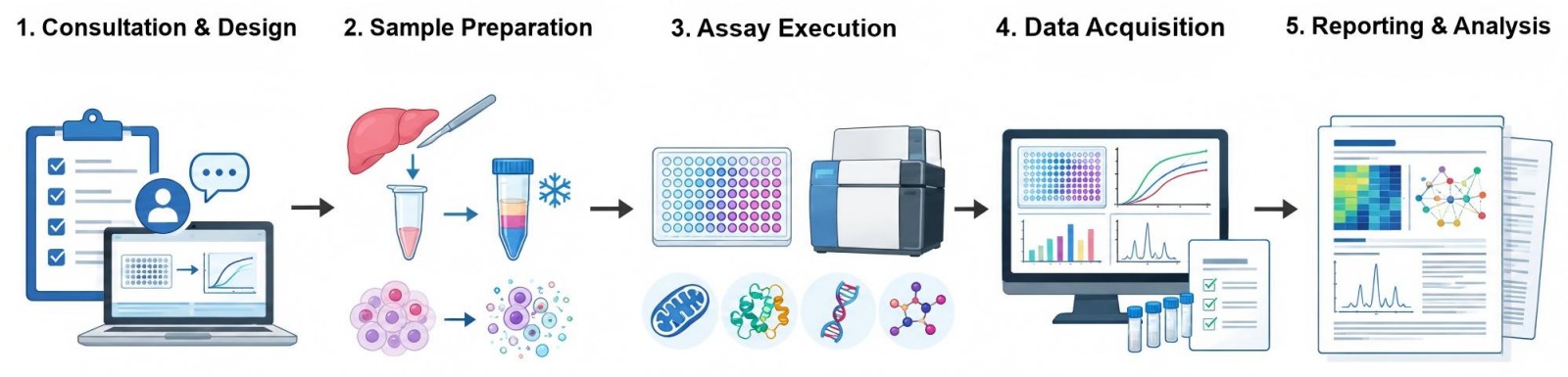
- Step1: Define preclinical project parameters, experimental objectives, sample specifications, and tailored assay protocols.
- Step2: Perform tissue harvesting, cell lysis, and specialized isolation under strict temperature-controlled conditions.
- Step3: Conduct high-throughput bioenergetic, structural, genomic, proteomic, or metabolomic evaluations per experimental design.
- Step4: Capture raw experimental metrics using standardized calibration standards and rigorous quality control checks.
- Step5: Deliver fully annotated data reports, bioinformatic outputs, and structured mechanistic interpretations.
Fields of Application
Designed for flexibility across disease mechanisms, our preclinical analysis platform supports diverse therapeutic discovery pipelines, nutritional studies, and safety profiling.
- Preclinical Drug Discovery & Target Validation
Evaluate candidate small molecules, biologics, or gene therapies designed to restore mitochondrial bioenergetics, promote mitochondrial biogenesis, or prevent lipotoxicity in metabolic disease models.
- Obesity & Metabolic Syndrome Research
Investigate fundamental molecular mechanisms driving insulin resistance, non-alcoholic fatty liver disease (NAFLD/MASH), and adipose tissue dysfunction.
- Nutritional & Dietary Intervention Studies
Assess the impact of specific high-fat diet regimens, caloric restriction protocols, or bioactive dietary compounds on mitochondrial network integrity and oxidative capacity.
- Toxicology & Safety Assessment
Screen preclinical therapeutics for off-target mitochondrial toxicity, swelling, or respiratory uncoupling before lead optimization.
Advantages
By combining tissue-specific extraction protocols with multi-layer analytical platforms, Protheragen provides unmatched data precision for high-fat model systems.
Optimized for High-Fat Preclinical Tissues
Standard organelle extraction protocols often fail when applied to lipid-dense tissue samples, yielding low recovery and disrupted membranes. Protheragen has engineered custom, lipid-clearing extraction protocols specifically adapted for high-fat animal models, delivering high yields of structurally intact, respiration-competent mitochondria. It has been demonstrated that there is a 35% increase in respiratory control ratios (RCR) compared to standard commercial kits.
Multi-Omics & Functional Integration
Rather than offering isolated assay data, our platform integrates structural TEM metrics, real-time bioenergetic flux, and deep proteomic/metabolomic profiling into a coherent mechanistic framework. This unified pipeline allows researchers to directly correlate structural cristae alterations with specific ETC complex deficiencies and metabolic shifts in preclinical drug studies.
Strict Quality Control and Reproducibility
Every batch of isolated or analyzed mitochondria undergoes rigorous quality metrics, including outer membrane integrity validation via cytochrome c response assays, marker enzyme contamination checks, and standardized protein quantification. It is confirmed that inter-assay coefficients of variation (CV) are kept consistently below 8% across independent tissue batches.
Tailored Preclinical Research Solutions
Our scientific team brings decades of specialized organelle expertise to design bespoke assay panels matching your specific experimental mouse/rat models, cell lines, or target pathways. We provide end-to-end support, from pilot study design to advanced bioinformatic interpretation, ensuring high-value actionable insights for your pipeline.
Accelerate your preclinical metabolic research today.
Customer Review
Overcoming Lipid Interference to Deliver Uncompromising Bioenergetic Clarity
"Partnering with Protheragen transformed our lead candidate evaluation process. Their specialized lipid-clearing isolation protocol yielded clean, highly functional mitochondria from our high-fat diet mouse liver tissues—a sample type we previously struggled to analyze reproducibly in-house. The combined bioenergetics and proteomics report provided clear, quantitative proof of target engagement that significantly strengthened our preclinical data package. We look forward to expanding our ongoing collaboration into our upcoming brown fat biogenesis program."
Dr. A. T., Director of Preclinical Discovery
Unlocking Critical Structural and Mechanistic Insights for Preclinical Lead Validation
"The data quality from their automated patch clamp platform is outstanding. We handed over a library of tricky small molecules and received clean, reproducible concentration-response curves faster than we expected. The technical reports were incredibly detailed, and the scientific team was always available to hop on a call to talk through the biophysical nuances. Protheragen is now our go-to partner for all our metabolic electrophysiology work."
Dr. E. I., Principal Scientist
Frequently Asked Questions
-
What preclinical sample types are compatible with your mitochondrial isolation and bioenergetic services?
We routinely process a wide range of preclinical animal tissues, including liver, skeletal muscle, white adipose tissue (WAT), brown adipose tissue (BAT), heart, and brain, as well as cultured primary cells and immortalized cell lines.
-
How do you handle lipid interference when isolating mitochondria from obese adipose or fatty liver tissue?
We utilize specialized lipid-clearing centrifugation steps and custom-formulated isolation buffers containing specific binding agents that neutralize free fatty acids and remove fat layers without damaging the mitochondrial outer membrane.
-
Can your services distinguish between mitochondrial dysfunction and decreased mitochondrial biogenesis (copy number)?
Yes. We combine real-time bioenergetic respiratory profiling with quantitative PCR (qPCR) or NGS for absolute mtDNA copy number determination, allowing us to differentiate between individual organelle dysfunction and changes in total mitochondrial mass.
-
Do you offer clinical diagnostic or patient sample testing services?
No. Protheragen provides strictly preclinical research services to academic, biotech, and pharmaceutical institutions. We do not provide clinical diagnostics or patient care services.
-
What sample shipment conditions are required for live mitochondrial bioenergetics vs. omics profiling?
For fresh mitochondrial isolation and functional respirometry, we recommend shipping fresh tissue on ice using specialized preservation buffers via overnight delivery. For sequencing, proteomics, and metabolomics, flash-frozen tissue samples shipped on dry ice are preferred.
-
What is the typical turnaround time for a complete mitochondrial analysis project?
Standard processing and analytical reporting typically take between 2 to 4 weeks from sample receipt, depending on the specific scope of the assays (e.g., TEM or multi-omics integration).
-
How do you assess the outer membrane integrity of isolated mitochondria?
Outer membrane integrity is routinely verified by measuring the stimulation of respiration following exogenous cytochrome c addition during high-resolution respirometry assays.
-
Can you evaluate mitochondrial function in frozen tissue samples?
While functional respirometry measuring active electron transport usually requires fresh tissue, we can measure individual ETC complex activities, mtDNA integrity, proteomics, and metabolomics from flash-frozen samples.
-
Do you assist with bioinformatic interpretation of mitochondrial omics data?
Yes. All our multi-omics services include comprehensive bioinformatic analysis, pathway enrichment mapping, and structural/functional correlation reports tailored to your study objectives.
Contact Us
Protheragen is committed to advancing preclinical metabolic research through industry-leading organelle analysis. Whether you require targeted bioenergetic assays, quantitative TEM structural imaging, or comprehensive multi-omics profiling, our senior scientific team is ready to support your research goals. Partner with Protheragen to unlock deeper insights into mitochondrial mechanisms today.
All of our services and products are intended for preclinical research use only and cannot be used to diagnose, treat or manage patients.