
Obesity-Related Mitochondrial Sequencing Service
InquiryMitochondria play a huge role in cellular bioenergetics, metabolic regulation, and lipid homeostasis. In metabolic disorders, especially obesity, mitochondrial dysfunction often manifests through subtle variations in the mitochondrial genome (mtDNA). These include point mutations, low-level heteroplasmy, structural rearrangements, and shifts in copy number. Detecting these small genomic changes isn't easy, though. The high copy number of mtDNA per cell, combined with nuclear mitochondrial DNA sequences (NUMTs) that mimic true mitochondrial genomes, creates real technical challenges for standard sequencing methods.
High-Depth Preclinical Mitochondrial Sequencing for Obesity Research
Protheragen provides a dedicated obesity-related mitochondrial sequencing service built exclusively for preclinical research projects. We help drug discovery teams, translational researchers, and academic laboratories unpick the complex genetic mechanisms that link mitochondrial variants to diet-induced obesity, impaired thermogenesis, and metabolic inflammation. By combining targeted amplification strategies with high-depth next-generation sequencing (NGS), our platform helps you profile mtDNAs cleanly. It cleanly separates true mitochondrial signals from nuclear interference, giving you reliable data to move your target validation forward.
Core Technologies
Protheragen integrates high-fidelity long-range PCR, ultra-deep next-generation sequencing, and custom bioinformatic pipelines to deliver accurate, high-resolution mitochondrial genomic data:
We use overlapping long-range PCR (LR-PCR) strategies designed to cover the entire mitochondrial genome (approx. 16.5 kb in rodents and humans). By amplifying the mtDNA genome in a few long, specific fragments, we drastically reduce the risk of co-amplifying pseudogenes located in the nuclear genome (NUMTs). This approach ensures that downstream NGS reads accurately reflect the actual mitochondrial genome.
Detecting low-frequency heteroplasmic variants—sometimes representing less than 1% of total cellular mtDNA—requires deep sequencing coverage. Our sequencing platforms yield average read depths exceeding 10,000x across the targeted regions. This depth gives us the statistical power needed to distinguish low-level somatic mutations from background noise in preclinical tissue samples like white fat, brown fat, liver, and skeletal muscle.
Raw sequence data undergoes a rigorous analytical workflow tuned for mitochondrial genomics. Our custom pipelines handle:
- Precise mapping against species-specific mitochondrial reference genomes.
- Filtering out potential NUMT reads using alignment scoring and junction checking.
- Quantifying heteroplasmy levels down to low thresholds with strict error-correction algorithms.
- Calculating relative mitochondrial DNA copy numbers (mtDNA/nDNA ratios) from normalized sequencing coverage.
Service Scope
Our service supports preclinical discovery across a wide range of sample types and experimental setups:
- Whole Mitochondrial Genome Sequencing
Complete coverage of coding regions (ND1-ND6, CYTB, COX1-3, ATP6/8) and the non-coding control region (D-loop) to discover rare variants and somatic shifts linked to metabolic stress.
- Targeted mtDNA Panel Profiling
Focused sequencing of specific mitochondrial genes implicated in respiratory chain assembly, ROS production, or uncoupling mechanisms (e.g., UCP1-related pathways).
- Heteroplasmy Quantification
Precise identification and tracking of mixed mtDNA populations within heterogeneous tissue samples, allowing researchers to measure how heteroplasmy changes during drug candidate dosing or dietary interventions.
- mtDNA Copy Number Analysis
Relative and absolute quantification of mitochondrial genome abundance relative to nuclear reference genes, serving as a biological biomarker for mitochondrial biogenesis or depletion.
- Preclinical Animal Model Profiling
Optimized protocols for mouse (e.g., C57BL/6J diet-induced obesity models), rat, non-human primate, and cell culture samples, ensuring consistent data across diverse research models.
Contact Our Team for More Information and to Discuss Your Project
Workflow
Our streamlined five-step workflow is built to keep your research project moving forward on schedule:
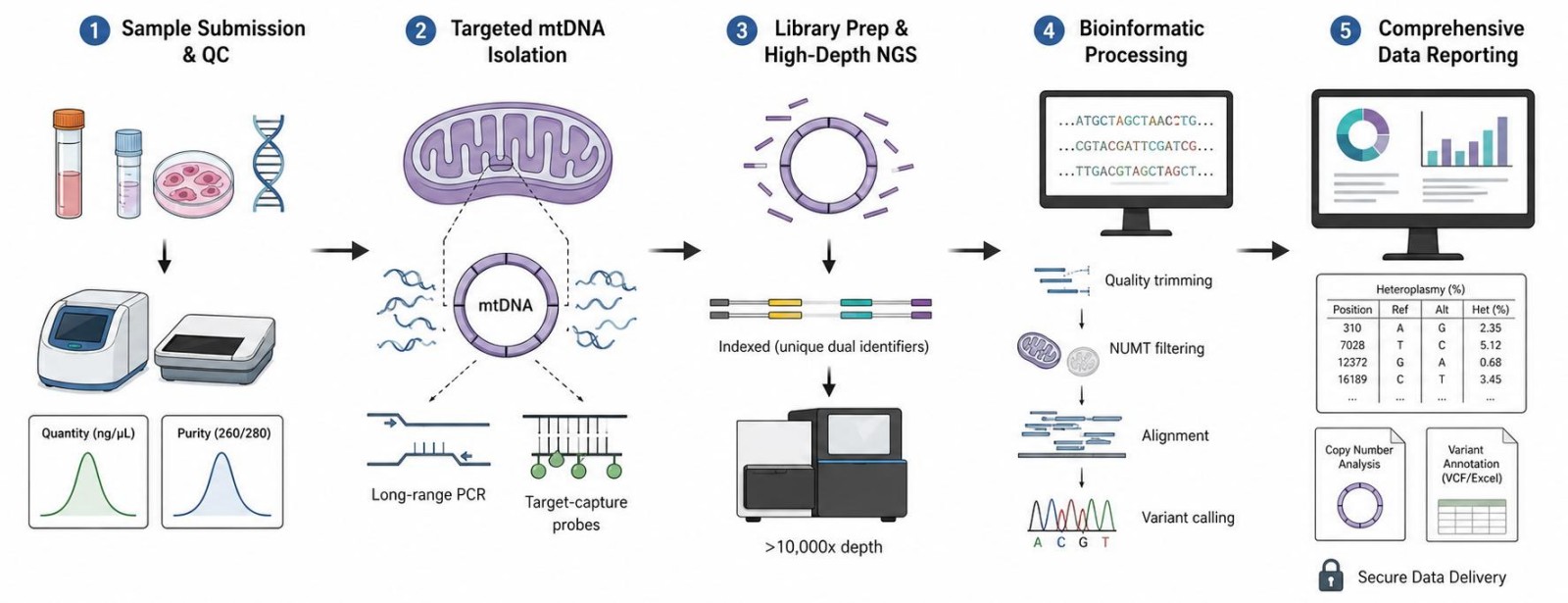
- Step 1: Incoming tissue, isolated cell, or DNA samples undergo immediate quantity and purity assessment using fluorometric assays.
- Step 2: High-fidelity long-range PCR or specialized target-capture probes selectively enrich the full mitochondrial genome.
- Step 3: Enriched mtDNA is fragmented, indexed with unique dual identifiers, and sequenced at target depths over 10,000x.
- Step 4: Raw reads pass through quality trimming, NUMT filtering, alignment, and calibrated variant-calling algorithms.
- Step 5: Fully analyzed datasets, including heteroplasmy tables, copy number ratios, and variant annotation files, are delivered securely and ready for interpretation.
Fields of Application
Our obesity-related mitochondrial sequencing service empowers researchers across critical stages of preclinical metabolic drug discovery and translational science:
- Target Discovery and Validation
Identify novel mtDNA mutations or metabolic variants that alter oxidative phosphorylation efficiency, contributing to positive energy balance and weight gain.
- Preclinical Drug Candidate Evaluation
Measure the off-target mitochondrial toxicity or therapeutic efficacy of anti-obesity drugs, compounds targeting AMPK, or mitochondrial uncouplers by monitoring mtDNA integrity and copy number.
- Brown and Beige Adipose Tissue Research
Assess mitochondrial biogenesis and genome stability in thermogenic tissues during cold exposure or pharmacological stimulation.
- Metabolic Biomarker Identification
Track shifts in mtDNA heteroplasmy or copy number ratios as non-invasive biomarkers of disease progression in preclinical diet-induced obesity (DIO) animal models.
Advantages
Protheragen combines ultra-deep sequencing coverage with specialized enrichment strategies to overcome the technical challenges of preclinical mitochondrial genomics:
High Sensitivity for Low-Frequency Heteroplasmy
Our specialized enrichment protocols and ultra-deep sequencing depth allow us to detect mtDNA heteroplasmy levels down to 0.5-1.0%. This capability helps you spot minor variant shifts long before overt metabolic phenotypes appear in your model organisms. It is confirmed that our pipeline maintains exceptional signal-to-noise ratios even in difficult tissue matrices like liver and brown adipose tissue.
Complete Nuclear Pseudogene (NUMT) Elimination
NUMTs frequently contaminate standard whole-genome or exome sequencing data, leading to false-positive variant calls. Protheragen utilizes dual-stage amplification validation and tailored bioinformatic filters that remove NUMT interference, ensuring your variant calls reflect genuine mitochondrial events.
End-to-End Preclinical Optimization
We don't offer generic human clinical assays adapted for research; our workflows are tuned specifically for preclinical models (mouse, rat, cell lines). We accept challenging sample types with low DNA input, offering tailored extraction and amplification steps optimized for tissue samples with high fat content.
Actionable, Publication-Ready Bioinformatics Deliverables
Beyond raw FASTQ files, we supply structured variant tables annotated with functional predictions, heteroplasmy frequencies, and relative mtDNA copy number calculations.
Contact Our Expert Team Today to request a detailed proposal.
Customer Review
Overcoming NUMT Interference in Diet-Induced Obesity Models
"Working with Protheragen transformed our search for mitochondrial target genes in our mouse diet-induced obesity model. We had struggled with persistent nuclear pseudogene background from standard exome sequencing, which made heteroplasmy calls unreliable. The team at Protheragen walked us through their long-range PCR enrichment workflow and delivered clean, high-coverage data that clearly highlighted minor heteroplasmic shifts in our high-fat diet cohorts. We plan to keep collaborating with Protheragen for all our upcoming secondary compound screening studies."
Dr. A. T., Principal Scientist
Precision Heteroplasmy and Copy Number Profiling in Thermogenic Fat Research
"The depth of coverage and clear copy number analysis provided by Protheragen gave us the exact data we needed to submit our recent grant proposal. Their bioinformatic reports were easy to navigate, and their scientific support team was always available to refine data parameters to match our study needs. We view Protheragen as a true research partner for our ongoing work in brown fat thermogenesis."
Dr. E. R., Director of Translational Genomics
Frequently Asked Questions
-
What sample types do you accept for the obesity-related mitochondrial sequencing service?
We accept isolated genomic/mitochondrial DNA, fresh-frozen tissues (such as liver, skeletal muscle, white adipose, and brown adipose tissue), cell pellets, and primary culture suspensions from standard animal models and cell lines.
-
How do you prevent nuclear mitochondrial DNA segments (NUMTs) from skewing the results?
We use validated long-range PCR primers designed to selectively amplify full-length mitochondrial DNA while avoiding nuclear regions. Coupled with specialized alignment algorithms during bioinformatic processing, NUMT reads are recognized and filtered out.
-
What is the minimum DNA input required for this service?
While standard protocols perform best with 50-100 ng of high-quality genomic DNA, our optimized low-input workflows can accommodate down to 10 ng for precious preclinical samples.
-
Can this service measure mitochondrial DNA copy number (mtDNA/nDNA ratio)?
Yes. By pairing normalized mitochondrial sequencing coverage with nuclear target reference markers, we deliver reliable relative mtDNA copy number measurements alongside variant and heteroplasmy profiling.
-
How low of a heteroplasmy frequency can your sequencing pipeline reliably detect?
Our ultra-deep sequencing strategy (typically >10,000x coverage) allows us to confidently identify heteroplasmic variants down to a threshold of 0.5% to 1.0%, depending on sample quality and input quantity.
-
Is this service intended for diagnostic or clinical use in human patients?
No. Protheragen provides services strictly dedicated to preclinical research, drug discovery, and basic scientific investigation. Our testing cannot be used for clinical diagnostic purposes.
-
How do you handle high-fat tissue samples like white adipose tissue during DNA extraction?
We use specialized tissue lysis and lipid-clearing extraction protocols tailored for adipose-rich samples, ensuring high-purity DNA free from downstream PCR inhibitors.
-
What formats are provided for the final bioinformatic deliverables?
We provide raw FASTQ files, aligned BAM files, and fully annotated VCF/XLSX spreadsheets listing variant positions, read depths, heteroplasmy percentages, functional annotations, and copy number ratios.
Contact Us
Protheragen helps preclinical research teams uncover deeper genetic insights into metabolic diseases. Our obesity-related mitochondrial sequencing service gives you high-depth, low-noise mitochondrial genomic data designed specifically for drug discovery and target validation workflows. Contact Protheragen!
All of our services and products are intended for preclinical research use only and cannot be used to diagnose, treat or manage patients.