
Two-Electrode Voltage Clamp Service
InquiryTargeting membrane proteins that regulate energy homeostasis, nutrient transport, and metabolic signaling has become a cornerstone of modern preclinical anti-obesity drug development. Ion channels and electrogenic transporters located across central hypothalamic circuits, pancreatic beta cells, and peripheral adipose tissues govern fundamental processes like satiety signaling, insulin secretion, and mitochondrial uncoupling. Characterizing candidate molecules against these targets requires high-fidelity functional assays capable of resolving ion fluxes, voltage dependencies, and subtle kinetic alterations with extreme precision.
Two-Electrode Voltage Clamp Service for Obesity Research
At Protheragen, our two-electrode voltage clamp (TEVC) service offers a robust quantitative platform specifically tailored for preclinical obesity research. By utilizing Xenopus laevis oocytes as heterologous expression hosts, TEVC enables direct functional interrogation of membrane channels, transporters, and GPCR-coupled effector pathways. The large physical size and resilient membrane architecture of oocytes allow for precise voltage control and rapid microfluidic exchange, making TEVC ideal for screening small molecules, peptides, and natural compounds. Whether you are validating novel metabolic targets or screening hit compounds against ionotropic pathways, Protheragen provides the biophysical rigor needed to advance your preclinical drug discovery pipeline.
Core Technologies
The two-electrode voltage clamp (TEVC) technique remains the gold standard for biophysical characterization of membrane transport proteins in heterologous expression systems. Our specialized platform integrates several advanced biophysical mechanisms and instrumentation components:
Uses two microelectrodes impaled into a single Xenopus oocyte—one electrode continuously senses the intracellular voltage while the high-speed feedback amplifier injects a compensating current through the second electrode to hold the membrane potential precisely at the target voltage.
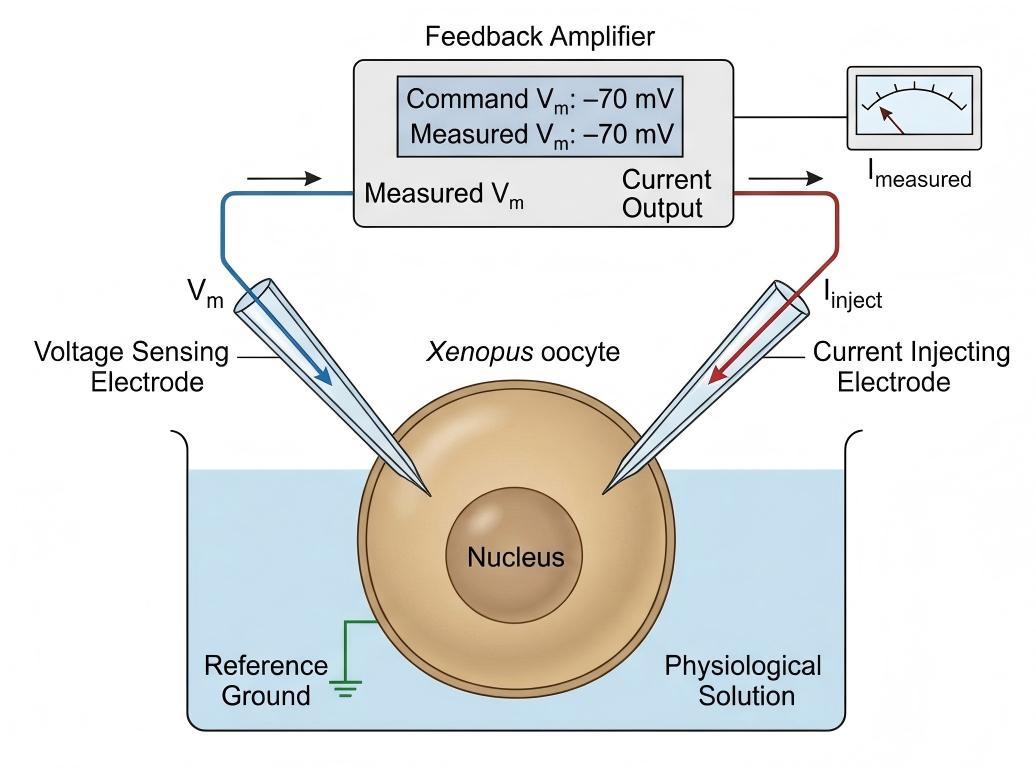
Measures the injected compensating current in real time, providing a direct, highly accurate readout of the net ionic fluxes across the plasma membrane driven by channel opening or transporter turnover.
Utilizes high-gain, low-noise amplifiers tuned for high-capacitance cells, guaranteeing rapid clamping settling times and reliable detection of microampere- and nanoampere-level current responses.
Combines linearized plasmid vector design, high-yield in vitro transcription, and automated nanoliter-volume oocyte microinjection to deliver consistent, dense protein expression on the cell surface.
Incorporates continuous-flow microfluidic bath chambers that ensure complete bath exchange within milliseconds, enabling precise kinetic measurements, wash-in/wash-out profiles, and state-dependent drug interactions.
Service Scope
Protheragen delivers comprehensive TEVC evaluation across a broad array of membrane proteins implicated in energy balance, adipogenesis, and metabolic regulation. Our preclinical assay portfolio includes:
- Sodium-Glucose Cotransporters (SGLT1 & SGLT2)
Quantify electrogenic glucose transport currents generated by SGLT family members. We evaluate competitive inhibition kinetics, substrate selectivity, and dose-dependent block by candidate anti-diabetic and weight-management molecules.
- ATP-Sensitive Potassium (KATP) Channels
Assess Kir6.2/SUR1 and Kir6.2/SUR2 subunit combinations governing pancreatic insulin secretion and hypothalamic glucose sensing. Our assays measure channel activation, inhibition, and modulation by intracellular metabolic intermediates.
- Transient Receptor Potential (TRP) Channels
Characterize TRPM8, TRPV1, TRPA1, and endolysosomal TPC channels involved in brown adipose tissue thermogenesis, dietary lipid availability, and metabolic energy expenditure. We measure agonist-induced inward currents, pore block, and temperature-dependent gating kinetics.
- Anion Channels & Proton Transporters
Measure electrogenic proton leaks, chloride transport, and uncoupling protein activity across cellular membranes to evaluate compounds targeting metabolic efficiency and basal energy expenditure.
- Metabotropic GPCR-GIRK Pathways
Co-express G-protein coupled receptors regulating appetite (e.g., neuropeptide targets, cannabinoid receptors, and ghrelin/leptin pathways) alongside G-protein-coupled inwardly rectifying potassium (GIRK) channels. This functional setup converts GPCR activation into measurable current changes, providing a direct readout of receptor agonism, antagonism, and allosteric modulation.
- Nutrient & Amino Acid Transporters
Study electrogenic amino acid, peptide, and fatty acid transport complexes that modulate gut-brain nutrient signaling and metabolic homeostasis.
Explore Our Service Scope & Request a Custom Assay Design
Workflow
Our TEVC assay pipeline follows a structured, quality-controlled pathway designed to generate clear, actionable biophysical data for preclinical drug candidates.
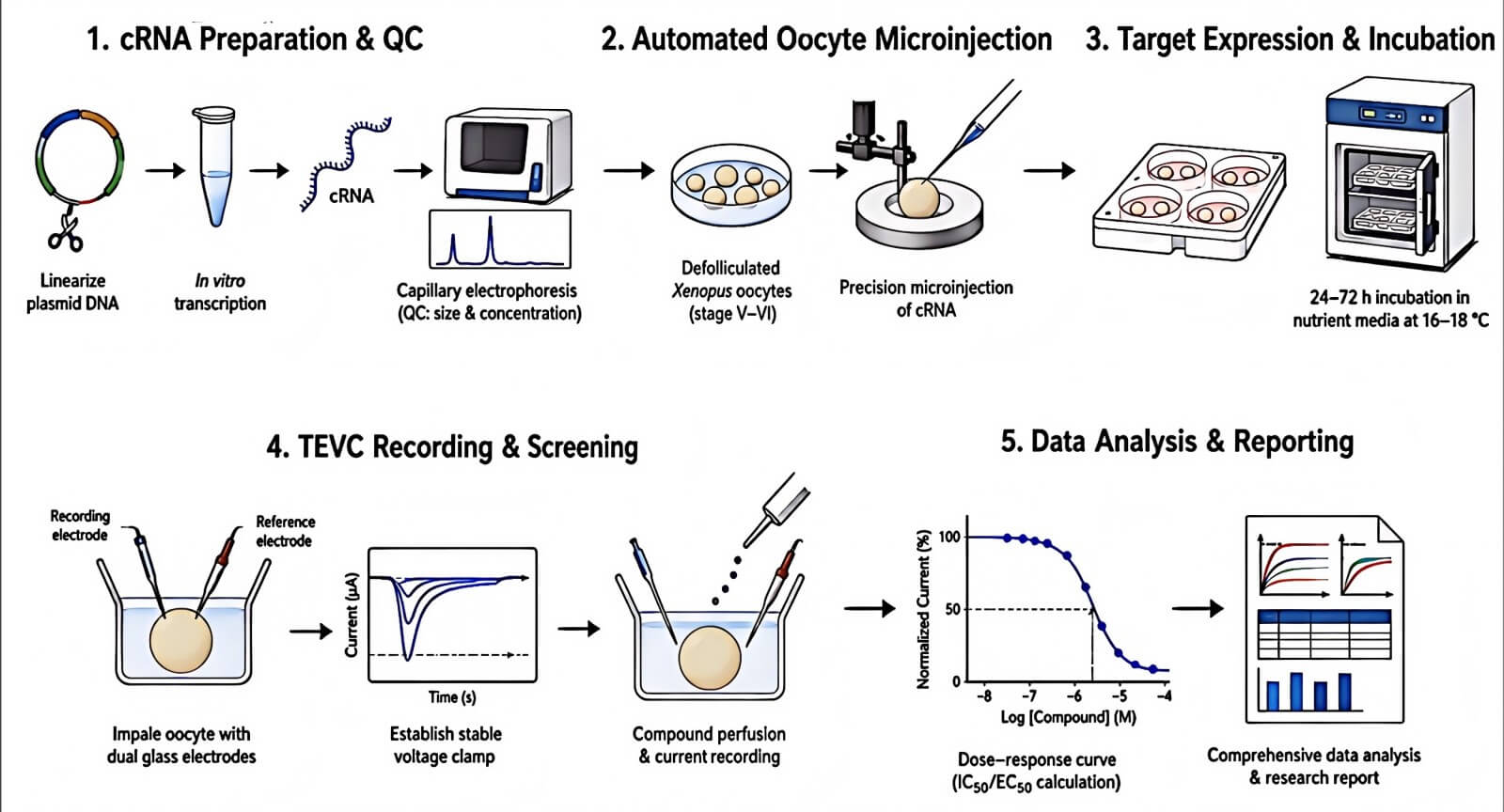
- Step1: Linearize plasmid DNA templates, synthesize high-purity cRNA transcripts in vitro, and verify length and concentration via capillary electrophoresis.
- Step2: Defolliculate stage V-VI Xenopus oocytes using collagenase treatment and inject nanoliter volumes of target cRNA using precision glass micropipettes.
- Step3: Maintain injected oocytes in temperature-controlled nutrient media for 24 to 72 hours to allow optimal plasma membrane protein expression.
- Step4: Impale oocytes with dual glass electrodes, establish stable voltage clamp conditions, and record current responses during compound perfusion.
- Step5: Analyze current amplitudes, activation kinetics, dose-response curves, and IC50/EC50 values to generate detailed research reports.
Fields of Application
Our preclinical TEVC services directly support several key domains within metabolic disease drug discovery:
- Hypothalamic Appetite & Satiety Screening: Evaluate Small Molecules and peptide analogs acting on central circuit ion channels and GPCR-GIRK cascades that govern hunger signals.
- Adipose Tissue Thermogenesis Research: Screen channel modulators that activate brown and beige adipocyte thermogenic pathways, boosting basal metabolic rate.
- Intestinal & Renal Nutrient Transport Blockade: Profile selective inhibitors of SGLT glucose transporters and peptide cotransporters to reduce caloric absorption or enhance urinary glucose excretion.
- Pancreatic Beta-Cell Electrophysiology: Study KATP channel openers or blockers that modulate membrane depolarization and downstream calcium-dependent insulin release dynamics.
Advantages
Partnering with Protheragen for your preclinical TEVC assays provides significant biophysical and operational benefits for your anti-obesity discovery programs:
Exceptional Signal Resolution & Stability
Xenopus oocytes offer a massive surface area that yields robust, high-amplitude ionic currents. This large signal window minimizes background noise, making it straightforward to resolve partial agonism or subtle channel blockages that might be missed in smaller mammalian cell lines. It has been demonstrated that lower run-down rates and higher recording stability over prolonged compound exposures.
Unmatched Assay Flexibility for Complex Targets
Heterologous expression in oocytes allows easy co-expression of multiple protein subunits, accessory factors, and biosensor channels. Whether your target requires multi-subunit assembly or metabolic pathway coupling, our platform accommodates custom cRNA stoichiometry with high success rates.
Fast Microfluidic Washout & Kinetic Precision
Our specialized chamber geometry enables rapid bath solution exchange within milliseconds. This rapid flow ensures precise determination of compound association/dissociation rates, wash-in times, and state-dependent channel block without compound accumulation artifacts.
Cost-Effective Preclinical Screening Capacity
By combining automated microinjection with semi-automated multi-channel clamp rigs, Protheragen offers rapid assay turnaround times. You get high-rigor electrophysiological data without the massive overhead associated with maintaining dedicated patch-clamp facilities in-house.
Request a Customized TEVC Proposal & Consult with Our Biophysics Team.
Customer Review
Accelerating Central Nervous System Target Pipelines
"Working with Protheragen transformed our hit-to-lead timeline for our hypothalamic ion channel target. Their TEVC team demonstrated exceptional technical skill in co-expressing our multi-subunit complex in oocytes, delivering clear, reproducible dose-response data that clarified our compound's mechanism of action. Communication was seamless throughout the project."
Dr. E. R., Senior Principal Scientist in Metabolic Diseases
Solving Complex Biophysical and Solubility Challenges
"The biophysical rigor Protheragen brings to electrogenic transporter assays is unmatched. Their customized perfusion setup solved our solubility issues with lipophilic hits, giving us accurate IC50 values that directly informed our lead optimization strategy. We look forward to continuing our partnership across our pipeline."
Dr. M. V., Vice President of Preclinical Discovery
Frequently Asked Questions
-
Why should we choose TEVC over automated mammalian patch-clamp for our obesity targets?
TEVC in Xenopus oocytes excels at recording large electrogenic transporters and multi-subunit channel complexes that can be difficult to express functionally in mammalian expression lines. The system allows precise control over injected cRNA ratios, yielding exceptionally stable signals for kinetic and thermodynamic profiling.
-
Can Protheragen handle custom cRNA synthesis, or do we need to supply the transcripts?
We offer full end-to-end support. You can provide plasmid vectors, wild-type/mutant cDNA sequences, or pre-synthesized cRNA. Our molecular biology team handles sub-cloning, linearization, in vitro transcription, and quality control internally.
-
What compound quantities are required for a typical TEVC dose-response assay?
Because our microfluidic recording chambers feature minimal dead volume, we generally require only 1 to 2 milligrams of small-molecule compound or sub-milligram quantities of peptides to complete full concentration-response curves.
-
How do you validate functional protein expression on the oocyte membrane before compound testing?
Every batch of injected oocytes undergoes baseline electrophysiological screening using known reference agonists or membrane potential jump protocols. Only oocyte batches exhibiting robust, uniform current amplitudes move forward into compound evaluation.
-
Can you test lipophilic or poorly soluble anti-obesity candidate compounds?
Yes. We customize bath solutions using low concentrations of non-interfering solubilizers or specialized carrier protocols. Our continuous perfusion setup prevents lipophilic compound precipitation and surface adsorption.
-
Is it possible to study GPCR targets using TEVC if the receptor itself isn't an ion channel?
Directly. By co-expressing your GPCR of interest with GIRK channel subunits (Kir3.x family), receptor activation triggers G-protein beta-gamma subunit dissociation, which opens the GIRK channel. This creates a clear, quantifiable potassium current directly proportional to receptor activation.
-
How fast can we expect data delivery after shipping our test items to Protheragen?
Standard screening projects typically wrap up within 2 to 3 weeks following cRNA synthesis and expression validation. Detailed data reports and raw trace archives are shared immediately upon study completion.
-
Does Protheragen offer wild-type vs. mutant channel comparisons for structure-function studies?
We frequently perform mutagenesis studies. We can engineer specific point mutations in your target channel or transporter to map drug binding sites, mechanism of action, or resistance mutations.
-
What temperature ranges can be maintained during TEVC electrophysiology experiments?
Our recording stages feature automated Peltier temperature control, enabling continuous clamp measurements at physiological temperatures (up to 37°C) or controlled room temperatures (18–22°C).
Contact Us
Protheragen provides high-precision two-electrode voltage clamp (TEVC) services tailored for preclinical anti-obesity and metabolic drug discovery. From cRNA synthesis and oocyte expression to complex biophysical characterization of channels, transporters, and GPCR pathways, our team delivers high-quality data to drive your therapeutic pipeline forward. Contact Protheragen!
All of our services and products are intended for preclinical research use only and cannot be used to diagnose, treat or manage patients.