

Vitamin D Metabolism Profiling Service
InquiryWhile epidemiological data consistently show an inverse relationship between body mass index (BMI) and serum 25-hydroxyvitamin D [25(OH)D], the underlying mechanisms—ranging from volumetric dilution and adipose sequestration to dysregulated hepatic 25-hydroxylase (CYP2R1) activity—require sophisticated preclinical dissection.
Vitamin D Metabolism Profiling Service for Obesity Research
Protheragen provides a specialized vitamin D metabolism profiling service tailored specifically for obesity research. We move beyond simple serum testing to offer a multidimensional view of how vitamin D is stored, metabolized, and utilized within specific tissue compartments. By leveraging our advanced preclinical models and high-sensitivity analytical platforms, we empower researchers to identify how metabolic syndrome and adiposity interfere with vitamin D signaling pathways, providing the decision-ready data necessary to advance next-generation therapeutics.
Core Technologies
Our profiling service is built upon a foundation of analytical precision and biological relevance. We utilize a "multi-omic" approach to map the journey of vitamin D from intake to biological action:
- High-Sensitivity Ultra Performance Liquid Chromatography-Tandem Mass Spectrometry (UHPLC-MS/MS)
We employ UHPLC-MS/MS to simultaneously quantify multiple vitamin D metabolites, including D3, D2, 25(OH)D, 1,25(OH)2D, and the C3-epimer. This is essential for distinguishing between circulating levels and tissue-specific concentrations.
- Adipose Tissue Compartmentalization Analysis
Using localized biopsy and extraction techniques, we measure the sequestration of vitamin D within white adipose tissue (WAT) versus brown adipose tissue (BAT), allowing for a precise calculation of the "volumetric dilution" effect.
- Enzymatic Activity & Gene Expression Assays
We profile the expression and functional activity of key P450 enzymes (CYP2R1, CYP27B1, CYP24A1) and the vitamin D receptor (VDR) across various tissues, identifying where obesity-induced repression occurs.
Our platform utilizes diet-induced obesity (DIO) and genetically modified models to simulate metabolic syndrome, enabling the study of how vitamin D status influences adipogenesis and systemic inflammation (NF-κB and NLRP3 pathways).
Contact Our Technical Team Today to Initiate Your Project.
Service Scope
Our vitamin D metabolism profiling service encompasses a multidimensional analytical suite designed to quantify the systemic and localized flux of vitamin D metabolites within specialized metabolic compartments.
Evaluate the bioavailability and half-life of vitamin D formulations in obese vs. lean models.
- Adipocyte Biology Studies
Analyze the effects of vitamin D on adipogenesis, lipolysis, and the secretion of pro-inflammatory cytokines (IL-6, TNF-α).
- Hepatic & Renal Metabolism Profiling
Investigating the impact of metabolic associated steatotic liver disease (MASLD) on 25-hydroxylation efficiency.
- C3-Epimer Analysis
Specific quantification of epimeric forms which may have distinct biological activities in the context of metabolic health.
- VDR Signaling Dynamics
Mapping the transcriptional regulation of over 200 genes influenced by calcitriol in metabolic tissues.
Workflow
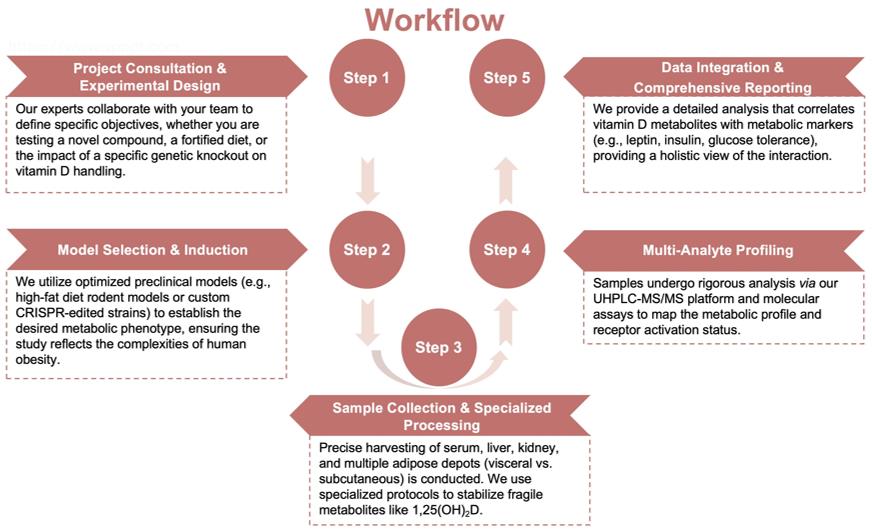
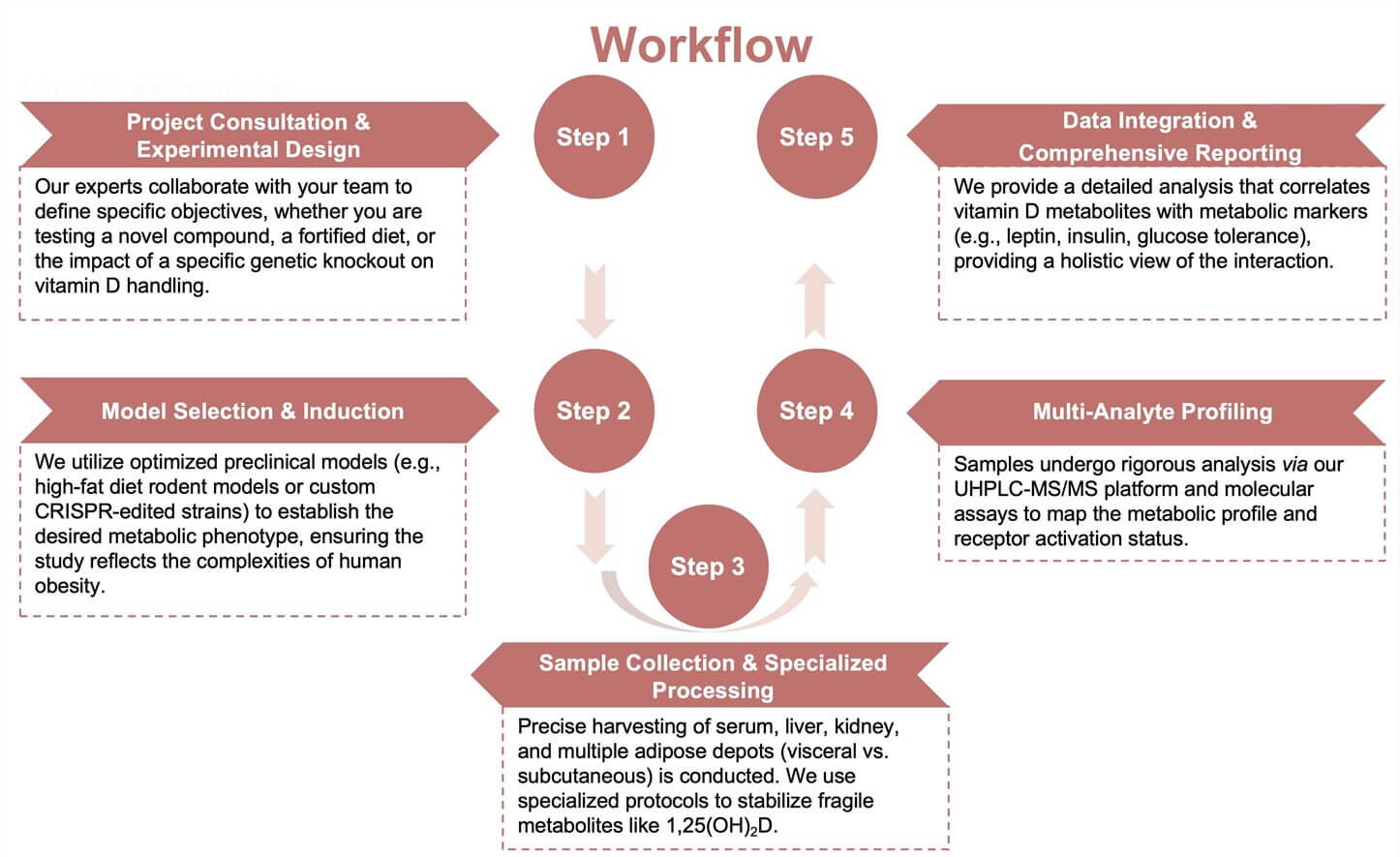
Protheragen ensures a streamlined, transparent process designed to integrate seamlessly with your existing research pipeline.
Fields of Application
The specialized profiling capabilities at Protheragen provide critical mechanistic insights across a diverse range of scientific disciplines, enabling researchers to translate complex vitamin D metabolic data into targeted therapeutic strategies.
- Therapeutic Drug Development: Testing the efficacy of VDR agonists or vitamin D analogs in treating metabolic syndrome.
- Nutraceutical Innovation: Optimizing delivery systems for fat-soluble vitamins to overcome volumetric dilution in overweight populations.
- Endocrinology Research: Studying the crosstalk between the parathyroid hormone (PTH) axis and adipose tissue expansion.
- Precision Nutrition: Developing data to support personalized vitamin D dosing strategies based on metabolic phenotypes.
Advantages
Choosing Protheragen means partnering with a leader in preclinical metabolic research. Our advantages include:
Unrivaled Analytical Precision
Unlike traditional ELISA methods, which often suffer from cross-reactivity, our MS-based approach provides absolute quantification of specific metabolites.
Tissue-Centric Insights
We go beyond the blood. Understanding that adipose tissue is a "dynamic reservoir," we provide data on the slow but continuous exchange between fat depots and circulation.
Proven Expertise in Inflammation
Our studies have successfully mapped how vitamin D supplementation modulates the NF-κB pathway in hypertrophic adipose tissue.
Scalable Discovery
Our platform allows for fast, scalable in vivo discovery, significantly shortening the timeline from target identification to validation.
Beyond Conventional Vitamin D Assays
Our platform decodes obesity-induced enzymatic repression at the molecular level, identifying metabolic bottlenecks like impaired hepatic hydroxylation. This provides high-resolution mechanistic data on 25(OH)D deficiency that occurs independently of sunlight or diet, essential for metabolic syndrome research.
Contact Our Specialists Today for a Custom Project Quote.
Customer Review
Uncovering Mechanistic Drivers in Metabolic Research
"The team at Protheragen provided us with clarity that we couldn't achieve through standard clinical observations. By using their tissue-specific profiling, we were able to prove that our candidate compound wasn't just being 'washed out' in the fat, but was actively modulating the hepatic 25-hydroxylase pathway. Their expertise in the UHPLC-MS/MS space is unparalleled."Dr. G. D., Metabolic Disease Research Institute
Accelerating Discovery Through High-Resolution Data Integration
"Collaborating with Protheragen has been a game-changer for our preclinical pipeline. Their ability to correlate vitamin D metabolites with real-time inflammatory markers in a DIO model allowed us to secure the data needed for our next phase of development. We look forward to our next project focusing on VDR signaling in the gut-liver axis."Dr. H. G., Biopharma Solutions
Frequently Asked Questions
-
Why is MS/MS preferred over ELISA for vitamin D profiling?
MS/MS provides superior specificity, eliminating interference from other sterols and allowing for the simultaneous measurement of multiple metabolites (D2, D3, epimers) that ELISA cannot distinguish.
-
Can you differentiate between vitamin D storage and metabolic dysfunction?
Yes. By analyzing both tissue concentrations and the activity of enzymes like CYP2R1, we can determine if low serum levels are due to sequestration or impaired hepatic conversion.
-
Does your service include brown adipose tissue (BAT) analysis?
Absolutely. We recognize the role of BAT in thermogenesis and its unique vitamin D metabolic profile compared to WAT.
-
Are your services limited to rodent models?
While rodents are the gold standard for DIO studies, we also offer specialized modeling in other organisms via our genomic engineering platform.
-
How do you handle the high lipophilicity of vitamin D in adipose samples?
We utilize proprietary lipid-removal extraction protocols that ensure high recovery of vitamin D metabolites without interference from the fat matrix.
-
Can you measure the active hormone 1,25(OH)2D in very small volumes?
Yes, our high-sensitivity MS/MS platform is optimized for low-volume samples typical of preclinical biopsies.
-
Do you provide markers of systemic inflammation alongside vitamin D data?
Yes, we frequently co-profile cytokines (IL-6, TNF-α, leptin) to correlate vitamin D status with the inflammatory state.
-
How long does a typical profiling project take?
Standard metabolic profiling projects typically yield comprehensive reports within 6–8 weeks, depending on the model induction phase.
-
Can this service help determine the "optimal dose" for obese populations?
Our PK/PD modeling is specifically designed to identify the dose-response relationship needed to overcome volumetric dilution.
-
Is the C3-epimer relevant to obesity research?
Recent "published data" suggests epimers may have different biological potencies; we include them to provide a complete metabolic picture.
Contact Us
Protheragen is committed to advancing the frontier of metabolic science. Our vitamin D metabolism profiling service provides the high-resolution data necessary to turn complex biological questions into actionable insights.
Contact Protheragen for More Information and to Discuss Your Project
All of our services and products are intended for preclinical research use only and cannot be used to diagnose, treat or manage patients.