
Branched-Chain Amino Acid Metabolic Flux Analysis Service
InquiryThe global escalation of metabolic disorders has positioned obesity at the forefront of preclinical research. Central to this pathology is the dysregulation of branched-chain amino acids (BCAAs)—leucine, isoleucine, and valine. While traditional metabolomics provides a static snapshot of BCAA concentrations, Protheragen offers a sophisticated BCAA metabolic flux analysis service designed to decode the dynamic rates of synthesis, transport, and oxidation.
Branched-Chain Amino Acid (BCAA) Metabolic Flux Analysis for Obesity Research
Elevated circulating BCAA levels are established biomarkers for insulin resistance and type 2 diabetes (T2D). However, research indicates that the accumulation of these amino acids is often a result of impaired catabolism in adipose tissue and skeletal muscle rather than increased intake alone. By employing stable isotope resolved metabolomics (SIRM), Protheragen enables researchers to track the metabolic fate of carbon-labeled BCAAs through the TCA cycle and lipogenic pathways. This service is critical for identifying how enzymatic bottlenecks, such as those involving the BCKDH complex, contribute to metabolic inflexibility and lipid accumulation in obesity models.
Core Technologies
Protheragen utilizes a multi-platform approach to ensure the highest resolution of metabolic data:
- High-Resolution Mass Spectrometry (Liquid Chromatography Tandem Mass Spectrometry (LC-MS/MS) & Gas Chromatography–mass Spectrometry (GC–MS))
We employ state-of-the-art Orbitrap and triple quadrupole systems to detect isotopologue distributions with extreme sensitivity. This high-fidelity analytical capability allows for the precise mapping of metabolic fluxes and the identification of subtle molecular "fingerprints" within complex biological matrices, ensuring unparalleled depth in pathway analysis.
- Stable Isotope Tracing
Utilizing [U-13C]-labeled leucine, valine, or isoleucine to map the metabolic "flow" through specific enzymatic checkpoints.
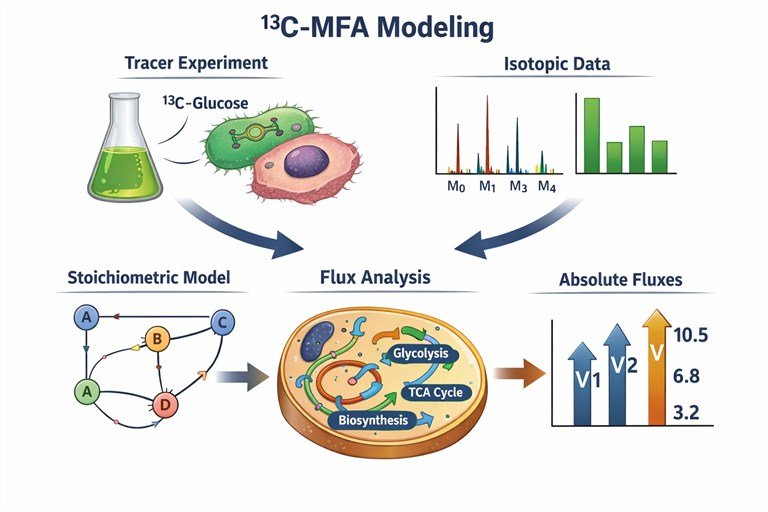
- 13C-MFA Modeling
Advanced computational algorithms that integrate experimental enrichment data with stoichiometric models to calculate absolute flux rates in intracellular compartments.
- Automated Sample Micro-Extraction
Proprietary techniques for processing minimal tissue volumes (e.g., white adipose tissue or hypothalamus) without compromising metabolite stability.
Service Scope
Our streamlined preclinical service ensures reproducible results and rapid turnaround times:
- Tissue-Specific Catabolism
Assessing BCAA oxidation rates in brown vs. white adipose tissue and skeletal muscle.
- Inter-organ Exchange
Quantifying the flux of BCKAs from the liver to peripheral tissues.
- Mitochondrial Bioenergetics
Determining the contribution of BCAA-derived carbon to the citrate pool and ATP production.
- Gut Microbiome Influence
Analyzing the impact of microbially-derived BCAAs on host metabolic homeostasis.
Contact Our Specialists to Initiate Your High-resolution BCAA Flux Mapping Project Today.
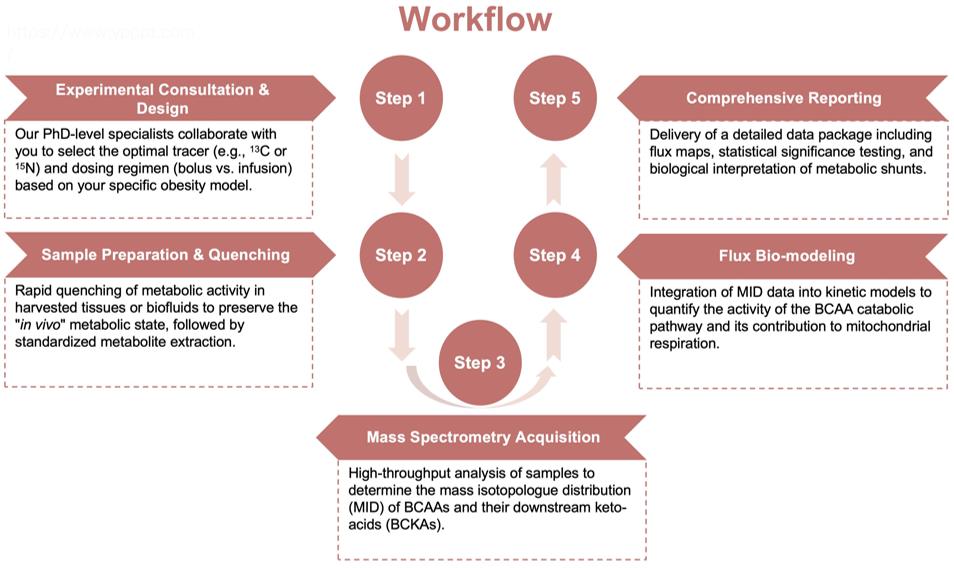
Workflow
Our streamlined preclinical service ensures reproducible results and rapid turnaround times:
Fields of Application
Our BCAA metabolic flux analysis service provides critical mechanistic insights across diverse research landscapes, enabling investigators to pinpoint how branched-chain amino acid turnover dictates systemic physiological outcomes in specialized metabolic contexts.
- Insulin Resistance Studies: Investigating how BCAA-derived acylcarnitines interfere with mitochondrial fatty acid oxidation.
- Adipocyte Differentiation: Mapping the role of leucine catabolism in lipogenesis and adipocyte maturation.
- Appetite Regulation: Tracing BCAA transport across the blood-brain barrier and its influence on hypothalamic signaling.
- Therapeutic Screening: Evaluating the efficacy of small molecules designed to activate the BCKDH complex or inhibit BCAA transporters.
Advantages
Choosing Protheragen for your obesity research provides unparalleled depth into metabolic mechanisms:
Unrivaled Precision
Our platforms distinguish between isomeric metabolites that standard metabolomics often conflate, ensuring accurate quantification of leucine vs. isoleucine flux.
Deep Mechanistic Insight
We go beyond "high" or "low" levels. Our data reveals whether BCAA accumulation is due to impaired oxidation or increased proteolysis, a distinction vital for drug target validation.
Benchmarked Analytical Precision
Our analytical platforms are engineered to meet the highest industry standards for metabolic research. By achieving precise quantitation of BCAA flux and its regulatory impact on mTORC1 signaling, we provide the high-resolution data necessary to resolve complex mechanisms of insulin desensitization.
Optimized for Preclinical Models
Our platform features robust, validated protocols across a spectrum of metabolic models, including HFD-induced rodent models, classical genetic strains (ob/ob, db/db), and sophisticated organoid systems. This versatility ensures high-fidelity BCAA flux quantification across varied biological complexities, providing a seamless bridge from cellular mechanisms to systemic metabolic phenotypes.
Contact Our Experts Today for a Project-specific Consultation.
Publication Data
Title: BCAA-nitrogen flux in brown fat controls metabolic health independent of thermogenesis
Journal: Cell, 2024
DOI: https://doi.org/10.1016/j.cell.2024.03.030
Summary: This study uncovers a novel function of brown adipose tissue (BAT) beyond thermogenesis: regulating metabolic health via branched-chain amino acid (BCAA)-nitrogen flux. BAT uses BCAA as a key nitrogen source to synthesize non-essential amino acids (e.g., glutamate, alanine) and glutathione, which are secreted to modulate systemic glucose homeostasis. Impaired mitochondrial BCAA catabolism in BAT—due to mitochondrial BCAA carrier (MBC/SLC25A44) deletion—induces insulin resistance without altering energy expenditure or body weight. Obesity attenuates this BCAA-nitrogen flux and metabolite synthesis, while cold exposure enhances it. Human data further confirm that cold-activated BAT correlates with elevated circulating glutathione, highlighting a metabolite-mediated pathway linking BAT to cardiometabolic health.
Key Findings
- BCAA Serves as a Critical Nitrogen Donor in BAT: BAT catabolizes BCAA in mitochondria (via MBC and BCAT2) to supply nitrogen for synthesizing glutamate, alanine, proline, glycine, and glutathione—most of which are secreted into circulation.
- MBC Is Essential for BCAA-Derived Metabolite Synthesis: MBC mediates mitochondrial BCAA import; its deletion (or BCAT2 inhibition) reduces BCAA-nitrogen transfer, lowering levels of BCAA-derived metabolites in BAT and serum.
- Impaired BAT BCAA Flux Causes Insulin Resistance: BAT-specific MBC knockout induces hepatic insulin resistance, elevated oxidative stress, and reduced hepatic insulin signaling—independent of energy expenditure or body weight.
- Glutathione Mediates the Metabolic Effect: Restoring glutathione levels reverses insulin resistance in MBC-deficient mice, while inhibiting glutathione synthesis (via BSO) impairs insulin tolerance, linking redox balance to BAT's metabolic role.
- Physiological and Pathophysiological Regulation: High-fat diets suppress BAT BCAA catabolism and metabolite synthesis; cold exposure enhances both. In humans, cold-activated BAT correlates with higher circulating glutathione, confirming translational relevance.
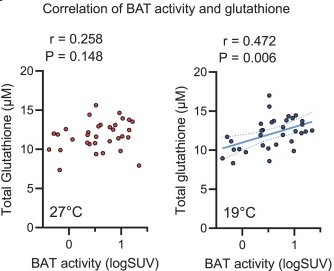 Fig.1 Correlation between brown fat activity and systemic glutathione levels in healthy adults post cold stimulation. (Verkerke, et al., 2024)
Customer Review
Principal Investigator, University Medical Center
"The team at Protheragen provided us with clarity that we couldn't achieve through standard metabolomics. By tracing 13C-Leucine flux, we were able to demonstrate that our lead compound successfully restored mitochondrial oxidation in adipose tissue. Their technical support during the experimental design phase was world-class." Dr. A. S., Metabolic Disease Biotech
Partnering for Success: Accelerating Mechanistic Discovery and Funding
"Protheragen has become our go-to partner for obesity modeling. The depth of their flux reports allowed us to secure our next round of funding by providing definitive mechanistic proof of our target's role in BCAA dysregulation. We are already planning our next series of skeletal muscle studies with them." Dr. S. M., University Medical Center
Frequently Asked Questions
-
Why should I choose flux analysis over steady-state BCAA measurement?
Steady-state levels do not show the "why." High BCAA levels could mean high intake OR blocked breakdown. Flux analysis reveals the actual rate of metabolic turnover.
-
Which tracers do you recommend for obesity research?
[U-13C6]Leucine is most common for tracing protein turnover and TCA cycle entry, while [U-13C5]valine is excellent for studying gluconeogenic contributions.
-
What tissue types can be analyzed?
We specialize in skeletal muscle, liver, white/brown adipose tissue, and plasma.
-
Can you detect the flux into the TCA cycle?
Yes, we track the incorporation of BCAA carbon into citrate, α-ketoglutarate, and succinate.
-
What is the minimum sample size required?
Typically, 20-50mg of tissue or 50µL of plasma, depending on the target metabolites.
-
Is this service compatible with HFD rodent models?
Absolutely. We have extensive experience with HFD-induced obesity and metabolic syndrome models.
-
Do you provide bioinformatic support?
Yes, every project includes a full bioinformatic analysis and flux visualization report.
-
How do you handle BCAA isomers?
We use specialized chromatography columns that achieve baseline separation of leucine and isoleucine.
-
What is the typical turnaround time?
Standard projects are completed within 4-6 weeks from sample receipt.
Contact Us
Protheragen's BCAA metabolic flux analysis service is an essential tool for modern obesity research, transforming static metabolite data into dynamic physiological insights. By leveraging advanced stable isotope tracing and high-resolution mass spectrometry, we empower researchers to uncover the underlying metabolic drivers of insulin resistance and obesity.
Contact Protheragen for More Information and to Discuss Your Project
Reference
- Verkerke, A. R. P.; et al. Bcaa-Nitrogen Flux in Brown Fat Controls Metabolic Health Independent of Thermogenesis. Cell. 2024, 187.10: 2359-74.e18. Print.
All of our services and products are intended for preclinical research use only and cannot be used to diagnose, treat or manage patients.