
Tetrahydrofolate Cycle Metabolic Flux Analysis Service
InquiryThe global rise in obesity and its comorbidities, such as non-alcoholic fatty liver disease (NAFLD) and type 2 diabetes, has intensified the need for precise preclinical tools to dissect the metabolic rewiring associated with adiposity. While static metabolite profiling provides a snapshot of cellular status, it fails to capture the dynamic rates of metabolic reactions—the true drivers of phenotype.
Tetrahydrofolate (THF) Cycle Metabolic Flux Analysis for Obesity Research
Protheragen introduces a specialized tetrahydrofolate (THF) cycle metabolic flux analysis service designed specifically for obesity and metabolic disorder research. The folate cycle (one-carbon metabolism) is a critical integrator of nutrient status, regulating nucleotide synthesis, the methylation potential (SAM/SAH ratio) essential for epigenetic control of adipogenesis, and the generation of NADPH required for fatty acid synthesis and redox homeostasis.
Core Technologies
To accurately resolve the rapid turnover and compartmentalization of folate intermediates, Protheragen employs a multi-faceted technological approach:
- Stable Isotope Labeling (13C/15N Tracing)
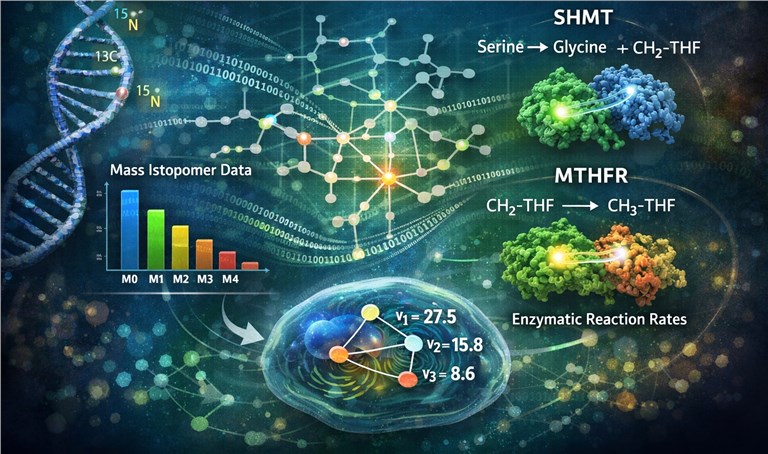
We utilize specific tracers, such as [U-13C]-serine, [2-13C]-glycine, or [methyl-13C]-methionine, to track the flow of one-carbon units through the oxidative and reductive arms of the folate cycle. This allows for the differentiation between de novo synthesis and salvage pathways.
- Ultra-High Performance Liquid Chromatography-Tandem Mass Spectrometry (UHPLC-MS/MS)
Our platform features high-sensitivity triple quadrupole and Orbitrap mass spectrometers optimized for the detection of low-abundance, labile folate intermediates (e.g., 5,10-methylene-THF, 10-formyl-THF) under strictly controlled anaerobic conditions to prevent oxidation.
- Stoichiometric Modeling & Isotopemer Analysis
We use proprietary computational algorithms to calculate intracellular fluxes based on mass isotopomer distribution (MID) data. This allows us to quantify the rates of key enzymatic reactions, such as those catalyzed by serine hydroxymethyltransferase (SHMT) and methylenetetrahydrofolate reductase (MTHFR).
Customize Your Metabolic Analysis Strategy with Our Experts
Service Scope
Our service is strictly preclinical, supporting academic and pharmaceutical research in cell-based assays and animal models.
- Targeted Metabolites
- Folate intermediates: tetrahydrofolate (THF), 5-methyl-THF, 5,10-methylene-THF, 10-formyl-THF, dihydrofolate (DHF), folic acid.
- One-carbon donors/recipients: serine, glycine, formate.
- Methionine cycle (transmethylation): methionine, S-adenosylmethionine (SAM), S-adenosylhomocysteine (SAH), homocysteine, cystathionine.
- Redox cofactors: NAD+/NADH, NADP+/NADPH (ratio analysis linked to folate flux).
- Supported Matrices
- Adipocytes: 3T3-L1, primary white/brown adipocytes.
- Tissues: liver (hepatic steatosis studies), white adipose tissue (WAT), brown adipose tissue (BAT), muscle.
- Biofluids: plasma, serum (for systemic turnover assessment).
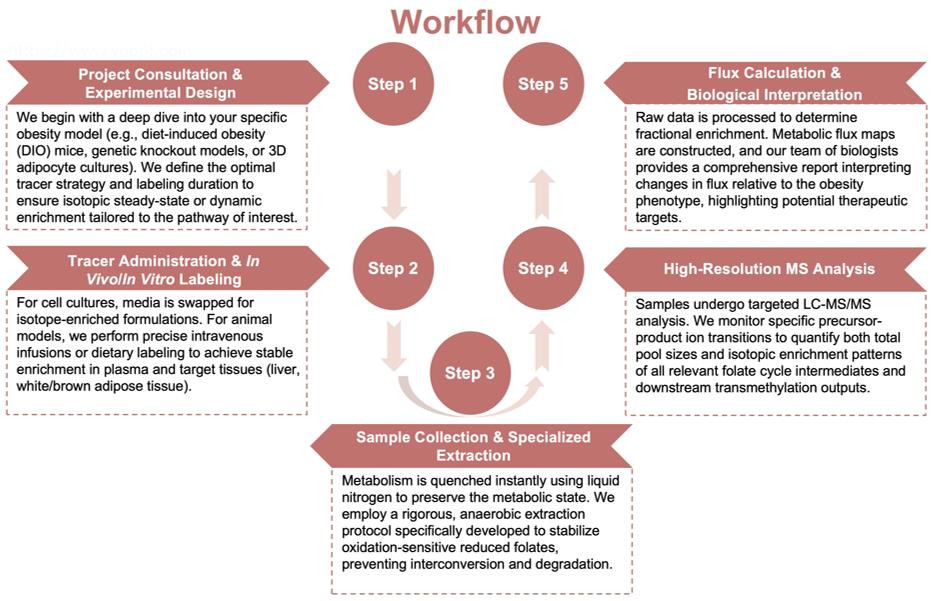
Workflow
Our streamlined workflow ensures high-quality data generation and seamless integration with your preclinical research timeline.
Fields of Application
The dysregulation of one-carbon metabolism is a hallmark of metabolic syndrome, making our tetrahydrofolate cycle flux analysis a critical tool for dissecting the mechanisms driving obesity and its comorbidities across various preclinical models.
- Adipogenesis and Epigenetic Regulation: Investigating how the SAM/SAH ratio (modulated by the folate cycle) influences histone methylation and the transcriptional activation of adipogenic transcription factors like PPARγ and C/EBPα.
- Hepatic Steatosis (NAFLD/NASH): Analyzing the role of one-carbon metabolism in phosphatidylcholine synthesis (via the PEMT pathway) and its impact on VLDL secretion and liver fat accumulation.
- Insulin Resistance Studies: Examining the link between elevated plasma homocysteine, mitochondrial dysfunction, and insulin signaling impairment in skeletal muscle and adipose tissue.
- Thermogenesis in Brown Fat: Studying the demand for one-carbon units in mitochondrial biogenesis and energy dissipation in brown and beige adipocytes.
Advantages
Protheragen stands at the forefront of metabolic research, offering distinct advantages for clients investigating the complexities of obesity.
Superior Sensitivity for Labile Metabolites
Standard metabolomics often overlooks the "missing pieces" of the metabolic puzzle. Unlike standard metabolomics providers, our platform is optimized to detect highly unstable reduced folates that are often lost in conventional extraction processes.
Customized for Lipid Metabolism
Obesity is not just about lipid storage; it is about the redox power that fuels it. We specifically analyze the intersection of the folate cycle with lipid biosynthesis, providing data on NADPH contribution to lipogenesis—a critical factor in obesity.
Expert Data Curation
While other providers deliver static heatmaps, Protheragen provides directional flux dynamics. We provide pathway maps showing directional flux rates (e.g., "flux through SHMT2 increased by 40% in obese phenotype"), offering direct mechanistic evidence.
Rapid Turnaround
In the competitive landscape of obesity therapeutics, timing is everything. Our optimized, automated workflows reduce the time from sample submission to comprehensive flux analysis to a matter of weeks, ensuring your lead optimization or target validation stays ahead of the curve.
Inquire Now to Discuss Your Study Design.
Customer Review
Unveiling Critical Metabolic Bottlenecks in Obesity Models
"Collaborating with Protheragen gave us a completely new perspective on our obesity model. We suspected a methylation defect was driving the phenotype, but standard assays were inconclusive. Protheragen’s flux analysis clearly showed a bottleneck in the mitochondrial folate pathway. The data quality was exceptional, and their team explained the complex flux maps clearly."Dr. A. T., Metabolic Disorders Institute
Robust Target Validation in Challenging Adipose Matrices
"We needed a partner who could handle difficult adipose tissue matrices for a high-stakes preclinical trial. Protheragen delivered. Their ability to stabilize and detect reduced folates gave us the robust data we needed to validate our drug target. They are true experts in dynamic metabolism. We are already planning our next cohort study with them."Dr. S. L., Biotech Startup
Frequently Asked Questions
-
Can this service be applied to human clinical samples?
No, our services are strictly limited to preclinical research (cell cultures and animal models). We do not accept human clinical samples for diagnostic or therapeutic purposes.
-
Why is "flux" analysis better than measuring metabolite concentration?
Concentration acts as a pool size, which can be misleading. A high concentration could mean high production or a blockage in consumption. Flux analysis measures the speed of the pathway, telling you exactly how active the metabolic route is.
-
Which tracer is best for studying obesity-related methylation?
[U-13C]-Serine or [methyl-13C]-Methionine are typically preferred to trace the flow of methyl groups into the SAM cycle, which is crucial for analyzing epigenetic changes in obesity.
-
How much sample do you need for adipose tissue analysis?
We typically require 50-100 mg of wet tissue weight per sample to ensure adequate detection of low-abundance folate intermediates.
-
Can you detect shifts in NADPH production via the folate cycle?
Yes, by tracing specific carbon flows through methylene-THF dehydrogenase (MTHFD) enzymes, we can infer the contribution of the folate cycle to the cytosolic and mitochondrial NADPH pools used for fatty acid synthesis.
-
Do you provide data on the "browning" of white fat?
While we do not phenotype the cells visually, our flux data can reveal metabolic signatures unique to beige/brown adipocytes, such as altered glycine consumption and mitochondrial one-carbon flux.
-
How do you prevent the degradation of folates during shipping?
We provide a detailed sample collection kit and protocol. Samples must be flash-frozen in liquid nitrogen immediately upon collection and shipped on dry ice. We also use antioxidant-enriched extraction buffers.
-
What is the typical turnaround time for a project?
For a standard study (e.g., 20-40 samples), the turnaround time from sample receipt to final report is approximately 3-4 weeks.
-
Can you compare diet-induced obesity (DIO) mice vs. Lean controls?
Absolutely. This is a core application of our service. We can statistically compare flux maps between phenotypic groups to identify metabolic bottlenecks.
-
Is bioinformatic support included?
Yes, all projects include standard bioinformatic analysis, including flux visualization and statistical testing. Advanced pathway modeling is available as an add-on.
Contact Us
Understanding the dynamic metabolic shifts in obesity requires more than standard tools. Protheragen is dedicated to providing the high-resolution metabolic insights necessary to drive your preclinical programs forward. Whether you are investigating hepatic steatosis, adipocyte differentiation, or metabolic epigenetics, our team is ready to design a flux analysis strategy tailored to your goals.
Contact Protheragen for More Information and to Discuss Your Project
All of our services and products are intended for preclinical research use only and cannot be used to diagnose, treat or manage patients.