
CETSA Thermal Stability-based Obesity Target Screening Service
InquiryObesity is a complex metabolic disorder characterized by the dysfunction of energetic homeostasis, involving intricate signaling pathways in adipose tissue, the hypothalamus, and peripheral organs. Traditional drug discovery for obesity often suffers from high attrition rates due to the lack of physiological relevance in early-stage screening. Protheragen addresses this challenge through our thermal stability-based obesity target screening service.
Functional Proteomics in Obesity: Advanced Enzyme Profiling and Target Engagement Services
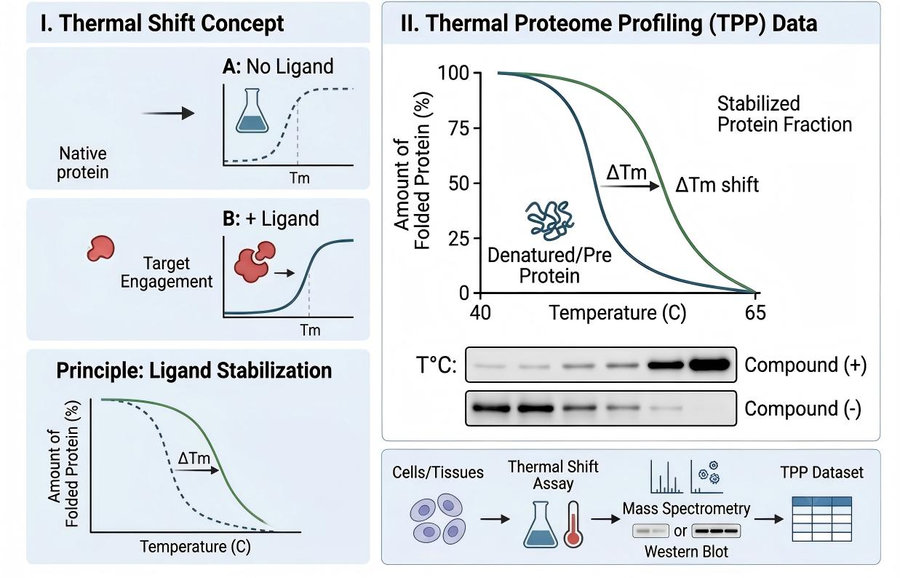
This platform leverages the biophysical principle that proteins become more thermally stable upon binding to a ligand. Unlike traditional labeled assays, our CETSA-based approach allows for the direct measurement of target engagement in native cellular environments. By utilizing intact cells or tissue biopsies relevant to metabolic disease—such as adipocytes or hepatocytes—Protheragen provides a high-fidelity readout of drug-target interactions, ensuring that potential anti-obesity compounds reach their intended intracellular targets under physiological conditions.
Core Technologies
The foundation of our service lies in advanced proteomic and biophysical methodologies optimized for metabolic research:
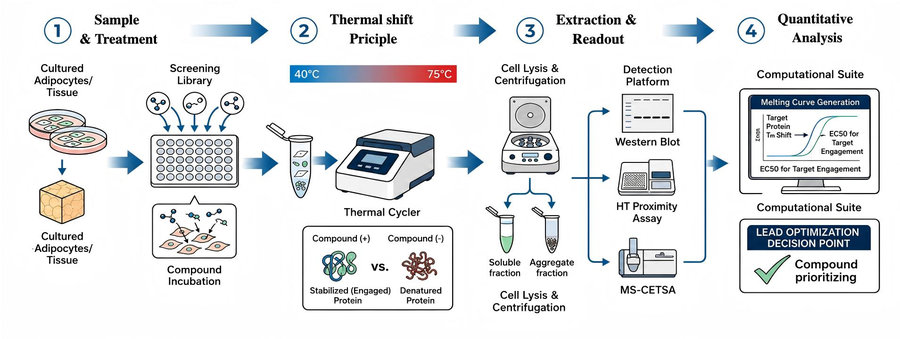
Combining thermal shift assays with liquid chromatography tandem mass spectrometry (LC-MS/MS) to monitor the stability of thousands of proteins simultaneously. This is critical for identifying off-target effects that might lead to metabolic toxicity.
For high-throughput screening (HTS), we utilize bead-based proximity assays to quantify target protein levels in the soluble fraction after thermal denaturation, allowing for rapid kinetic analysis of obesity-related enzymes and receptors.
This technology determines the potency of a lead compound by measuring target engagement across a range of concentrations at a constant temperature, providing a Tagg (aggregation temperature) shift curve essential for SAR (structure-activity relationship) modeling.
Solution Scope
Our CETSA screening service is tailored to the specific needs of metabolic disease drug discovery, focusing on the following areas:
- GPCR Target Engagement
Direct validation of binding for G protein-coupled receptors involved in appetite regulation and energy expenditure, such as GLP-1R and MC4R analogs.
- Kinase & Enzyme Profiling
Screening for inhibitors or activators of key metabolic regulators, including AMPK, ACC (acetyl-CoA carboxylase), and various PDE (phosphodiesterase) isoforms.
- Transcription Factor Stabilization
Identifying small molecules that stabilize nuclear receptors like PPARγ or THRβ, which are pivotal in lipid metabolism and thermogenesis.
- Protein-Protein Interaction (PPI) Modulation
Assessing how compounds disrupt or stabilize complexes involved in insulin signaling pathways.
- Tissue-Specific Validation
Conducting CETSA on ex vivo white or brown adipose tissue to confirm that compounds penetrate complex tissue matrices and engage targets in a physiological microenvironment.
Contact Our Team for More Information
Workflow
Protheragen employs a rigorous, multi-stage process to ensure the highest data integrity for your preclinical obesity research:
Fields of Application
The Protheragen CETSA platform provides critical target engagement data across a diverse range of metabolic research areas, enabling researchers to validate therapeutic interactions within the complex intracellular environment of obesity-related disease models.
- Target Identification: Discovering novel protein targets for obesity by observing stability shifts in the presence of phenotypic "hits."
- Lead Optimization: Utilizing ITDR-CETSA to rank-order chemical series based on their actual binding affinity within the cellular matrix.
- Mechanism of Action (MoA) Studies: Deconvoluting the molecular targets of natural products or phenotypic screening hits in adipocyte biology.
- Selectivity Profiling: Assessing potential off-target binding across protein families to predict and mitigate side effects like hepatotoxicity or cardiovascular risks.
Advantages
Choosing Protheragen for your obesity target screening provides distinct strategic benefits:
Label-Free Precision
Eliminate the need for fluorescent tags or radioactive tracers that can alter compound pharmacology or protein folding.
Physiological Relevance
Execute assays in intact cells where endogenous co-factors and post-translational modifications are present, reflecting true in vivo biology.
Preclinical Predictive Power
Our data bridges the gap between biochemical assays and animal models, reducing the risk of late-stage preclinical failure.
High Sensitivity
Detect subtle conformational changes in proteins that other biophysical methods might miss.
Contact our team to determine the true binding profile of your metabolic compounds.
Publication Data
Title: CETSA screening identifies known and novel thymidylate synthase inhibitors and slow intracellular activation of 5-fluorouracil
Journal: Nature Communications, 2016
DOI: https://doi.org/10.1038/ncomms11040
Summary: Target engagement—direct drug binding to its molecular target in native cellular environments—is the cornerstone of therapeutic efficacy, yet traditional screening methods often fail to measure this in live cells, contributing to high clinical trial failure rates. The study developed a no-wash Alphascreen-based CETSA assay for TS in live human myelogenous leukemia (K562) cells, enabling the first CETSA-driven HTS of a 10,928-compound library (including lead-like molecules, nucleosides, and approved drugs). The assay accurately detected known TS inhibitors, identified novel chemical scaffolds and repurposable drugs with unreported TS-binding activity, and combined time-resolved CETSA with liquid chromatography-tandem mass spectrometry (LC-MS/MS) to link drug uptake/metabolism to intracellular target engagement. Additionally, the research characterized the metabolic activation of unexpected TS inhibitors (e.g., decitabine) and uncovered stark differences in the kinetic activation of nucleoside-based TS drugs versus 5-FU—one of the most commonly used cancer therapies.
Key Findings
- CETSA Validated for High-Throughput Screening
A 384-well AlphaScreen CETSA assay for TS in live K562 cells achieved 90% hit confirmation (≥30% TS stabilization), detecting known inhibitors (floxuridine, raltitrexed) with sub-nM EC50s and measuring target binding in native cellular environments (no engineered proteins). - Novel & Repurposable TS Inhibitors Identified
The screen uncovered the novel inhibitor CBK115334, which binds the TS folate pocket via unique interactions and inhibits K562 proliferation (IC50 <100 μM). It also found approved drugs (decitabine, triamterene, pyrimethamine) with unreported TS-binding activity; decitabine requires phosphorylation/ deamination to form its active TS-binding metabolite. - 5-FU Has Drastically Slow Intracellular Activation
Unlike nucleoside-based inhibitors (floxuridine/TFT, full TS engagement by 2h via rapid metabolite formation), 5-FU shows fast cellular uptake but undetectable active FdUMP for 6h, leading to delayed CETSA response and 19 μM EC50 (vs. floxuridine's 47 pM). - CETSA Links Kinetics to Target Engagement
Time-resolved ITDRF_CETSA paired with LC-MS/MS directly correlates active metabolite levels with TS stabilization, confirming CETSA as a readout of functional target binding (not just uptake). - Translatable Drug Discovery Workflow
CETSA enables hit validation across the pipeline, applicable to primary cells/patient biopsies, and integrates target engagement, uptake, and metabolism—reducing clinical trial failure risks.
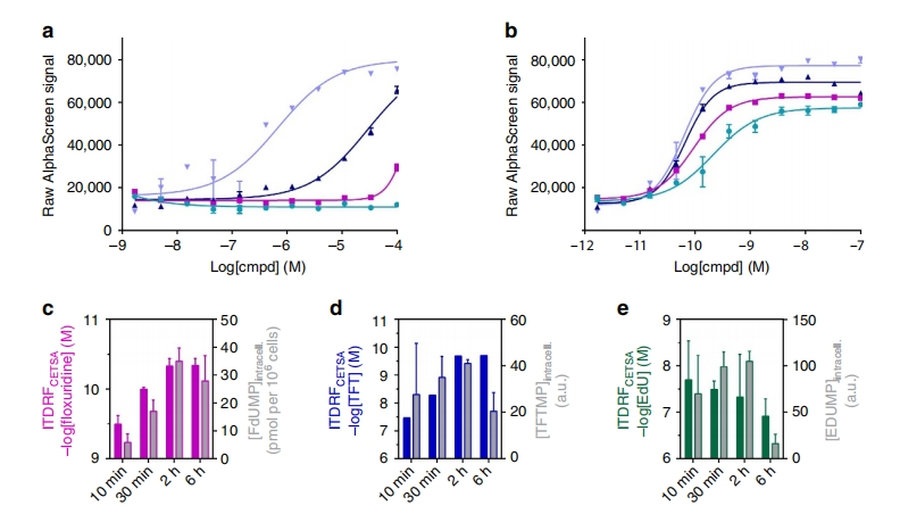 Fig.1 Time-dependent TS target engagement and intracellular active metabolite kinetics in K562 cells. (Almqvist, et al., 2026)
Customer Review
Precision in Adipocyte Target Validation: A Startup Perspective
"Working with Protheragen transformed our lead optimization phase. Their CETSA platform provided clear evidence of target engagement for our kinase inhibitors in primary adipocytes, which our previous biochemical assays had failed to replicate. The depth of their scientific report allowed us to confidently select our lead candidate for further development."
Dr. S. R., Senior VP of Discovery
Solving Off-Target Metabolic Toxicity for Global Biopharma
"The expertise Protheragen brings to metabolic disease is unmatched. We were struggling with off-target effects in our obesity program, and their proteome-wide CETSA screening identified a specific off-target binding event in hepatocytes that we were able to engineer out of our chemical series. We look forward to our next project together."
Dr. J. H., Principal Scientist
Frequently Asked Questions
-
How does CETSA differ from traditional SPR or ITC for obesity targets?
Unlike SPR or ITC, which require purified proteins, CETSA measures binding in the cellular environment, accounting for membrane permeability and competitive binding with endogenous ligands.
-
Can this service be used for insoluble membrane proteins?
Yes, we have optimized detergent-based lysis protocols that allow us to apply CETSA to multi-pass transmembrane proteins frequently targeted in obesity.
-
What is the typical sample requirement?
We generally require approximately 106 to 107 cells per melting curve, depending on the abundance of the target protein.
-
Is CETSA compatible with primary human adipocytes?
Absolutely. We frequently use primary cells to ensure the highest clinical relevance during the preclinical phase.
-
How do you handle compounds with low solubility?
Our team uses specialized vehicle formulations and optimized incubation times to ensure maximum bioavailability during the assay.
-
Can you detect allosteric modulators?
Yes, CETSA is highly sensitive to the conformational changes induced by both orthosteric and allosteric binding.
-
What is the turnaround time for a 10-point dose-response assay?
Typically, results are delivered within 2–4 weeks, depending on the detection method chosen.
-
Does Protheragen provide clinical samples?
No, our services are strictly limited to preclinical research, utilizing cell lines and animal-derived tissues.
-
How do you ensure data reproducibility?
We include internal positive control compounds and utilize automated liquid handling to minimize intra-assay variability.
-
Can CETSA identify targets for weight-loss supplements?
Yes, we can screen complex mixtures to identify which specific proteins are being stabilized by the active ingredients.
Contact Us
Protheragen is committed to providing the high-resolution target engagement data necessary to drive your obesity programs forward. Our CETSA thermal stability-based service offers the precision, physiological relevance, and throughput required for modern drug discovery. Welcome to Contact Protheragen.
Reference
- Almqvist, H.; et al. CETSA screening identifies known and novel thymidylate synthase inhibitors and slow intracellular activation of 5-fluorouracil. Nat Commun. 2026, 7, 11040. (CC BY 4.0)
All of our services and products are intended for preclinical research use only and cannot be used to diagnose, treat or manage patients.