
Macrophage Cell Therapy Development Service
InquiryObesity is no longer viewed simply as an issue of lipid accumulation. Deep within expanding adipose tissue, chronic low-grade inflammation drives metabolic dysfunction, insulin resistance, and cardiovascular complications. At the very center of this pathogenic cascade are adipose tissue macrophages (ATMs). In a lean state, these immune cells maintain homeostatic tissue remodeling and insulin sensitivity, primarily exhibiting a protective, anti-inflammatory M2-like phenotype. However, nutrient overload triggers a massive shift. Pro-inflammatory M1-like macrophages infiltrate the visceral fat, secreting a storm of detrimental cytokines like TNF-α and IL-6 that shut down normal insulin signaling.
Advanced Preclinical Solutions: Macrophage Cell Therapy Development for Obesity
Targeting these cellular drivers has emerged as an incredibly promising therapeutic avenue. By isolating, phenotyping, or genetically re-engineering these cells, we can effectively flip the metabolic switch from chronic inflammation back to homeostatic balance. At Protheragen, we offer comprehensive, highly specialized preclinical development platforms designed to help researchers explore macrophage-centered interventions. Our focus remains strictly on robust in vitro and in vivo animal models to validate your therapeutic candidates before they ever transition toward downstream translation.
Core Technologies
Unlocking the therapeutic potential of macrophages requires highly specialized tools that can manipulate immune behavior within complex metabolic environments. Our platform integrates several state-of-the-art capabilities tailored specifically for obesity and metabolic disease models.
We utilize advanced multi-color flow cytometry and high-content imaging systems to track the precise transition between M1 (pro-inflammatory) and M2 (anti-inflammatory) states. This allows for high-throughput screening of small molecules, biologics, or cell-based modifiers that can force pathological macrophages into a protective phenotype.
Traditional monolayer cultures fail to capture the complex signaling that happens inside living tissue. We set up specialized non-contact and direct co-culture models pairing primary adipocytes with engineered macrophages. This recreates the paracrine signaling loops that drive insulin resistance, letting you watch how your therapy alters lipid accumulation and glucose uptake in real time.
Understanding how a macrophage behaves means looking at its cellular energetic pathways. Using Seahorse XF technology, we measure the real-time oxygen consumption rate (OCR) and extracellular acidification rate (ECAR). This allows us to map the metabolic shift between glycolysis (typical of inflammatory M1 cells) and oxidative phosphorylation (typical of resolving M2 cells) following your specific treatment.
Solution Scope
To help you overcome the unique challenges of working with notoriously sensitive myeloid cell lines, we have built our core capabilities around two highly specialized, robustly validated research pathways.
Getting reliable, reproducible data starts with flawless primary cells. Protheragen provides expert isolation of primary macrophages from diverse tissues, including bone marrow-derived macrophages (BMDMs), peritoneal macrophages, and highly specialized adipose tissue macrophages (ATMs) extracted from the stromal vascular fraction (SVF) of lean or Diet-Induced Obesity (DIO) Animal Models. We handle the delicate extraction process to preserve native surface receptors and metabolic programming. Our optimized, serum-screened growth media formulations maintain these cells in stable culture without causing unintended, spontaneous activation. This gives you a clean, highly relevant cellular canvas for your experimental testing.
Overcoming the natural resistance of primary myeloid cells to genetic manipulation is one of our core specialties. We design and execute tailored genetic modification strategies using advanced CRISPR/Cas9 ribonucleoprotein (RNP) complexes, Lentiviral Vectors, or highly efficient Non-viral Electroporation Methods. Whether your goal is to knock out a critical inflammatory receptor, overexpress a protective anti-inflammatory cytokine like IL-10, or insert a specific metabolic reporter gene, our platform delivers high transfection efficiencies with minimal off-target effects. Every batch undergoes strict quality control, including next-generation sequencing validation and functional Western blot checks, ensuring the edited cells behave exactly as intended in downstream metabolic assays.
Connect with an Immunologist to Map Out Your Custom Cell Architecture.
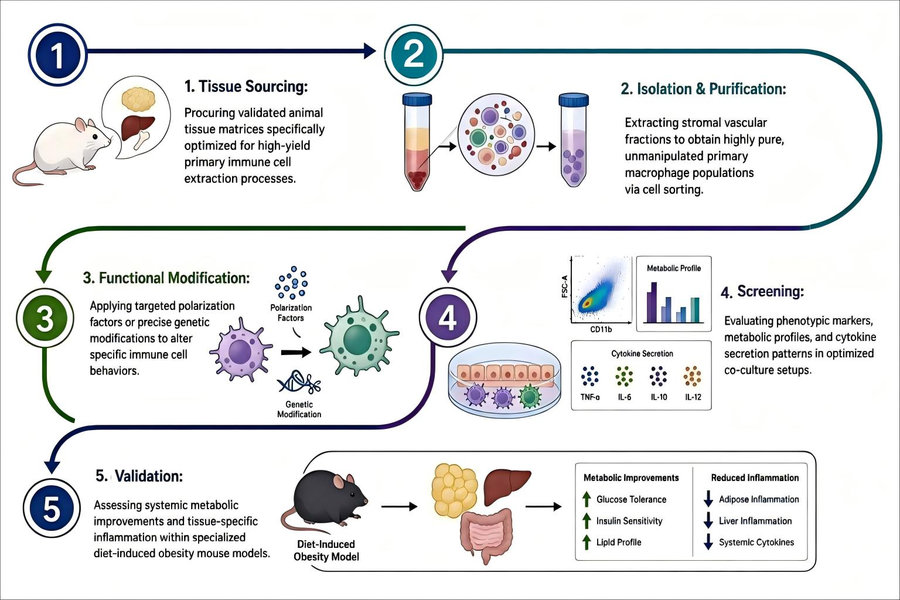
Workflow
Turning complex biological concepts into actionable data requires a structured, step-by-step roadmap that leaves absolutely no room for experimental variance.
Fields of Application
Our macrophage development services support innovative research across several cutting-edge therapeutic areas:
- Insulin Resistance and Type 2 Diabetes
Evaluating how engineered or repolarized macrophages alter glucose transporter expression (like GLUT4) and insulin receptor substrate signaling within peripheral metabolic tissues. - Nonalcoholic Fatty Liver Disease (NAFLD/NASH)
Studying the cross-talk between edited macrophages and hepatic stellate cells to evaluate treatments targeting liver inflammation and subsequent fibrotic scarring. - Adipose Tissue Remodeling and Browning
Investigating how specific anti-inflammatory macrophage populations stimulate the browning of white adipose tissue, enhancing thermogenesis and energy expenditure.
Advantages
When you choose to partner with us, you are not just getting standard contract lab hands; you are tapping into a deeply refined platform built specifically to de-risk early-stage metabolic discoveries.
Unrivaled Adipose-Specific Expertise
We do not just work with standard cell lines; our team has spent years optimizing the difficult extraction and culture of true adipose tissue macrophages (ATMs). This gives you access to the exact cell populations driving metabolic disease in vivo, making your early-stage data significantly more predictive of complex physiological outcomes.
High-Efficiency Myeloid Editing
Myeloid cells are notoriously difficult to transfect and modify without accidentally triggering premature cell death or non-specific maturation cascades. Our optimized CRISPR-RNP delivery protocols achieve gene knockout efficiencies exceeding 85% in primary murine macrophages while maintaining post-activation viability scores above 90%.
Fully Integrated Metabolic Readouts
Our platform connects cellular phenotype directly to metabolic function. We do not just tell you if a surface marker changed; we back it up with comprehensive data showing altered cytokine secretion profiles, shifted mitochondrial bioenergetics, and improved insulin sensitivity metrics within treated adipocyte microenvironments.
Submit a Preclinical Project Inquiry Today
Customer Review
Overcoming Transfection Barriers in Primary Myeloid Models
"We were struggling to achieve consistent gene knockouts in primary tissue-derived macrophages without killing off our entire cell population. The technical team at Protheragen developed a tailored CRISPR-RNP protocol that gave us highly viable, beautifully edited cells. Their deep understanding of adipose tissue biology completely turned our project around, and we are already mapping out our next series of co-culture screening studies with them."
Dr. F. S., Associate Scientist
Streamlining Lead Selection Through Integrated Metabolic Phenotyping
"Partnering with Protheragen for our metabolic cell therapy validation was an excellent experience. Their integrated approach—combining highly pure cell isolation with precise Seahorse metabolic flux analysis—gave us the exact data package we needed to confidently select our lead therapeutic candidate. The communication was flawless, and the raw data was beautifully structured for our internal profiling."
Dr. M. V., Research Associate.
Frequently Asked Questions
-
Why should we focus on primary ATMs instead of using standard immortalized cell lines like RAW 264.7?
Immortalized myeloid lines lack the specific metabolic wiring and surface receptor expression found in real tissue environments. Primary ATMs provide a much truer reflection of chronic metabolic inflammation, making your preclinical data far more reliable when transitioning to complex animal models.
-
What typical purity levels do you guarantee for your primary adipose tissue macrophage isolation?
We routinely achieve macrophage purity levels greater than 90% using automated magnetic-activated cell sorting (MACS) or fluorescence-activated cell sorting (FACS) tracking specific markers like F4/80 and CD11b.
-
Can your gene editing service handle large knock-in sequences in primary macrophages?
Yes. While large insertions are inherently tougher in primary myeloid cells, we utilize optimized viral and non-viral delivery methods to insert specific reporter cassettes or functional genes into targeted loci safely.
-
How do you ensure the isolated macrophages do not spontaneously activate during shipment or culture?
We implement strict low-endotoxin protocols and utilize specially formulated, pre-screened media components that keep the cells in an uncommitted baseline state until you initiate your specific polarization workflow.
-
Do you offer established animal model testing as part of your preclinical validation package?
Absolutely. We support downstream in vivo profiling using validated diet-induced obesity (DIO) or genetic rodent models to evaluate how your modified macrophage therapies perform in a living system.
-
What sample size or cell yield can we expect from a single primary isolation run?
Yields depend heavily on the donor tissue and model state (e.g., obese fat pads yield significantly more macrophages than lean ones). We sit down during our initial technical consult to map out exact animal requirements to ensure you get all the cells you need.
-
Can we test our own proprietary small molecule candidates in your adipocyte co-culture system?
Definitely. Our co-culture platforms are completely modular. They are explicitly designed to test how small molecules, antibodies, or edited cells disrupt the inflammatory cross-talk between fat cells and immune cells.
-
How do you verify that a gene knockout has successfully shifted the cell's functional profile?
We use a multi-layered validation approach: genomic sequencing confirms the edit, western blots check protein expression, and downstream multiplex ELISA/Seahorse assays verify the functional shift in cytokine production and cellular respiration.
Contact Us
Navigating the complex cellular microenvironment of obese adipose tissue requires highly specialized technical expertise. Protheragen provides the precise isolation, robust genetic engineering, and advanced functional screening platforms necessary to turn complex macrophage biology into reproducible, data-driven preclinical success. Our specialized platforms ensure your therapeutic candidates are evaluated with the highest level of scientific rigor. Welcome to Contact Protheragen today to discover how our high-performance molecular tools can accelerate your discovery process.
All of our services and products are intended for preclinical research use only and cannot be used to diagnose, treat or manage patients.