
Custom Non-viral Gene Delivery System Development
InquiryOverview
In Anti-obesity Therapy research, non-viral gene delivery systems are rapidly emerging as a promising technology. Obesity, as a complex chronic metabolic disorder, fundamentally stems from imbalances in multiple genetic pathways governing lipogenesis, energy expenditure, and appetite regulation. Given the side effects and limitations of traditional treatments, gene therapy offers a novel approach by directly modulating the expression of relevant genes. Compared to viral vectors, non-viral delivery systems—such as lipid nanoparticles (LNPs), polymers, and peptide-based non-viral vectors—exhibit superior safety and flexibility. They enable precise and efficient delivery of DNA, mRNA, or siRNA to critical targets like adipose tissue, liver, and hypothalamus, achieving precise control over metabolic processes. This technology provides a robust foundation for developing safe, durable, and repeatable innovative anti-obesity therapies.
Breakthrough Gene Delivery, Unlocking a New Era in Obesity Treatment
Protheragen provides end-to-end non-viral gene delivery system development services designed to overcome major challenges in delivering genetic payloads to specific tissues and cells involved in metabolic regulation. Leveraging our deep understanding of obesity biology and cutting-edge non-viral delivery platforms, we create customized solutions to enhance Gene Therapy efficacy, minimize off-target effects, and accelerate research progress.
Types of Gene Vectors Available for Development
- LNPs
Intelligently engineered LNPs are employed for efficient encapsulation and delivery of diverse nucleic acids (DNA, mRNA, siRNA, etc.), precisely regulating adipocyte differentiation, lipid metabolism, and appetite control pathways. We meticulously formulate these systems, adjusting physicochemical properties or incorporating targeting ligands to enhance specificity toward adipose tissue, liver, or hypothalamic regions, thereby increasing therapeutic selectivity and reducing off-target effects.
- Polymeric Nanoparticles (PNPs)
PNPs demonstrate exceptional versatility in gene delivery. Constructed from biocompatible and degradable polymers, PNPs both encapsulate nucleic acid molecules and facilitate their entry into target cells. By precisely controlling PNP particle size, surface charge, degradation properties, and targeting capabilities, we achieve selective delivery and sustained release kinetics—particularly advantageous for long-term therapeutic outcomes in obesity.
- Inorganic Particles
The core advantages of inorganic nanoparticles in Gene Delivery lie in their high stability and tunability. Unlike organic materials prone to degradation, inorganic nanoparticles maintain structural integrity in complex biological environments, effectively protecting their loaded genetic material (such as DNA, siRNA, etc.) from nucleases. Furthermore, their size, shape, and surface charge are precisely controlled to achieve optimal cellular uptake efficiency. We develop highly efficient inorganic particles for targeted gene delivery. Developable types include gold nanoparticles, silica nanoparticles, magnetic nanoparticles, and others.
- Peptide-Based Non-Viral Vectors
Peptide-based delivery systems utilize short amino acid sequences to encapsulate and deliver genetic material (such as DNA, siRNA, mRNA) into cells. Compared to traditional liposomal or polymeric carriers, peptide vectors have garnered significant attention due to their unique biological functionality and design flexibility. We possess extensive experience in developing peptide-based non-viral vectors.
- Physical Methods
Beyond the above, we integrate physical methods such as electroporation and sonophoresis for targeted gene delivery in specific studies. These techniques temporarily increase cell membrane permeability via electrical pulses or ultrasound, facilitating genetic material entry. They provide powerful tools for anti-obesity therapeutic strategies requiring precise localized gene regulation.
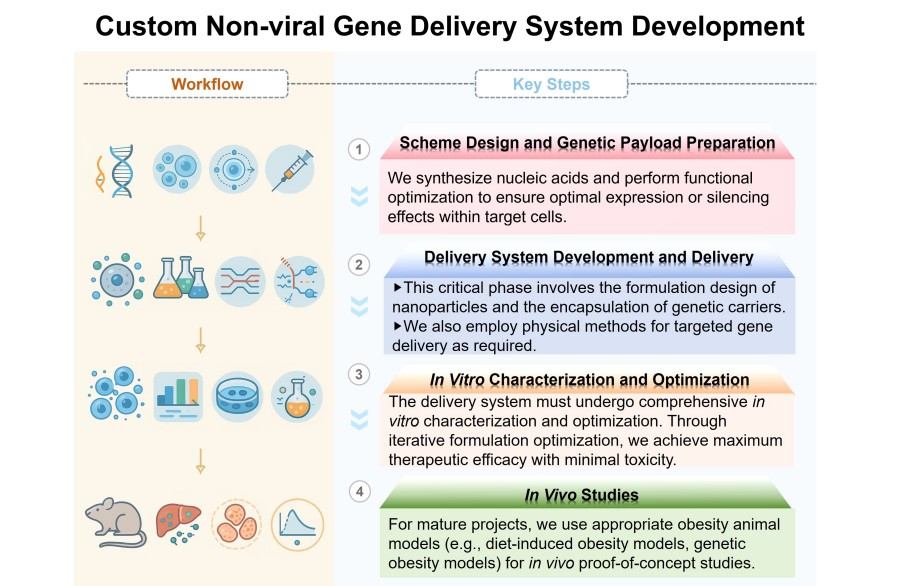
Workflow
Our customized non-viral gene delivery system development service follows a systematic collaborative workflow, covering R&D needs from early discovery to preclinical studies to ensure delivery systems are optimized for specific research and therapeutic targets.
Scheme Design and Genetic Payload Preparation
After defining the genetic payload characteristics, target cell types, desired therapeutic effects, and in vivo administration routes, we formulate the optimal non-viral delivery strategy and establish the core technical approach. Subsequently, we synthesize nucleic acids and perform functional optimization to ensure optimal expression or silencing effects within target cells.
Delivery System Development and Delivery
- This critical phase involves the formulation and design of nanoparticles and the encapsulation of genetic carriers. Based on the selected delivery platform, we screen and synthesize suitable lipids, polymers, or peptides. Utilizing advanced microfluidic technology or controlled self-assembly techniques, nanoparticles are precisely prepared to encapsulate genetic material. Through precise regulation and optimization of key parameters—including particle size, polydispersity index, surface charge, and encapsulation efficiency—we ensure stability, bioavailability, and cellular uptake efficiency.
- We also employ physical methods such as electroporation for targeted gene delivery as required.
Preclinical Studies




- In Vitro Characterization and Optimization
The prepared gene delivery system must undergo comprehensive in vitro characterization and optimization. This includes rigorous testing in relevant cell culture models (e.g., primary human adipocytes, hepatocyte lines, neuronal cells) to evaluate:
- Transfection/transduction efficiency: The effectiveness of delivering genetic material to target cells.
- Gene expression/silencing levels: Measurement of the intended biological effect.
- Cytotoxicity: Ensuring the delivery system is non-toxic to cells at effective doses.
- Cell uptake mechanisms: Investigating pathways for nanoparticle internalization.
- Biomedia stability: Evaluating nanoparticle and carrier integrity in serum-containing media.
Based on these results, iterative formulation optimization is performed to achieve maximum efficacy with minimal toxicity.
- In Vivo Studies
For mature projects, we use appropriate obesity animal models (e.g., diet-induced obesity models, genetic obesity models) for in vivo proof-of-concept studies. These studies evaluate:
- Distribution: Tracking nanoparticle distribution across organs and tissues.
- Targeting Specificity: Validating preferential delivery to metabolism-related tissues (e.g., adipose tissue, liver, hypothalamus).
- Pharmacokinetics and Pharmacodynamics: Evaluate systemic clearance of delivered genes and their biological effects on obesity-related parameters (e.g., body weight, fat mass, glucose homeostasis, energy expenditure).
- Immunogenicity and Safety: Monitor for adverse immune responses or systemic toxicity.
In vivo data are critical for validating the therapeutic potential and safety of customized delivery systems.
Applications
Our non-viral delivery system enables precisely targeted engineering for delivering genetic material that suppresses adipogenesis (i.e., blocks the differentiation of preadipocytes into mature adipocytes) or remodels the metabolic function of existing adipocytes.
Our non-viral delivery system possesses highly efficient tissue-specific targeting capabilities, enabling precise action on thermogenic tissues (such as brown adipose tissue and skeletal muscle) to efficiently deliver key thermogenic genes like uncoupling proteins (UCPs).
Our customized delivery systems serve as valuable tools for both basic and translational research, enabling the identification of novel genes involved in obesity pathways, precise regulation of gene expression, and validation of potential therapeutic targets for anti-obesity drugs.
Advantages
Metabolic Tissue-targeted Delivery
Our core strength lies in developing highly targeted delivery systems tailored for diverse tissues and cells, such as adipocytes and hepatocytes. This precision minimizes off-target effects while significantly enhancing therapeutic efficacy.
High-efficiency Delivery with Low Immunogenicity
Our non-viral vector platform achieves efficient transfection/transduction while maintaining low immunogenicity. This balance of efficacy and safety forms the cornerstone of our services.
Comprehensive Characterization and Validation
We provide thorough in vitro and in vivo characterization and validation, employing advanced analytical techniques to assess key performance metrics. These include particle size and stability, encapsulation efficiency, cellular uptake rates, gene expression, biodistribution, and therapeutic efficacy in relevant obesity models.
At our core, we're dedicated to empowering the next generation of obesity researchers. We don't just provide technology; we offer a complete partnership to help you decode the intricate molecular, epigenetic, and microbiome changes that underlie this disease. By translating these profound scientific insights into actionable strategies, we help pave the way for a healthier future.

Publication Data
Title: Gene therapy based on mesenchymal stem cells derived from adipose tissue for the treatment of obesity and its metabolic complications
Journal: International Journal of Molecular Sciences, 2023
DOI: https://doi.org/10.3390/ijms24087468
Summary: This paper introduces obesity treatment methods with a focus on adipose tissue. Repair using genetically modified adipose-derived mesenchymal stem cells (ADMSCs) has been studied and found to be an effective anti-obesity therapy. Genetic modification methods include virus-mediated gene modification and non-viral gene modification. Among these, non-viral gene modification can be achieved through physical or chemical methods and has been validated to enhance the proliferation and differentiation capabilities of ADMSCs.
Customer Review
Deeply Optimized Lipid Formulation
"Protheragen's customized LNP service provided us with an ideal solution. Through deep optimization of the lipid formulation, they successfully ensured ultra-high nucleic acid delivery efficiency and in vivo stability."— C*, R&D Executive
High Targeting Efficiency
"The Protheragen team demonstrated exceptional expertise in polymeric nanoparticle technology. Leveraging specialized chemical knowledge, they precisely engineered specific surface charges and targeting ligands, significantly enhancing hepatocyte-specific uptake efficiency in experiments."— K*, Scientific Lead
Frequently Asked Questions
-
How do we ensure specificity in gene delivery to relevant cells within anti-obesity therapies?
We achieve precise targeting through advanced strategies, such as integrating specific targeting ligands onto nanoparticles or modulating physicochemical properties. These engineered ligands selectively bind to receptors overexpressed on key obesity-related cells—such as adipocytes or specific hypothalamic neurons. This ensures the gene payload precisely reaches its target site, maximizing therapeutic efficacy while minimizing off-target effects.
-
What in vivo efficacy data do you provide for the developed anti-obesity gene delivery system?
We provide comprehensive in vivo data. You will receive a detailed report containing analyses of specific gene expression, protein levels, biodistribution, body weight, fat mass, glucose homeostasis, energy expenditure, and more. All these serve to validate the system's therapeutic efficacy.
-
How flexible are we regarding unique or novel gene targets in adapting anti-obesity therapy development?
Our services are built on customization and flexibility! We excel at tackling innovative challenges. Whether you possess unique gene targets, specific cell types, or novel therapeutic hypotheses for obesity, our expert team will collaborate closely with you to design a customized non-viral delivery system tailored to precise specifications.
Protheragen is your trusted partner, accelerating the development of innovative anti-obesity therapies through professionally customized non-viral gene delivery system development services. We provide tailored, efficient, and safe solutions that precisely address the unique challenges of delivering genetic material to metabolism-related targets. Leveraging expertise in lipid nanoparticles, polymer systems, and other areas, combined with a rigorous workflow from design to in vivo validation, we ensure the successful advancement of your project. Contact us today to learn more about this project and receive a customized solution tailored to your needs.
Reference
- Lopez-Yus, M.; et al. Gene therapy based on mesenchymal stem cells derived from adipose tissue for the treatment of obesity and its metabolic complications. International Journal of Molecular Sciences. 2023, 24(8): 7468.
All of our services and products are intended for preclinical research use only and cannot be used to diagnose, treat or manage patients.