
Activity-based Protein Profiling Service
InquiryActivity-based protein profiling (ABPP) has emerged as a transformative chemoproteomic technology that transitions obesity research from static protein abundance measurements to functional enzymatic analysis.
Functional Proteomics in Obesity: Advanced Enzyme Profiling and Target Engagement Services
In the complex landscape of metabolic disorders, total protein levels often fail to correlate with actual biological activity due to post-translational modifications and endogenous inhibitors. Protheragen utilizes advanced ABPP platforms to specifically label only the active fractions of enzymes—such as lipases, proteases, and kinases—involved in lipid metabolism and energy homeostasis. By employing active-site-directed chemical probes, we enable researchers to map the "functional proteome" of adipose tissues, liver, and hypothalamus, providing a high-resolution map of the enzymatic drivers of obesity.
Core Technologies
Protheragen utilizes a sophisticated chemoproteomic architecture to capture functional snapshots of the metabolic proteome. Our platform is built upon the following technological pillars:
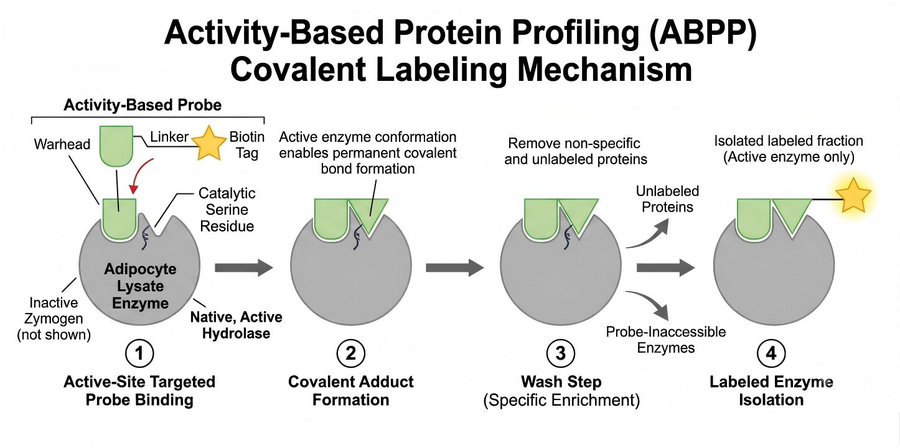
We utilize a library of functionalized small molecules consisting of three essential components: a reactive "warhead" that covalently binds only to the active sites of specific enzyme families, a chemical spacer to prevent steric hindrance, and a versatile reporter tag (biotin or fluorophore).
Unlike traditional antibodies that bind to any surface epitope, our probes are mechanism-based. They discriminate between the active and inactive (pro-enzyme or inhibited) states of key obesity targets, such as hormone-sensitive lipases and metabolic kinases.
This high-throughput screening technology allows us to determine the potency and selectivity of your lead compounds. By measuring the competition between a drug candidate and our probes, we map the "global footprint" of a molecule across thousands of enzymes simultaneously.
We employ state-of-the-art LC-MS/MS to identify and quantify enriched active proteins. This provides an unbiased, deep-proteome view of enzymatic changes in complex tissues like white adipose or liver.
Our technology is designed to operate within native cell lysates and tissue homogenates. This ensures that enzymes are profiled while maintaining their natural post-translational modifications and protein-protein interactions.
Solution Scope
Protheragen offers the industry's most comprehensive suite of ABPP services tailored for the preclinical obesity pipeline:
Targeted activity mapping of serine hydrolases, including hormone-sensitive lipase (HSL) and monoacylglycerol lipase (MAGL), to evaluate lipolysis and fatty acid oxidation rates.
- Target Engagement Assays
Precise quantification of "on-target" binding and "off-target" cross-reactivity for anti-obesity drug candidates in primary tissue lysates or live cell cultures.
- Thermogenic Pathway Analysis
Profiling the activation state of enzymes within brown adipose tissue to identify novel regulators of UCP1-independent thermogenesis.
- Kinase Activity Mapping
Large-scale profiling of metabolic kinases involved in insulin signaling pathways and glucose uptake mechanisms.
- Endocrine Protease Profiling
Analysis of the proteases responsible for the processing of appetite-regulating neuropeptides and incretin hormones (e.g., GLP-1).
Contact Our Team for More Information and to Discuss Your Project
Workflow
Our streamlined preclinical service process ensures data integrity and rapid turnaround for complex metabolic studies:
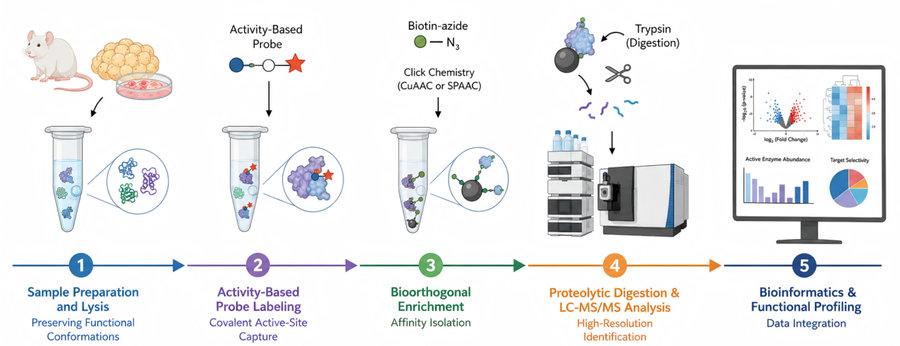
- STEP 1: Preclinical tissue samples or cell cultures are harvested under mild, non-denaturing conditions to preserve the native active folding states of target enzyme classes.
- STEP 2: Lysates are incubated with tailored active-site-directed probes. The warhead reacts covalently, permanently tagging only the active enzyme fractions within the proteome sample.
- STEP 3: Using bioorthogonal click chemistry, probe-labeled proteins are coupled to biotin-avidin matrices. Stringent washing removes non-specific background proteins, isolating only truly active targets.
- STEP 4: Enriched proteins undergo on-bead tryptic digestion to generate clean peptide fragments, which are analyzed via high-resolution tandem mass spectrometry for definitive quantification.
- STEP 5: Advanced computational pipelines process raw mass spectrometry data to map active enzyme abundance, perform differential analysis, and deliver comprehensive target selectivity profiles.
Fields of Application
The activity-based protein profiling (ABPP) platform at Protheragen bridges the gap between basic metabolic research and therapeutic development by providing functional enzyme readouts across a diverse range of preclinical obesity studies.
- Drug Discovery: Identifying the mechanism of action (MoA) for phenotypic screening hits in metabolic assays.
- Biomarker Identification: Discovering active enzyme signatures in blood or tissue that predict responsiveness to caloric restriction or pharmacological intervention.
- Safety Pharmacology: Screening anti-obesity candidates against the entire functional proteome to predict potential metabolic side effects before entering clinical phases.
- Nutraceutical Research: Evaluating the impact of bioactive food components on lipid-regulating enzyme activities.
Advantages
Protheragen stands at the forefront of chemoproteomics, providing insights that traditional proteomics cannot reach. Our platform offers:
Deep Functional Insight
We measure what proteins are doing, not just what is present, revealing the hidden drivers of metabolic dysfunction.
Native Environment Analysis
All assays are conducted in complex tissue homogenates or intact cells, maintaining the crucial protein-protein interactions and cofactor requirements often lost in purified assays.
High Sensitivity for Low-Abundance Targets
Our enrichment protocols allow for the detection of regulatory enzymes that are typically masked by high-abundance metabolic proteins like albumin or actin.
Inquire today to receive a technical consultation for your project.
Customer Review
Redefining Target Engagement and Mechanism of Action Discovery
"The team at Protheragen provided a level of clarity our obesity program was missing. By using their ABPP platform, we discovered that our lead candidate was actually targeting a previously overlooked lipase in the liver, rather than the adipose target we initially suspected. This insight allowed us to pivot our strategy early, saving us months of misdirected preclinical trials. Their expertise in handling fatty tissues was evident in the high-quality data we received."
Dr. T.T., Senior Director of Metabolic Research
Seamless Integration of Chemoproteomics into Drug Discovery Pipelines
"Collaborating with Protheragen has been a seamless experience. Their functional profiling gave us a competitive edge in characterizing our small-molecule library's selectivity. We were particularly impressed by the depth of their bioinformatics report, which translated complex MS data into actionable biological insights. We look forward to integrating their ABPP services into all our future metabolic drug discovery programs."
Dr. P.S., Preclinical Pharmacology
Frequently Asked Questions
-
How does ABPP differ from standard Western blotting for obesity targets?
Western blotting measures total protein mass, which often stays constant even if the enzyme is inhibited or degraded. ABPP measures the active protein, providing a direct readout of biological function.
-
Can your service handle high-fat tissue samples?
Yes, Protheragen has developed proprietary lipid-removal protocols that prevent interference with MS analysis while preserving enzyme activity.
-
Which enzyme families are most commonly targeted in obesity research?
We frequently target serine hydrolases, cysteine proteases, and kinases, as these families dominate the regulation of lipid storage and energy expenditure.
-
Is it possible to perform ABPP on live adipocytes?
Absolutely. We offer "in-situ labeling" where cell-permeable probes are added directly to the culture media to capture activity in a living system.
-
What is the typical sample requirement for a liver profiling project?
Generally, we require 20-50 mg of tissue, though our high-sensitivity MS platform can work with smaller biopsies if necessary.
-
Can you help identify the targets of a compound found via phenotypic screening?
This is a core strength of Protheragen. We use ABPP to "deorphan" compounds by identifying which enzymes they bind to in the native metabolic proteome.
-
Do you provide assistance with data interpretation?
Every project includes a detailed report from our PhD-level biologists, relating the MS data back to metabolic pathways and obesity pathology.
-
How do you ensure the stability of enzyme activity during shipping?
We provide detailed protocols for flash-freezing and dry-ice shipment to ensure the "activity snapshot" is preserved from your lab to ours.
-
Are your services applicable to muscle insulin resistance studies?
Yes, we can profile the activity of insulin-signaling kinases and glucose-metabolism enzymes in skeletal muscle tissues.
Contact Us
Protheragen provides the specialized expertise and high-resolution technology required to decode the functional complexities of obesity. Our activity-based protein profiling services transform raw biological samples into actionable maps of enzyme activity, empowering your preclinical drug discovery and metabolic research. Welcome to Contact Protheragen.
All of our services and products are intended for preclinical research use only and cannot be used to diagnose, treat or manage patients.