
Manual & Automated Patch Clamp Service
InquiryMetabolic regulation depends heavily on precise bioelectrical signaling across ion channels in peripheral tissues and central neural networks. In obesity research, ion channels within hypothalamic neurons, pancreatic beta-cells, adipose tissue, and cardiovascular targets dictate energy intake, nutrient sensing, lipid accumulation, and metabolic homeostasis. Characterizing these ion channels requires rigorous electrophysiological platforms capable of evaluating complex ion flux and cellular excitability during lead optimization.
Manual & Automated Patch Clamp Services for Preclinical Obesity Research
Protheragen provides specialized manual and automated patch clamp services specifically designed for preclinical obesity drug discovery. Our platforms support early-stage screening, target validation, lead optimization, and comprehensive cardiac safety profiling. By combining high-throughput automated patch clamp platforms with high-precision manual recordings, Protheragen delivers reproducible ionic current measurements across primary cells, induced pluripotent stem cell-derived models, and recombinant cell lines.
Core Technologies
Our electrophysiology suite leverages complementary manual and automated patch clamp platforms to address the specific functional demands of obesity research:
High-throughput glass chips and multi-channel planar arrays enable rapid functional screening of ion channel targets across thousands of compound interactions daily. APC systems deliver standardized voltage-clamp protocols, automated solution exchanges, and parallel data capture to assess ion channel modulators, pore blockers, and allosteric regulators.
Dual-microelectrode and single-cell manual patch clamp systems offer microsecond temporal resolution and high seal resistance (Giga-ohm seals). Manual patch clamp configurations excel at recording complex endogenously expressed ionic currents, action potential firing dynamics in brain slice preparations, and primary adipocyte or cardiocyte ion conductance.
Microfluidic and rapid solution exchange systems allow sub-second drug application, facilitating precise characterization of fast activation, deactivation, and desensitization kinetics. Precise thermal control units replicate physiological conditions (37°C) to accurately assess metabolic channel kinetics.
Service Scope
Protheragen delivers tailored electrophysiological assays designed around key ion channels implicated in metabolic disease, energy expenditure, and obesity-related comorbidities:
- Central Nervous System (CNS) Appetite & Energy Balance Pathways
Hypothalamic neural circuits, particularly Pro-opiomelanocortin (POMC) and Agouti-related peptide (AgRP) neurons in the arcuate nucleus, control satiety and hunger signaling. We measure ATP-sensitive potassium (KATP) channels, voltage-gated sodium (NaV) channels, hyperpolarization-activated cyclic nucleotide-gated (HCN) pacemaker channels, and transient receptor potential (TRP) channels that govern neuronal membrane potential and firing frequency.
- Peripheral Metabolic Targets & Pancreatic Incretin Axis
Ion channels in pancreatic islet beta-cells and peripheral visceral tissues coordinate insulin secretion, lipid storage, and thermogenesis. Our services measure voltage-gated calcium (CaV) channels (CaV1.2, CaV1.3, voltage-gated potassium (KV) channels, and store-operated calcium entry (SOCE) mechanisms in primary pancreatic islets and adipocyte models.
- Brown & Beige Adipocyte Thermogenesis Profiling
Non-shivering thermogenesis in brown adipose tissue (BAT) and beige adipocytes involves distinct uncoupling mechanisms and membrane ion fluxes. We quantify non-selective cation currents, TRP channel activity (such as TRPV1 and TRPM8), and anion currents that modulate adipocyte mitochondrial potential and cellular differentiation.
- Safety Electrophysiology & hERG Off-Target Profiling
Preclinical drug development for chronic conditions like obesity demands robust early cardiac safety evaluation. We offer comprehensive hERG (KV11.1), NaV1.5, and CaV1.2 cardiac channel panel screens to detect potential QT prolongation risks, cardiac arrhythmia tendencies, and off-target ion channel interactions before advancing compounds into expensive Animal Models.
Contact Our Team for More Information and to Discuss Your Project
Workflow
Our preclinical electrophysiology service follows a disciplined, step-by-step workflow:
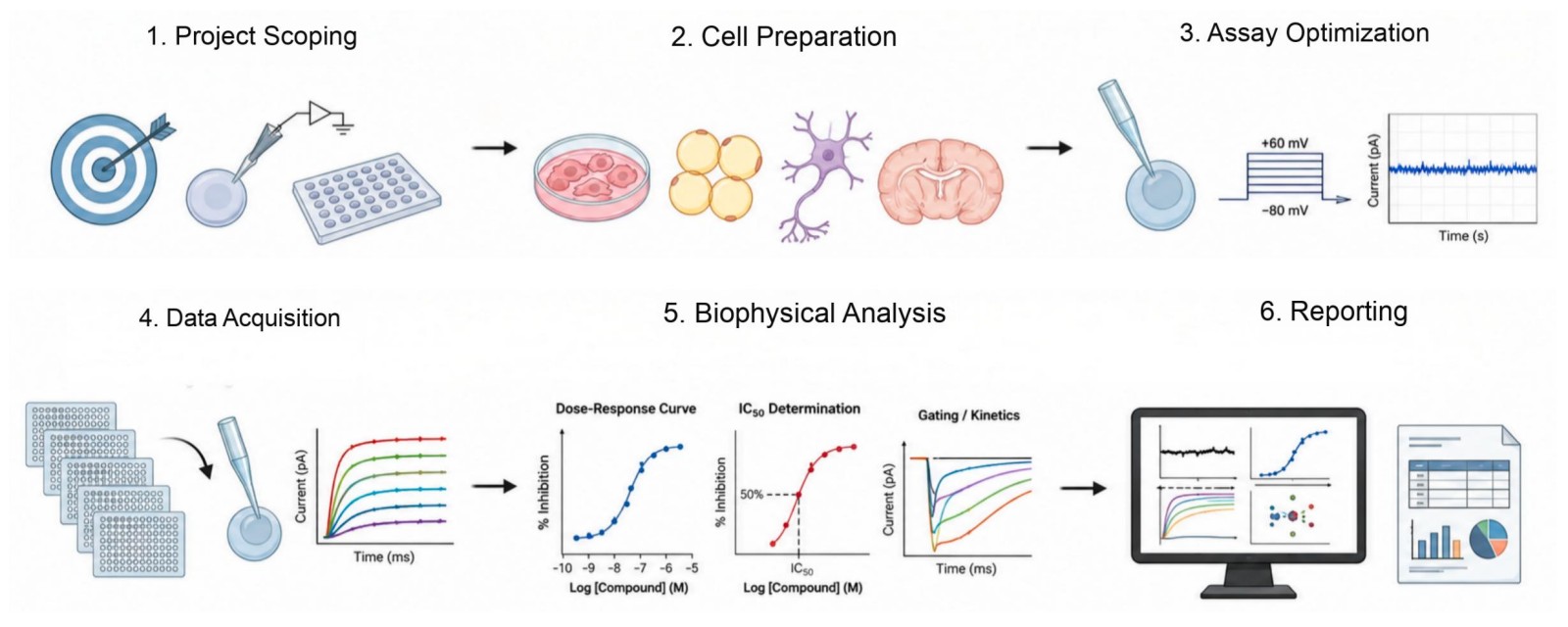
- Step1: Defining electrophysiological targets, recording modes, experimental conditions, compound delivery protocols, and screening throughput criteria.
- Step2: Culturing recombinant cell lines, isolating primary adipocytes or hypothalamic neurons, or preparing tissue slice samples.
- Step3: Fine-tuning seal formation, voltage-clamp parameters, solution compositions, and vehicle tolerance for reliable baseline stability.
- Step4: Executing automated screening protocols or manual recordings to evaluate concentration-response curves and gating kinetics.
- Step5: Extracting peak current densities, half-maximal inhibitory concentrations (IC50), activation shifts, and action potential parameters.
- Step6: Delivering curated datasets, raw electrophysiological traces, dose-response fits, and actionable target activity summaries.
Fields of Application
From central satiety circuits to peripheral thermogenic tissue, our patch clamp services adapt to a wide spectrum of preclinical metabolic discovery programs.
- CNS Energy Balance Modulators: Testing Small Molecules, peptides, and neuropeptide receptor agonists targeting POMC, AgRP, or NPY neuronal excitability.
- Incretin Secretagogues & Beta-Cell Enhancers: Assessing ion channel modulators designed to restore glucose-stimulated insulin secretion without inducing hypoglycemia.
- Adipocyte Thermogenesis & Metabolic Accelerators: Evaluating ion channel targets that promote adipocyte browning, uncoupled respiration, and increased lipid utilization.
- Metabolic Cardiac Safety Profiling: Screening Anti-obesity lead candidates early to eliminate cardiac ion channel liability (KV11.1, NaV1.5, CaV1.2).
Advantages
Combining scalable high-throughput capacity with deep biophysical precision, our electrophysiology platform gives your preclinical metabolic pipeline a distinct competitive edge.
Integrated Dual-Platform Precision
Protheragen pairs the high-throughput capabilities of automated patch clamp platforms with the micro-scale precision of manual brain-slice and primary-cell patch clamp setups. This dual strategy allows clients to transition seamlessly from primary library screening directly to in-depth biophysical mechanism-of-action studies.
Physiologically Relevant Tissue & Cell Models
We go beyond simple recombinant cell lines. Our team regularly records from mouse and rat hypothalamic brain slices, isolated primary adipocytes, pancreatic islet cells, and human iPSC-derived cardiomyocytes, delivering data that closely reflects complex physiological microenvironments.
Rigorous Safety & hERG Risk Mitigation
It has been demonstrated that early integration of automated hERG and cardiac panel assays significantly lowers late-stage drug attrition. Protheragen yields standardized IC50 values and action potential duration measurements that satisfy regulatory requirements early in lead discovery.
Custom Microfluidic & Thermal Control Capabilities
Our temperature-controlled recording setups enable rapid solution changes and physiological temperature testing (37°C). This precise environment preserves delicate channel gating kinetics, which often shift dramatically between room temperature and true physiological states.
Contact Our Team to Discuss Your Obesity Lead Discovery Strategy.
Customer Review
Accelerating Central Metabolic Lead Discovery Through Dual-Platform Screening
"Working alongside Protheragen on our central metabolic peptide program completely reshaped our lead candidate selection. Their ability to deliver slice electrophysiology data from arcuate nucleus neurons while running high-throughput hERG screens in parallel cut months off our pipeline timeline. The data clarity and direct access to their Senior Scientists made interpreting complex kinetic shifts straightforward."
Dr. A. T., VP of Discovery Chemistry
Resolving Complex TRP Channel Mechanisms in Primary Brown Adipocytes
"The reproducibility of exosome isolation was our primary bottleneck before partnering with Protheragen. Their tangential flow filtration and rigorous characterization services gave us complete confidence in our vesicle batches. We're currently planning our next phase of in vivo efficacy testing with them and highly value their deep scientific expertise in metabolic syndrome biology."
Dr. E. R., BioVanguard Sciences
Frequently Asked Questions
-
Why should we use patch clamp electrophysiology instead of fluorescence-based ion flux assays for our obesity targets?
Fluorescence assays provide useful bulk kinetic data, but they lack real-time voltage control and often fail to detect fast kinetic alterations, voltage-dependent blockages, or subtle gating shifts. Patch-clamp recording remains the gold standard, yielding accurate, direct current recordings and voltage-clamp precision.
-
Can Protheragen record directly from brain slices containing hypothalamic feeding centers?
Yes. Our electrophysiologists perform manual patch clamp recordings on acutely prepared hypothalamic brain slices, allowing direct evaluation of compound effects on POMC, AgRP, or paraventricular nucleus (PVN) neuronal firing rates.
-
What throughput can we expect from your automated patch clamp service?
Our APC platforms can screen hundreds to thousands of compound data points per day, making them ideal for hit-to-lead campaigns, concentration-response curve generation, and broad ion channel selectivity panels.
-
How do you validate seal quality and cell stability during high-throughput screening?
We monitor seal resistance, membrane capacitance, series resistance, and baseline current stability throughout every automated run. Data points falling outside strict quality control thresholds are automatically flagged and excluded.
-
Can your team record ion channel currents at physiological temperatures?
Yes. Both our manual microelectrode rigs and automated platforms feature integrated thermal controls to execute experiments at 37°C, ensuring kinetic parameters match in vivo conditions.
-
Do you evaluate cardiac safety channels beyond hERG?
We offer comprehensive cardiac safety panels including hERG KV11.1, NaV1.5, CaV1.2, and KV4.3 to give you a complete profile of potential pro-arrhythmic liabilities.
-
What amount of compound material is required for automated versus manual patch clamp testing?
Automated platforms typically require low microliter volumes per concentration, whereas manual patch clamp slice work depends on perfusion chamber volumes. We work with you to minimize compound consumption based on your available stock.
-
Can Protheragen assess peptide-based anti-obesity therapeutics?
Yes. Our solution delivery systems are optimized to minimize sticky peptide adsorption, using specialized low-bind plastics and inert fluid pathways to maintain accurate compound concentrations.
-
How are primary cells such as adipocytes or pancreatic islets handled for patch clamp recordings?
We utilize gentle digestion protocols to isolate primary cells while preserving surface membrane proteins and ion channel complexes, ensuring baseline function remains intact during recording.
-
What format will the final electrophysiology data be delivered in?
You receive a clear summary report containing fitted dose-response curves, calculated IC50\EC50 values, biophysical kinetic constants, representative current traces, and complete raw data files.
Contact Us
Protheragen delivers high-quality manual and automated patch clamp services tailored to the needs of preclinical obesity research. Whether you require high-throughput ion channel screening or deep biophysical slice recordings, our experienced electrophysiology team is ready to accelerate your drug discovery pipeline. Contact Protheragen!
All of our services and products are intended for preclinical research use only and cannot be used to diagnose, treat or manage patients.