
Obesity-Related Mitochondrial Bioenergetics & Respiration Analysis Service
InquiryMitochondrial bioenergetic dysfunction sits right at the center of obesity, type 2 diabetes, non-alcoholic fatty liver disease, and related metabolic syndromes. When nutrient oversupply swamps white adipocytes, skeletal muscle, or hepatocytes, electron transport chain complexes get overwhelmed. This leads to uncoupled respiration, lower ATP synthesis capacity, elevated reactive oxygen species production, and altered mitochondrial membrane potential.
Preclinical Mitochondrial Bioenergetics & Respiration Analysis Services
At Protheragen, we offer comprehensive preclinical testing solutions designed to characterize metabolic, respiratory, and bioenergetic alterations in cellular and animal models of obesity. Our services focus entirely on preclinical research, helping biotech and pharmaceutical teams evaluate novel small molecules, biotherapeutics, and natural compounds without clinical regulatory overhead. Through high-throughput microplate-based respirometry and isolated organelle assays, our specialized platform delivers the actionable kinetic and quantitative data required to move your metabolic drug discovery pipeline forward.
Core Technologies
Our analytical platforms integrate real-time bioenergetic profiling with high-sensitivity biochemical assays to evaluate mitochondrial performance in intact cells, permeabilized tissues, and isolated organelles.
Real-time, label-free measurement of oxygen consumption rate (OCR) and extracellular acidification rate (ECAR) in microplate formats.
Potentiometric dye assays (JC-1, TMRM, Rhodamine 123) for assessing matrix polarization (ΔΨm).
Single- and multi-complex activity profiling across complexes I through V in purified mitochondrial fractions.
Kinetic tracking of total cellular and mitochondrial ATP generation following substrate stimulation.
Service Scope
Our comprehensive service portfolio targets every functional node of mitochondrial energy conversion in obesity-related preclinical models.
We measure basal, ATP-linked, maximal, and non-mitochondrial respiration in living cells using automated extracellular flux instruments. By injecting specific modulators like oligomycin, FCCP, and rotenone/antimycin A in real time, our assays quantify spare respiratory capacity and proton leak in adipocytes, myocytes, and hepatocytes exposed to high-fat or high-glucose stress.
Our team profiles mitochondrial respiratory chain complexes under physiological substrate regimes. We evaluate substrate-dependent oxygen consumption using pyruvate, malate, glutamate, or succinate to identify specific metabolic bottlenecks within the electron transport chain caused by lipid overload or candidate drug treatment.
We evaluate changes in inner mitochondrial membrane voltage (ΔΨm) using potentiometric dyes. This service monitors mitochondrial depolarization or hyperpolarization in model systems, providing clear metrics on uncoupling efficiency, permeability transition pore opening, and overall mitochondrial integrity.
We isolate mitochondria from cell cultures or animal tissues to measure the individual kinetic activities of complexes I, II, III, IV, and ATP synthase (complex V). These spectrophotometric microplate assays isolate specific complex deficits resulting from metabolic stress or compound toxicity.
We quantify real-time ATP generation rates derived from oxidative phosphorylation versus glycolysis. Our kinetic assays trace energy production dynamics over time, providing absolute quantification of ATP synthesis rates and the ATP/ADP ratio in nutrient-overloaded tissue models.
Discuss Your Project with Our Metabolic Specialists Today
Workflow
Our standardized, five-stage preclinical testing workflow ensures robust, reproducible, and timely data deliverables for your bioenergetic studies.
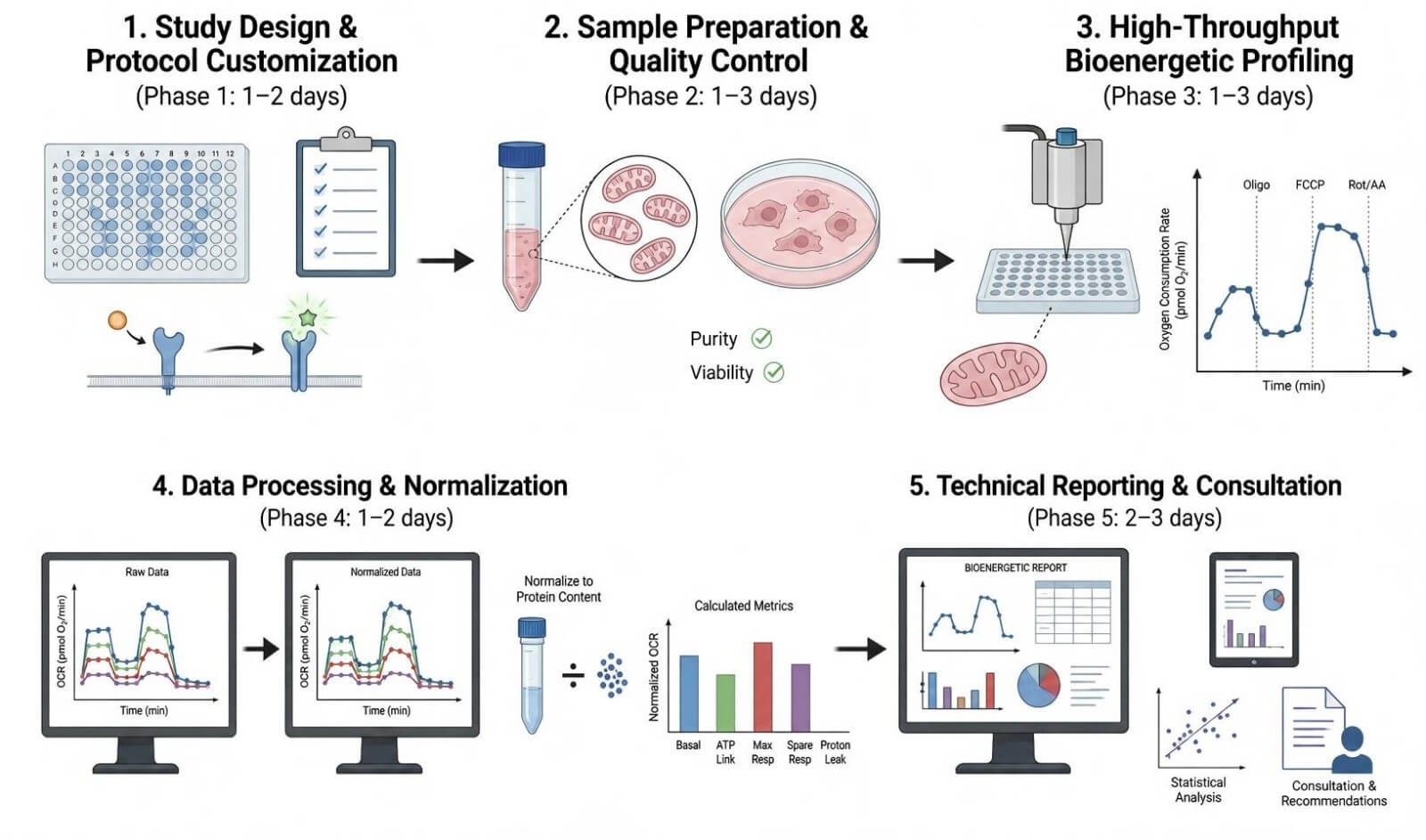
- Step 1: Formulate experimental layout and choose specific assay parameters tailored to your project targets.
- Step 2: Isolate mitochondria or culture primary cells, checking viability and purity standards before testing.
- Step 3: Run multi-parameter respirometry, membrane potential, or enzymatic kinetic assays.
- Step 4: Analyze raw signals, normalize data to protein content, and calculate bioenergetic parameters.
- Step 5: Deliver complete experimental reports including statistical analyses and executive scientific summaries.
Fields of Application
Our bioenergetic analysis services directly support a broad range of drug discovery and mechanistic research areas:
- Antiobesity Drug Candidate Screening
Screening small molecules, peptide mimetics, or natural products for their ability to increase mitochondrial uncoupling or boost basal metabolic rate in brown or beige adipocytes.
- Insulin Resistance & Type 2 Diabetes Research
Assessing mitochondrial function in skeletal muscle cells and adipocytes to identify compounds that restore insulin sensitivity and glucose uptake.
- NAFLD / NASH Preclinical Therapeutics
Evaluating hepatic mitochondrial flexibility, beta-oxidation efficiency, and ROS generation in cellular and rodent models of non-alcoholic fatty liver disease.
- Mitochondrial Toxicity Profiling
Assessing potential off-target mitochondrial toxicity or uncoupling effects of developmental therapeutic leads early in the drug discovery process.
Advantages
Our specialized mitochondrial platforms combine real-time extracellular flux respirometry with isolated organelle kinetics to deliver precise, translationally relevant bioenergetic data for your preclinical pipeline.
Unmatched Preclinical Expertise
Our scientific team brings decades of combined experience in metabolic biology and mitochondrial physiology. We have successfully executed hundreds of bioenergetic assay projects for global biotechnology clients. It is confirmed that proper normalization and substrate choice are critical; our team applies rigorous quality standards to deliver highly reproducible bioenergetic metrics across every run.
Advanced Multi-Platform Capabilities
Protheragen integrates extracellular flux profiling, high-resolution respirometry, and spectrophotometric enzyme assays under one roof. This allows us to correlate real-time cellular oxygen consumption directly with individual complex activity and membrane potential changes. It is shown that combining these technologies provides a far more complete picture of metabolic health than single-endpoint assays.
Tailored Assay Designs for Complex Models
We do not use one-size-fits-all protocols. Our scientists customize assay parameters, substrate combinations, and compound exposure times based on your specific cell line, tissue type, or isolated mitochondrial fraction. It has been demonstrated that adjusting substrate availability to reflect physiological lipid exposure yields significantly more predictive translational data.
Accelerated Turnaround with Complete Data Integrity
Our optimized microplate workflows allow us to process large compound libraries quickly without sacrificing scientific rigor. Clients receive fully processed raw data, normalized bioenergetic parameters, publication-ready graphics, and a detailed technical report prepared by expert bioenergeticists within short, predictable timelines.
Contact Our Team for More Information and to Discuss Your Project
Customer Review
Accelerating Adipocyte Target Profiling
"Working with Protheragen was a game-changer for our lead optimization campaign targeting mitochondrial uncoupling in adipocytes. Their team helped us refine our compound treatment window and handled the complex OCR and membrane potential assays flawlessly. The detailed report gave us clear, actionable insights into complex-specific activities that directly informed our next medicinal chemistry iteration. We're already planning our next round of rodent tissue studies with them."
Dr. M. V., Director of Pharmacology
Unlocking Hepatic Bioenergetic Insights
"Working with Protheragen felt like an extension of our own internal lab group. Their scientists helped us refine our palmitate-stress protocols and delivered highly reproducible multi-channel fluorescence data that perfectly complemented our internal metabolic flux assays. The data package was clean, thorough, and ready for our internal reviews."
Dr. E. R., Senior Principal Scientist
Frequently Asked Questions
-
What cell types or sample formats can be used in your OCR measurement service?
We accept primary mammalian cells, established cell lines (such as 3T3-L1 adipocytes, C2C12 myotubes, or HepG2/primary hepatocytes), isolated mitochondria from animal tissues, and frozen tissue homogenates suitable for complex enzyme activity assays.
-
Can Protheragen assist with in vivo animal studies?
While we focus on ex vivo and in vitro assay execution, we routinely receive isolated tissue samples (e.g., liver, brown adipose tissue, skeletal muscle) harvested from animal models run at your facility or partner CROs.
-
How do you normalize OCR and ATP production data across different wells?
Data can be normalized to total protein content (via BCA or Bradford assays), total genomic DNA content, or cell number using automated fluorescence imaging, depending on your experimental setup.
-
What is the typical turnaround time for a bioenergetic profiling project?
Most standard cell-based or isolated organelle projects are completed within 2 to 4 weeks following sample receipt and protocol finalization.
-
Can you test hydrophobic or poorly soluble compounds in your microplate respirometry assays?
Yes. Our team routinely formulates vehicles (such as DMSO, ethanol, or cyclodextrins) compatible with living cell respirometry to ensure compound solubility without compromising mitochondrial or cellular viability.
-
What distinguishes your mitochondrial membrane potential assay from standard viability dyes?
Standard viability dyes measure cell membrane integrity or general metabolic activity, whereas our potentiometric assays specifically evaluate the electrical gradient (ΔΨm) across the inner mitochondrial membrane, directly reflecting OXPHOS coupling state.
-
Can we customize substrate injection sequences during extracellular flux analysis?
Absolutely. While we offer standard stress tests (oligomycin, FCCP, rotenone/antimycin A), we frequently build custom injection protocols incorporating fatty acids, pyruvate, glutamine, or proprietary pathway inhibitors.
-
How do I select the best bioenergetic assay combination for my compound class?
Simply reach out to our team. Our senior scientists will review your drug target, preliminary data, and project goals to recommend an optimal, cost-effective assay strategy.
Contact Us
Protheragen provides high-precision preclinical services for evaluating obesity-related mitochondrial bioenergetics and respiration. From extracellular flux respirometry and membrane potential monitoring to complex enzyme kinetics and bioluminescent ATP tracking, our experienced team delivers reliable, high-throughput bioenergetic profiling tailored to your metabolic drug discovery goals. Contact Protheragen!
All of our services and products are intended for preclinical research use only and cannot be used to diagnose, treat or manage patients.