
Obesity-Related Mitochondrial Respiratory Chain Enzyme Activity Assay Service
InquiryObesity is no longer viewed simply as an issue of excessive fat storage. At its core, it is a complex systemic energy crisis tightly linked to metabolic gridlock. Inside the cell, the mitochondrial respiratory chain is responsible for managing this energy flow. When individuals or animal models develop obesity, chronic nutrient overload puts immense pressure on these metabolic engines. This pressure often triggers a severe breakdown in electron transport chain function. Protheragen provides highly specialized, preclinical obesity-related mitochondrial respiratory chain enzyme activity assay services. These services are specifically designed to help researchers pinpoint where these bioenergetic failures occur in metabolic disease models.
Quantifying Mitochondrial Bioenergetics in Metabolic Disease: Preclinical Obesity-Related Mitochondrial Respiratory Chain Enzyme Activity Assay Services
Our platform focuses entirely on preclinical research. We provide the precise biochemical insights needed to evaluate how therapeutic compounds, genetic edits, or dietary interventions influence mitochondrial health. By measuring the individual activities of complexes I through V, we help therapeutic development teams turn vague metabolic observations into clear, actionable data.
Core Technologies
Our analytical approach combines traditional biochemistry with modern microplate optimizations. This allows us to deliver highly reproducible data from challenging preclinical tissue samples.
We utilize customized, colorimetric and fluorometric kinetic assays to follow enzyme activity in real time. By introducing specific electron donors and acceptors along with targeted inhibitors, we isolate and measure the precise performance of each complex.
Our protocols use specific detergent-to-protein ratios to open up mitochondrial membranes without harming the structures of the respiratory complexes. This step ensures the enzymes remain stable and fully functional during testing.
Extracting functional mitochondria from fat-heavy tissue is notoriously difficult. Our lab has developed specialized homogenization and differential centrifugation workflows that successfully separate clean mitochondrial fractions from interfering lipids.
Service Scope
Protheragen offers a comprehensive suite of assays tailored to the unique demands of preclinical metabolic research. We modify our protocols to fit the exact tissue types and animal models used in your study.
- Individual Complex Activity Assays
- Complex I (NADH Dehydrogenase): We measure the rate of NADH oxidation to NAD+ by tracking the reduction of artificial electron acceptors. This measurement includes using rotenone to establish baseline specificity.
- Complex II (Succinate Dehydrogenase): We follow the transformation of succinate to fumarate. This is done by tracking the decolorization of DCPIP as it accepts electrons from the ubiquinone pool.
- Complex III (Coenzyme Q: Cytochrome c Oxidoreductase): We monitor the reduction of cytochrome c at a specific wavelength, using antimycin A to verify the reaction's specificity.
- Complex IV (Cytochrome c Oxidase): We quantify the oxidation of reduced cytochrome c, providing a clear window into the terminal step of the electron transport chain.
- Complex V (ATP Synthase): We measure the enzyme's reverse activity by coupling ATP hydrolysis to NADH oxidation through a pyruvate kinase/lactate dehydrogenase reaction loop.
- Tissue-Specific Customizations
- Adipose Tissue Profiling: Optimized handling for white and brown adipose tissue to eliminate lipid interference and measure true enzyme capability.
- Hepatic and Muscular Bioenergetics: High-throughput screening of liver and skeletal muscle samples from high-fat diet (HFD) or genetically modified rodent models.
- Mitochondrial Mass Verification
- Citrate Synthase Reference Assays: We measure citrate synthase activity to determine overall mitochondrial mass. This step ensures that any observed drops in complex activity are caused by actual enzyme dysfunction rather than a simple change in mitochondrial numbers.
Contact our scientific team today to map out your next study.
Workflow
Our streamlined pipeline guarantees that your preclinical tissue or cell samples are processed efficiently and yield reliable, reproducible data.
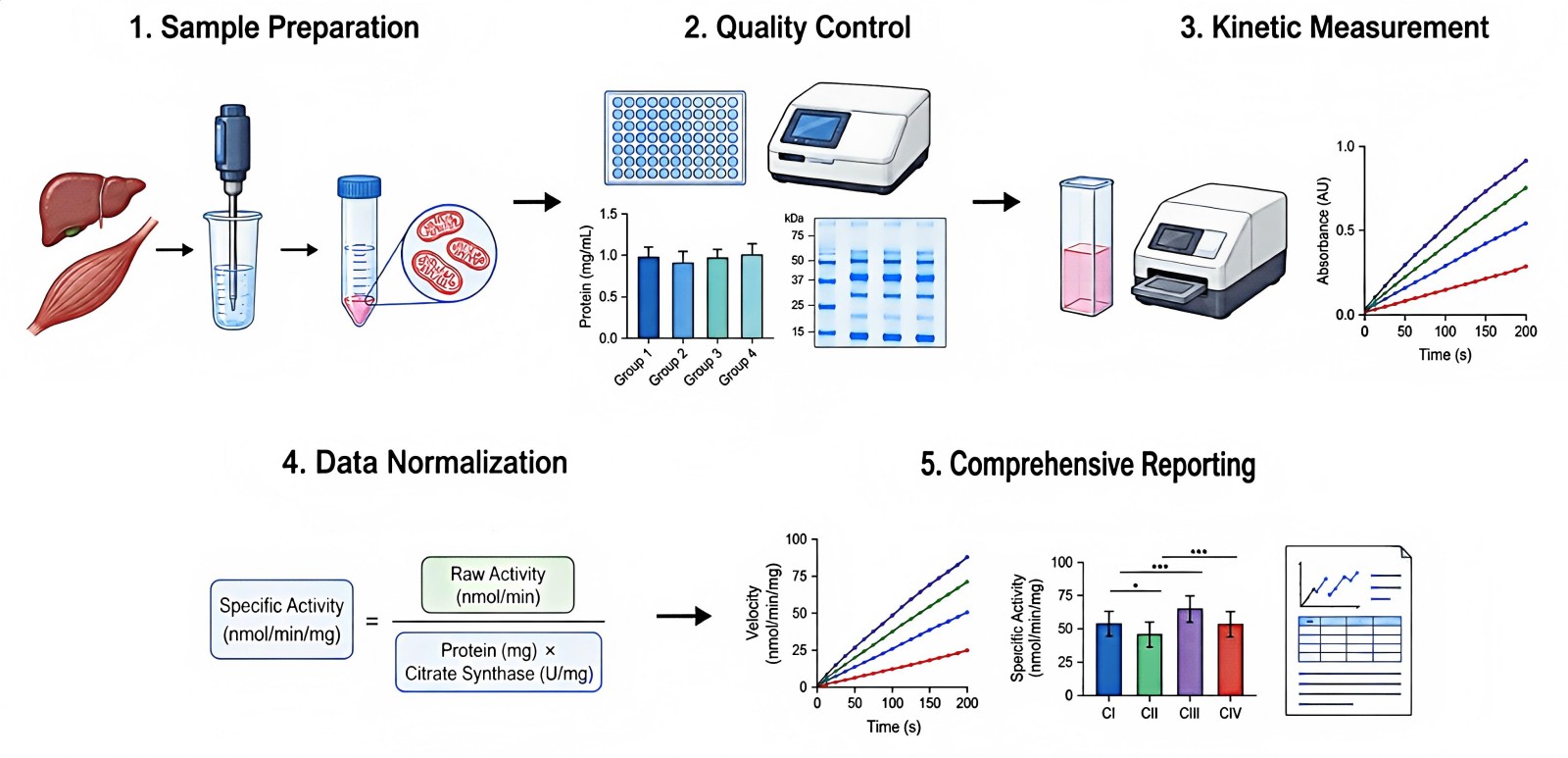
- Step 1: We isolate intact mitochondrial fractions or prepare specialized tissue homogenates using validated, lipid-optimized isolation protocols.
- Step 2: Our team verifies protein concentrations and sample integrity to ensure consistent input across groups.
- Step 3: We run targeted spectrophotometric assays to measure specific respiratory chain complex activities under controlled conditions.
- Step 4: We calculate precise specific activities by normalizing raw kinetic values against total protein and citrate synthase.
- Step 5: You receive detailed raw data graphs, calculated specific velocities, and statistical summaries tailored for study timelines.
Fields of Application
Our assay services integrate directly into various stages of preclinical drug discovery and metabolic research.
- Anti-Obesity Drug Screening: Screen small molecules, biologics, or natural extracts to see if they can restore or boost respiratory chain activity in metabolic disease models.
- Phenotypic Profiling of Models: Establish baseline mitochondrial performance across various animal models, including high-fat diet mice, ob/ob mice, and db/db rodents.
- Toxicity and Safety Assessments: Evaluate whether candidate drugs cause unintended mitochondrial toxicity or disrupt normal electron transport chain function.
- Dietary and Lifestyle Intervention Studies: Track how different nutritional strategies or exercise regimens alter tissue-specific mitochondrial function at the molecular level.
Advantages
Our preclinical platform is engineered to overcome the classic hurdles of lipid interference and sample scarcity, delivering high-fidelity bioenergetic profiles that give your therapeutic pipeline a distinct competitive edge.
Tailored Adipose Tissue Processing Protocols
Adipose tissue is notoriously difficult to work with due to its high lipid content and low protein yields. Our specialized extraction methods can successfully remove lipid contaminants without damaging delicate enzyme structures, ensuring you receive clean and highly reproducible kinetic data.
Comprehensive Multi-Complex Insights from Minimal Sample Volumes
We have optimized our microplate assays to measure multiple respiratory chain complexes using very small sample volumes. This approach allows you to get full bioenergetic profiles from limited tissue biopsies or small mouse organs, leaving plenty of sample for other critical analyses.
Rigorous Bi-Layer Normalization for High-Confidence Adjustments
We do not rely solely on total protein measurements to analyze your data. Our protocols include simultaneous citrate synthase tracking, allowing us to separate true changes in enzyme activity from fluctuations in overall mitochondrial mass, which provides deeper clarity for your study.
Submit a Preclinical Project Inquiry
Publication Data
Title: The Biochemical Assessment of Mitochondrial Respiratory Chain Disorders
Journal: International journal of molecular sciences, 2022
DOI: https://doi.org/10.3390/ijms23137487
Summary: This review covers biochemical testing for mitochondrial respiratory-chain disorders. It discusses blood-urine metabolites, spectrophotometric enzyme assays (gold-standard), polarography, and biomarkers including FGF-21/GDF-15, highlighting test limitations and the need for multi-modal diagnosis.
Key Findings
- Mitochondrial respiratory chain (MRC) disorders are genetically heterogeneous and demand multidisciplinary diagnostic workflows combining clinical, biochemical and genetic work-ups.
- Routine blood and urine metabolites (lactate-pyruvate ratio, alanine, urinary organic acids) provide initial screening clues, yet have limited sensitivity and specificity; normal results cannot exclude MRC disease.
- Spectrophotometric measurement of MRC enzyme activities in skeletal muscle is the biochemical gold-standard for confirming dysfunction; complex V activity cannot be measured via this method and requires blue-native gel electrophoresis.
- Polarography evaluates integrated mitochondrial oxygen consumption, but limited lab availability prevents it from being a core diagnostic assay.
- Serum FGF-21 and GDF-15 are promising non-invasive biomarkers, best suited for muscle-manifesting MRC disease; they underperform for non-muscle presentations and are not fully specific.
- Additional informative analytes include CoQ10, glutathione redox markers, and cerebrospinal fluid 5-methyltetrahydrofolate.
- Biochemical tests alone cannot separate primary from secondary mitochondrial damage; genetic analysis is mandatory for definitive classification. Future multi-omics research aims to deliver better non-invasive signatures to reduce the need for invasive muscle biopsies.
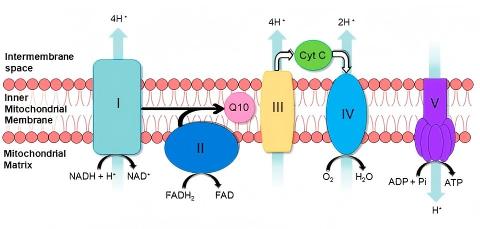 Fig.1 Mitochondrial respiratory chain & oxidative phosphorylation: how mitochondria make cellular ATP. (Turton, et al.; 2022)
Customer Review
Overcoming Lipid Interference in High-Fat Diet Rodent Models
"Isolating high-quality mitochondria from the heavy adipose tissues of our high-fat diet mouse models was a constant roadblock for our team. Protheragen took over the processing and delivered highly consistent complex I and IV kinetic profiles that clearly showed the impact of our lead compounds. The clarity of their data normalization helped us confidently select our top candidate for the next phase of development. We plan to keep working with them for our upcoming animal studies."
Dr. E. V., Metabolic Therapeutics Division
High-Throughput Toxicity Screening with Minimal Sample Volume
"We needed to screen a library of small molecules for potential mitochondrial toxicity while looking for positive metabolic modulators. The microvolume capabilities at Protheragen meant we didn't have to sacrifice large amounts of our limited tissue samples. Their dual normalization against both total protein and citrate synthase gave us the clear data we needed to move forward. Their team is knowledgeable, responsive, and clearly understands the nuances of metabolic disease research."
Dr. A. T., Biopharmaceutical Research Group
Frequently Asked Questions
-
What preclinical sample types can I send to Protheragen for this assay?
We work with a wide range of animal tissues, including white and brown adipose tissue, liver, skeletal muscle, and cardiac tissue. We also process cell pellets from in vitro metabolic models. Since our services are purely preclinical, we do not accept or process human clinical samples.
-
Why is measuring individual complex activity better than just tracking total oxygen consumption?
Total oxygen consumption gives you a broad view of overall mitochondrial respiration, but it cannot tell you where a specific problem lies. Measuring individual complex activities allows you to pinpoint the exact site of a bioenergetic bottleneck or identify the specific target of your therapeutic compound.
-
How do you handle the high fat content in tissue samples from obese animals?
Our laboratory uses customized differential centrifugation protocols along with specialized, mild detergents. This setup separates the lipid layer completely while keeping the underlying mitochondrial membranes stable and the respiratory complexes fully functional.
-
Can we include specific reference inhibitors in our custom study design?
Yes. We routinely use standard inhibitors like rotenone, antimycin A, and sodium azide to confirm assay specificity. We can easily add your experimental compounds or specific reference controls into the study design to match your project goals.
-
What is the typical sample amount required for a full complexes I–V profile?
Because we use optimized microvolume plate assays, we can generally obtain a full profile from 20 to 50 milligrams of tissue or a cell pellet containing roughly 2 to 5 million cells, depending on the specific tissue type.
-
Do you offer validation through citrate synthase activity measurement?
Yes, every full profile includes an optional or integrated citrate synthase activity assay. This gives you a clear look at mitochondrial mass, helping you determine if a drop in activity is due to damaged enzymes or fewer mitochondria.
-
How are the final activity results calculated and delivered?
Results are typically delivered as specific enzyme activities, expressed as nanomoles of substrate consumed or product formed per minute per milligram of total protein. We can also normalize these numbers against total citrate synthase activity.
-
Can this assay service help identify mitochondrial toxicity in new drug candidates?
Absolutely. By running your lead compounds through our assay cascade, you can quickly spot unintended inhibition of any respiratory chain complexes, helping you eliminate toxic candidates early in the preclinical phase.
-
How do we ensure our frozen tissue samples do not lose enzyme activity during shipping?
We provide detailed flash-freezing guidelines and advice on dry-ice shipping configurations. Keeping the samples at stable ultra-low temperatures prevents freeze-thaw damage and preserves enzyme function.
Contact Us
Protheragen delivers high-resolution, preclinical obesity-related mitochondrial respiratory chain enzyme activity assay services designed to reveal how metabolic disease affects cellular energy. By providing precise, tissue-specific profiles of complexes I through V, we give your team the clear data needed to make informed decisions about therapeutic targets, evaluate drug safety, and optimize metabolic compounds. Contact Protheragen for more information or to request a quote.
Reference
- Turton, N.; et al. The Biochemical Assessment of Mitochondrial Respiratory Chain Disorders. International journal of molecular sciences. 2022, 23(13), 7487. (CC BY 4.0)
All of our services and products are intended for preclinical research use only and cannot be used to diagnose, treat or manage patients.