
Obesity-Related Mitochondrial Oxidative Phosphorylation (OXPHOS) Analysis Service
InquiryMitochondria sit at the center of cellular energy metabolism. Through oxidative phosphorylation (OXPHOS), electrons derived from carbohydrates, fatty acids, and other nutrients move through the mitochondrial respiratory chain, creating a proton gradient that drives ATP synthesis. In obesity, this system can change substantially—but not always in the same direction, and not necessarily in every tissue.
Obesity-Related Mitochondrial OXPHOS Analysis Service for Preclinical Research
Protheragen's obesity-related mitochondrial OXPHOS analysis service is designed around this biological complexity. The service supports preclinical investigation of mitochondrial respiration in obesity models, allowing researchers to determine whether a phenotype is associated with altered respiratory capacity, substrate utilization, ATP-linked respiration, proton leak, respiratory-chain activity, or broader mitochondrial adaptation.
Core Technologies
Protheragen combines complementary mitochondrial technologies to provide functional and mechanistic insights into obesity-related OXPHOS changes.
Measure oxygen consumption to assess basal respiration, ATP-linked respiration, proton leak, maximal respiratory capacity, and spare respiratory capacity.
Evaluate mitochondrial respiration under defined substrate and inhibitor conditions to investigate respiratory-chain function and substrate utilization.
Distinguish oxygen consumption associated with ATP production from respiration related to proton leak and other processes.
Assess respiratory-chain complex activities to identify potential defects or changes in specific mitochondrial electron-transport steps.
Normalize respiratory data using appropriate protein or mitochondrial-content markers to distinguish mitochondrial abundance from intrinsic functional changes.
Combine OXPHOS data with ATP, ROS, membrane potential, mitochondrial markers, proteomics, metabolomics, or lipidomics for deeper mechanism studies.
Service Scope
Protheragen provides flexible preclinical mitochondrial OXPHOS analysis for obesity, metabolic disease, and drug discovery studies.
- Obesity Model Comparison
Compare mitochondrial respiration between lean, obese, treated, and control groups.
- Adipose Tissue OXPHOS
Assess mitochondrial respiration, biogenesis, fatty-acid metabolism, and thermogenic function.
- Liver Mitochondrial Respiration
Investigate hepatic OXPHOS, fatty-acid oxidation, and metabolic adaptation.
- Skeletal Muscle OXPHOS
Evaluate mitochondrial capacity, substrate utilization, and ATP production.
- Drug Candidate Screening
Determine how anti-obesity compounds affect mitochondrial respiration and function.
- Mechanism-of-Action Studies
Examine mitochondrial changes associated with fatty-acid oxidation, biogenesis, thermogenesis, and energy metabolism.
- Treatment Response
Compare mitochondrial function across doses, treatments, and experimental time points.
- Integrated OXPHOS Analysis
Combine respiration data with ATP, ROS, membrane potential, enzyme activity, metabolomics, or proteomics for deeper interpretation.
Contact Protheragen to discuss a tailored preclinical OXPHOS analysis strategy.
Workflow
Our streamlined workflow is designed to generate reliable, reproducible OXPHOS data from experimental design through biological interpretation.
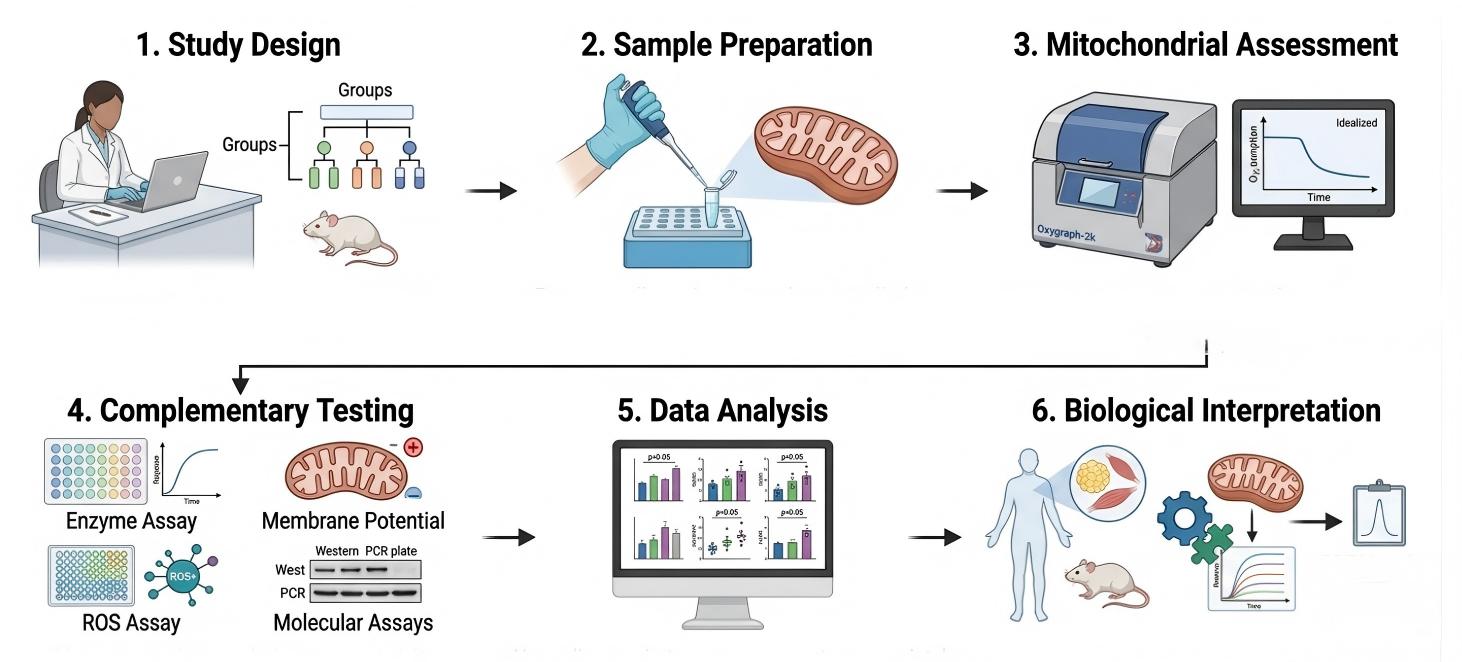
- Step 1: Define obesity model, tissue type, treatment groups, dose levels, controls, sampling points, and primary mitochondrial endpoints before experimentation begins.
- Step 2: Process cells or tissues under controlled conditions while preserving mitochondrial integrity and minimizing handling-related changes in respiratory activity.
- Step 3: Measure oxygen consumption, respiratory capacity, ATP-linked respiration, proton leak, and substrate-dependent mitochondrial performance as appropriate.
- Step 4: Add respiratory-chain enzyme activity, mitochondrial content, membrane potential, ROS, or molecular assays when mechanism-level interpretation is required.
- Step 5: Normalize respiratory measurements appropriately, compare experimental groups statistically, and identify treatment-associated mitochondrial functional changes.
- Step 6: Integrate OXPHOS results with obesity phenotypes and molecular data to determine potential mechanisms and guide subsequent preclinical experiments.
Fields of Application
Obesity-related OXPHOS analysis can support a wide range of preclinical studies investigating mitochondrial metabolism, metabolic dysfunction, and therapeutic responses.
- Obesity Models
The service supports diet-induced obesity, genetically predisposed obesity, obesity-associated metabolic dysfunction, and other experimental models where mitochondrial energy metabolism is a central research question.
- Adipose Biology
Applications include white adipose dysfunction, adipocyte metabolism, mitochondrial biogenesis, fatty-acid oxidation, thermogenic remodeling, and metabolic adaptation.
- Liver Metabolism
OXPHOS profiling can be used to investigate hepatic lipid accumulation, fatty-acid oxidation, insulin resistance-related metabolism, and mitochondrial responses to nutritional stress.
- Muscle Metabolism
Studies can examine mitochondrial respiratory capacity, substrate oxidation, ATP production, and relationships between mitochondrial function and systemic metabolic phenotypes.
- Anti-Obesity Drug Discovery
OXPHOS measurements can be incorporated into compound screening and candidate prioritization, particularly where mitochondrial metabolism is part of the proposed pharmacological mechanism.
- Metabolic Intervention Studies
Dietary manipulation, exercise-related models, weight-loss interventions, genetic manipulation, and combination treatments can all be evaluated using appropriate mitochondrial endpoints.
Advantages
Protheragen's OXPHOS analysis service delivers targeted, mechanism-oriented data to strengthen preclinical obesity research and drug development.
In-Depth Assessment of Mechanisms and Functional Integration
This approach provides an in-depth analysis of basal respiration, ATP production, proton leakage, and substrate utilization, while seamlessly integrating ROS, membrane potential, respiratory chain activity, and molecular assays to deliver a comprehensive mitochondrial functional profile.
Tissue-Specific Targeting and Preclinical Screening
Precisely targets key tissues such as adipose tissue, liver, and skeletal muscle to identify obesity-related differences; simultaneously, it efficiently evaluates the mitochondrial effects of candidate compounds, supporting mechanism validation and drug screening.
Flexible Customization
Flexibly customize experimental groupings, dosages, tissue types, time points, and endpoints based on specific research needs and objectives.
Contact our team to discuss your project and experimental needs
Customer Review
Clearer Mechanistic Insights
"We initially planned to measure only mitochondrial respiration, but the project discussion helped us recognize that respiration alone would not tell us whether our treatment changed mitochondrial abundance or intrinsic function. The final experimental design gave us a much clearer way to connect the mitochondrial results with our obesity phenotype. The data were useful for deciding which mechanism experiments should come next."
Dr. P. P., Representative Preclinical Metabolism Researcher
Flexible Study Support
"Working with Protheragen felt like an extension of our own internal lab group. Their scientists helped us refine our palmitate-stress protocols and delivered highly reproducible multi-channel fluorescence data that perfectly complemented our internal metabolic flux assays. The data package was clean, thorough, and ready for our internal reviews."
Dr. R. D., Representative Drug Discovery Scientist
Frequently Asked Questions
-
Why analyze OXPHOS in an obesity model?
Obesity can alter mitochondrial metabolism in a tissue-specific manner. OXPHOS analysis provides functional information that can complement body weight, glucose tolerance, insulin sensitivity, lipid measurements, and molecular profiling.
-
Which tissues are most suitable?
Adipose tissue, liver, and skeletal muscle are common choices. The best tissue depends on the mechanism being investigated. For a thermogenic hypothesis, adipose tissue may be particularly informative, while hepatic lipid metabolism may require liver-focused analysis.
-
Is OCR alone sufficient?
Not always. OCR is an important functional readout, but a single value may not distinguish mitochondrial abundance, respiratory capacity, ATP coupling, proton leak, or substrate limitation. A tailored respiratory profile is usually more informative.
-
Can you compare lean and obese animals?
Yes. Comparative designs can include lean controls, obese controls, treatment groups, genetic controls, or obesity-resistant models. Proper matching of tissue collection, sample handling, and normalization is essential for meaningful comparisons.
-
Can candidate anti-obesity compounds be tested?
Yes. OXPHOS analysis can be incorporated into preclinical compound evaluation to determine whether treatment changes mitochondrial respiratory capacity, ATP-linked respiration, substrate utilization, or other functional parameters.
-
Can multiple treatment doses be analyzed?
Yes. Dose-response designs can be incorporated when sufficient biological replicates and sample material are available. Multiple doses can help distinguish pharmacological effects from nonspecific mitochondrial stress.
-
Can OXPHOS be combined with ROS or membrane-potential analysis?
Yes. Combining respiration with ROS and membrane-potential measurements can provide a more complete view of mitochondrial functional status and may help distinguish beneficial metabolic adaptation from mitochondrial stress.
-
How should mitochondrial content be considered?
A change in respiration does not necessarily mean that individual mitochondria have become more or less efficient. Normalization to an appropriate mitochondrial-content or sample-content marker can help distinguish mitochondrial quantity from intrinsic functional changes.
-
Can the analysis be performed at multiple time points?
Yes. Longitudinal or staged experimental designs can be developed to investigate whether mitochondrial changes appear before, during, or after changes in body weight and metabolic phenotype.
-
What information should be provided before starting?
Useful information includes the animal or cellular model, tissue type, treatment compounds, dose groups, expected mechanism, sample amount, number of biological replicates, collection conditions, and primary research question. Sharing these details early allows the OXPHOS panel to be tailored rather than unnecessarily expanded.
Contact Us
Protheragen provides preclinical mitochondrial OXPHOS analysis for obesity research, drug discovery, and metabolic mechanism studies. Share your model, tissue type, treatment conditions, sample availability, and research objectives with our team to develop a suitable analysis strategy. Reach out and Contact Protheragen for more information on how we can support your project.
All of our services and products are intended for preclinical research use only and cannot be used to diagnose, treat or manage patients.