
Obesity-Related Mitochondrial ATP Production & Kinetic Analysis Service
InquiryMetabolic disease research continues to uncover how fundamental energy regulation goes awry in obesity. At the heart of this metabolic breakdown is the mitochondrion. When excess nutrient loading occurs, mitochondrial energy production shifts. Respiration mechanics, electron transport chain (ETC) kinetics, and total adenosine triphosphate (ATP) yield undergo significant alterations across key metabolic tissues.
High-Resolution Preclinical Mitochondrial ATP Kinetics Service
Understanding these physiological changes requires going deeper than simple end-point ATP assays. Researchers need real-time, high-resolution insights into mitochondrial bioenergetics. Protheragen provides a dedicated obesity-related mitochondrial ATP production & kinetic analysis service specifically designed to support preclinical drug discovery and translational research.
Core Technologies
Accurate metabolic profiling requires sensitive and reliable analytical tools. Protheragen utilizes several complementary, high-resolution platforms to quantify mitochondrial function and kinetic parameters in preclinical models.
Using advanced closed-chamber polarographic technology, our systems track oxygen consumption rates (OCR) down to picomoles per second per milligram of tissue. This high sensitivity allows us to measure subtle changes in respiration driven by complex I, II, or IV substrates in low-yield samples.
Standard endpoint ATP measurements miss transient kinetic shifts. Our setup couples luciferase-based enzymatic assays with microplate readers to continuously measure ATP synthesis rates right after adding substrates like ADP, pyruvate, malate, or succinate.
We isolate individual respiratory chain complexes (complexes I–V) to measure their maximum catalytic activity (Vmax) and substrate affinity (Km). This reveals whether an observed metabolic defect stems from a specific enzyme deficiency or broader structural issues within the inner mitochondrial membrane.
Mitochondrial ATP production depends on the proton motive force across the inner membrane. We use fluorescent probes like safranin-O, TMRM, and Amplex Red to monitor changes in membrane potential (△Ψm) and reactive oxygen species (ROS) production at the same time as oxygen consumption.
Service Scope
Protheragen offers an extensive suite of preclinical assays designed to give a complete picture of mitochondrial health in obesity models.
- Real-Time Bioenergetic Profiling
- Assessment of basal respiration, ATP-linked respiration, proton leak, maximal respiration, and spare respiratory capacity.
- Evaluation of respiratory control ratios (RCR) across isolated mitochondria from brown adipose tissue (BAT), white adipose tissue (WAT), skeletal muscle, and liver tissue.
- Mitochondrial ATP Production & Kinetic Analysis
- Determination of kinetic parameters (Vmax, Km) for ADP-stimulated ATP production.
- Measurement of the P/O ratio (moles of ATP synthesized per atom of oxygen consumed) to evaluate coupling efficiency.
- Quantification of total cellular and mitochondrial ATP flux under normoxic or stress-induced conditions.
- Substrate-Specific Utilization Assays
- Evaluation of palmitoyl-L-carnitine and octanoylcarnitine oxidation rates to study mitochondrial fatty acid β-oxidation efficiency.
- Assessment of pyruvate/malate (complex I) and succinate/rotenone (complex II) driven ATP synthesis pathways.
- Glutamine and amino acid substrate utilization studies in tissue models affected by lipid accumulation.
- Mitochondrial Dynamics & Quality Control Metrics
- Fluorometric measurement of mitochondrial membrane potential (ΔΨm) collapse and recovery.
- Quantification of mitochondrial reactive oxygen species (mito-ROS) production rates during state 3 and state 4 respiration.
- Evaluation of uncoupling protein 1 (UCP1) activity in thermogenic adipose tissue.
Click here to submit your project details and request a customized quote.
Workflow
Our streamlined five-step preclinical pipeline ensures reproducible data and fast turnarounds for your research projects.
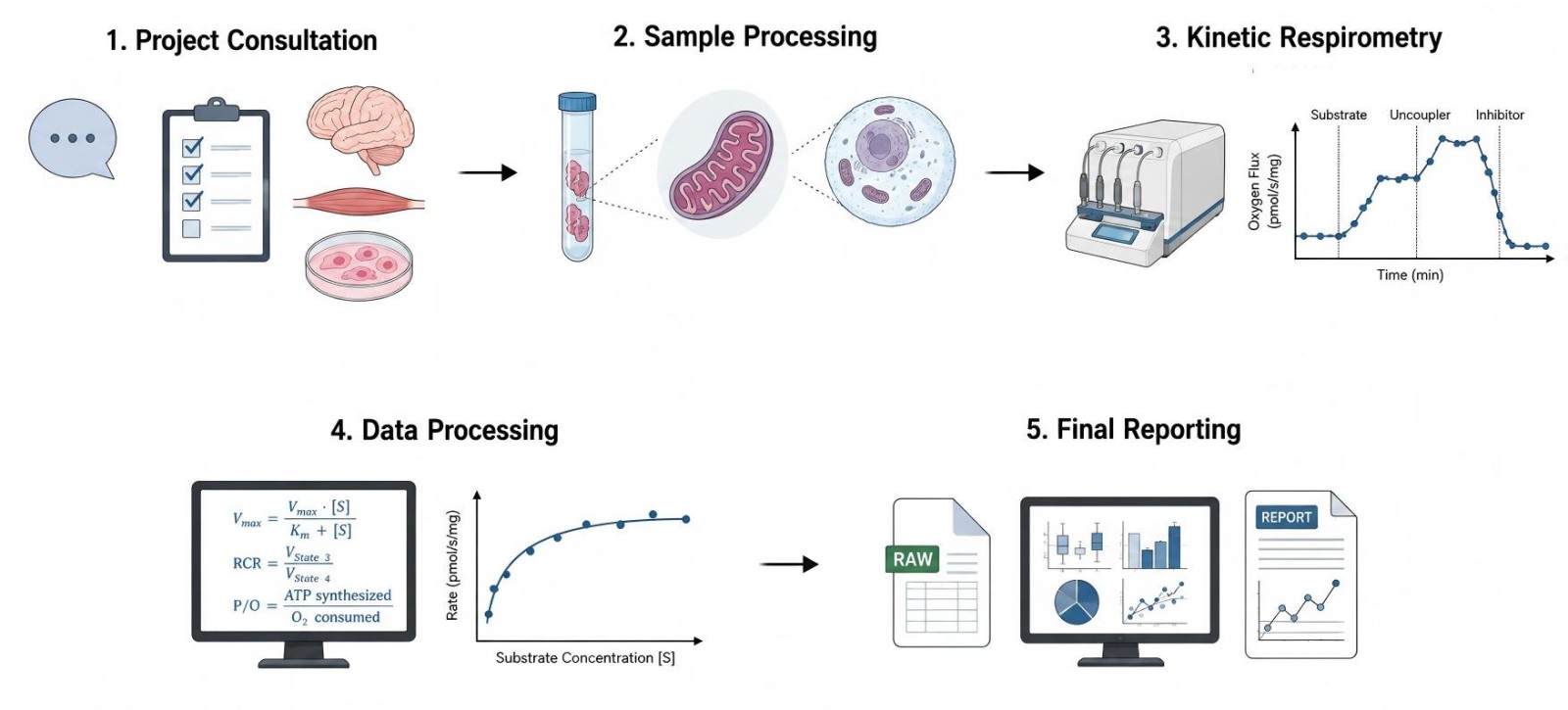
- Step 1: Define specific research endpoints, experimental groups, and select ideal tissue or cell models with our technical team.
- Step 2: Extract intact mitochondria or prepare permeabilized tissue samples using specialized, low-damage isolation protocols.
- Step 3: Perform high-resolution oxygen flux and ATP synthesis rate assays using customized substrate-uncoupler-inhibitor-titration (SUIT) protocols.
- Step 4: Calculate parameter values including Vmax, Km, respiratory control ratios, and P/O efficiency ratios using rigorous mathematical models.
- Step 5: Receive a clear data package with raw datasets, statistical analyses, and publication-ready graphs within two weeks.
Fields of Application
Understanding mitochondrial kinetics is crucial across several areas of metabolic drug discovery and preclinical research:
- Anti-Obesity Drug Screening: Screening small molecules, peptides, or natural compounds designed to increase energy expenditure, promote mitochondrial uncoupling, or enhance β-oxidation capacity.
- Non-Alcoholic Fatty Liver Disease (NAFLD) & NASH: Evaluating mitochondrial dysfunction, lipid overload, and electron transport chain breakdown in hepatocytes and hepatic tissues.
- Type 2 Diabetes & Insulin Resistance Research: Studying the link between impaired mitochondrial ATP synthesis and insulin signaling defects in skeletal muscle and adipose tissues.
- Targeting Thermogenesis in Adipocytes: Measuring the activation kinetics of UCP1 and uncoupled respiration in brown and beige adipocytes for metabolic therapeutics.
- Preclinical Safety & Mitochondrial Toxicity: Assessing off-target mitochondrial toxicity, electron transport chain inhibition, or membrane depolarization caused by candidate drug molecules.
Advantages
Partnering with Protheragen brings advanced bioenergetic technologies and dedicated expertise to your preclinical drug pipeline.
High-Resolution Precision
Our polarographic and optode-based respirometry systems detect minute oxygen flux variations in small tissue samples. It has been shown that there is high consistency across biological replicates, even with challenging samples like white adipose biopsies.
Simultaneous Multi-Parameter Profiling
We capture continuous ATP production rates, oxygen consumption, and membrane potential changes in a single run. This multi-metric approach saves sample material and provides a complete view of mitochondrial function.
Tissue-Specific Optimization
Over two decades of specialized research allow us to refine tissue-specific protocol optimizations for skeletal muscle, liver, BAT, and WAT.
Expert Data Interpretation
We do not just send back raw numbers. Our team analyzes complex enzyme kinetics, respiratory states, and coupling metrics, providing actionable insights for your drug development decisions.
Publication Data
Title: Mitochondrial ATP Biosynthesis Is Negatively Associated with FFA in Cardiac and Skeletal Muscle During the Development of Obesity in a Rodent Model.
Journal: International journal of molecular sciences, 2025
DOI: https://doi.org/10.3390/ijms26188768
Summary: This rodent study explored how high-sucrose-diet-induced obesity impacts mitochondrial ATP biosynthesis in cardiac and skeletal muscle. Skeletal-muscle ATP synthesis declined with FFA accumulation; heart muscle remained diet-resistant. UCP-dependent uncoupling and elevated IF1 shaped mitochondrial energy function during obesity progression.
Key Findings
- A 30% sucrose drinking-water diet triggered visceral fat gain, hypertriglyceridemia and elevated plasma free fatty acids (FFA) in Wistar rats, with effects worsening over 6-56 weeks of feeding.
- Sucrose feeding caused significant FFA build-up (palmitic, oleic, palmitoleic acid) in skeletal muscle homogenates; cardiac muscle showed no FFA tissue accumulation at any time-point.
- Long-term sucrose exposure (24-56 weeks) reduced skeletal-muscle mitochondrial ATP synthesis; heart-muscle ATP production declined only with ageing and was unaffected by sucrose diet.
- Skeletal-muscle total FFA and oleic acid negatively correlated with ATP synthesis (r=-0.6532, p<0.0001), linking lipotoxic FFA accumulation to impaired energy production.
- Oleic acid suppressed ATP synthesis dose-dependently; GDP (UCP inhibitor) partially reversed this inhibition, confirming UCP2/UCP3-mediated uncoupling contributes to energy defects.
- Sucrose diet increased ATPase inhibitory factor 1 (IF1) protein in both muscles, a protective response limiting ATP hydrolysis; ATP5A synthase subunit levels remained unchanged.
- UCP2/UCP3 expression rose mainly with age rather than sucrose-diet status in cardiac and skeletal mitochondria.
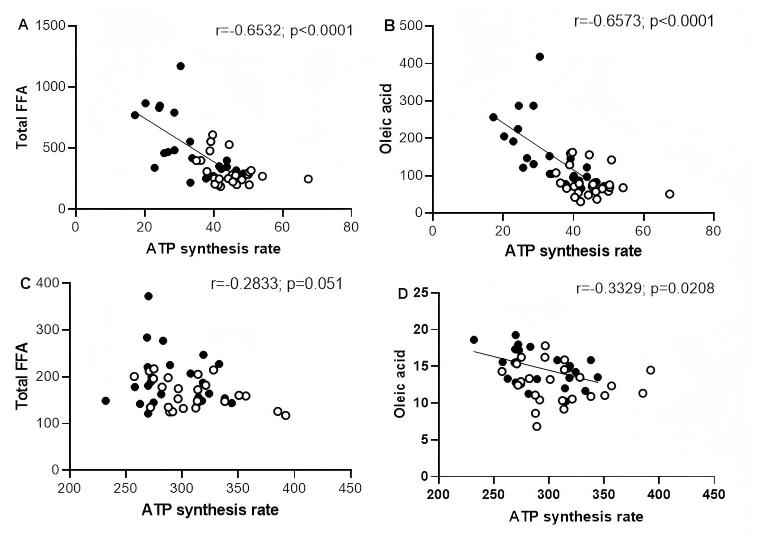 Fig.1 Negative correlation between tissue free fatty acids and mitochondrial ATP synthesis in sucrose-induced obesity in rats. (Nava-Aguilar, et al.; 2025)
Customer Review
Uncovering Novel Mechanisms of Action Through High-Resolution Kinetic Profiling
"Working with Protheragen made a huge difference in our anti-obesity drug discovery program. We were struggling to figure out why our lead compound altered systemic metabolism without clear hits on standard cell assays. The Protheragen team ran high-resolution ATP kinetic profiling on primary liver and muscle tissues. Their data clearly showed a selective increase in complex II-driven respiration and kinetic rate changes we hadn't seen before. Their technical team walked us through every parameter, helping us confirm our mechanism of action."
Dr. A. T., VP of Discovery Biology
Overcoming Adipose Tissue Processing Challenges for Fast, Reliable Preclinical Data
"Protheragen provided exceptional bioenergetic testing support for our preclinical obesity models. Isolating intact, functional mitochondria from fat-laden adipose tissue was a major bottleneck for our internal lab. Protheragen handled our sample shipments seamlessly, running full substrate titration protocols with impressive consistency. The comprehensive reports gave us publication-ready figures and clear Vmax and Km kinetic values. Their work saved us months of assay development time."
Dr. E. R., Lead Translational Scientist
Frequently Asked Questions
-
How does kinetic ATP analysis differ from a standard endpoint ATP assay?
Standard endpoint assays only provide a static snapshot of total ATP content at a single moment. Our kinetic service continuously tracks the rate of ATP synthesis over time in response to specific substrates and ADP titrations. This reveals dynamic enzyme kinetics (Vmax, Km) that static assays miss completely.
-
Can your team evaluate mitochondrial uncoupling drugs that increase energy expenditure?
Yes, our platform is well-suited for measuring uncoupling kinetics. We can quantify proton leak rates, changes in membrane potential (ΔΨm), and non-phosphorylating respiration (State 4) to determine if a compound acts as a direct uncoupling agent or works through specific carrier proteins like UCP1.
-
How do you normalize ATP production and respiration data across experimental groups?
We normalize data using multiple parameters based on project requirements, including total protein content, citrate synthase activity, mitochondrial DNA (mtDNA) copy number, or total mitochondrial mass. This ensures fair comparisons between lean and obese tissue models.
-
Is this service suitable for regulatory preclinical safety toxicity screening?
Absolutely. Our platform detects drug-induced mitochondrial toxicity, such as complex I-V inhibition, uncoupling effects, or membrane potential collapse. We help identify potential off-target metabolic toxicity early in the drug discovery phase.
-
What is the typical turnaround time for a standard assay project?
Most projects are completed within two to three weeks from sample receipt. This includes sample preparation, respirometry runs, kinetic calculations, and delivery of a final report.
-
Can you perform substrate-specific studies to see if a drug shifts metabolism toward fatty acid oxidation?
Yes. We run targeted substrate titrations using fatty acid substrates (like palmitoyl-carnitine) alongside carbohydrates (pyruvate/glutamate). This directly measures shifts in substrate preference and utilization capacity.
-
What primary controls are included in your bioenergetic assays?
We include positive and negative controls in every run. Standard controls feature oligomycin (ATP synthase inhibitor), FCCP/DNP (uncouplers), rotenone (complex I inhibitor), and antimycin A (complex III inhibitor) to confirm mitochondrial responsiveness.
-
Can you isolate mitochondria from small adipose tissue samples obtained from obese rodent models?
Yes, we have optimized tissue-processing techniques specifically for high-lipid samples like WAT and BAT. Our methods effectively remove lipid fractions while preserving delicate mitochondrial membranes.
Contact Us
Protheragen provides high-resolution bioenergetic and kinetic analysis services to support your metabolic drug discovery pipeline. Whether you need assistance evaluating compound mechanisms, assessing off-target mitochondrial toxicity, or profiling substrate kinetics in obesity models, our scientific team is here to help. Contact Protheragen for more information on tailored solutions for your research.
Reference
- Nava-Aguilar, V.; et al. Mitochondrial ATP Biosynthesis Is Negatively Associated with FFA in Cardiac and Skeletal Muscle During the Development of Obesity in a Rodent Model. International Journal of Molecular Sciences. 2025, 26(18), 8768. (CC BY 4.0)
All of our services and products are intended for preclinical research use only and cannot be used to diagnose, treat or manage patients.