
Cellular Oxygen Consumption Rate (OCR) Measurement Service
InquiryUnderstanding how cells generate energy gives us a direct look into their metabolic condition and general vitality. Mitochondria drive this engine by using oxidative phosphorylation to convert nutrients into adenosine triphosphate (ATP). Because oxygen serves as the terminal electron acceptor in this pathway, tracking the cellular oxygen consumption rate (OCR) provides a clear, quantitative window into mitochondrial respiration and bioenergetic health. Whether a compound alters baseline metabolic workflows or triggers a significant mitochondrial collapse, tracking these dynamic adjustments in real-time reveals drug effects that endpoint assays routinely miss.
Accelerating Preclinical Discovery: Cellular Oxygen Consumption Rate (OCR) Measurement Services
At Protheragen, we provide specialized preclinical OCR measurement services designed to deliver deep, actionable data for early-stage pipeline development. Our cell-based platforms let researchers monitor respiratory dynamics continuously across diverse preclinical models. By avoiding clinical services completely, we focus all our scientific resources on screening compound libraries, characterizing lead candidates, and identifying potential safety risks early in the development lifecycle.
Core Technologies
To capture real-time metabolic fluctuations across different cell systems, we use a complementary suite of high-resolution bioenergetic technologies.
This method tracks minute changes in oxygen levels within a transient micro-chamber created just above a cell monolayer. It allows us to continuously monitor OCR under steady-state conditions and actively measure metabolic shifts following automated, sequential injections of respiratory modulators.
For broad-scale screenings and flexible setups, we use advanced multi-well plate assays featuring quenching-based phosphorescent probes. As cells consume oxygen from the surrounding medium, the probe's signal intensity changes proportionally. This approach integrates with standard fluorescence microplate readers equipped with precise temperature controllers, removing the need for rigid, proprietary hardware configurations.
This system is optimized for continuous, multi-day monitoring. It allows us to capture the slow-developing, chronic toxicities or delayed phenotypic switches that typical short-term metabolic assays fail to detect.
Service Scope
Our preclinical service portfolio is built to handle the varied experimental demands of modern biotechnology and pharmaceutical research. We support everything from initial cell preparation to advanced kinetic modeling, ensuring every study returns clear data.
- Mitochondrial Stress Profiling
We systematically evaluate cellular bioenergetics by analyzing critical parameters like basal respiration, ATP-linked respiration, proton leak, maximal respiratory capacity, and spare respiratory capacity. This is done using targeted modulators, including ATP synthase inhibitors (oligomycin), uncoupling agents (FCCP), and complex I/III blockers (rotenone and antimycin A).
- Dose-Response Phenotyping
We run multipoint concentration screens to characterize how candidate molecules affect cellular respiration over time. This service helps establish clear metabolic IC50 or EC50 values, distinguishing between subtle therapeutic modulations and overt mitochondrial toxicity.
- Substrate Utilization Assays
We help investigators determine cellular dependency on specific metabolic fuels, such as glucose, fatty acids, or glutamine. By blocking specific pathway entrances, we map how cells rearrange their respiratory strategies to survive under stress.
- Isolated Organelle Respirometry
When whole-cell architectures obscure primary mechanisms, we isolate functional mitochondria from animal tissues or cell cultures to measure respiration directly. This isolates the direct effects of a compound on individual electron transport chain complexes.
- Custom Preclinical Model Customization
We regularly adapt our OCR protocols to support non-traditional systems, including primary cell cultures, specialized immune cells, stem cells, and complex three-dimensional cell aggregates or spheroids.
Contact Our Team for More Information and to Discuss Your Project
Workflow
To ensure reproducibility and precision, we guide your project through a structured, carefully monitored progression from initial setup to final analysis.
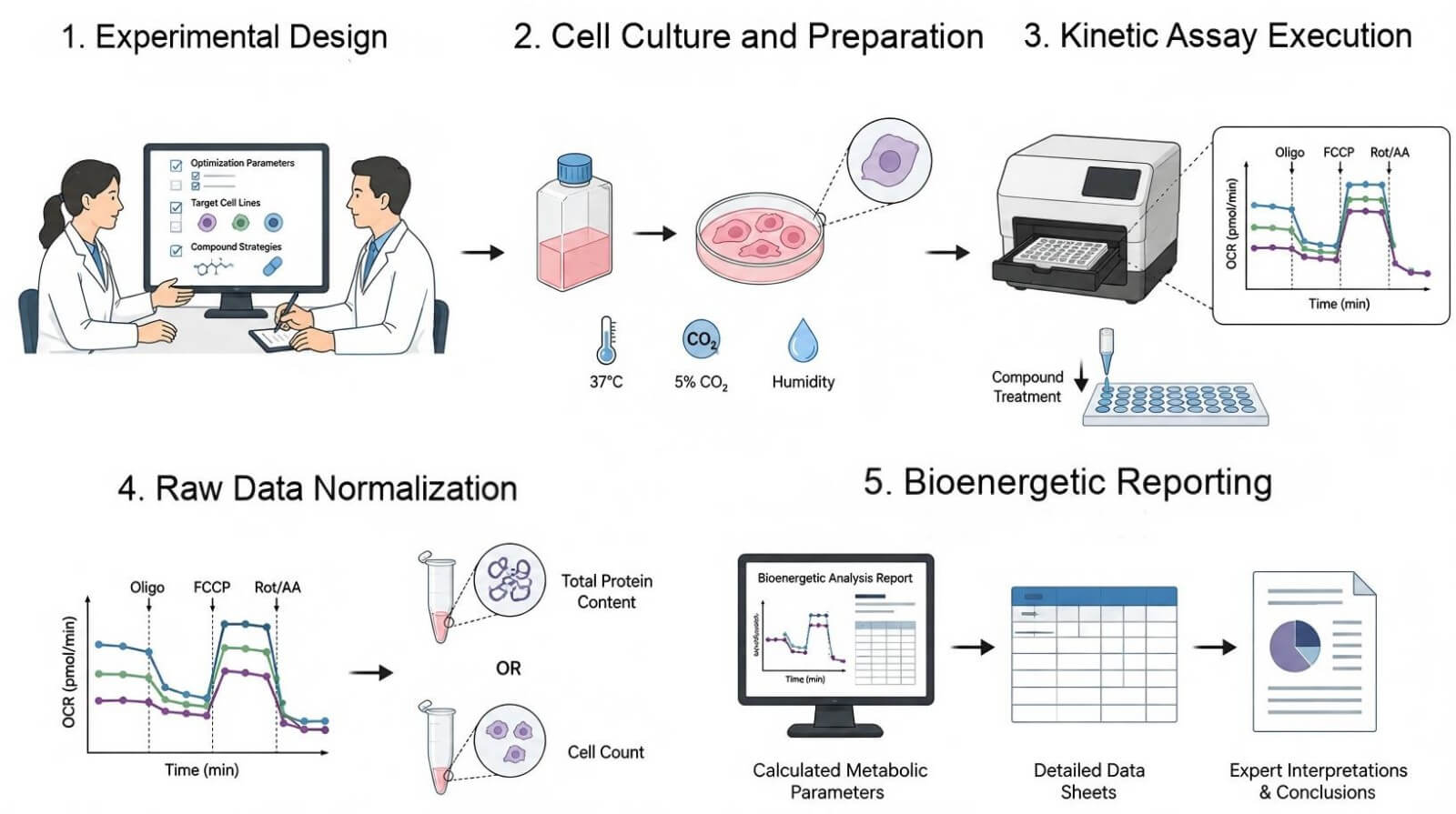
- Step 1: Our scientific team collaborates with you to outline optimization parameters, target cell lines, and compound treatment strategies.
- Step 2: Cells are seeded and acclimated under strictly controlled microenvironmental conditions to ensure a stable baseline.
- Step 3: We perform real-time OCR measurements on specialized microplates while delivering precise compound treatments.
- Step 4: Respiratory values are normalized against total protein content or precise cell counts to eliminate well-to-well variation.
- Step 5: We deliver clear data sheets, calculated metabolic parameters, and expert interpretations ready for regulatory filings.
Fields of Application
Tracking cellular respiration provides vital insights across a broad range of therapeutic areas where metabolic function and energy production are central to disease pathology.
- Oncology and Immuno-Oncology: Mapping how cancer cells shift toward glycolysis (the Warburg effect) and tracking how targeted therapies or activated immune cells disrupt that metabolic reliance.
- Cardiovascular and Metabolic Disorders: Evaluating compound impacts on fatty acid oxidation and oxidative capacity in specialized cell models like cardiomyocytes and hepatocytes.
- Early Preclinical Safety and Toxicology: Screening chemical libraries early to flag hidden mitochondrial toxins, avoiding late-stage drug candidate attrition.
Advantages
Partnering with Protheragen gives you access to specialized expertise and refined screening techniques designed specifically to overcome the common hurdles of preclinical metabolic testing.
Preclinical Specialization and Accuracy
Because Protheragen focuses exclusively on preclinical research, we have tailored our workflows around the unique challenges of in vitro testing. We skip the generic protocols common in broader testing facilities, giving your project our full scientific attention and deep technical focus.
Continuous, Long-Term Tracking Capabilities
Unlike standard endpoint assays that provide only a snapshot of cell health, our platforms can measure metabolic rates continuously over extended periods. This extended tracking helps capture delayed toxicities and subtle therapeutic effects that shorter assays miss.
Thorough Validation and Data Normalization
We don't rely on raw, unadjusted fluorescence values. Every single run goes through rigorous verification and is normalized against protein concentration or cell count, yielding reproducible data.
Flexible Platform Adaptability
Our technology fits a wide range of formats, handling primary cells, cell lines, and complex 3D spheroids alike. This flexibility lets you configure custom compound injections and switch media easily to suit unique project goals.
Connect with an Application Scientist to Elevate Your Preclinical Discovery Program
Customer Review
Uncovering Hidden Metabolic Compensation Mechanisms in Oncology
"Partnering with Protheragen for our early-stage neurodegeneration program was a turning point. Their specialists adapted their phosphorescent OCR platforms to support our fragile primary neural cultures, delivering clean, reproducible data with minimal variation. The scientific report they provided was incredibly detailed and ready for our internal reviews. We really appreciate their focus on preclinical research and look forward to working with them on our upcoming target validation studies."
Dr. M. T., Principal Investigator
Validating Neurodegenerative Targets with Fragile Primary Cultures
"Working with Protheragen felt like an extension of our own internal lab group. Their scientists helped us refine our palmitate-stress protocols and delivered highly reproducible multi-channel fluorescence data that perfectly complemented our internal metabolic flux assays. The data package was clean, thorough, and ready for our internal reviews."
Dr. H. V., Director of Preclinical Pharmacology
Frequently Asked Questions
-
What sample types can you handle for your OCR measurement services?
We routinely analyze established cell lines, primary cells, stem cells, and isolated mitochondria. We can also adapt our workflows to fit complex 3D structures like spheroids or organoids.
-
How do you handle data normalization across different wells?
We normalize our data using post-assay cell counting, total protein quantification assays, or DNA content measurements. This step accounts for any seeding variations and ensures your final OCR metrics remain consistent and accurate.
-
Can your team detect both direct mitochondrial inhibition and general cell toxicity?
Yes, we can. By pairing real-time OCR tracking with standard cell viability metrics and using automated injections of specific respiratory inhibitors, we can separate direct electron transport chain interference from broader, non-specific toxicity.
-
What makes your long-term kinetic assays different from standard endpoint tests?
Most endpoint kits give you a single data point after a set incubation period. Our kinetic systems track metabolic shifts continuously over hours or days, allowing us to catch slow-acting compounds and time-dependent phenotypic adaptations.
-
We have a unique compound that requires an unconventional solvent. Can you accommodate this?
Our team regularly works with challenging compounds. We can adjust the vehicle controls, microfluidic handling, and injection protocols to ensure your solvent does not interfere with cell health or the assay's phosphorescent sensors.
-
What specific parameters are calculated during a standard mitochondrial stress test?
We routinely measure basal respiration, ATP-linked respiration, proton leak, maximal respiration, non-mitochondrial oxygen consumption, and spare respiratory capacity.
-
Do you provide raw data or fully analyzed reports?
We provide both. You will receive the complete raw kinetic data sheets along with a detailed report featuring normalized figures, statistical analyses, and a technical summary written by our biology specialists.
-
How do you prevent temperature-driven fluctuations from affecting assay results?
Since OCR is highly sensitive to temperature shifts, all our measurements are carried out using internal, bottom-reading microplate systems with strict, uniform temperature controls.
-
Can your platform evaluate how cells switch between glycolysis and oxidative phosphorylation?
Yes. By combining oxygen consumption tracking with extracellular acidification metrics or fuel-blocking treatments, we can map exactly how cells shift their metabolic strategies under stress.
Contact Us
Quantifying cellular bioenergetics is an effective way to confirm target engagement, characterize metabolic therapeutics, and catch safety liabilities early in your pipeline. Protheragen combines advanced respirometry platforms with deep preclinical expertise to deliver clean, actionable data that keeps your development timeline on track. Contact Protheragen now for more information and a personalized consultation.
All of our services and products are intended for preclinical research use only and cannot be used to diagnose, treat or manage patients.