
Obesity-Related Mitochondrial Proteomics Service
InquiryMitochondria drive cellular bioenergetics, acting as central hubs for oxidative phosphorylation, fatty acid β-oxidation, and metabolic signaling. In obesity, chronic nutrient excess disrupts these pathways, causing profound structural and functional remodeling of mitochondrial networks within key preclinical tissues such as hepatic, skeletal muscle, and adipose tissue. Analyzing these organelle-level alterations at the protein level is essential for resolving early cellular stress, electron transport chain uncoupling, and metabolic inflexibility.
Obesity Mitochondrial Proteomics: Preclinical Biomarker & Pathway Profiling
At Protheragen, our obesity-related mitochondrial proteomics service offers targeted, deep-coverage proteomic profiling for preclinical research models. We specialize in isolating pure mitochondrial fractions from diverse tissue types and Animal Models (such as high-fat diet rodent models or genetically modified strains). By leveraging high-resolution mass spectrometry and multiplexed assay platforms, we help researchers dissect intricate protein expression shifts, post-translational modifications, and pathway alterations. Whether you are mapping the mechanics of insulin resistance or screening novel small-molecule candidates in preclinical safety and efficacy studies, our workflows deliver reproducible, publication-ready insights.
Core Technologies
To reliably quantify low-abundance mitochondrial enzymes and membrane complexes, we utilize advanced liquid chromatography-mass spectrometry (LC-MS) and multiplexed protein detection systems. Our isolation protocols separate intact mitochondrial populations from cytoplasm to minimize signal interference from high-abundance cytosolic proteins.
Provides comprehensive, reproducible proteome coverage without sample-to-sample missing value problems, making it ideal for deep-dive discovery across preclinical animal cohorts.
Enables precise isobaric labeling and relative quantification of up to 18 samples per MS run, reducing batch-to-batch variation in large-scale animal feeding studies.
Offers high-sensitivity, absolute or relative quantification of specific protein panels, such as electron transport chain complexes, mitochondrial dynamics markers, or acylcarnitine-processing enzymes.
Allows high-throughput, low-input quantification of circulating and tissue-specific metabolic markers, providing complementary sensitivity for scarce sample volumes.
Service Scope
Our preclinical service scope is tailored specifically to evaluate mitochondrial health and metabolic perturbations across diverse research designs:
- Bioenergetics & Oxidative Phosphorylation Profiling
- Quantification of electron transport chain (ETC) complexes I through V to monitor respiratory chain stoichiometry.
- Measurement of ATP synthase subunits and specific assembly factors influencing cellular ATP production.
- Targeted assessment of uncoupling proteins (UCP1, UCP2, UCP3) to evaluate non-shivering thermogenesis and energy expenditure dynamics.
- Fatty Acid β-Oxidation & Lipid Processing
- Profiling of the carnitine palmitoyltransferase system (CPT1 and CPT2) to assess long-chain fatty acid transport across mitochondrial membranes.
- Comprehensive coverage of acyl-CoA dehydrogenases (VLCAD, MCAD, SCAD) to pinpoint rate-limiting enzymatic bottlenecks.
- Characterization of acylcarnitine transporters and matrix enzymes involved in fatty acid catabolism and lipid overload responses.
- Mitochondrial Dynamics & Quality Control
- Assessment of outer and inner membrane fusion machinery, including Mitofusins (MFN1, MFN2) and OPA1.
- Quantification of fission regulators such as DRP1 and FIS1 to measure organelle fragmentation during nutrient excess.
- Tracking of PINK1/Parkin-mediated mitophagy signaling pathways to determine cellular organelle turnover and clearance efficiency.
- Stress Adaptation & Post-Translational Modifications
- Measurement of mitochondrial antioxidant defense enzymes (SOD2, PRDX3, TRX2) to quantify localized oxidative stress.
- Targeted profiling of mitochondrial sirtuins (SIRT3, SIRT4, SIRT5) and global protein acetylation states governing metabolic flexibility.
- Evaluation of matrix chaperone networks (HSP60, GRP75) to monitor mitochondrial unfolded protein responses (UPRmt).
Inquire today to customize a target panel
Workflow
Our streamlined preclinical workflow spans five coordinated stages, guiding your tissue samples smoothly from initial experimental design through to high-resolution mass spectrometry and publication-ready bioinformatics.
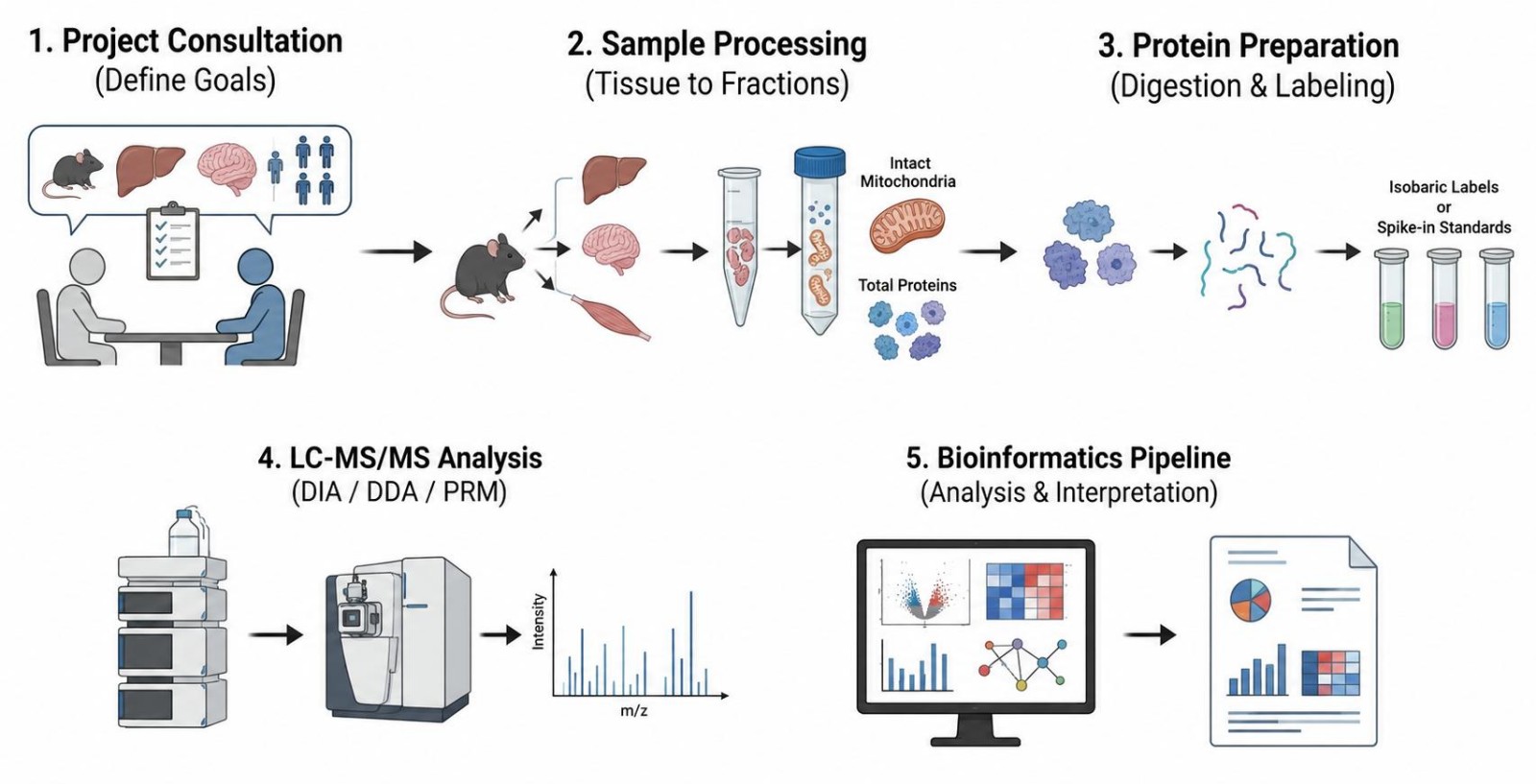
- Step 1: Define experimental goals, model systems, tissue types, and sample numbers with our specialized scientific team.
- Step 2: Extract intact mitochondria or extract total proteins using optimized tissue disruption and subcellular fraction protocols.
- Step 3: Perform enzymatic digestion, peptide clean-up, and chemical isobaric labeling or spiked-in peptide standard addition.
- Step 4: Run high-resolution mass spectrometry using DIA, DDA, or targeted PRM acquisition protocols on high-end instruments.
- Step 5: Execute automated protein identification, quantitative normalization, pathway enrichment, and differential expression statistical analysis.
Fields of Application
Our preclinical mitochondrial proteomics service provides critical organelle-level insights across a wide spectrum of metabolic disease models and Early-Stage Drug Discovery pipelines.
- Metabolic Dysfunction-Associated Steatohepatitis (MASH/NAFLD): Uncovering hepatic mitochondrial protein remodeling, respiratory chain impairment, and lipid overload signatures in diet-induced mouse models.
- Obesity and Type 2 Diabetes Preclinical Research: Evaluating skeletal muscle and adipose tissue mitochondrial alterations during insulin resistance development.
- Target Identification & Lead Optimization: Characterizing organelle-specific protein responses following small-molecule or biotherapeutic candidate treatments in animal studies.
- Mitochondrial Toxicity & Safety Profiling: Screening compound-induced mitochondrial liability, disruption of oxidative phosphorylation, or loss of organelle integrity early in pipeline development.
Advantages
Partnering with Protheragen gives your preclinical research a competitive edge through industry-leading mitochondrial isolation techniques, deep pathway coverage, and publication-ready quantitative precision.
Subcellular Fractionation Mastery
We have optimized protocols for isolating enriched mitochondrial fractions from challenging preclinical tissues, including liver, skeletal muscle, brown/white adipose tissue, and cardiac muscle. This drastically increases the signal-to-noise ratio for true organelle proteins while clearing high-abundance cytosolic interferences.
Extensive Pathway Resolution
Our quantitative pipelines cover all major mitochondrial processes, including tricarboxylic acid (TCA) cycle enzymes, electron transport complexes, fatty acid β-oxidation machinery, and mitochondrial dynamics factors.
Robust Reproducibility & Statistical Rigor
With strict quality control checks at sample extraction, peptide digestion, and instrument acquisition, Protheragen consistently delivers inter-assay coefficients of variation (CV) well below industry standards.
Integrated Multi-Omics Capability
We offer seamless cross-platform integration between mitochondrial proteomics, lipidomics, and metabolomics, allowing you to correlate protein abundance directly with downstream metabolic fluxes.
Contact Our Team for More Information and to Discuss Your Project.
Publication Data
Title: Mitochondrial-related proteomic changes during obesity and fasting in mice are greater in the liver than skeletal muscles.
Journal: Functional & integrative genomics, 2014
DOI: https://doi.org/10.1007/s10142-013-0342-3
Summary: This mouse study combined mitochondrial proteomics and transcriptomics to compare obesity- and fasting-driven molecular shifts in liver vs skeletal muscle. Liver exhibited far larger mitochondrial proteome alterations than muscle. Distinct protein-network responses differed between diet-induced and genetic obesity models.
Key Findings
- Tissue-specific molecular magnitude: Obesity and fasting triggered substantially greater mitochondrial-associated proteomic changes in liver (221 obesity-altered proteins; 107 fasting-altered proteins) versus skeletal muscle (44 obesity-altered proteins; 35 fasting-altered proteins).
- Obesity-model divergent protein responses: 27 hepatic proteins showed opposite expression changes between high-fat-diet (HFD)-induced obesity and hyperphagic genetic ob/ob, db/db obesity; no such opposing proteins existed in muscle. This network centred on Cyp3a11, Cyp4a14, Aldob, linking xenobiotic, fatty-acid and PPAR signalling pathways.
- Functional pathway enrichment: Liver proteome changes mapped to well-defined KEGG pathways including fatty-acid metabolism, peroxisome and PPAR signalling. Skeletal muscle differential proteins yielded no significant functional pathway annotations for obesity states.
- Fasting responses: Overnight fasting altered hepatic protein profiles most strongly in lean control mice. Cyp4a14 and Cyp4a10 were consistently up-regulated across all mouse groups during fasting.
- Transcript-proteome mismatch: Transcriptomic data uncovered more pathway signals than proteomic data, suggesting transcriptional adaptation precedes protein-level mitochondrial remodelling.
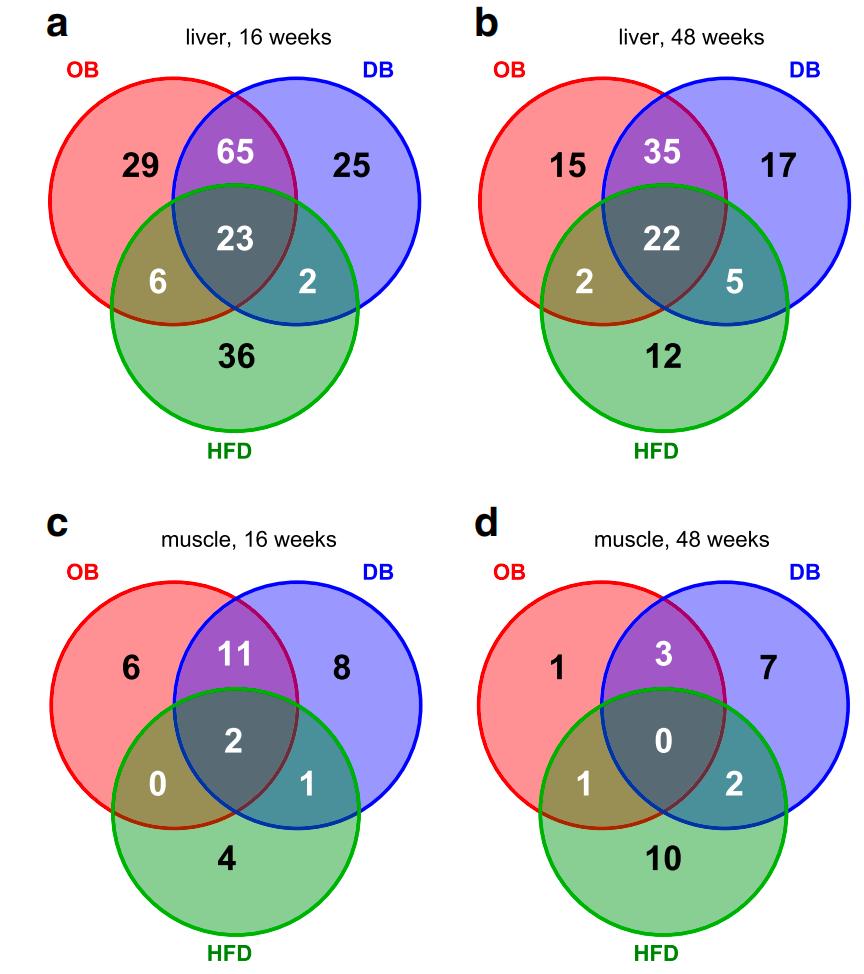 Fig.1 Venn comparison: differentially expressed mitochondrial-associated proteins in liver and skeletal muscle across mouse obesity models. (Nesteruk, et al.; 2014)
Customer Review
Accelerating Target Discovery in Preclinical MASH Models
"Working with Protheragen was a turning point for our preclinical MASH program. We had struggled to get clean mitochondrial yields from high-fat diet liver samples without massive cytosolic background. Protheragen handled the subcellular fractionation perfectly, and their DIA-MS dataset pointed us directly to key β-oxidation enzymes that were dysregulated early in the disease progression. The data quality gave us the confidence to submit our preclinical target package, and we are already setting up our next cohort study with them."
Dr. T. T., Senior Director of Pharmacology
Actionable Pathway Insights and Exceptional Collaborative Support
"The depth of pathway analysis provided by the Protheragen team exceeded what typical CROs offer. They did not just dump raw mass spec files on us; they provided clear, publication-grade pathway enrichment plots highlighting mitochondrial dynamics and stress responses. We appreciate their ongoing technical communication and consider Protheragen a primary partner for all our upcoming metabolic disease profiling projects."
Dr. D. G., Lead Research Scientist
Frequently Asked Questions
-
What preclinical animal model samples are compatible with your mitochondrial proteomics service?
We accept a wide variety of preclinical animal tissues, including frozen liver, skeletal muscle, cardiac tissue, white adipose tissue (WAT), and brown adipose tissue (BAT). We can also process cultured cell lines used in in vitro metabolic assays.
-
How much tissue sample mass is typically required for mitochondrial isolation?
Required input depends on tissue type and mitochondrial density. Typically, 50 to 100 mg of wet tissue is ideal for liver or muscle, while adipose tissues may require slightly more due to high lipid content. Contact our team to discuss specific guidance for limited samples.
-
Can Protheragen handle human clinical samples under this service?
No. Our services are strictly dedicated to preclinical research, animal model studies, and cell culture systems. We do not process clinical samples or provide clinical diagnostic services.
-
How do you prevent cytosolic protein contamination in mitochondrial fractions?
We utilize specialized differential centrifugation and gradient purification techniques optimized specifically for metabolic tissues. Every run includes Western blot or mass spec biomarker checks for cytosolic and nuclear markers to confirm purity.
-
What is the difference between your DIA and targeted PRM proteomics options?
DIA (data-independent acquisition) is an unbiased, broad-coverage strategy ideal for biomarker discovery across thousands of proteins. PRM (parallel reaction monitoring) focuses on a pre-selected panel of target proteins, offering maximum sensitivity and absolute quantification.
-
Can you analyze post-translational modifications (PTMs) such as mitochondrial protein acetylation?
Yes. Reversible protein acetylation (governed by SIRT3/4/5) plays a critical role in mitochondrial metabolic control. We offer specialized enrichment strategies for acetylated or phosphorylated mitochondrial peptides.
-
How long does a typical project take from sample shipment to final report?
Our standard turnaround time is typically 3 to 5 weeks from receipt of verified samples, depending on the sample batch size and chosen analytical platform.
-
What bioinformatic deliverables are included in the final service package?
You receive raw data, normalized quantitative tables, differential protein expression analysis, volcano plots, hierarchical clustering, and functional pathway enrichment mapping (KEGG/Reactome).
Contact Us
At Protheragen, we are dedicated to helping preclinical researchers unlock deeper insights into metabolic disease mechanisms, organelle pathology, and therapeutic efficacy. Our advanced mass spectrometry platforms, rigorous subcellular isolation techniques, and dedicated bioinformatic support ensure your project yields clear, actionable results. Contact Protheragen for more information on how we can support your project.
Reference
- Nesteruk, M.; et al. Mitochondrial-related proteomic changes during obesity and fasting in mice are greater in the liver than skeletal muscles. Functional & Integrative Genomics. 2014, 14(1), 245–259. (CC BY 4.0)
All of our services and products are intended for preclinical research use only and cannot be used to diagnose, treat or manage patients.