
Autologous Cell Therapy Development Service
InquiryObesity has historically been managed as a behavioral or thermodynamic issue—simply a matter of "calories in, calories out." Yet, anyone working in drug discovery knows the biology is far more complex. When individuals restrict calories, their bodies instinctively fight back. The endocrine system coordinates a sharp drop in resting energy expenditure (REE) to conserve fuel. This evolutionary defense mechanism is the main driver behind weight cycling, or the "yo-yo effect," which routinely derails long-term weight management.
Autologous Cell Therapy Development for Obesity: Advancing Pre-Clinical Translation
At Protheragen, we specialize exclusively in the pre-clinical development of these advanced cell therapies. We do not offer clinical trials or human treatments. Instead, we provide the precise, high-integrity analytical, culturing, and processing platforms required to take your candidate therapy from a conceptual design to a publication-ready package.
Core Technologies
To successfully transition an autologous obesity therapy from the lab bench to pre-clinical proof-of-concept, you need highly specialized technical tools. Our platforms are built around the unique challenges of handling adipose tissue and fragile immune cells.
We utilize automated, closed-loop systems to extract high-yield SVF from adipose samples. This process minimizes enzymatic degradation of critical mesenchymal progenitor cells.
We have optimized gene delivery platforms (including high-efficiency lentiviral and non-viral transfection methods) to introduce uncoupling protein 1 (UCP1) or synthetic metabolic pathways into target autologous cells, such as T cells or pre-adipocytes, replicating the natural thermogenic capabilities of brown adipose tissue (BAT).
Our labs are equipped with high-throughput extracellular flux analyzers to measure oxygen consumption rate (OCR) and extracellular acidification rate (ECAR) in real time, giving you definitive proof of mitochondrial uncoupling.
Using multicolor flow cytometry and single-cell RNA sequencing, we trace cell-surface markers and genetic stability, ensuring your modified autologous cells retain their phenotype without unwanted lineage drift.
Solution Scope
Developing an autologous therapy is inherently tricky because every donor sample is biologically unique. Protheragen provides a comprehensive suite of pre-clinical contract research services to help you navigate this variability.
- Adipose-Derived Stem Cell (ADSC) and SVF Characterization
We assist researchers in isolating, expanding, and thoroughly characterizing ADSCs and SVF from animal models. Our analytical services verify cell viability, cell-surface marker profiles (CD90+, CD105+, CD73+, CD45-), and multi-lineage differentiation potential. This ensures your starting material behaves consistently across different cohorts.
- Thermogenic Construct Engineering & Validation
Whether you are exploring engineered thermogenic T cells or directing ADSCs toward a brown/beige adipocyte phenotype, we validate your genetic constructs. We measure the downstream expression of key thermogenic markers, such as UCP1, PGC-1ɑ, and PRDM16, confirming that your target cells have been reprogrammed to expend energy.
- Cellular Integrity & Viability Preservation Studies
Autologous therapies are highly sensitive to shipping and processing delays. We design and execute rigorous cell-integrity studies, evaluating how different cryopreservation media, holding temperatures, and transport parameters affect cell recovery. We help you establish robust standard operating procedures (SOPs) that prevent sample loss during transport between harvest sites and processing facilities.
- In Vitro Efficacy and Metabolic Profiling
We perform deep metabolic characterization on your engineered cells. By analyzing mitochondrial respiration, glycolytic rates, and lipid accumulation assays, we provide the quantitative proof of metabolic acceleration required for regulatory filings.
Contact our scientific team to help you design a rigorous, customized development path.
Workflow
Our structured pre-clinical development workflow is designed to maintain absolute sample integrity, ensuring that critical cellular phenotypes are preserved at every stage of the process.
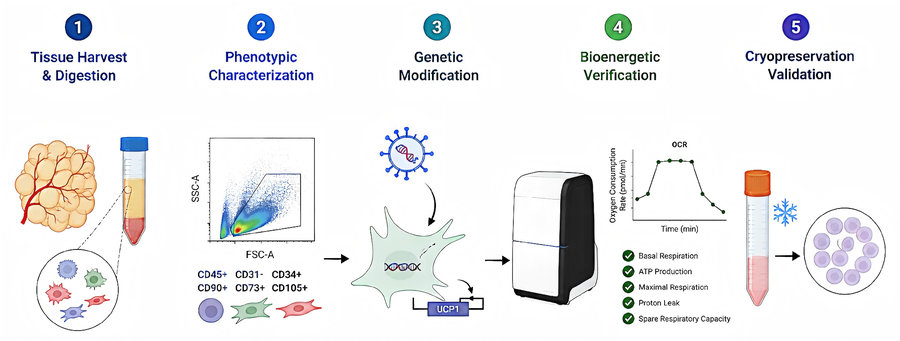
- Tissue Harvest & Digestion: Initial processing. Isolating stromal vascular fractions or target primary immune cells from donor tissue under strict temperature controls.
- Phenotypic Characterization: Baseline quality control. Profiling baseline cells using flow cytometry to confirm target progenitor subpopulations are viable and plentiful.
- Genetic Modification: Target engineering. Transducing cells with metabolic or thermogenic vectors (e.g., UCP1) to drive localized energy expenditure.
- Bioenergetic Verification: Functional assaying. Measuring real-time oxygen consumption rates to confirm successful mitochondrial uncoupling and high metabolic activity.
- Cryopreservation Validation: Optimizing freezing formulations to guarantee post-thaw recovery meets stringent pre-clinical requirements.
Fields of Application
Our development platform is highly adaptable, supporting a wide range of therapeutic approaches aiming to resolve metabolic disorders.
- Brown Adipose Tissue (BAT) Mimicry
Supporting research into converting white adipose tissue (WAT) progenitors into thermogenic beige/brown adipocytes to naturally increase systemic basal metabolic rate.
- Engineered Immune Thermogenesis
Helping innovators validate the metabolic profiles of engineered immune cells (like thermogenic T cells) designed to safely consume excess circulating glucose and lipids.
- Metabolic Syndrome & Type II Diabetes Co-therapies
Evaluating how autologous cellular therapeutics improve peripheral insulin sensitivity and glucose tolerance in Diet-Induced Obesity (DIO) Models.
Advantages
Partnering with Protheragen means gaining access to a specialized pre-clinical infrastructure that drastically reduces development timelines and mitigates downstream regulatory risks.
Pioneering Expertise in Metabolic Cell Engineering
We have spent years refining our protocols for handling delicate metabolic pathways. Our team knows exactly how to drive UCP1-mediated uncoupling without triggering premature cell death or loss of potency. This ensures your therapeutic candidates are evaluated under optimal conditions.
Uncompromising Sample Integrity and Zero-Loss Protocols
Drawing from industry-best practices, we have built a chain-of-custody and processing framework that guarantees zero sample loss. We protect your invaluable material through every freeze-thaw and analysis cycle.
State-of-the-Art Bioenergetic Profiling
Our specialized laboratory suite features advanced extracellular flux analysis platforms. We do not just guess if your cells are active; we provide highly granular metrics showing exact energy expenditure and mitochondrial respiration changes.
Developing a robust protocol to avoid costly delays during clinical manufacturing scale-up.
Publication Data
Title: Adipokines at the crossroads of obesity and mesenchymal stem cell therapy
Journal: Experimental & Molecular Medicine, 2023
DOI: https://doi.org/10.1038/s12276-023-00940-2
Summary: This review explores bidirectional crosstalk between adipokines and mesenchymal stem cells (MSCs) in obesity. Obese microenvironments disrupt adipokine balance, impairing MSC survival, differentiation and immunoregulation; MSC therapy restores healthy adipokine profiles to reverse obesity-related metabolic damage.
Key Findings
- Obesity's chronic inflammatory, lipid-rich niche severely dysregulates MSC function: slower proliferation, accelerated senescence, blunted osteochondral differentiation, weakened immune suppression, and impaired migration/angiogenesis, driven by DNA instability, ER/oxidative stress and metabolic rewiring toward oxidative phosphorylation.
- Adipokine imbalance is a core mediator: protective adiponectin/apelin/omentin-1 drop, while pro-inflammatory leptin/resistin/visfatin surge. Short-term leptin aids MSC osteogenesis, yet chronic high leptin in obesity shifts MSC toward adipogenesis, senescence and pro-inflammatory phenotypes. Adiponectin boosts MSC survival, osteogenic potential and therapeutic exosome release via AMPK signaling.
- Autologous MSCs from obese patients lose therapeutic potency, but allogeneic MSC treatment rebalances adipokines (raises adiponectin, lowers leptin), reduces fat mass, insulin resistance and adipose inflammation to ease type 2 diabetes, fatty liver and cardiovascular complications.
- Critical knowledge gaps remain: reversibility of obesity-induced MSC dysfunction, clinical efficacy data for obese autologous MSC, and how adipokine signaling modulates transplant success in obese recipients. Targeting adipokine pathways is a promising strategy to optimize MSC therapy for obese populations.
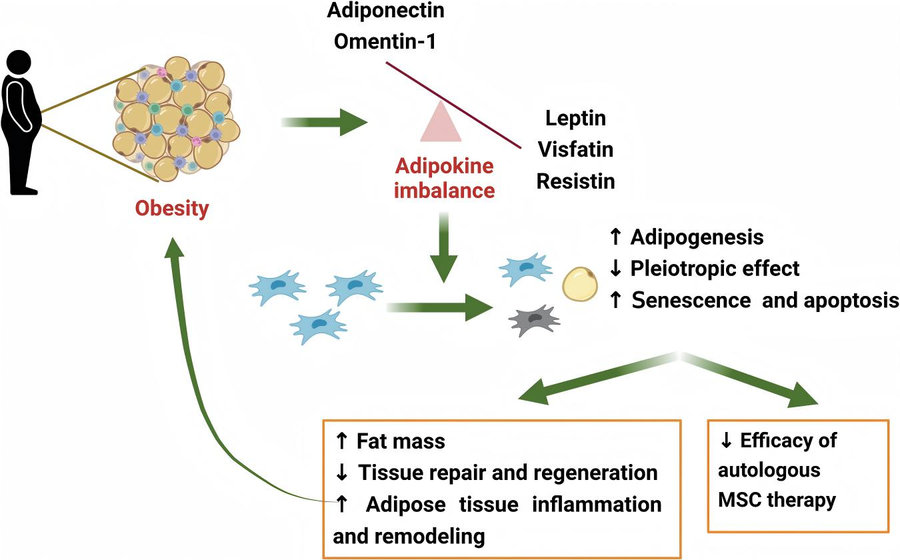 Fig.1 Adipokines & mesenchymal stem cell therapy: how obesity disrupts stem cell function & treatment efficacy. (Pham, et al., 2023)
Customer Review
Securing Investment with Definitive Bioenergetic Validation
"Protheragen has been an essential partner for our R&D group. Their bioenergetic testing platform gave us the definitive, highly reproducible oxygen-consumption data we needed to convince our investment board to fund our next development phase. Their technical transparency is second to none."
Dr. A. W., Scientific Researcher
Overcoming Viability Hurdles via Collaborative Protocol Optimization
"As a virtual biotech, we rely heavily on external expertise. The team at Protheragen did not just run our assays; they actually helped us optimize our cryopreservation protocol after identifying a major post-thaw viability drop in our initial pilot run. They saved us months of trial and error."
Dr. S. J., Associate Scientist.
Frequently Asked Questions
-
Can we send you frozen tissue samples, or do you require fresh adipose harvests?
We can work with both, though starting from fresh tissue often yields higher viability for SVF and ADSC isolation. We can assist you in drafting collection and shipping protocols to optimize viability before arrival at our facility.
-
How do you measure the actual energy-wasting capacity of our modified cells?
We primarily utilize real-time extracellular flux analysis to track oxygen consumption rates (OCR). By introducing specific mitochondrial inhibitors and uncouplers during testing, we can calculate the exact percentage of respiration dedicated to uncoupled thermogenesis.
-
Do you have experience working with non-viral transfection methods for autologous cells?
Yes. While we regularly use lentiviral platforms, we have also optimized electroporation and nanoparticle-mediated delivery systems to minimize the genomic disruption risks often associated with viral integration.
-
What animal model samples do you typically process?
We routinely process tissues from standard rodent models of obesity (such as ob/ob, db/db, and DIO mice), as well as rabbit and non-human primate tissue samples.
-
How do you control for the inherent biological variability in donor-derived autologous samples?
We employ standardized positive and negative control cell lines alongside your donor samples. This allows us to isolate run-to-run assay variables from true, donor-specific biological differences.
-
Can you help us optimize our cell formulation for long-term cryopreservation?
Absolutely. We run multi-variable stability studies testing different cryoprotectants, cooling rates, and storage temperatures to identify the precise formulation that keeps your specific engineered cells intact and functional upon thawing.
Contact Us
At Protheragen, we are dedicated to transforming complex metabolic concepts into viable therapeutic candidates. By combining biological expertise with advanced bioenergetic and analytical platforms, we help you overcome the unique challenges of autologous development. Welcome to Contact Protheragen to see how we can bring your project requirements to life.
Reference
- Pham, D.V.; et al. Adipokines at the crossroads of obesity and mesenchymal stem cell therapy. Exp Mol Med. 2023, 55, 313–324 (CC BY 4.0).
All of our services and products are intended for preclinical research use only and cannot be used to diagnose, treat or manage patients.