
Cell-based Anti-Obesity Drug Screening Service
InquiryObesity is no longer understood as just a cosmetic issue or a simple lack of willpower. It is a complex, progressive metabolic disease driving global health crises like type 2 diabetes, fatty liver disease, and cardiovascular complications. For decades, the pharmaceutical industry relied heavily on in vivo animal screening to find anti-obesity drugs. However, relying purely on rodent models early in the pipeline is costly, slow, and often leads to poor clinical translation. Differences in adipose tissue biology and metabolic regulation between rodents and humans frequently cause promising preclinical molecules to fail later on.
Next-Gen Cell-Based Assays for Preclinical Anti-Obesity Drug Discovery
To bridge this translation gap and streamline early-stage drug discovery, Protheragen offers a highly advanced, physiologically relevant cell-based anti-obesity drug screening service. By utilizing human-derived cell lines, primary adipocytes, and complex co-culture platforms, we help biopharmaceutical researchers evaluate candidate molecules in a humanized context before moving into animal models. Our screening platform focuses on key biological mechanisms of obesity, including adipogenesis, lipolysis, thermogenesis, and cellular metabolic signaling. This ensures you identify the most promising leads with high specificity and efficiency.
Core Technologies
To deliver highly predictive and reproducible screening data, Protheragen leverages state-of-the-art cellular and analytical technologies. Our platforms are designed to closely mimic human metabolic physiology in vitro, giving you deeper insights into your compound's mechanism of action.
We utilize human-derived preadipocytes and iPSC-derived adipocytes. These cells provide a much more accurate genetic and physiological representation of human adipose tissue than standard rodent cell lines like 3T3-L1.
Adipose tissue is a complex mixture of adipocytes, immune cells, and stromal cells. We establish advanced co-culture models, including adipocyte-macrophage systems, to study obesity-linked inflammation, as well as novel omental mesothelial-adipocyte co-cultures to study local regulatory signaling pathways (such as the IGFBP2 pathway).
Our automated imaging systems allow for multiplexed analysis of lipid accumulation, droplet morphology, mitochondrial membrane potential, and cellular hypertrophy, providing rich phenotypic data from every screen.
We measure real-time mitochondrial respiration (OCR) and glycolysis (ECAR) in living cells. This is essential for assessing thermogenic activation (browning of white adipose tissue) and cellular energy expenditure.
We utilize high-throughput qPCR, ELISA, and multiplex bead assays to monitor changes in key adipokines (such as adiponectin and leptin), inflammatory cytokines, and gene expressions associated with lipogenesis and lipid oxidation.
Solution Scope
Protheragen provides a comprehensive suite of cell-based assays designed to target different facets of obesity pathophysiology. Our customizable screening panels allow you to thoroughly evaluate candidate compounds across multiple biological mechanisms.
- Adipogenesis and Lipid Accumulation Assays
We assess the ability of your compounds to inhibit or regulate the differentiation of preadipocytes into mature, lipid-storing adipocytes. Using high-content imaging with fluorescent lipid dyes, we quantify lipid droplet size, count, and total cellular lipid accumulation. This is critical for discovering drugs aimed at preventing adipose tissue hyperplasia.
If your therapeutic strategy focuses on breaking down stored fat, our lipolysis assays measure the release of glycerol and free fatty acids (FFAs) into the culture medium. We evaluate both basal lipolysis and stimulated lipolysis (e.g., catecholamine-induced) to identify compounds that promote lipid mobilization without causing cellular toxicity.
- Adipocyte Browning and Thermogenesis Assays
Promoting the transdifferentiation of white adipocytes into energy-burning beige adipocytes (browning) is an exciting area in anti-obesity drug discovery. We measure uncoupling protein 1 (UCP1) expression at both the mRNA and protein levels. Additionally, we use extracellular flux analysis to track mitochondrial oxygen consumption rates (OCR) to confirm functional thermogenic activation.
- Metabolic Signaling and Adipokine Profiling
Adipose tissue acts as an endocrine organ. We monitor how your compounds influence the secretion of key metabolic hormones, such as adiponectin, leptin, and inflammatory cytokines (IL-6, TNF-alpha). We also analyze intracellular signaling pathways, including AMPK, insulin receptor substrate (IRS-1) phosphorylation, and PPAR-γ activation, to understand the precise molecular mechanism.
Inquire Now to Explore Our Technological Platforms.
Workflow
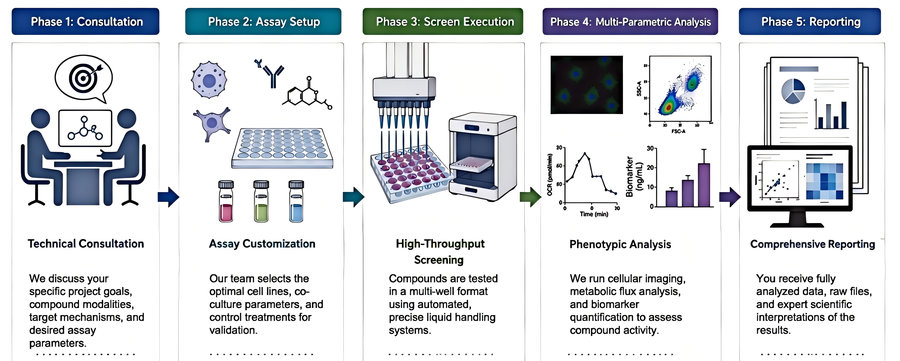
Our workflow is built to ensure seamless collaboration, transparent milestones, and high-quality data generation. Below are the key stages of our cell-based screening service:
Fields of Application
Our cell-based anti-obesity screening services support various stages of preclinical research and development across multiple sectors:
- Small Molecule Drug Discovery
Screening chemical libraries to identify novel activators of lipolysis, inhibitors of adipogenesis, or promoters of adipose browning. - Biologics and Peptide Therapeutics
Evaluating the metabolic activity, receptor binding, and downstream signaling of peptide agonists (such as GLP-1, GIP, and glucagon receptor co-agonists) on human target cells. - Nutraceutical and Natural Product Research
Testing bioactive compounds, dietary extracts, and functional food ingredients for their capacity to modulate lipid metabolism and mitochondrial respiration. - Target Validation Studies
Utilizing RNAi or CRISPR-mediated knockdown in our cell models alongside compound treatments to validate the therapeutic viability of novel metabolic targets.
Advantages
Partnering with Protheragen for your preclinical anti-obesity drug discovery offers distinct advantages that can significantly accelerate your pipeline.
Human-Centric Physiological Relevance
By prioritizing primary human adipocytes and specialized co-culture models over standard rodent cell lines, our assays yield data that translates far better to human physiology. This minimizes clinical failure rates and helps you select candidates with the highest therapeutic potential.
High-Content, Multi-Parametric Data
We do not rely on simple, single-endpoint readouts. Our automated phenotypic imaging and extracellular flux profiling capture detailed cellular responses. You get insights into lipid morphology, mitochondrial health, and metabolic rate simultaneously. This multi-parametric approach increases hit-to-lead success rates compared to single-point colorimetric assays.
Robust and Scalable Platforms
Our screening assays are optimized for 96-well and 384-well microplate formats, using automated liquid handling to guarantee exceptional reproducibility, low CV values, and rapid turnaround times. This makes our platform perfect for both focused lead optimization and high-throughput screening campaigns.
End-to-End Scientific Support
Our team of PhD-level metabolic specialists does not just return raw data. We provide deep biochemical interpretation, structure-activity relationship (SAR) support, and guidance on subsequent preclinical strategies to keep your project moving forward smoothly.
Request a Project Consultation.
Customer Review
De-Risking Small-Molecule Leads with Human-Derived Adipocyte Screens
"We partnered with Protheragen to evaluate a series of small-molecule AMPK activators. Their human primary adipocyte screening platform gave us exceptionally clear, reproducible, and translatable data that we simply couldn't get from standard rodent cell models. The scientific team's input during data analysis was invaluable, and we are currently planning our next screening campaign with them."
Dr. A. T., Senior Research Scientist.
Accelerating Peptide Programs with Advanced Browning and Metabolic Flux Data
"The adipocyte browning assays provided by Protheragen were a game-changer for our peptide therapeutic program. Their high-content imaging and mitochondrial respiration data gave us the robust preclinical proof-of-concept we needed to secure our next round of funding. We highly recommend their professional team and reliable assays."
Dr. H. V., Postdoctoral Researcher
Frequently Asked Questions
-
Why should we choose cell-based screening over animal models in early-stage anti-obesity drug discovery?
Cell-based assays are much faster, more cost-effective, and allow for high-throughput screening of thousands of compounds. More importantly, using human-derived cells avoids the translational discrepancies often seen between rodent and human lipid metabolism, helping you de-risk your pipeline before investing in animal models.
-
Can Protheragen run screening on primary human adipocytes, or do you only use cell lines?
We routinely use both. While human preadipocyte cell lines are great for consistency in high-throughput screens, we highly recommend validating your top leads in primary human adipocytes (derived from subcutaneous or visceral fat depots) to ensure physiological relevance.
-
How do you evaluate the "browning" of white adipose tissue in vitro?
We assess browning by measuring the upregulation of UCP1 and other brown/beige fat markers (like PGC-1 alpha) using qPCR and immunofluorescence. We then back this up with functional mitochondrial respiration testing (OCR) using extracellular flux analyzers.
-
What is the typical turnaround time for a standard 384-well anti-obesity screen?
Turnaround times depend on the specific assays and the size of your compound library. Typically, a standard adipogenesis or lipolysis screen takes about 3 to 6 weeks from receiving your compounds to delivering the final, fully analyzed report.
-
Can you accommodate customized co-culture models to study obesity-linked inflammation?
Absolutely. We set up adipocyte-macrophage co-culture systems to mimic the chronic, low-grade inflammatory environment of obese adipose tissue. This lets you see if your compounds can reduce inflammatory cytokine release while improving insulin sensitivity.
-
Do you offer screening services for peptide therapeutics like GLP-1 or dual-receptor agonists?
Yes, our cell-based assays are highly compatible with peptides, biologics, and small molecules. We can customize target receptor expression in our cell models to match the specific mechanism of your biological candidates.
-
How do you prevent compound-related toxicity from skewing the lipolysis or adipogenesis results?
We run parallel multiplexed cell viability assays (like multiplexed LDH release or ATP-based assays) alongside all screens. This ensures that any observed decrease in lipid accumulation or change in biomarker release is due to metabolic modulation rather than simple cell toxicity.
-
What options do we have for high-content phenotypic imaging?
We use automated confocal imaging to quantify specific cellular features. We can measure things like lipid droplet count, average droplet size, nuclear translocation of transcription factors (e.g., PPAR-γ), and mitochondrial membrane potential in individual cells.
-
Are your services strictly preclinical, or do you support clinical studies?
Protheragen is a specialized preclinical contract research provider. We do not run clinical trials. Our goal is to help you generate high-quality, human-relevant preclinical data to confidently advance your candidates toward IND-enabling studies.
Contact Us
Protheragen is dedicated to helping researchers advance anti-obesity drug discovery through highly predictive, human-relevant, and reproducible cell-based screening platforms. By focusing on the complex cellular biology of adipose tissue—from lipid accumulation to thermogenic energy expenditure—we provide the high-quality data you need to de-risk your pipeline and confidently advance your best candidates. Contact Protheragen for more information or a custom quote.
All of our services and products are intended for preclinical research use only and cannot be used to diagnose, treat or manage patients.