
Obesity-Related Mitochondrial ROS & Oxidative Stress Analysis Service
InquiryMitochondria play a huge role in keeping metabolic homeostasis intact, acting as the main engine for cellular energy production. However, under chronic nutrient overload, like what happens in diet-induced obesity, this mitochondrial machinery gets overwhelmed. Substrate overload drives up the mitochondrial membrane potential, causing electrons to leak out from complexes I and III of the electron transport chain. This leads directly to overproduction of reactive oxygen species (ROS), including superoxide anions and hydrogen peroxide (H2O2).
Preclinical Mitochondrial ROS & Oxidative Stress Profiling Services
Protheragen offers pre-clinical analytical services tailored to evaluate mitochondrial ROS and oxidative stress mechanisms in obesity research models. Our testing platforms help biomedical teams evaluate target engagement, screen potential antioxidants, and trace metabolic pathways in preclinical study designs.
Core Technologies
To help researchers dive deep into mitochondrial function, Protheragen utilizes a robust suite of bioanalytical platforms tailored for preclinical tissue and cell line research.
Utilizing Agilent Seahorse XF Analyzers, we quantify oxygen consumption rates (OCR) and extracellular acidification rates (ECAR). This allows us to track mitochondrial proton leak, spare respiratory capacity, and ATP-linked respiration in intact cells or isolated mitochondria.
We run specialized fluorescent assays using probes like MitoSOX Red, Amplex Red, and DCFH-DA to track mitochondrial superoxide and hydrogen peroxide generation in real time under simulated metabolic stress.
Quantification of lipid peroxidation products, including 4-HNE, 8-iso-PGF2α, and MDA, alongside precise measurement of reduced-to-oxidized glutathione ratios (GSH/GSSG).
High-throughput activity assays for key antioxidant enzymes, including manganese superoxide dismutase (MnSOD/SOD2), glutathione peroxidase (GPx), catalase (CAT), glutathione S-transferase (GST), and paraoxonase-1 (PON1).
Ratiometric dye platforms (such as JC-1 and TMRM) measure changes in mitochondrial membrane potential caused by nutrient overload or uncoupling mechanisms.
Service Scope
Our preclinical analytical services cover a wide range of biological models and specialized assays designed to provide comprehensive insights into metabolic disease research.
- Mitochondrial ROS Profiling & Quantification
- Measurement of intracellular and mitochondrial-specific reactive oxygen species (ROS) levels.
- Identification of key sites of oxidative stress production within isolated mitochondria or whole-cell models.
- Oxidative Stress & Biomarker Analysis
- Profiling of downstream oxidative stress markers, including lipid peroxidation, protein carbonylation, and DNA damage indicators.
- Assessment of cellular antioxidant capacity and endogenous antioxidant enzyme activity.
- Cellular & Mitochondrial Bioenergetics
- Real-time measurement of oxygen consumption rate (OCR) and extracellular acidification rate (ECAR) to quantify metabolic flux.
- Comprehensive evaluation of ATP production rates, basal respiration, maximal capacity, and proton leak.
- Disease Model Evaluation (Obesity Focus)
- Assessment of bioenergetic dysfunction and oxidative burden across in vitro (adipocytes, hepatocytes, myotubes) and in vivo/ex vivo preclinical obesity models.
- Quantitative analysis of drug candidates/therapeutics aimed at restoring mitochondrial function and mitigating ROS production.
Contact our scientific team today to discuss your project requirements
Workflow
Our testing pipeline follows a structured, step-by-step process to ensure quality control, clear communication, and reliable scientific outcome reporting.
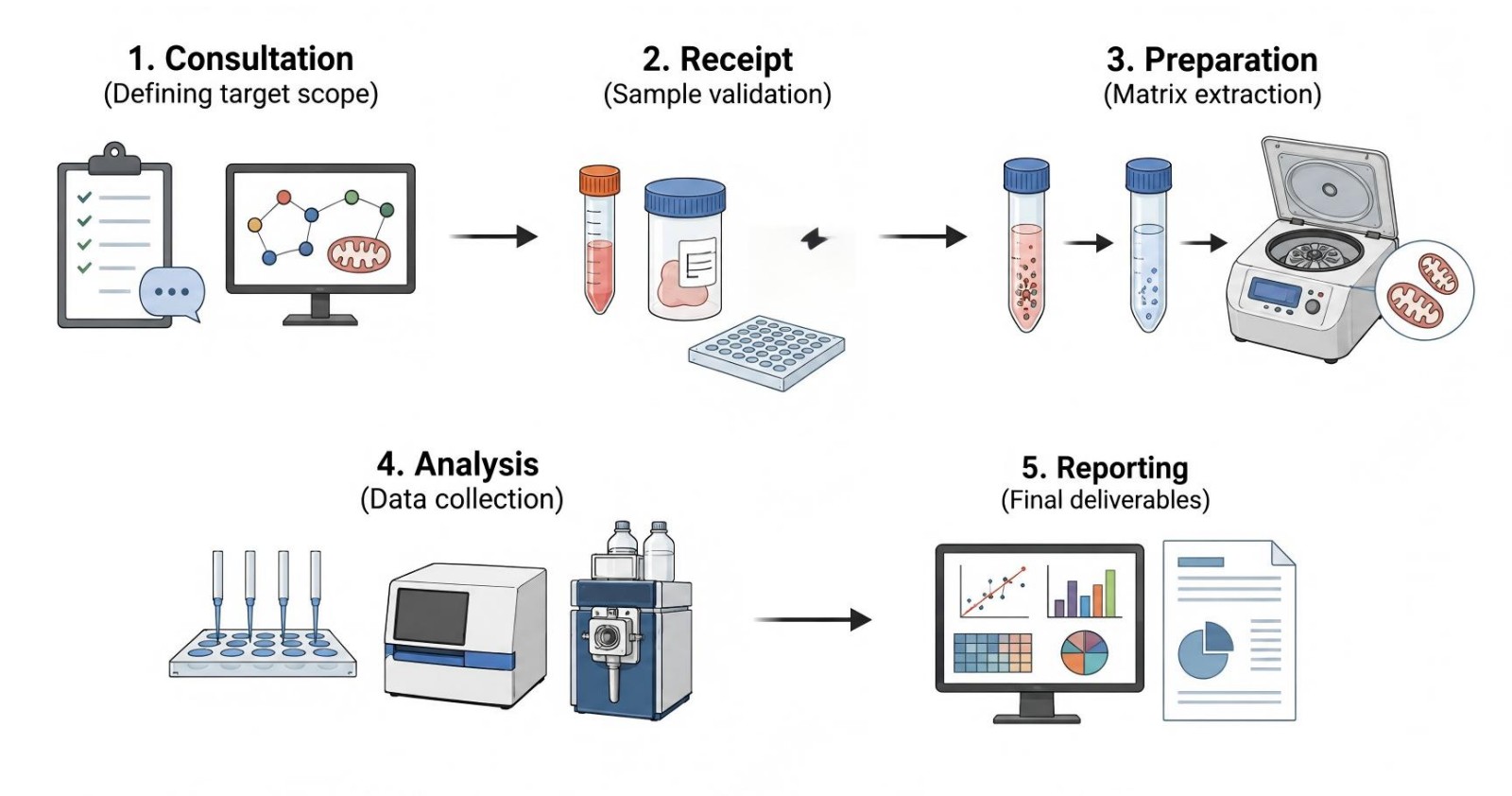
- Step 1: Initial technical consultation to define study objectives, sample requirements, and testing panel selections.
- Step 2: Secure receipt, cataloging, and quality verification of tissue specimens, cellular lysates, or compound libraries.
- Step 3: Isolation of intact mitochondria or sub-cellular fractions using optimized, cold-temperature centrifugation protocols.
- Step 4: Execution of respirometric assays, spectroscopic ROS profiling, or mass spectrometry biomarker quantifications.
- Step 5: Comprehensive statistical analysis, standard curve validation, and submission of a detailed study report.
Fields of Application
Our preclinical testing platform supports a wide range of research areas in metabolic health, cardiometabolic disease, and drug discovery:
- Metabolic Syndrome & Type 2 Diabetes Research: Evaluate how high-fat diets or glucolipotoxicity trigger mitochondrial ROS overproduction, alter NNT flux, impair GLUT4 translocation, and disrupt insulin signaling in skeletal muscle and adipose tissues.
- NASH / MASH & Hepatic Steatosis Studies: Measure hepatic mitochondrial ROS generation, lipid peroxidation (MDA, 4-HNE), upregulation of uncoupling protein-2 (UCP-2), and depletion of mitochondrial glutathione pools in fatty liver models.
- Cardiovascular & Renal Risk Evaluations: Track oxidative damage to renal and cardiac tissues resulting from mineralocorticoid receptor overactivation, systemic inflammation, and mitochondrial respiratory chain dysfunction in obese models.
- Therapeutic Compound & Antioxidant Screening: Screen novel Small Molecules, natural products, or target-directed biologics for their ability to neutralize mitochondrial free radicals, enhance SOD/GPx enzymatic activity, or restore cellular redox equilibrium.
Advantages
When you partner with Protheragen, you gain access to high-precision analytical workflows built specifically to accelerate metabolic and oxidative stress research.
High-Precision Respirometry & Fluorometry Integration
We combine real-time mitochondrial oxygen consumption measurements with specific fluorogenic probes. This dual approach helps separate structural mitochondrial damage from functional substrate overload, giving clear, reliable insight into drug response profiles. It has been shown that integrating Seahorse OCR with live-cell fluorometry reduces measurement variability across high-fat diet rodent model cohorts.
Comprehensive Redox Biomarker Panels
Our analytical suite goes beyond simple ROS assays by evaluating downstream targets—like MDA, protein carbonyls, and the GSH/GSSG ratio—alongside antioxidant enzyme activities like SOD2, catalase, GPx, and PON1. It is confirmed that tracking multi-marker oxidative networks provides a much clearer picture of tissue health than relying on any single biomarker.
Optimized Mitochondrial Isolation Protocols
Subcellular fractionation is tricky, but our strict cold-chain workflows preserve outer mitochondrial membrane integrity and native enzymatic function. This minimizes artifacts and yields reliable readings for delicate enzymatic assays like NNT and GPx.
Scalable Preclinical Platform for High-Throughput Screening
Whether you are analyzing a few tissue samples from an animal model or running large compound libraries through cell-based screening assays, our testing workflows scale seamlessly to deliver accurate, reproducible results within tight project deadlines.
Click here to discuss your project and request a custom quote.
Publication Data
Title: Oxidative Stress, Inflammation, and Obesity: Insights into Mechanism and Therapeutic Targets
Journal: Proceedings, 2025
DOI: https://doi.org/10.3390/ijms26188768
Summary: This paper reviews links among obesity, oxidative stress (OS), and low-grade inflammation. Dysregulated adipokines drive ROS overproduction, antioxidant depletion and tissue damage, triggering insulin resistance and metabolic diseases. It assesses pre-clinical and clinical evidence, discusses therapeutic hurdles and calls for personalised, translational research.
Key Findings
- Obesity triggers redox imbalance and chronic low-grade inflammation; visceral adipose tissue acts as an endocrine organ releasing pro-inflammatory adipokines while protective adiponectin declines.
- Excess reactive oxygen species (ROS) and weakened antioxidant defence (lower SOD, CAT, GPx) cause lipid peroxidation, protein and DNA damage, driving cellular and metabolic dysfunction.
- Signalling pathways NF-κB and JNK amplify inflammatory cytokine release (TNF-α, IL-6), promoting insulin resistance; adiponectin exerts anti-oxidative and anti-inflammatory protection via AMPK/PPAR-α activation.
- Animal models (KKAy, adiponectin-knockout, high-fat-diet mice) recapitulate obesity-linked OS and insulin resistance, yet species differences limit direct human translation.
- Human cohort data link raised OS biomarkers (8-epi-PGF2α, ox-LDL, MDA, 8-OHdG) with high BMI, insulin resistance and systemic pro-oxidant status.
- Antioxidants, adipokine modulators, GLP-1 agonists and SGLT2 inhibitors show promise, but clinical trial results are inconsistent due to dosage, bioavailability and patient heterogeneity.
- Future work needs stratified trial designs, multi-omics and AI-assisted biomarker discovery to advance personalised anti-obesity therapeutic strategies.
 Fig.1 Experimental models uncovering oxidative stress mechanisms in obesity. (Patil, et al.; 2025)
Customer Review
Target Engagement Validation Through Robust Oxidative Stress Profiling
"Working with Protheragen made a huge difference in our preclinical NASH drug candidate program. Their team helped us set up a solid oxidative stress panel using our high-fat diet liver samples. The clear data on GSH/GSSG ratios and lipid peroxidation markers gave us the concrete proof we needed to validate target engagement. We're already planning our next round of study samples with them."
Dr. A. T., Senior Principal Scientist
Reliable Bioenergetic Data & Seamless Technical Collaboration
"Their Seahorse respirometry and mitochondrial isolation protocols were spot on for our project. We had been running into consistency issues trying to measure ROS in isolated visceral adipocytes, but Protheragen stepped in and delivered reliable, reproducible data right on schedule. The technical team was super accessible and easy to collaborate with throughout the study."
Dr. E. R., Director of Pharmacology
Frequently Asked Questions
-
Why focus specifically on mitochondrial ROS rather than general cytosolic oxidative stress in obesity research?
Mitochondria are a primary source of cellular ROS under nutrient excess conditions. Excess fatty acids and glucose increase the mitochondrial membrane potential and drive electron leakage at complexes I and III. Tracking mitochondrial ROS specifically helps pinpoint early metabolic dysfunction before cytosolic secondary ROS cascades take over.
-
What sample types can we submit for the mitochondrial ROS analysis service?
We accept fresh-frozen tissue samples (such as adipose depots, liver, heart, or kidney), isolated primary cells, and immortalized cell lines. For respirometry assays requiring live mitochondria, special tissue shipping protocols or fresh cell preparations are arranged prior to sample delivery.
-
How do you prevent auto-oxidation and sample degradation during shipping and storage?
We provide clear, detailed sample preparation protocols before shipping. Samples generally require rapid flash-freezing in liquid nitrogen and storage at -80°C, often with specific antioxidant additives included during homogenization to prevent artifactual oxidation.
-
Can this service differentiate between superoxide (O2-) and hydrogen peroxide (H2O2)?
Yes, we utilize targeted fluorogenic probes and specific spectrophotometric assays that isolate individual reactive species. For instance, MitoSOX Red targets mitochondrial matrix superoxide, while Amplex Red assays measure extracellular and organellar hydrogen peroxide accumulation.
-
How does nutrient overload impact Uncoupling Protein-2 (UCP-2) in your assay models?
Chronic ROS generation often leads to a compensatory upregulation of UCP-2, which acts to mitigate membrane potential and lower radical generation at the expense of ATP synthesis efficiency. Our panels can track UCP-2 gene and protein expression alongside OCR to evaluate this uncoupling response.
-
Are these testing platforms applicable to drug discovery and candidate screening?
Absolutely. Our assays are well-suited for screening small-molecule drugs, natural compounds, or peptides designed to reduce ROS production, act as targeted antioxidants, or improve mitochondrial bioenergetics in preclinical models.
-
How do you handle variability between different adipose tissue depots (e.g., VAT vs. SAT)?
Visceral and subcutaneous adipose tissue depots often show distinct metabolic activity and baseline ROS generation. We standardize sample preparation, normalize data against total protein content or mitochondrial marker enzymes (like citrate synthase), and analyze each depot independently.
-
Can we evaluate the enzymatic activity of the Nicotinamide Nucleotide Transhydrogenase (NNT) pathway?
Yes, we offer targeted assays for NNT activity. NNT uses the mitochondrial proton gradient to produce NADPH, which is essential for regenerating reduced glutathione (GSH) and driving ROS clearance mechanisms.
Contact Us
Protheragen provides high-quality preclinical testing platforms to help advance your scientific research. Whether you need specialized mitochondrial respirometry, oxidative biomarker panels, or candidate drug screening, our team is ready to support your study goals. Contact Protheragen today for more information.
Reference
- Patil, B.S.; et al. Oxidative Stress, Inflammation, and Obesity: Insights into Mechanism and Therapeutic Targets. Proceedings. 2025, 119(1), 6. (CC BY 4.0)
All of our services and products are intended for preclinical research use only and cannot be used to diagnose, treat or manage patients.