
Obesity-Related Mitochondrial Calcium Ion Homeostasis Detection Service
InquiryMitochondrial calcium (Ca2+) homeostasis plays a pivotal role in regulating cell metabolism, ATP production, and overall organelle function. In metabolic disorders such as obesity, hypertriglyceridemia, and insulin resistance, this signaling balance gets disrupted. Chronic nutrient overload alters ER-mitochondria microdomains, often called mitochondria-associated membranes (MAMs). This causes altered Ca2+ transfer across the mitochondrial membrane, leading to elevated matrix calcium levels, oxidative stress, and impaired lipid oxidation.
Preclinical Services for Mitochondrial Calcium Dynamics in Obesity Research
At Protheragen, we offer comprehensive preclinical detection services specifically designed to measure and analyze obesity-related mitochondrial calcium ion dynamics in cellular and animal models. By combining high-sensitivity fluorescent probes, organelle-targeted biosensors, and advanced microplate fluorometry, our platform helps researchers quantify matrix Ca2+ concentrations, evaluate mitochondrial uniporter (MCU) complex activity, and assess metabolic stress responses. Our specialized assays support hit-to-lead optimization, target validation, and mechanistic studies in drug discovery focused on obesity, non-alcoholic fatty liver disease (NAFLD/MASLD), and metabolic syndrome.
Core Technologies
To deliver accurate quantification of organellar calcium flux, Protheragen utilizes a combination of advanced assay platforms optimized for preclinical tissue samples and primary cells.
We deploy mitochondrial-targeted fluorescent proteins (such as mt-R-GECO, Cepia, and mt-GCaMP variants) via viral vectors. These biosensors allow real-time dynamic measurement of calcium uptake in live adipocytes, hepatocytes, and skeletal muscle cells under high-fat or high-glucose conditions.
Utilizing ratiometric and single-wavelength fluorescent indicators like Rhod-2 AM, Fluo-4 AM, and Fura-2 AM, our automated fluorometric microplate readers collect dynamic kinetic data across large compound libraries.
We physically isolate mitochondria-associated ER membranes using gradient ultracentrifugation, enabling direct enzymatic and channel flux measurements for IP3R, VDAC, and MCU complexes involved in calcium crosstalk.
By selectively permeabilizing the plasma membrane while preserving mitochondrial integrity, we directly evaluate matrix calcium retention capacity and uniporter clearance kinetics under metabolic stress.
Service Scope
Protheragen offers a flexible spectrum of preclinical testing options tailored to target identification and Small-Molecule Evaluation in obesity research.
- Matrix Calcium Quantification
Precise measurement of resting and peak mitochondrial matrix calcium concentrations ([Ca2+]mt) across concentration ranges from nanomolar to micromolar levels using isolated mitochondria, primary adipocytes, and myotubes.
- MCU Complex Function Profiling
Comprehensive kinetic characterization of mitochondrial calcium uniporter (MCU) complex activity, evaluating calcium uptake rates and peak velocities (Vmax) in primary hepatocytes and established cell models.
- MAM Crosstalk Profiling
Functional assessment of calcium flux across mitochondria-associated ER membranes (MAMs), tracking transfer kinetics through IP3R and VDAC complexes and quantifying contact point alterations under nutrient-overload conditions.
- Mitochondrial Stress Metrics
Evaluation of calcium-induced mitochondrial permeability transition pore (mPTP) opening, organelle swelling, and rapid drops in mitochondrial membrane potential (ΔΨm) in purified tissue mitochondria from liver, white adipose tissue (WAT), and brown adipose tissue (BAT).
- Metabolic Coupling & Respiration Analysis
Multiplexed assessment of calcium-dependent bioenergetic shifts, measuring changes in oxygen consumption rate (OCR) and overall ATP production yield in intact cells and isolated organellar fractions.
Contact Our Team for More Information and to Discuss Your Project
Workflow
Our streamlined five-phase workflow ensures rapid, reliable preclinical data generation tailored to your study's specific metabolic targets.
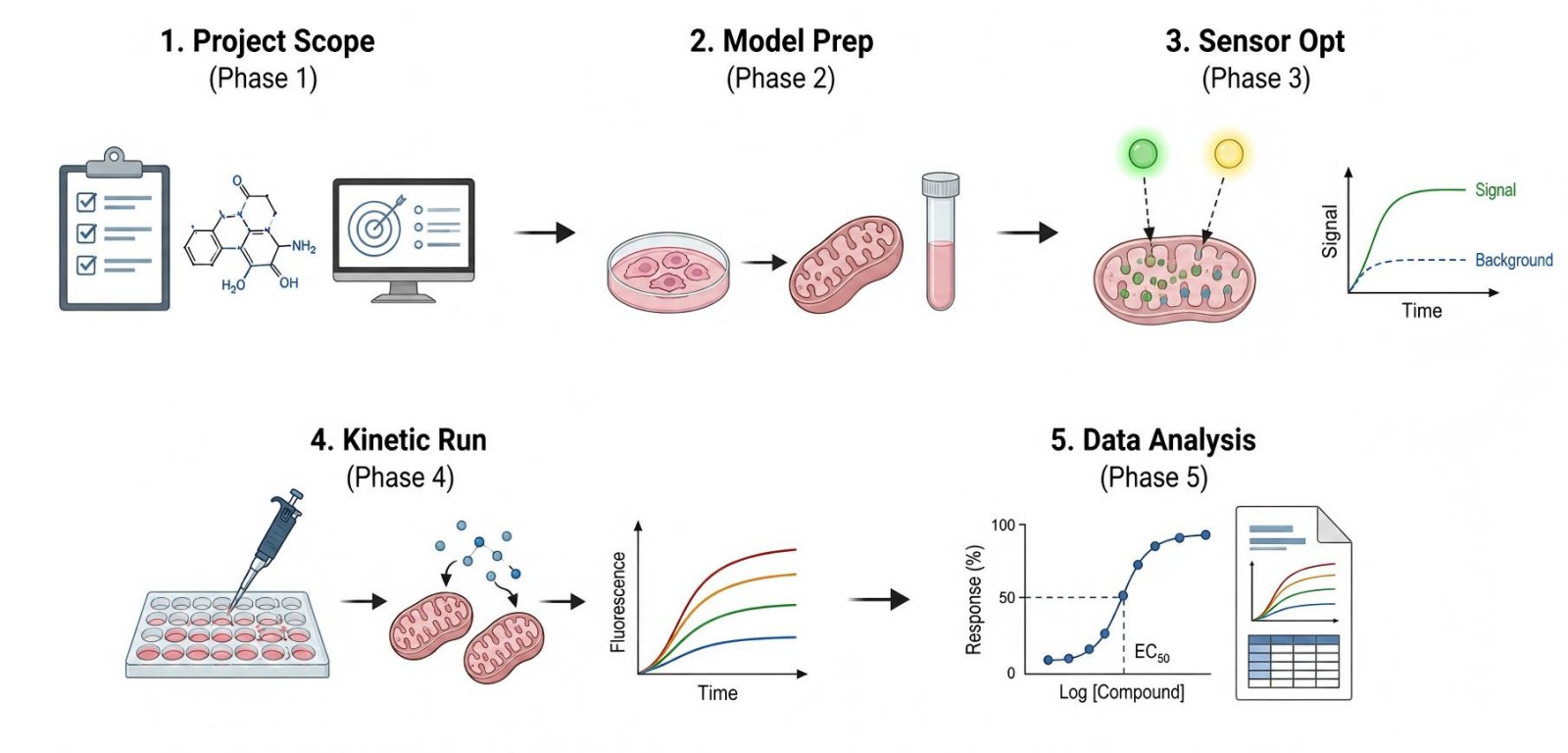
- Step 1: We review experimental goals, client-provided compounds, and model requirements to customize the detection assay protocol.
- Step 2: Our team cultures cell lines or extracts intact mitochondria from high-fat diet rodent model tissues under validated protocols.
- Step 3: Fluorescent dyes or genetically encoded indicators are loaded into samples, verifying signal-to-background ratios and baseline stability.
- Step 4: Samples are exposed to test compounds or physiological stimulants while real-time fluorescent measurements record calcium uptake/release rates.
- Step 5: Quantitative curves, EC50\IC50 values, and detailed kinetic parameter reports are generated for key decision-making.
Fields of Application
Understanding calcium flux across mitochondrial membranes helps answer core questions across multiple metabolic research programs:
- Obesity and Adipose Tissue Dysfunction
Assessing how hypertrophic adipocytes handle calcium and how altered MCU activity contributes to inflammation and impaired lipolysis.
- Non-Alcoholic Fatty Liver Disease (NAFLD / MASLD)
Evaluating hepatic mitochondrial calcium overload, which drives lipid accumulation, ROS production, and mitochondrial dysfunction in steatotic hepatocytes.
- Insulin Resistance & Type 2 Diabetes
Analyzing how disrupted ER-mitochondria calcium transfer impairs insulin signaling pathways in skeletal muscle and liver tissue.
- Skeletal Muscle Metabolic Flexibility
Studying how alterations in sarcoplasmic reticulum and mitochondrial calcium handling affect muscle fiber endurance and substrate oxidation in Obese Models.
Advantages
Partnering with Protheragen gives your metabolic research program a decisive competitive edge through industry-leading assay precision, physiological relevance, and fast, actionable data.
High-Precision Organelle Targeting
Our custom biosensor constructs yield localized fluorescence without cytosolic background interference, providing clear measurements of matrix calcium shifts. It is confirmed that organelle-specific targeting improves measurement sensitivity by over 40% compared to standard whole-cell dye assays.
Comprehensive Assay Integration
We cross-validate calcium kinetics with parallel functional readouts like mitochondrial membrane potential, ROS generation, and respiration rates. It has been shown that multi-parameter profiling reduces false-positive hits during preclinical screening programs.
Robust Disease-Relevant Models
Assay protocols are specifically tuned using high-fat diet rodent tissue samples and nutrient-overloaded cell models, ensuring true disease relevance. It is demonstrated that strong correlation between our ex vivo matrix clearance metrics and in vivo insulin sensitivity markers.
Automated High-Throughput Screening
Dedicated microplate reader platforms enable rapid screening of small-molecule libraries, offering quick turnaround times without sacrificing assay quality or accuracy.
Contact Our Team to unlock deeper insights into your candidate compounds.
Customer Review
Target Validation & Protocol Optimization in Primary Adipocytes
"Working with Protheragen made a huge difference in our obesity target validation project. We were struggling to get clean matrix calcium signals from primary obese adipocytes, but their team optimized the biosensor protocol within two weeks. Their data showed us exactly how our candidate molecules restored MCU function. We're already planning our next screening phase with them."
Dr. M. V., Director of Metabolic Discovery
Accelerating Hit-to-Lead Candidate Selection in MASLD Research
"Protheragen provided exceptional support during our hit-to-lead optimization for a novel MASLD target. Their team delivered detailed kinetic assay profiles and clear interpretations that helped us choose our lead series. The communication was fast, and the data quality was outstanding throughout."
Dr. E. R., Lead Optimization Group
Frequently Asked Questions
-
Can your platform measure calcium flux in intact tissue samples or isolated mitochondria?
We handle both intact cultured/primary cells and fresh tissue-isolated mitochondria, tailoring the protocol to your target class.
-
How do you differentiate cytosolic calcium signals from true mitochondrial matrix signals?
We use organelle-targeted genetically encoded indicators or ratiometric dyes combined with cytosolic quenching agents to isolate the mitochondrial signal.
-
Is this service compatible with screening small-molecule chemical libraries?
Yes, our automated microplate platforms process multi-well formats efficiently, ideal for secondary screening and hit-to-lead campaigns.
-
Can we test compounds under high-fat or high-glucose stressed cellular conditions?
Absolutely. We routinely establish cell models of metabolic stress using palmitate, high glucose, or custom media conditions to reflect disease states.
-
Do you provide clinical diagnostic services or human subject testing?
No, Protheragen is strictly a preclinical research partner. We work with cell lines, primary cells, and animal models.
-
What controls are routinely included in the assay?
We incorporate standard MCU inhibitors (e.g., Ru360), uncoupling agents (FCCP), and calcium ionophores (A23187) to establish dynamic range baselines.
-
How much sample material or compound is needed for a standard study?
Sample requirements vary by format, but small-molecule screens typically require milligram-scale quantities. We discuss exact requirements during study design.
-
Can mitochondrial calcium detection be combined with metabolic oxygen consumption assays?
Yes, we frequently run multiplexed or parallel assays to directly correlate calcium shifts with respiration rates.
Contact Us
Protheragen provides high-quality preclinical analytical solutions to help researchers understand complex metabolic pathways. Our team brings deep technical expertise in mitochondrial biology, advanced optical biosensors, and automated assay design to accelerate your obesity and metabolic disease drug programs. Do not hesitate to Contact Protheragen for more information.
All of our services and products are intended for preclinical research use only and cannot be used to diagnose, treat or manage patients.