
Obesity-Related Mitochondrial Biogenesis & DNA Copy Number (mtDNA) Assay Service
InquiryMeasuring mtDNA copy number relative to nuclear DNA (nDNA) offers direct insights into mitochondrial mass and genomic stability across brown, beige, and white adipose tissues, as well as skeletal muscle and hepatic tissues. As therapeutic discovery moves toward targeted interventions—such as thermogenic adipose activation, mitochondrial uncoupling, and metabolic pathway modulation—accurate preclinical quantification of mtDNA dynamics becomes vital.
Preclinical Obesity Research: Mitochondrial Biogenesis & mtDNA Copy Number Assay Services
Protheragen provides robust, specialized obesity-related mitochondrial biogenesis & DNA copy number assay services. Designed strictly for preclinical research, our platform empowers researchers to evaluate drug candidates, Small Molecules, and genetic therapies with high sensitivity and analytical precision.
Core Technologies
Accurate quantification of mtDNA copy number requires distinguishing mitochondrial genomic targets from nuclear pseudogenes (numts) while maintaining high sensitivity across low-yield tissue samples. Protheragen integrates multiple advanced molecular platforms to ensure reliable preclinical data.
Our digital PCR workflows provide absolute quantification of mitochondrial DNA target copies per cell without needing external standard curves. By partitioning samples into thousands of reaction microdroplets, dPCR minimizes susceptibility to PCR inhibitors commonly found in lipid-rich adipose samples. This ensures high precision even when detecting subtle shifts in mtDNA copy number in early-stage preclinical studies.
For high-throughput preclinical screening, our optimized qPCR panels utilize validated, intron-spanning nuclear reference genes alongside conserved mitochondrial target genes (e.g., ND1, ND4, COX1). This dual-target strategy eliminates numt amplification artifacts and guarantees accurate relative mtDNA/nDNA ratios.
To support large-scale compound screening, Protheragen uses microfluidic qPCR platforms. These systems enable simultaneous profiling of mitochondrial genome copy numbers alongside key biogenesis transcriptional markers (such as PGC-1α, TFAM, and NRF-1) across hundreds of preclinical samples in a single run.
Genomic copy number changes do not always correlate directly with functional protein expression. To address this, our platform combines nucleic acid quantification with high-sensitivity capillary Western blot and ELISA platforms. This allows simultaneous measurement of core mitochondrial proteins, including VDAC1, CS (Citrate Synthase), and OXPHOS complexes.
Service Scope
Protheragen offers an extensive preclinical service scope designed to support metabolic disease research, anti-obesity drug development, and functional target validation.
- Adipose Tissue Subtype Analysis
Quantification of mtDNA copy number across inguinal, epididymal, and interscapular brown adipose depots, enabling precise measurement of WAT browning and BAT activity.
- In Vivo Preclinical Model Profiling
Comprehensive assessment of tissue-specific mitochondrial copy number in rodent models of obesity, including high-fat diet (HFD) fed mice, db/db mice, and ob/ob models.
- In Vitro Screening Protocols
Scalable assays using primary adipocytes, 3T3-L1 cell lines, and human induced pluripotent stem cell (iPSC)-derived adipocytes to evaluate compound toxicity and biogenesis upregulation.
- Hepatic and Muscle Metabolic Profiling
Assessment of mitochondrial mass alterations in non-alcoholic fatty liver disease (NAFLD/MASH) models and skeletal muscle insulin resistance models.
- Biogenesis Transcriptional Crosstalk Studies
Simultaneous profiling of master regulatory networks (PPARγ, PGC-1α, ERRα, TFAM) alongside direct mtDNA copy number measurement to resolve mechanisms of action.
- Oxidative Stress & Damage Quantification
Dual assessment of mitochondrial genomic abundance and mtDNA damage/lesion frequencies resulting from chronic inflammation or lipid overload.
Contact Our Preclinical Services Team
Workflow
Our streamlined preclinical workflow ensures high data reproducibility and quick turnaround times for every study phase.
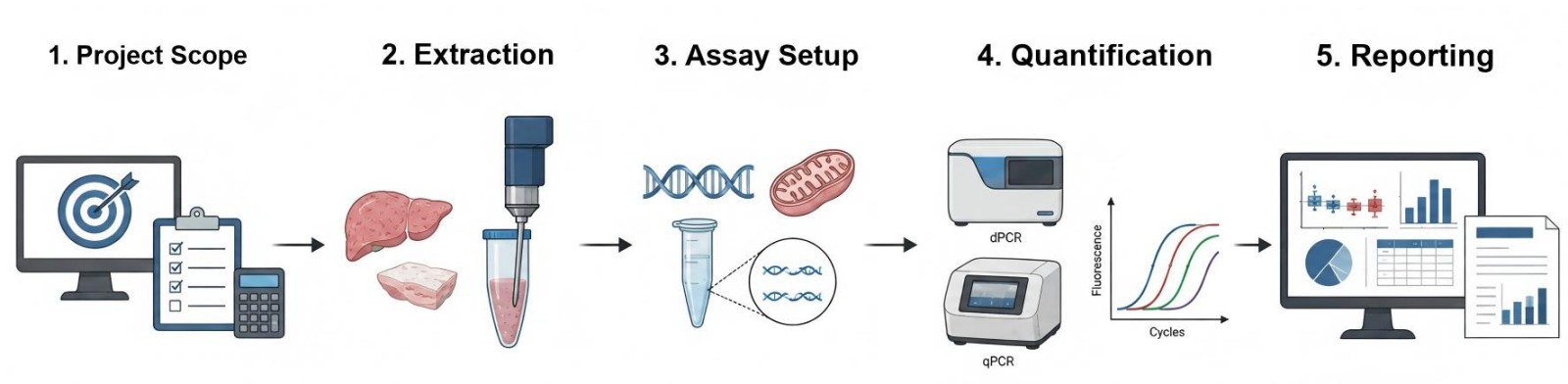
- Step 1: We define target tissues, choose suitable assay platforms, and establish power calculations tailored to your preclinical model.
- Step 2: Tissue samples undergo standardized mechanical disruptor processing using optimized buffers designed to preserve high-quality mitochondrial DNA.
- Step 3: Ultra-pure extraction removes PCR-inhibiting lipids and proteins while maintaining equal recovery rates for both nuclear and mitochondrial genomic fragments.
- Step 4: Assays are run on dPCR or qPCR platforms, employing validated primers and probes designed to exclude nuclear-encoded mitochondrial pseudogenes.
- Step 5: Normalization against verified single-copy nuclear genes, strict outlier filtering, and statistical evaluation ensure reliable experimental results.
Fields of Application
Preclinical assessment of mitochondrial biogenesis and mtDNA copy number is critical across various areas of metabolic research:
- Anti-Obesity Therapeutics Discovery: Evaluating compound efficacy in stimulating mitochondrial biogenesis within white adipose tissue to promote thermogenesis and weight loss.
- NASH/MASH and Metabolic Liver Disease: Measuring hepatic mitochondrial depletion and recovery in response to targeted anti-fibrotic or anti-steatotic preclinical candidates.
- Insulin Resistance & Type 2 Diabetes: Assessing the link between skeletal muscle mitochondrial copy number, oxidative capacity, and systemic glucose control.
- Mitochondrial Toxicity Screening: Identifying early safety risks by detecting drug-induced mitochondrial DNA depletion in off-target tissues during preclinical candidate selection.
- Nutraceutical & Dietary Intervention Studies: Validating the bioactivity of metabolic modulators and natural compounds designed to enhance mitochondrial health.
Advantages
By combining advanced quantification platforms with tissue-specific protocols, Protheragen delivers reproducible, high-resolution mitochondrial assay data that accelerates preclinical drug discovery.
High-Precision Pseudogene Exclusion
Our proprietary primer-probe sets selectively amplify actual mitochondrial genomic targets while avoiding nuclear mitochondrial pseudogenes (numts). This prevents baseline noise and guarantees reliable mtDNA quantification in all preclinical tissue samples. It is confirmed that our assays achieve a linear dynamic range across six orders of magnitude with minimal inter-assay variance.
Optimized Lipid-Rich Tissue Extraction Protocol
Extracting high-yield genomic DNA from obese adipose tissues is difficult due to heavy lipid interference. Protheragen employs specialized lysis and purification chemistry optimized for WAT and BAT, delivering pure template DNA free from PCR inhibitors.
Flexible Dual-Platform Technology
Customers choose between high-throughput qPCR for large compound screens or absolute digital PCR (dPCR) for delicate studies requiring subtle copy number resolution. This flexibility helps optimize research budgets while keeping data quality high.
Integrated Genomic & Protein Profiling
We provide complete evaluations of mitochondrial state by combining mtDNA copy number measurements with functional protein profiling (PGC-1α, TFAM, OXPHOS complexes). This delivers a clearer picture of metabolic drug responses than DNA quantification alone.
Inquire Today to Discuss Your Mitochondrial Assay Design
Publication Data
Title: Dysfunctional Mitochondria Clearance in Situ: Mitophagy in Obesity and Diabetes-Associated Cardiometabolic Diseases
Journal: Diabetes & metabolism journal, 2024
DOI: https://doi.org/10.4093/dmj.2023.0213
Summary: This study investigated mtDNA copy number in subcutaneous (SAT) and visceral adipose tissue (VAT) from 27 insulin sensitive and insulin resistant patients. Insulin resistant participants had significantly lower VAT mtDNA copy number, linked with disrupted insulin signalling, lipid metabolism and epigenetic gene expression, highlighting VAT mitochondrial dysfunction in metabolic disease.
Key Findings
- Tissue specific mtDNA differences: Visceral adipose tissue (VAT) showed approximately two fold lower mtDNA copy number compared to subcutaneous adipose tissue (SAT), indicating divergent mitochondrial profiles between fat depots.
- Insulin resistance linked mtDNA depletion: Insulin resistant (IR) individuals had reduced mtDNA in both SAT and VAT; only VAT reduction reached statistical significance (p=0.031).
- Clinical correlations: VAT mtDNA copy number negatively correlated with BMI (R2=−0.57, p=0.050) and positively correlated with QUICKI insulin sensitivity index (R2=0.51, p=0.014).
- Gene expression changes: IR patients displayed downregulated insulin signalling, lipid metabolism and adipogenic genes within VAT; SAT gene expression alterations were more limited.
- mtDNA gene expression associations: VAT mtDNA copy number strongly positively correlated with insulin signalling, lipid metabolism, adipocyte regulatory and epigenetic regulatory gene expression; these robust correlations were absent in SAT.
- Therapeutic implication: Targeting VAT mitochondrial regulation may represent a promising strategy for treating insulin resistance driven metabolic dysregulation.
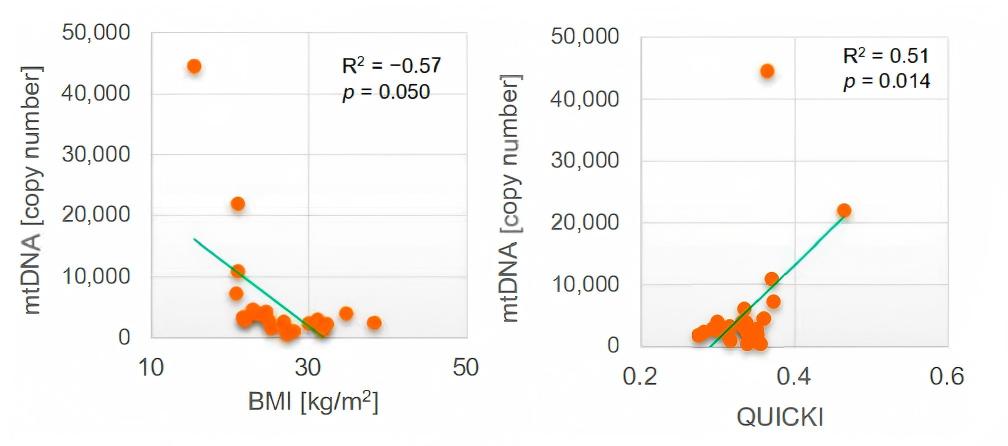 Fig.1 Mitochondrial DNA levels in visceral fat correlate with BMI and insulin sensitivity. (Tang, et al.; 2024)
Customer Review
Accelerating Thermogenic Lead Optimization with Precision dPCR Data
"Working with Protheragen significantly accelerated our preclinical anti-obesity program. We needed precise, reproducible measurement of mtDNA copy number across various mouse adipose depots following treatment with our novel thermogenic compound. The team provided expert guidance on tissue handling, and the dPCR data was exceptionally clean, allowing us to clearly demonstrate target engagement."
Dr. S. D., Senior Director of Pharmacology
Overcoming Lipid Interference in Adipose Profiling
"Submitting lipid-dense liver and adipose samples to external vendors often resulted in variable data for us in the past. Protheragen solved this challenge. Their custom extraction protocols eliminated our background noise issues, and their dual expression and copy-number reporting gave us deep mechanistic insights. They remain our trusted partner for preclinical mitochondrial profiling."
Dr. L. M., Lead Metabolic Disease Researcher
Frequently Asked Questions
-
Why measure mtDNA copy number in preclinical obesity research?
Mitochondrial DNA copy number acts as a reliable surrogate marker for mitochondrial mass and cellular respiratory capacity. In obesity, mitochondrial density often declines in key metabolic tissues. Tracking copy number helps show whether a drug candidate restores mitochondrial biogenesis or triggers WAT browning.
-
How does Protheragen prevent nuclear pseudogene (numt) interference?
Nuclear pseudogenes can cause overestimation of mtDNA copy number. We use carefully optimized primer-probe sets designed against specific regions of the mitochondrial genome that lack nuclear homology, alongside validated single-copy nuclear reference genes for precise normalization.
-
What tissue types can I submit for this assay service?
We process a wide range of preclinical samples, including frozen rodent tissues (BAT, WAT, liver, skeletal muscle, heart), cell lysates, primary adipocytes, 3T3-L1 cultures, and tissue spheroids.
-
Is Digital PCR (dPCR) better than qPCR for mtDNA copy number analysis?
While qPCR works well for high-throughput screening, dPCR offers absolute quantification without needing standard curves. It is also less sensitive to residual PCR inhibitors, making it ideal for low-yield samples or studies where detecting subtle shifts in copy number is essential.
-
How much tissue sample is required per reaction?
Thanks to our optimized micro-extraction techniques, we can process as little as 5–10 mg of tissue or roughly 100,000 cells per sample, preserving your precious preclinical specimens for other assays.
-
Can Protheragen measure mitochondrial biogenesis gene expression alongside mtDNA copy number?
Yes. We offer combined workflows that analyze target gene expression (like PGC-1α, TFAM, NRF1) using RT-qPCR alongside nuclear and mitochondrial DNA copy number evaluations.
-
How are adipose samples handled to prevent lipid interference?
Lipids can interfere with downstream enzymatic steps. Our extraction protocol uses phase-separation and silica-column purification designed to remove lipids and proteins, producing pure nucleic acid templates.
-
Can this service be used for clinical trial patient diagnostics?
No. All Protheragen services are strictly dedicated to preclinical research, lead optimization, and basic scientific research. We do not provide clinical diagnostic services.
Contact Us
Protheragen provides high-precision assay services for quantifying obesity-related mitochondrial biogenesis and mtDNA copy number in preclinical studies. Using dPCR, microfluidic qPCR, and optimized extraction protocols for lipid-rich tissues, we help metabolic disease researchers get accurate, inhibitor-free data every time. Whether you are running high-throughput anti-obesity compound screens or investigating detailed mechanisms of WAT browning, our tailored workflows deliver clear, actionable results. Contact Protheragen today for more information.
Reference
- Tang, S.; et al. Dysfunctional Mitochondria Clearance in Situ: Mitophagy in Obesity and Diabetes-Associated Cardiometabolic Diseases. Diabetes & Metabolism Journal. 2024, 48(4), 503–517. (CC BY 4.0)
All of our services and products are intended for preclinical research use only and cannot be used to diagnose, treat or manage patients.