
Anti-Obesity Drug Metabolite Identification Service
InquiryObesity and related metabolic disorders represent a profound global health challenge, driving intensive research for novel and effective therapeutic agents. The success of any drug candidate, particularly in the complex metabolic space, hinges on a deep understanding of its absorption, distribution, metabolism, and excretion (ADME) profile. At Protheragen, we specialize in the advanced anti-obesity drug metabolite identification service, providing preclinical researchers with the detailed chemical intelligence required to progress their compounds with confidence.
High-Resolution Metabolite Characterization Service
Metabolite identification is not merely a box-checking exercise; it is fundamental to mechanistic understanding. When an anti-obesity compound, whether synthetic or derived from natural products, enters a biological system, it transforms. Identifying these circulating and excretory metabolites is crucial for:
- Safety Assessment: Determining if any biotransformation products are active, toxic, or contribute to off-target effects.
- Mechanism of Action (MOA) Elucidation: Confirming which molecular species interacts with key metabolic pathways, such as those regulating white adipose tissue (WAT) energy balance or targeting specific enzymes like cathepsin L (CTSL)—an emerging target for metabolic disorders.
- Optimizing Lead Candidates: Guiding medicinal chemistry efforts to synthesize more stable, efficacious, and selective analogues.
Our expert team, with over two decades of experience, delivers high-resolution, unambiguous metabolite data, ensuring your preclinical research maintains scientific rigor and statistical confidence (as demonstrated by established standards like Student's two-tailed t-test in our analytical reporting).
Core Technologies: Precision in Metabolite Structure Elucidation
Protheragen has established a state-of-the-art platform by integrating high-resolution analytical methods with powerful computational cheminformatics. This synergy allows us to overcome the common challenge of low-concentration, structurally diverse metabolites found in complex biological matrices.
- High-Resolution Mass Spectrometry (HRMS) and Chromatography
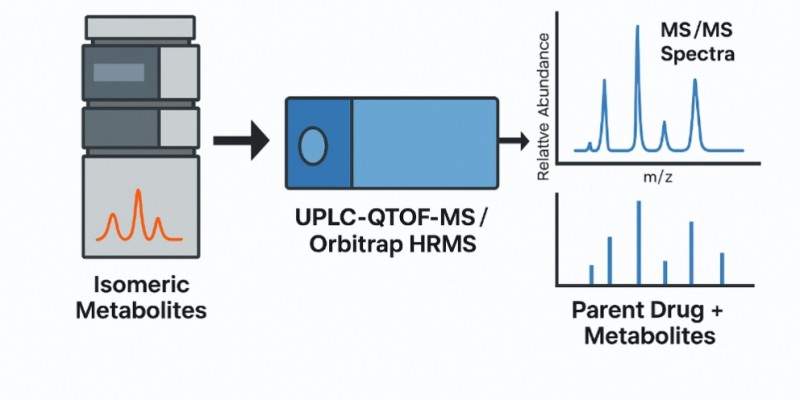
Our foundation is built upon ultra-high-performance liquid chromatography coupled with time-of-flight (UPLC-QTOF-MS) and Orbitrap HRMS systems. These instruments provide the requisite sensitivity and mass accuracy (down to sub-ppm levels) necessary for precise elemental composition determination of parent drugs and their biotransformation products. We employ specialized chromatographic methods to separate even highly similar structural isomers, a necessity when investigating alkaloid, steroid, or flavonoid glycoside metabolites often involved in anti-obesity therapies derived from medicinal and edible plants.
- Advanced Metabolomics and Cheminformatics
We move beyond simple mass matching using untargeted and targeted metabolomics approaches. Critical to our success is our ability to process vast spectral data using proprietary analytical pipelines. This includes leveraging:
- Bayesian Model Integration: Utilizing sophisticated statistical models and molecular fingerprints for efficient and reliable prediction of metabolite structures and properties, drastically reducing the time required for structural elucidation compared to traditional methods.
- Comprehensive Database Correlation: We correlate experimental data against extensive chemical databases (including public repositories and proprietary libraries) to facilitate the rapid identification and confirmation of bioactive molecules.
- Fragmentation Tree Analysis: Our experts employ advanced tandem MS/MS techniques to map the fragmentation pathways of unknown compounds, providing the definitive structural details for novel and complex metabolites.
Contact Protheragen today to discuss your project specifics.
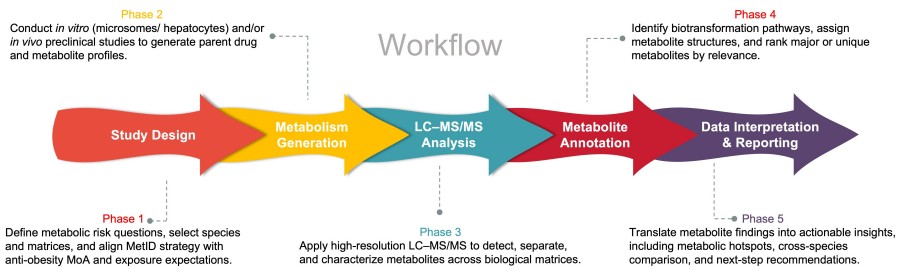
Workflow: A Systematic Path to Metabolite Identification
Our streamlined and validated five-stage workflow ensures fast turnaround times and the highest quality data for your preclinical studies.
Fields of Application
Our service is essential for any research team focusing on anti-obesity or metabolic disorder drug development in the preclinical stage.
Comprehensive characterization of metabolite profiles in preclinical species, fulfilling the requirements for early safety and Pharmacokinetic Modeling.
- Mechanism of Action (MOA) Elucidation
Identification of active metabolites that contribute to the therapeutic effect (e.g., WAT browning/modulation) or identifying metabolites that interact with known targets like cathepsin L.
- Natural Product Discovery
Essential for screening and validating novel anti-obesity constituents and their transformed products found in traditional medicinal and edible plants. Metabolite identification in this field is critical for both Drug Development and food fortification studies.
- Toxicology and Safety Assessment
Identifying and characterizing potentially reactive or toxic metabolites early in the preclinical phase to allow for timely compound optimization.
- Lead Optimization
Providing rapid structural feedback to medicinal chemistry teams, allowing them to synthesize and test analogues with improved metabolic stability and reduced formation of undesirable metabolites.
Advantages: The Protheragen Difference
Choosing Protheragen means partnering with a team that views metabolite identification as a strategic asset, not just an analytical requirement.
Deep Metabolic Disorder Focus
Our two decades of experience provide unparalleled insight into the unique metabolic pathways relevant to obesity, including lipid metabolism, WAT plasticity, and key enzymatic targets like cathepsin L (CTSL). We identify the relevant metabolites.
Proprietary Chem/Bio Database
We utilize an extensive, proprietary database of biotransformation products, particularly for natural product constituents (alkaloids, flavonoids) known for anti-obesity activities, enabling faster and more accurate identification than generic services.
Unambiguous Structural Assignment
By combining HRMS and sophisticated computational tools, we achieve high-confidence structural elucidation, mitigating the risk of costly misidentification further down the development pipeline.
Inquire about our accelerated discovery pipeline today!
Service Scope
Protheragen's anti-obesity drug metabolite identification service is explicitly designed to meet the rigorous demands of preclinical development. We specialize in non-GLP and research-grade studies, strictly adhering to the following scope:
- Sample Matrix Versatility
Analysis of in vivo samples (plasma, urine, feces, bile, tissue) from various rodent and non-rodent Animal Models, as well as in vitro systems (microsomes, hepatocytes, S9 fractions).
- Focus on Drug-Related Material
Identification and characterization of the parent compound and all significant primary and secondary circulating/excreted metabolites.
- Structural Determination
Provision of definitive structural assignments and, for novel compounds, providing the necessary information to guide subsequent synthesis or further in vivo efficacy testing.
Publication Data
Title: Identification of key candidate genes and molecular pathways in white fat browning: an anti-obesity drug discovery based on computational biology
Journal: Hum Genomics, 2019
DOI: https://doi.org/10.1186/s40246-019-0239-x
Summary: This paper systematically reviews the critical role of glycosylation (a key post-translational modification) in regulating immune cell function and inflammation, with a focus on its links to neurodegenerative diseases (Alzheimer's, Parkinson's), autoimmune disorders (rheumatoid arthritis, multiple sclerosis), and intestinal inflammation. It reveals a two-way regulatory relationship: abnormal glycosylation disrupts immune homeostasis, activates inflammatory cells (e.g., microglia), and accelerates disease progression; in turn, inflammatory environments further disturb glycosylation patterns, forming a vicious cycle. The study also highlights potential therapeutic strategies targeting glycosylation pathways, such as mRNA-based glycoengineering and enzyme inhibitors, providing new directions for treating inflammation-related diseases.
Key Findings
- Identified metabolites of HSG4112
-M1c: Formed via CYP enzyme-driven oxidation (dominant in rats).
-M4: A glucuronide metabolite formed via UGT enzyme-driven glucuronidation (dominant in dogs).
- Species-specific metabolite patterns
-In rats: M1c is the key metabolite (faster formation from HSG4112(R) drives its lower blood levels).
-In dogs: M4 is the main metabolite (faster formation from HSG4112(S) drives its lower blood levels).
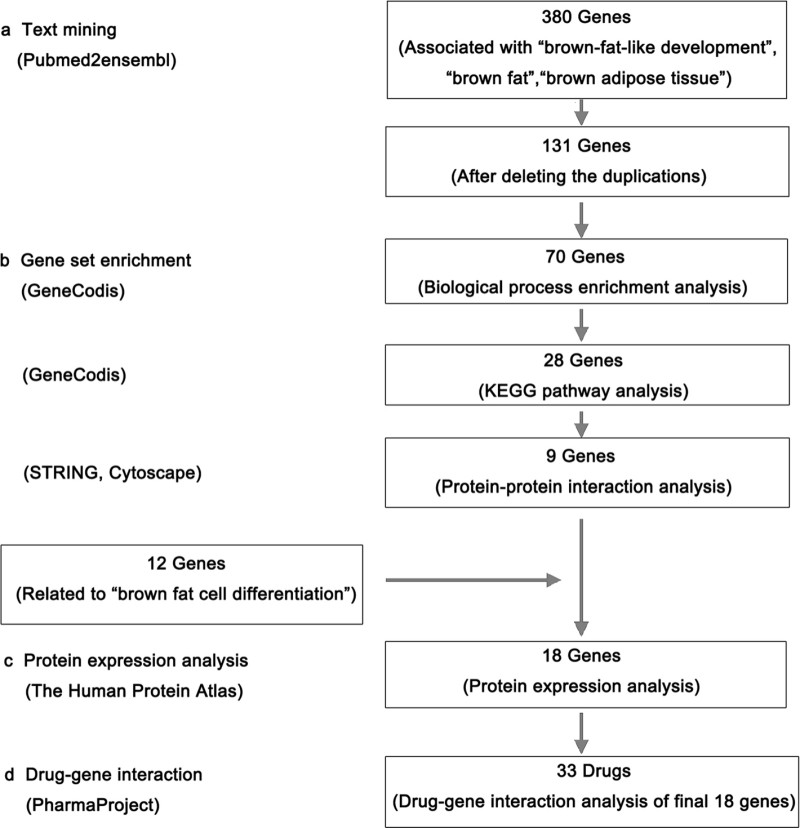 Fig.1 Summary of data mining results. (Pan, et al., 2019)
Customer Review
De-Risking the Pipeline: Saving Costs and Gaining Safety Confidence with Proactive Guidance
"The team at Protheragen was instrumental in advancing our lead anti-obesity compound. We were struggling to definitively characterize a Phase II glucuronide metabolite that was impacting our toxicology models. Protheragen's integration of high-resolution mass spectrometry and their proprietary Bayesian analysis pipeline delivered the unambiguous structure in half the time quoted by other CROs. This specific assistance allowed us to make an informed decision on compound modification and salvaged six months of work. We are now collaborating with them on a wider array of our pipeline candidates, utilizing their Accelerated Metabolite Profiling service for all new analogues."
Dr. E. V., Head of Preclinical R&D
Targeted Chemistry Success: Solving High Turnover Rates and Achieving a 10-Fold Improved Half-Life
"What sets Protheragen apart is their biological expertise coupled with their analytical rigor. They didn't just give us raw data; they gave us a complete scientific interpretation, relating metabolite formation directly back to our in vivo efficacy studies involving WAT. Their detailed reports, backed by statistical evidence, significantly strengthened our internal reports. Our future collaboration will focus on utilizing their associated custom compound synthesis service to produce stable-labeled standards of our critical metabolites for definitive quantification in our next animal studies. We consider them a true extension of our internal team."
Mr. D. C., Lead Research Scientist
Frequently Asked Questions
-
How does Protheragen ensure the accuracy of novel metabolite identification?
We integrate high-precision HRMS data (sub-ppm mass accuracy) with advanced computational tools, including Bayesian models and fragmentation tree analysis. For completely novel structures, we use synthesized standards or high-confidence prediction algorithms. This multi-layered approach provides the highest level of structural certainty for every metabolite.
-
What types of samples do you accept for metabolite identification?
We routinely handle a wide array of preclinical biological matrices, including plasma, urine, feces, tissue homogenates (e.g., liver, adipose), and in vitro incubation media from cell lines or enzyme systems.
-
Is your service compatible with both synthetic molecules and natural products?
Absolutely. Our platform is optimized to handle the extreme chemical diversity inherent in natural products (alkaloids, flavonoids, etc.) and the complexities of synthetic novel chemical entities alike.
-
How does your approach compare to basic LC-MS services?
Standard LC-MS provides mass data, but Protheragen delivers unambiguous structural elucidation. Our integration of untargeted metabolomics, proprietary databases, and cheminformatics ensures that you receive a confirmed structure and a proposed metabolic pathway, not just a list of masses.
-
What is the typical turnaround time for a complete metabolite identification study?
Turnaround time varies based on the compound's complexity and the number of samples. However, we pride ourselves on industry-leading speed. We encourage you to inquire directly with our project management team to receive a personalized, fast-track timeline for your specific drug candidate.
-
Can you identify metabolites present at extremely low concentrations in complex matrices?
Yes, our ultra-sensitive HRMS systems and optimized extraction protocols, combined with sophisticated data processing that statistically filters noise, allow us to detect and characterize metabolites present at trace levels in complex biological samples.
-
What precautions do you take regarding intellectual property (IP) and data security?
Data security and client IP protection are paramount at Protheragen. All client data is handled under strict confidentiality agreements, managed through secure, proprietary internal servers, and shared only via encrypted channels.
-
Do you offer options for targeted quantification of specific metabolites after identification?
Yes, after identification, we can transition to a high-throughput targeted analysis using validated quantitative methods to determine the precise concentrations of key metabolites in your preclinical samples. This is available as a sub-option within the service.
-
We are working on a novel cathepsin L inhibitor. Can your service support MOA confirmation?
Certainly. By identifying the exact circulating species, we can help confirm that the active compound or its metabolite is the one reaching and interacting with the target pathway, thereby strongly supporting your MOA claims in the preclinical setting.
How to Contact Us
Protheragen provides an industry-leading anti-obesity drug metabolite identification service, characterized by exceptional scientific knowledge, cutting-edge HRMS technology, and advanced cheminformatics. Our commitment is to deliver precise, high-confidence structural data that accelerates your preclinical ADME studies, elucidates your compound's mechanism of action, and de-risks your development pipeline. Partner with our 20+ years of expertise to ensure the success of your next therapeutic breakthrough.
Online Inquiry Form: Contact Protheragen
Email: info@obesityscientific.com
Phone: 1-631-506-1393
Reference
- Pan, Y.; et al. Identification of key candidate genes and molecular pathways in white fat browning: an anti-obesity drug discovery based on computational biology. Hum Genomics. 2019, 13, 55. (CC BY 4.0)
All of our services and products are intended for preclinical research use only and cannot be used to diagnose, treat or manage patients.