
Beyond Body Mass Index: How the OBSCORE Framework Enables Precision Prioritization for Weight Loss Interventions
September 16, 2026

June 22, 2026
Activating beige adipocytes (BAs) to increase energy expenditure represents a premier therapeutic target for treating metabolic diseases, yet chronic systemic activation of these cells consistently fails in clinical trials. This 2026 perspective review, published in Frontiers in Cell and Developmental Biology by an expert research group, shifts the scientific focus to cell-intrinsic constraints. The authors argue that historical therapeutic strategies failed because they focused entirely on upstream adrenergic stimulation, overlooking a fundamental, disease-induced decline in the physical capacity of the target cells to execute and sustain these energy-dissipating programs.
To understand why thermogenic strategies fail in pathological settings, we must dissect the three cell-intrinsic pillars that govern cellular competence, all of which are severely compromised in aging and obesity.
Thermogenesis is fundamentally an oxidative process that depends on the structural and functional integrity of the mitochondrial network, a state we define as mitochondrial competence (MC). Within this organelle network, the delicate balance between fusion and fission acts as a critical metabolic gatekeeper.
A second critical limit is intracellular signaling fidelity, which requires precise spatial and temporal compartmentation of cAMP rather than uniform, diffuse cytosolic signaling.
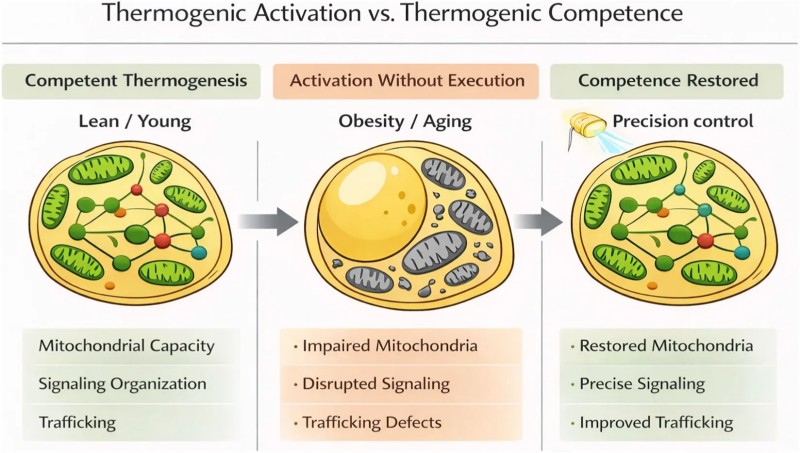 Fig.1 Adipocyte thermogenic capacity declines in obesity and aging but may be restored by improving cellular function. (Brown, 2026)
The third pillar, vesicle trafficking capacity, serves as a critical adaptive regulator that supports tissue-level homeostasis under high metabolic loads.
Tab. 1 Key cellular features determine the ability of adipocytes to maintain effective thermogenesis. (Brown, 2026)
| Dimension | Operational features | Representative readouts |
|---|---|---|
| Mitochondrial respiratory capacity | Ability to support sustained oxidative flux | Respiratory reserve capacity; electron transport chain activity; mitochondrial membrane potential |
| Mitochondrial architecture | Structural organization enabling efficient respiration | Cristae density and organization; fusion-fission balance; mitochondrial network morphology |
| Mitochondrial turnover | Balance between mitochondrial renewal and clearance | Mitophagy–biogenesis flux; Parkin recruitment; LC3-mitochondria colocalization; mitochondrial DNA content |
| Signaling compartmentation | Spatial organization of thermogenic signaling | cAMP microdomain amplitude and duration; phosphodiesterase localization; compartment-specific PKA activity |
| Receptor trafficking dynamics | Capacity to sustain productive signaling | β-adrenergic receptor internalization, recycling, and resensitization kinetics |
| Vesicle trafficking capacity | Intracellular organization and stress adaptation | Endosomal sorting efficiency; multivesicular body formation; Rab-dependent vesicle docking and release |
| Cellular stress tolerance | Ability to remodel under metabolic load | Endoplasmic reticulum stress markers; proteostasis capacity; oxidative stress responses |
Targeting cell state rather than pathway activation avoids the toxicity of forcing output from cells with compromised MC, intracellular signaling fidelity, and vesicle trafficking capacity. Future therapies must therefore restore cell-intrinsic competence before activation.
To achieve this spatiotemporal control, researchers use optogenetic approaches and wireless optogenetic systems. Key studies show that precise, temporally defined stimulation drives thermogenesis and prevents obesity without chronic activation. Rather than correcting every defect, these precision tools test if restoring specific competence components rescues durability, offering a strong validation framework alongside human iPSC-derived BA models.
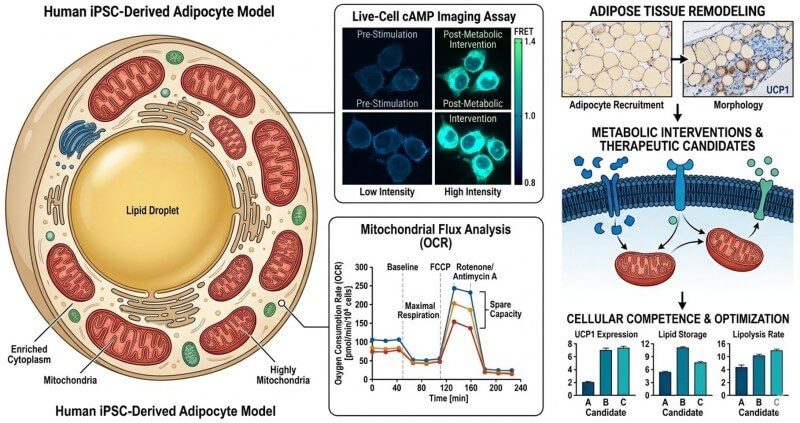
For researchers dedicated to exploring the complex mechanics of adipose tissue remodeling, mitochondrial dynamics, or metabolic interventions, Protheragen provides comprehensive, end-to-end support. We offer specialized services, including high-resolution mitochondrial flux analysis, customized live-cell cAMP imaging assays, and fully characterized human iPSC-derived adipocyte models designed to help you precisely measure and optimize cellular competence in your therapeutic candidates.
Reference
September 16, 2026

September 16, 2026
December 9, 2025
Copyright © Protheragen. All rights reserved.