
CAR-T Library Construction Service
InquiryObesity is no longer viewed just as a matter of excess fat storage. It is now understood to be a chronic inflammatory condition driven by metabolic strain and cellular senescence. In visceral adipose tissue, cellular senescence drives insulin resistance and metabolic dysfunction. Targeting these specific populations of senescent preadipocytes and specialized macrophages offers a fresh therapeutic strategy. Leveraging chimeric antigen receptor (CAR) T cells against metabolic targets like uPAR or specific markers on senescent fat cells has shown significant preclinical promise.
High-Throughput CAR-T Library Construction Services for Preclinical Obesity Research
To develop these metabolic immunotherapies, researchers require robust antibody screening tools. Discovering the right single-chain variable fragment (scFv) with ideal affinity and specificity for unique metabolic targets presents a substantial challenge. That is why Protheragen provides high-throughput CAR-T library construction services tailored for metabolic and obesity research. Our platforms enable massive screening of binder variations to fast-track preclinical asset development.
Core Technologies
Our library platforms utilize advanced molecular biology tools to expand the structural diversity of potential CAR candidates.
We utilize expansive, high-diversity synthetic and immune scFv/sdAb phage display libraries that are specifically optimized to preserve structural integrity and stability within inflammatory tissue environments.
Our platform incorporates precise randomized and site-directed mutagenesis strategies across the complementarity-determining regions (CDRs), maximizing structural variability to discover rare binding clones.
We employ specialized multi-round biopanning protocols utilizing primary murine adipocytes and senescent cell models, ensuring that selected binders recognize metabolic targets in their native conformation.
Screening matrices are designed to evaluate and select binder candidates under simulated hypoxic and cytokine-dense conditions, mirroring the actual pathophysiology of obese fat tissue.
Our platform integrates robust lentiviral and transposon-based library delivery vehicles to achieve stable expression and consistent surface density during primary in vitro screening stages.
Solution Scope
Protheragen provides comprehensive end-to-end preclinical library construction support. We recognize that metabolic receptors differ greatly from classic oncology targets, often exhibiting subtle expression nuances. Our services include:
- Custom scFv/sdAb Library Construction
Building expansive phage display or yeast display libraries derived from immunized Animal Models or fully synthetic human repertoires.
Utilizing advanced non-viral and viral transduction methods to generate, characterize, and expand custom CAR-T cell libraries in culture. This allows for rigorous high-throughput in vitro testing against senescent adipocytes and metabolic target profiles prior to animal testing.
Designing and packaging tissue-targeted viral or lipid nanoparticle (LNP) vectors intended for transient or stable in vivo CAR-T reprogramming research. This specialized service is engineered to help investigators study endogenous cell modification strategies within adipose microenvironments.
- Senolytic CAR Target Customization
Designing screening libraries focused on specific senescent markers like uPAR, glycoprotein nonmetastatic melanoma protein B (GPNMB), or novel adipocyte-specific surface molecules.
- Affinity Maturation Platforms
Optimizing existing binders to fine-tune affinity, preventing off-target exhaustion while ensuring potent clearance of pathological fat-tissue components.
- CAR Structural Optimization Variants
Engineering structural modifications including hinge lengths, transmembrane domains, and costimulatory configurations (e.g., CD28, 4-1BB) to maximize durability within inflamed adipose environments.
Inquire About Our Core Technologies!
Workflow
Protheragen streamlines CAR-T discovery for metabolic disease with an optimized, five-stage preclinical workflow, ensuring precise candidate selection and robust initial validation.
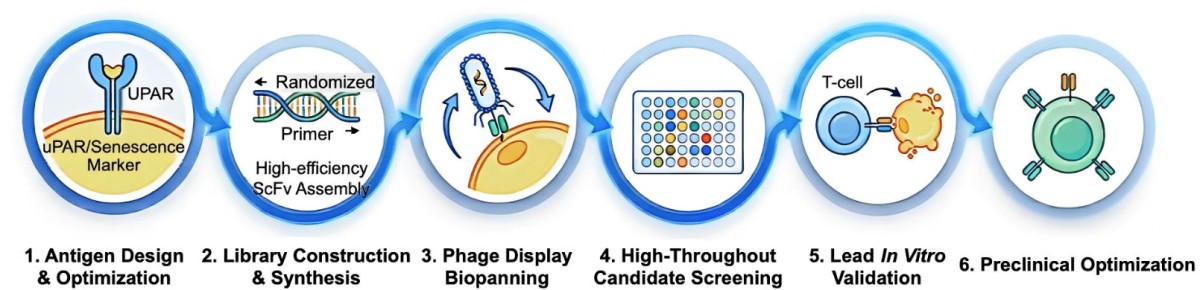
- Antigen Design and Optimization: Custom design of metabolic or senescent cell surface targets for optimal binder recognition.
- Library Construction and Synthesis: High-efficiency scFv library assembly incorporating degenerate primers to maximize sequence diversity across structural regions.
- Phage Display Biopanning: Multi-round selection against native adipocyte targets to enrich for binders with high functional specificity.
- High-Throughput Candidate Screening: Rapid functional characterization of binding kinetics and cross-reactivity profiling for selected metabolic candidate fragments.
- Lead In Vitro Validation: Cloning selected binders into CAR structural backbones followed by initial cytotoxic and activation assays.
Fields of Application
Our high-throughput CAR-T library construction services provide researchers with the robust molecular diversity needed to target the complex cellular mechanisms underlying chronic metabolic disorders.
- Senolytic Immunotherapy Development
Developing CAR architectures capable of clearing senescent preadipocytes and macrophages to reverse metabolic syndrome. - Metabolic Syndrome Modeling Engineering candidate libraries to discover novel surface receptors involved in weight gain and energy regulation.
- Chronic Adipose Inflammation Studies
Exploring binder interactions with pro-inflammatory immune cell subsets located within visceral fat. - Type 2 Diabetes Therapeutics
Investigating how targeted elimination of dysfunctional adipocytes can restore normal tissue insulin sensitivity.
Advantages
Choosing Protheragen for your CAR-T library construction provides unyielding technical expertise and specialized platforms designed to overcome the unique challenges of targeting metabolic and senescent cells in adipose tissue.
Unrivaled Structural Diversity
Our advanced synthetic libraries boast extraordinary sequence diversity, ensuring you can discover rare, high-affinity binders for challenging metabolic and senescent adipocyte targets. This high baseline diversity minimizes the need for multiple successive cycles of affinity maturation later on.
Adipose Microenvironment Optimization
We design libraries specifically to select for binders that maintain structural stability and function within the hypoxic, cytokine-rich milieu characteristic of obese fat tissues. Our engineered candidate fragments maintain superior binding kinetics even under simulated inflammatory conditions.
Preclinical Expertise and Specialization
Our entire platform is engineered strictly for discovery and preclinical research needs, maximizing turnaround speed and cost-effectiveness for laboratory programs. We provide actionable, multi-parameter screening data that helps you seamlessly select the safest and most effective candidates for in vivo animal models.
Accelerate Your Preclinical Program — Send an Inquiry Today
Publication Data
Title: Beyond Hematology—Current Insights into Chimeric Antigen Receptor (CAR) T-Cell Therapy for Skin and Connective Tissue Disorders
Journal: Cells, 2026
DOI: https://doi.org/10.3390/cells15100874
Summary: This 2026 review covers CAR-T therapy beyond blood cancers, analyzing its use in SLE, SSc, melanoma and cutaneous lymphomas. It details five CAR generations, clinical benefits, core toxicities like mild CRS, major solid tumor barriers and future engineering strategies for better durability and safety.
Key Findings
- Autoimmune disorders: CD19 CAR-T triggers deep B-cell depletion and immune reset for refractory SLE and SSc, reducing autoantibodies and enabling drug-free remission. Dual CD19/BCMA CAR-T targets long-lived plasma cells to cut relapse risk. SSc efficacy drops drastically with established irreversible fibrosis, requiring early intervention.
- Skin cancers: Melanoma CAR-T (GD2, cMET, CD20) expands peripherally but lacks robust tumor infiltration due to suppressive TME and antigen escape. CCR4/CD30/CD70 CAR-T for CTCL only achieves partial lesion shrinkage, with nearly all patients needing subsequent therapy; shared T-cell antigens cause CAR-T fratricide.
- Safety: Grade 1–2 CRS is the dominant side effect, while severe ICANS neurotoxicity is uncommon. Persistent cytopenias and hypogammaglobulinemia are lasting post-infusion complications.
- Core challenges & fixes: Tumor heterogeneity, T-cell exhaustion and costly autologous production restrict adoption. Multi-target armored CARs, in vivo cell engineering and early disease treatment are proposed to boost durability and accessibility.
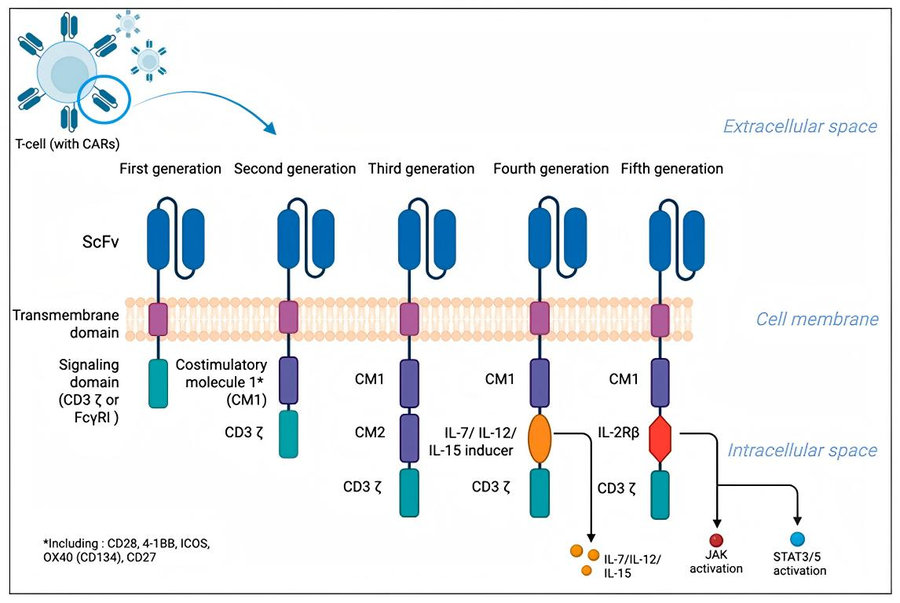 Fig.1 Five generations of CAR-T cell receptor structural design & functional differences. (Ciosek, et al., 2026).
Customer Review
Overcoming Target Specificity Hurdles in Senescent Adipocyte Selection
"We were struggling to find specific scFv binders that could distinguish senescent adipocytes from healthy tissue counterparts. The technical team at Protheragen constructed a highly diverse synthetic scFv library that allowed us to identify three excellent preclinical leads in record time. Their deep understanding of metabolic disease biology made a huge difference in how the screening strategy was set up."
Dr. A. T., Lead Metabolism Researcher
Streamlining Preclinical Discovery Pipelines with High-Diversity Matrices
"Working with Protheragen for our preclinical metabolic target discovery has streamlined our discovery pipeline significantly. The sequence diversity of the library they delivered was outstanding, and their data package was incredibly comprehensive. We plan to continue our collaboration with them for our upcoming affinity maturation projects."
Dr. E. R., Research Scientist of Immunotherapy Discovery
Frequently Asked Questions
-
What types of antibody libraries do you build for obesity-related CAR-T research?
We build synthetic, semi-synthetic, and immune-derived scFv and sdAb libraries optimized for recognizing cell-surface metabolic markers and senescence-associated proteins.
-
Can you screen for binders that only target senescent adipocytes?
Yes, our multi-step cellular biopanning strategies use negative selection against healthy cells to enrich for binders highly specific to senescent populations.
-
What is the typical sequence diversity of your constructed libraries?
Our synthetic libraries routinely achieve an effective diversity ranging from 109 to 1011 independent transformants, giving you a broad pool for candidate screening.
-
Are your services suitable for clinical manufacturing preparation?
Our services focus entirely on preclinical discovery and optimization; we provide high-quality research leads but do not offer clinical-grade GMP manufacturing services.
-
How do you ensure candidate binders perform well in inflammatory fat tissue?
We integrate screening steps that evaluate binder stability across various pH levels and cytokine concentrations, simulating the chronic inflammatory state of adipose tissue.
-
Can we provide our own proprietary antibody sequence for library expansion?
Absolutely, we can accept your lead sequence and perform targeted mutagenesis across specific CDR loops to improve its baseline affinity or structural stability.
-
Do you provide structural variants for the CAR hinge or transmembrane regions?
Yes, we can construct library matrices that combine your selected scFv with diverse hinge, transmembrane, and costimulatory signaling configurations.
-
What screening methods do you use to isolate the top binders?
We primarily utilize high-throughput phage display biopanning combined with automated ELISA-based binding verification and flow cytometry analysis on target cells.
-
How do I get a custom quote or discuss project feasibility for my metabolic target?
You can easily get in touch with our team by filling out the online inquiry form, and one of our scientific specialists will arrange a technical consultation.
Contact Us
Protheragen is dedicated to delivering industry-leading preclinical solutions for novel CAR-T discovery. Our highly specialized library construction services provide the structural diversity and environmental stability needed to overcome the unique challenges of targeting chronic inflammatory and metabolic conditions like obesity. By partnering with us, you gain access to advanced screening technologies, deep biological expertise, and optimized candidate discovery protocols designed to advance your research programs safely and efficiently. Contact Protheragen to learn more about how our custom services can align with your research timelines.
Reference
- Ciosek, A.; et al. Beyond Hematology—Current Insights into Chimeric Antigen Receptor (CAR) T-Cell Therapy for Skin and Connective Tissue Disorders. Cells. 2026, 15, 874 (CC BY 4.0)
All of our services and products are intended for preclinical research use only and cannot be used to diagnose, treat or manage patients.