
In Vivo CAT-T Construction Service
InquiryObesity is no longer seen as just a lifestyle issue. It is a chronic, low-grade inflammatory disease driven by senescent adipocytes and metabolic dysregulation. Traditional treatments often fail long-term because they do not address the cellular root causes. Protheragen is pioneering a shift by applying in vivo CAR-T cell construction directly to metabolic disease research.
In Vivo CAR-T Construction Service for Obesity Development
Unlike conventional ex vivo therapies that require complex cell harvesting and expensive cleanroom manufacturing, our preclinical platform eliminates outside-the-body manipulation. By engineering viral and non-viral vectors to deliver chimeric antigen receptor (CAR) genes straight to endogenous T cells inside the living model, we target metabolic bottlenecks directly. This approach opens up brand new paths for selective ablation of over-expanded, inflammatory visceral fat cells or senescent immune cells driving metabolic decline. It represents a massive leap forward in making targeted cell therapies scalable and practical for metabolic indications.
Core Technologies
Our in vivo construction platform relies on highly specialized delivery and targeting systems optimized specifically for non-oncology, metabolic environments.
We modify the surface glycoproteins of lentiviruses, often pseudotyping them with engineered measles virus or T-cell-specific antibodies. This ensures the CAR transgene is delivered exclusively to endogenous CD4+ or CD8+ T cells, preventing off-target gene transfer into adipocytes or parenchymal liver cells.
For transient expression profiles, our formulation team designs LNPs conjugated with T-cell-homing ligands. These particles encapsulate specialized mRNA encoding the CAR sequence, allowing for controlled, temporary receptor expression that mitigates long-term toxicity risks.
We utilize proprietary screening datasets to identify specific markers upregulated on pathologic adipocytes and fat-associated macrophages, minimizing cross-reactivity with healthy, lean tissues.
Solution Scope
Protheragen provides a fully integrated, end-to-end preclinical service package designed to move your metabolic in vivo CAR-T concept from design to validation. Our capabilities focus entirely on supporting your early-stage discovery and proof-of-concept pipelines.
- Custom CAR Design and Synthesis
We build specialized CAR architectures, adjusting signaling domains (like 4-1BB or CD28) to suit the slower, chronic kinetics required for metabolic clearing rather than acute oncology destruction.
- Targeted Vector Manufacturing
Production of research-grade, high-titer Viral Vectors (Lentivirus, AAV) or custom-formulated mRNA LNPs equipped with T-cell-specific targeting moieties.
- In Vitro Validation Panels
Prior to animal work, we validate vector transduction efficiency and target killing specificity using primary T-cell cultures and Adipocyte Cell Lines.
- In Vivo Proof-of-Concept Studies
Comprehensive handling of Animal Models, including diet-induced obesity (DIO) mice and genetic models (ob/ob, db/db), tracking dynamic weight changes and body composition.
- Metabolic and Histological Phenotyping
Comprehensive downstream analysis including glucose tolerance tests (GTT), insulin tolerance tests (ITT), serum lipid profiling, and detailed immunohistochemistry of adipose tissue depots to verify targeted cell depletion.
Partner with Protheragen to customize your preclinical service package.
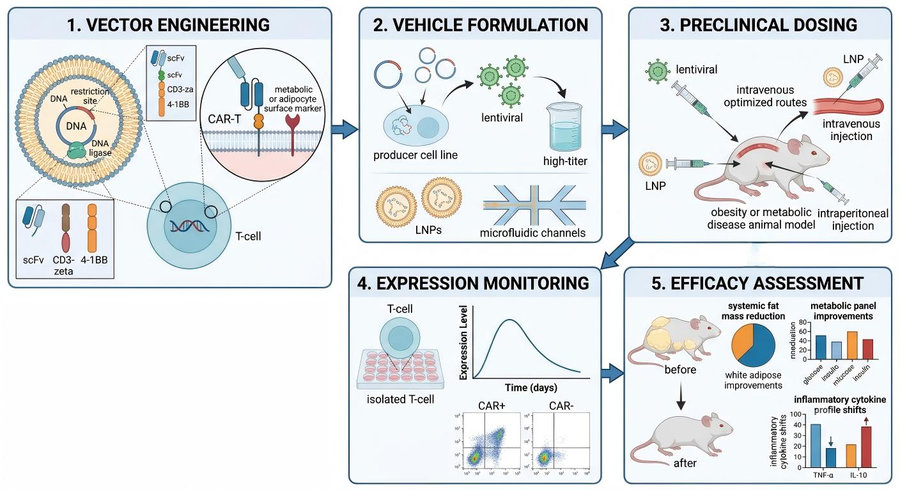
Workflow
Our streamlined workflow bridges the gap between initial molecular design and robust preclinical proof-of-concept data, providing a structured, step-by-step pathway to evaluate your metabolic targets.
Fields of Application
Our preclinical construction platform translates theoretical cell-based mechanisms into targeted metabolic interventions, offering versatile proof-of-concept pathways across a range of chronic metabolic and inflammatory conditions.
- Visceral Adipose Tissue Remodeling
Targeting senescent or hyper-inflammatory adipocytes to reverse insulin resistance and restore healthy tissue elasticity. - Metabolic Syndrome Interventions
Addressing systemic low-grade inflammation by eliminating chronic inflammatory macrophages residing in fat pads. - NASH and NAFLD Research
Utilizing engineered in vivo T cells to target fibrotic or lipid-loaded cells in liver tissue associated with advanced metabolic decline. - Type 2 Diabetes Therapeutics
Exploring target-specific cell clearing to improve pancreatic islet function and peripheral insulin sensitivity.
Advantages
Choosing Protheragen gives your discovery pipeline a distinct competitive edge by replacing complex, resource-heavy cell manufacturing with a streamlined, ultra-precise preclinical platform built for metabolic realities.
Unrivaled T-Cell Tropism
Our modified delivery vehicles home in on endogenous T cells with incredible precision. This minimizes the risk of delivering cargo to unintended tissues like hepatocytes or healthy muscle fibers, ensuring clean preclinical data.
Optimized for Chronic Indications
We recognize that metabolic disease requires a gentler touch than aggressive oncology targets. Our platform is fine-tuned to deliver controlled, moderate CAR expression levels, preventing systemic cytokine storms while steadily clearing pathological cells over time.
Accelerated Preclinical Timelines
By removing the need for harvesting, ex vivo culturing, and re-infusing cells, our in vivo workflow trims weeks off standard testing schedules. You get your proof-of-concept data much faster.
Proven Success and Reliability
Our targeted LNP formulations achieved stable in vivo T-cell transduction rates, resulting in a significant reduction in visceral adipose tissue inflammation without systemic adverse effects.
Contact our technical team to map out your custom preclinical study design.
Publication Data
Title: An Innovative In Vivo Model for CAR-T-Cell Therapy Development: Efficacy Evaluation of CD19-Targeting CAR-T Cells on Human Lymphoma, Using the Chicken CAM Assay
Journal: Int. J. Mol. Sci., 2026
DOI: https://doi.org/10.3390/ijms27020795
Summary: This study validates chicken CAM xenograft as a 3Rs-compliant CAR-T preclinical model using CD19 CAR-T against Raji lymphoma. Single CAR-T dosing outperformed two doses; dual infusions triggered chicken innate inflammation driving metastasis, while low-dose 4-1BB CAR-T suppressed tumour spread and angiogenesis.
Key Findings
- CAM tumour model validation: Raji cells stably express CD19 and form consistent, uniform xenografts on embryonic day 9 (EDD9) chicken CAM with predictable growth until EDD18, making it suitable for CD19 CAR-T efficacy screening.
- CD28-costim CAR-T dosing contrast: Single EDD11 CD3z-CD28 CAR-T injection cut tumour weight by 51.6% (p=0.0009). Two doses lost anti-tumour benefit and significantly boosted lower CAM human lymphoma metastasis (528.8% increase, p=0.0491).
- CAR-T activation marker data: Both single and double CAR-T infusions upregulated intratumoural human IFNγ and TNFα, proving functional CAR-T activation in ovo; dual doses yielded higher cytokine expression levels.
- Endogenous chicken immune hyperactivation with two doses: Double CAR-T treatment elevated macrophage (MMD), pro-inflammatory IL6/IL8 and chicken CD8 T-cell markers, matching histology showing stronger tumour inflammation and necrosis. Excess inflammation promoted metastatic progression.
- 4-1BB CAR-T low-dose superiority: Reduced-dose CD3z-41BB CAR-T reversed dual-dose metastasis risk. Single injection drove robust metastasis suppression (94.2% regression, p<0.0001) and significant tumour angiogenesis inhibition (33.94% reduction, p=0.0003).
- Model translational advantage: Unlike immunodeficient rodent models, chicken embryos possess functional native immunity, enabling study of CAR-T-triggered endogenous inflammatory responses linked to clinical cytokine release syndrome (CRS), aligning with 3Rs ethical research standards.
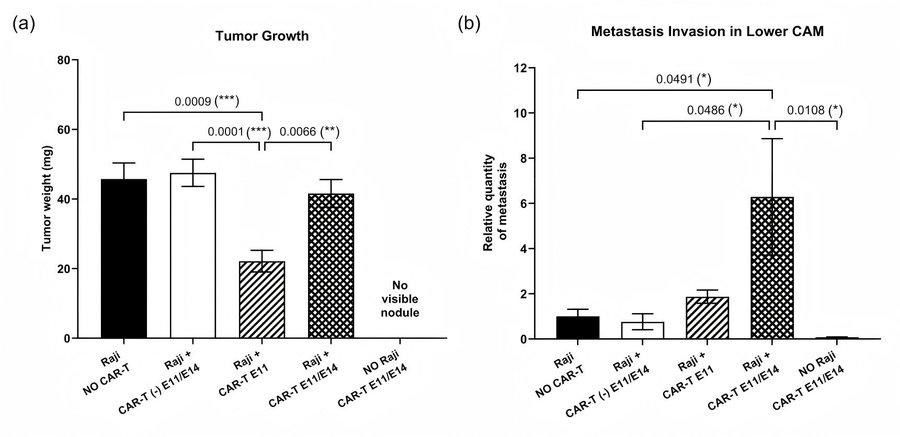 Fig.1 Single vs double CD19 CAR-T dosing contrasts tumour growth and metastatic burden in the chicken CAM Raji lymphoma model. (Wang, et al., 2026)
Customer Review
Overcoming Target Specificity Hurdles in Senescent Adipocyte Selection
"We were highly skeptical about using cell therapy concepts for metabolic targets, but Protheragen completely changed our perspective. Their custom lentiviral vector platform delivered exceptional targeting to endogenous T cells in our DIO mice. We observed clear, selective clearing of inflammatory macrophages in adipose tissue without any safety red flags. The data package they gave us was top-notch, and we're already outlining our next target discovery project with their team."
Dr. M. R., Biotech Partner
Streamlining Preclinical Discovery Pipelines with High-Diversity Matrices
"Working with Protheragen made our proof-of-concept phase incredibly smooth. Their team helped us navigate the design of a transient mRNA LNP system that worked beautifully in our obesity models. The timeline was exactly as promised, and their scientists provided excellent technical support throughout the study. They genuinely feel like an extension of our internal research group."
Dr. P. S., Therapeutic Discovery Group
Frequently Asked Questions
-
Why choose in vivo CAR-T over traditional ex vivo methods for obesity research?
Ex vivo methods are far too complex and costly for broad chronic diseases. An in vivo approach allows direct systemic injection, cutting down manufacturing barriers and making it a scalable option for metabolic indications.
-
How do you ensure the viral vectors do not transduce adipocytes directly?
We engineer our viral envelopes or use surface-conjugated antibodies on LNPs that specifically bind T-cell surface markers like CD3 or CD4, ensuring the payload is only taken up by the intended immune cells.
-
Can we use transient expression instead of permanent genomic integration?
Absolutely. We offer customized mRNA-loaded lipid nanoparticles (LNPs) which provide temporary CAR expression, a highly desirable feature when managing non-lethal, chronic conditions like obesity.
-
What animal models are compatible with this construction service?
We regularly work with diet-induced obesity (DIO) mouse models, as well as classic genetic models like ob/ob or db/db mice, adapting our vectors to match the specific strain background.
-
How do you measure the success of adipocyte clearing?
We track body weight, use EchoMRI for body composition, and run detailed immunohistochemistry on fat pads to evaluate the targeted depletion of specific cell populations.
-
What is the typical turnaround time for a complete vector construction and in vivo pilot run?
While it depends on the complexity of your custom targets, a standard construct design through initial in vivo validation typically takes about 10 to 14 weeks.
-
Is cytokine release syndrome (CRS) a major issue in these metabolic models?
In our experience, metabolic targets don't trigger the explosive cell lysis seen in tumors. We also optimize our dosing and signaling domains to keep inflammatory readouts low and manageable.
-
Do you provide clinical manufacturing or trial support?
No, our services are strictly limited to the preclinical phase, focusing on construct discovery, optimization, and animal proof-of-concept testing.
-
Can we provide our own proprietary antibody sequences for the CAR design?
Yes, we easily integrate client-provided scFv or ligand sequences into our modular vector backbones to build your customized therapeutic candidates.
Contact Us
Protheragen provides cutting-edge, preclinical in vivo CAR-T cell construction services specifically optimized for the evolving landscape of obesity and metabolic disease research. Our specialized targeting vectors, advanced LNP formulations, and comprehensive downstream screening capabilities allow you to rapidly evaluate novel therapeutic concepts without the overhead of traditional cell manufacturing. Let us help you turn your next-generation cell therapy ideas into robust, actionable preclinical data. Welcome to Contact Protheragen to learn more about how our custom services can align with your research timelines.
Reference
- Wang, Y.; et al. An Innovative In Vivo Model for CAR-T-Cell Therapy Development: Efficacy Evaluation of CD19-Targeting CAR-T Cells on Human Lymphoma, Using the Chicken CAM Assay. Int. J. Mol. Sci. 2026, 27, 795 (CC BY 4.0).
All of our services and products are intended for preclinical research use only and cannot be used to diagnose, treat or manage patients.