
CAR Construction Service
InquiryObesity is not just about fat storage anymore. We now understand it as a complex, chronic inflammatory state driven by senescent adipocytes, fibro-adipogenic progenitors, and hypertrophic tissues that wreak havoc on metabolic homeostasis. While typical weight-loss drugs manage symptoms or suppress appetite, they don't fix the underlying cellular pathology.
Next-Gen CAR Construction: Engineering Targeted T-Cell Therapies for Metabolic Health and Obesity
That is where chimeric antigen receptor (CAR) T-cell technology comes into play. By pivoting from oncology to metabolic disease, researchers are leveraging CAR-T cells to precisely target and clear the pathogenic cell populations driving insulin resistance and chronic tissue inflammation. At Protheragen, we provide high-precision preclinical CAR construction services designed specifically for these metabolic targets. We help you design, assemble, and optimize custom CAR constructs tailored to clear senescent or dysfunctional adipocytes, helping move your discovery pipeline from concept to validated preclinical candidate.
Core Technologies
Building an effective CAR for metabolic disease requires a highly tailored approach quite different from standard oncology designs. Our technical platform focuses on three main pillars:
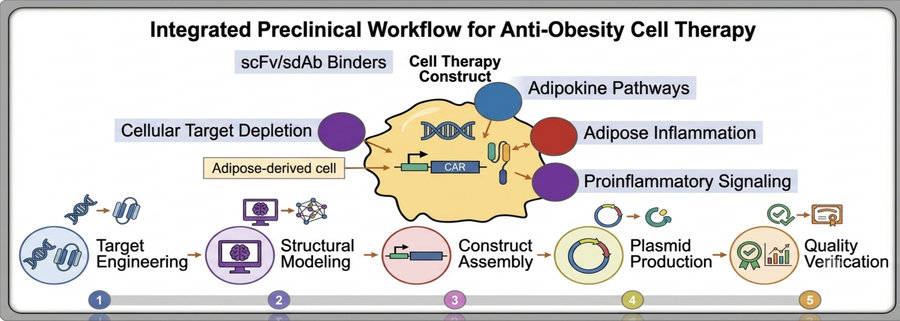
We design scFv and single-domain antibody (sdAb) sequences optimized for binding specific metabolic markers, including senescent cell antigens and hypertrophic adipocyte surface proteins, ensuring high specificity without cross-reactivity in healthy tissues.
Metabolic tissue environments can be highly immunosuppressive or chronically inflamed. We test various combinations of costimulatory domains (such as CD28, 4-1BB, or novel synthetic variants) to balance T-cell persistence and minimize premature exhaustion within adipose tissue.
Using high-fidelity synthetic biology approaches, we rapidly assemble multi-cistronic designs incorporating suicide switches, fluorescent reporters, or cytokine co-expression cassettes into robust lentiviral or transposon backbones.
Solution Scope
Our preclinical services cover every element of the CAR engineering phase, giving you complete flexibility over your metabolic disease programs. We do not provide clinical testing or manufacturing, focusing entirely on delivering optimized, research-grade candidates for your in vitro and in vivo proof-of-concept studies.
- scFv and sdAb Generation
We design and screen antibody fragments against specific adipose-associated targets. This includes optimizing affinity to make sure your CAR-T cells distinguish between highly upregulated pathological markers and low-level baseline expression on normal tissue.
- Multi-Generational CAR Structural Design
We build first, second, and third-generation CAR architectures. You can choose from standard activation domains or test custom spacer lengths (short, medium, or long hinges) to find the exact spatial arrangement needed to form an effective immunological synapse with adipocytes.
- Multiplex and Bicistronic Vector Construction
To prevent antigen escape or target heterogeneous tissue, we build dual-targeting or bicistronic CAR vectors. These loops allow the expression of two distinct CARs or a single gated CAR (AND/OR logic gates) to increase target specificity in complex adipose microenvironments.
- Reporter and Safety Switch Integration
Our molecular cloning pipeline naturally integrates reporter genes (like GFP, luciferase) or inducible elimination systems (such as iCasp9 or HSV-TK). This allows you to easily track cell trafficking or eliminate cells during your subsequent in vivo animal studies.
- High-Purity Preclinical Plasmid Production
We scale up your chosen constructs to provide transfection-grade, endotoxin-free plasmids. These materials are ready for immediate use in your internal lentiviral packaging lines or direct primary T-cell nucleofection experiments.
Contact our scientific team to request a detailed project proposal.
Workflow
A streamlined, five-stage preclinical workflow ensures the efficient development and robust validation of your custom CAR constructs tailored for metabolic tissue environments.
Fields of Application
Our custom preclinical CAR construction services open up new avenues for metabolic disease research, enabling precise cellular targeting across several critical therapeutic areas.
- Adipose Tissue Senescence Studies
Engineering CAR constructs to target senolytic markers like senescent fibro-adipogenic progenitors, helping reverse chronic low-grade tissue inflammation.
- Metabolic Syndrome Reversal Research
Developing targeted cell tools to clear dysfunctional hypertrophic adipocytes, aiming to restore systemic insulin sensitivity in Rodent Models.
- Fibrotic Microenvironment Modeling
Designing constructs that target collagen-producing cells within expanded fat depots, allowing researchers to study tissue remodeling dynamics.
- Preclinical Proof-of-Concept Screening
Generating reliable screening libraries of varied costimulatory or hinge combinations to establish initial efficacy profiles in vitro.
Advantages
Partnering with Protheragen provides your metabolic discovery pipeline with distinct engineering advantages designed to overcome the unique microenvironmental hurdles of inflamed adipose tissues.
Tailored Structural Optimization for Metabolic Strains
We do not just copy-paste oncology blueprints; our designs specifically address the challenges of homing into and surviving within inflamed, fibrotic adipose tissues. We optimize hinge lengths and choose costimulatory domains that prevent premature cell death or unexpected off-target exhaustion, ensuring robust performance in animal metabolic models.
Exceptional Construct Fidelity and Expression Yields
Our optimized codon-refining algorithms significantly boost surface expression rates once transfected into primary cells. Our synthetic expression architecture minimizes promoter silencing, giving you highly predictable, repeatable transfection efficiency across your preclinical experiments.
Strict Quality Control
Every single plasmid batch undergoes rigorous verification, including Sanger sequencing, restriction digestion profiling, and ultra-low endotoxin validation. This ensures that when you move to primary cell transfection or in vivo animal dosing, you will not encounter unexpected innate immune reactions or baseline toxicity artifacts.
Contact our specialist team to request a technical quote.
Publication Data
Title: Engineering strategies to safely drive CAR T-cells into the future
Journal: Front. Immunol., 2024
DOI: https://doi.org/10.3389/fimmu.2024.1411393
Summary: This review evaluates CAR-T gene delivery and cell engineering technologies, highlighting genotoxic risks of integrating viral/transposon systems. It introduces safer DSB-free editing, transient non-integrating platforms, in vivo delivery and cell-free vesicles, and proposes tailored strategies for different diseases with mandatory long-term safety monitoring.
Key Findings
- Clinically standard integrating retroviral and lentiviral vectors cause semi-random genome insertion. The 22 secondary T-cell cancers are tied to these products, as insertion can disrupt tumour suppressor genes or transform residual tumour cells during manufacturing.
- Transposon systems lower production costs and hold larger genetic cargoes, yet safety differs drastically.
- Non-integrating mRNA, LNP and AAV eliminate insertional mutagenesis entirely, but CAR expression is short-lived. Pre-existing neutralising antibodies limit repeated infusions needed for sustained anti-tumour efficacy.
- Conventional CRISPR-Cas9 creates DNA double-strand breaks that induce chromosomal truncations and off-target mutations. DSB-free base/prime editing and RNA modulators (RNAi, CRISPRi) avoid permanent genomic alterations for improved safety.
- In vivo CAR generation and cell-free CAR extracellular vesicles reduce proliferative toxicities, but their clinical scalability and long-term potency remain unvalidated.
- Therapeutic platforms must be matched to disease type: integrating vectors fit blood cancers, while transient non-integrating tools are preferred for autoimmune patients; all recipients of integrating CAR-T require long-term cancer surveillance.
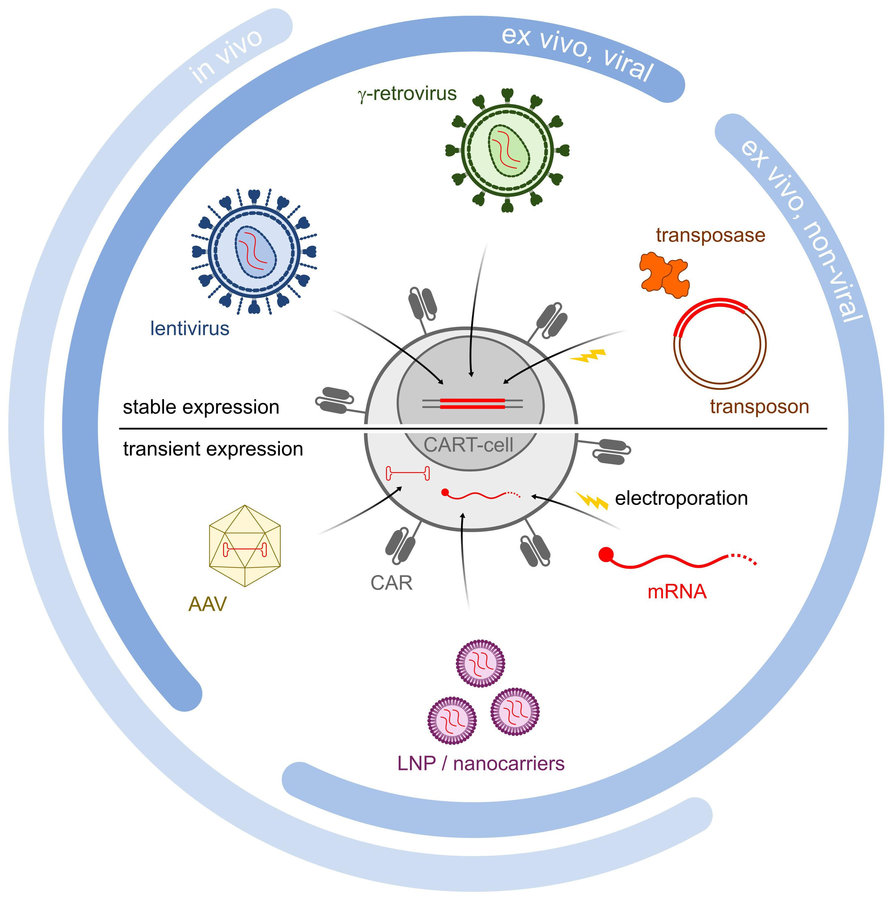 Fig.1 Classification of ex vivo and in vivo gene delivery methods for CAR-T cell generation, including integrating viral vectors, transposons, and non-integrating mRNA/LNP modalities. (Rossi, et al., 2024)
Customer Review
Identifying Novel Targets Through Precision Biophysical Screening
"We were having a lot of trouble with poor surface expression when trying to target senescent adipose cells using our older home-brewed constructs. Protheragen reworked our scFv framework and optimized the codon configuration. The difference was night and day—expression stability shot up in our initial lab models, which really saved our preliminary validation timeline. We are already talking to them about setting up our next batch of dual-targeting designs."
Dr. A. T., Metabolic Disease Research Institute
Accelerating Discovery with Integrated and Data-Driven Validation
"What I appreciate most about working with Protheragen is the sheer transparency of their quality control. Every batch of plasmid arrived with clear sequencing data and practically non-detectable endotoxin levels. It gave our lab team total confidence when moving into our pilot rodent studies. They have become our go-to partner for all our upstream cloning and construct exploration."
Dr. E. R., Lipomics Therapeutics
Frequently Asked Questions
-
Can we use your CAR construction service for an active clinical trial?
No, our services are strictly for preclinical research and discovery. We do not manufacture clinical-grade components or provide clinical trial services. We supply high-quality research plasmids and vector designs to help validate your targets in the lab.
-
Why would a CAR-T approach be useful for obesity research?
Standard therapies often fail to address the underlying cellular dysfunction, like chronic inflammation caused by senescent cells or pathogenic adipocytes. A CAR-T approach allows you to selectively deplete these specific populations to explore lasting systemic metabolic improvements.
-
What vector backbones do you routinely offer for cloning?
We regularly work with lentiviral vectors, but we also customize transposon-based systems like Sleeping Beauty or PiggyBac, depending on what your specific delivery model requires.
-
How do you optimize the scFv binding for a unique metabolic target?
We use structural modeling to evaluate candidate antibody sequences, tuning the framework and linker regions to ensure steady folding and stable surface expression on the T cell.
-
Can you integrate a suicide switch into our custom CAR construct?
Yes, we frequently include safety switches like iCasp9 or truncated surface markers. This allows you to selectively clear the cells during your in vivo proof-of-concept safety studies.
-
Do you handle the downstream primary T-cell isolation or culturing?
Our core service focus is the molecular engineering and construction of the CAR vectors themselves. We provide the validated genetic constructs, which you can then introduce into your own primary cell workflows.
-
What kind of quality control documentation do you provide with the plasmids?
Every delivery includes a comprehensive certificate of analysis, complete plasmid maps, Sanger sequencing alignments, and endotoxin level reports to guarantee identity and purity.
-
How do we know which costimulatory domain is best for our adipose target?
Because adipose tissue presents a unique inflammatory profile, we often suggest building a small matrix panel of constructs—comparing CD28, 4-1BB, or dual configurations—so you can empirically test what works best in your assays.
-
Can you manufacture bicistronic vectors that target two separate antigens?
Yes, we can configure tandem or bicistronic designs under a single promoter, which helps address target cell heterogeneity and prevents target escape in complex tissue profiles.
Contact Us
Protheragen delivers high-precision, customized preclinical CAR construction services designed to accelerate your metabolic disease and obesity research pipelines. From single-domain antibody tuning to advanced multi-cistronic vector configurations, our platform delivers high-yield, verified, and endotoxin-free constructs tailored specifically to survive and function in complex tissue environments. We bridge the gap between initial target discovery and robust preclinical proof of concept. Welcome to Contact Protheragen to discuss your project requirements.
Reference
- Rossi, M.; et al. Engineering strategies to safely drive CAR T-cells into the future. Front. Immunol. 2024, 15:1411393 (CC BY 4.0)
All of our services and products are intended for preclinical research use only and cannot be used to diagnose, treat or manage patients.